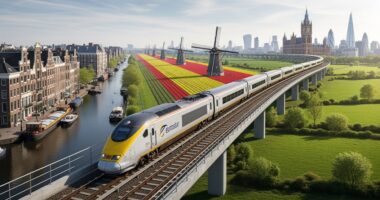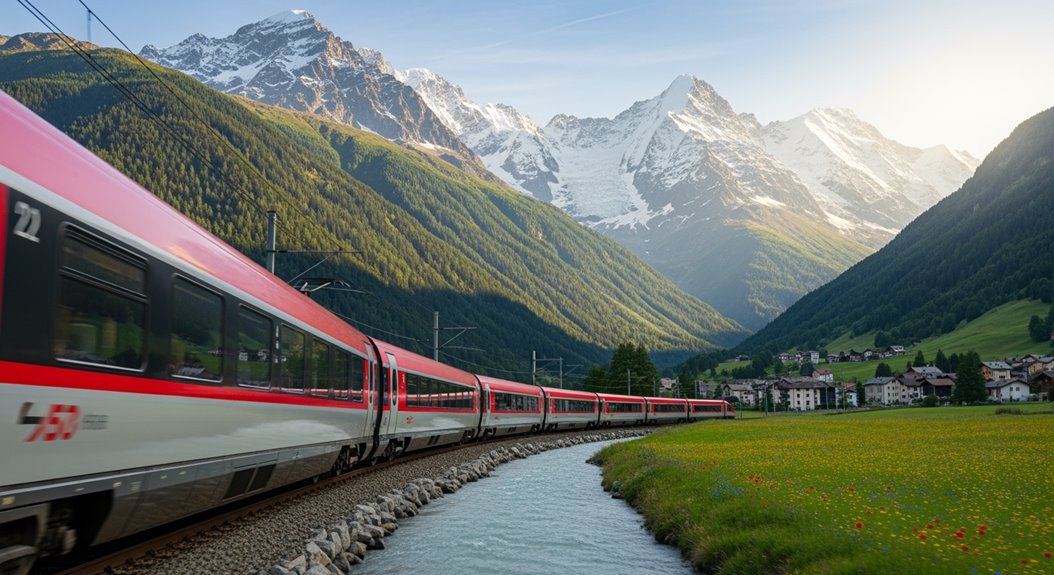

Two main operators run direct trains from Paris to Milan: SNCF TGV and Trenitalia’s Frecciarossa 1000. The journey takes roughly seven hours with scenic Alpine views, beating cramped airplane seats and airport security hassles. Tickets start at €29 on weekdays, averaging €51 in standard class. Here’s the catch—Frecciarossa service is suspended until April 2025 due to landslides near Modane. Border checks happen at the French-Italian frontier with brief stops for customs formalities.

Why endure the hassle of airports when you can glide from Paris to Milan by train in roughly seven hours? The journey connects two European powerhouses without the security theater, liquid restrictions, or cramped middle seats that seem to plague air travel.
Skip the airport circus and cruise through Alpine scenery instead—seven hours of civilized travel beats cramped flights any day.
Two main operators dominate this route: SNCF TGV and Trenitalia’s Frecciarossa 1000. The Italian newcomer launched its Paris service in December 2021, shaking up what was previously French territory. Frecciarossa typically runs one to two direct services daily, though this appears to depend on demand and whether it’s a weekend.
Both trains depart from Paris Gare de Lyon, but here’s where things get interesting. SNCF TGV dumps passengers at Milano Porta Garibaldi, while Frecciarossa arrives at Milano Centrale. The difference matters—Centrale offers better connections and sits more centrally in Milan.
The Frecciarossa route winds through Lyon Part-Dieu, Chambéry-Challes-les-Eaux, Modane, Bardonecchia, and Torino Porta Susa before reaching Milan. Travel time clocks in around 6 hours and 41 minutes. Not exactly bullet train speed, that said, the scenery through the Alps may well compensate for the leisurely pace.
Border formalities happen at Modane with a roughly 10-minute stop for customs and police checks. Nothing dramatic, just bureaucracy in motion.
Ticket prices start from €29 on weekdays for Frecciarossa, with standard class averaging €51. Weekends and holidays jack up prices because, well, supply and demand. Advanced booking helps secure better fares and seats, though you’ll want to book well ahead during peak travel periods. Business Class tickets typically cost approximately 45,00€ per person, representing decent value for the enhanced amenities.
Frecciarossa offers four classes: Executive, Business, Premium, and Standard. Even standard class includes free WiFi, power sockets, and basic amenities. Higher classes throw in Italian cuisine and quieter zones for those seeking peace from chattering tourists.
Here’s the catch: service faced suspension from August 2023 to April 2025 due to landslides near Modane. Mother Nature doesn’t care about train schedules, it seems. By February 2022, the service achieved an impressive 83% occupancy, demonstrating strong passenger demand despite initial challenges. Similar to routes between France and Spain, advance seat reservations are essential for high-speed trains due to limited availability.
The defunct Thello night train once provided an overnight alternative until 2020, allowing travelers to wake up in Milan. Those days are gone, leaving only daytime options for now.
For travelers seeking an alternative to flying, the Paris-Milan train route delivers comfort and scenery. Just check current service status before booking—learned that lesson the hard way.
Did You Know
Can I Bring My Pet on the Paris to Milan Train?
Yes, pets are allowed on Paris-Milan trains.
Small pets in carriers cost €7 on TGV trains, while larger dogs pay €20 and must wear muzzles.
Trenitalia’s Frecciarossa lets dogs under 5kg travel free in carriers; bigger dogs pay €30.
Carriers have strict size limits, and pets can’t occupy seats. One carrier per passenger, period.
Guide dogs get a free pass, naturally.
Is There Wifi Available During the Journey?
No wifi on TGV trains for the Paris-Milan route. Zero. The French rail operator skipped this upgrade, focusing on mobile coverage instead.
Stations offer free wifi though—Paris Gare de Lyon and Milano Centrale both have it.
Passengers rely on mobile data during the journey, which gets spotty in tunnels and rural areas. Some rent portable hotspots, but connection quality still depends on cell towers.
What Food Options Are Available on Board?
Both trains offer decent food options.
TGV has café-bars with hot drinks, sandwiches, quiche, lasagne, and alcohol. You can order via WiFi to skip lines.
Italo’s premium classes get proper Italian catering at your seat, while everyone else uses vending machines in coaches 3 and 7.
First-class passengers eat better, obviously.
Bringing your own food works too.
Do I Need to Make Seat Reservations in Advance?
Yes, seat reservations are absolutely mandatory for TGV and Frecciarossa trains between Paris and Milan.
No exceptions, no standing room, no “I’ll figure it out later” approach. Reservations open 4-6 months ahead, and trains sell out fast during peak times.
Rail pass holders aren’t exempt either—they still pay €31-45 reservation fees.
Want flexibility? Prepare for multiple train changes and marathon travel times on regional services.
Are There Power Outlets at Each Seat?
Yes, power outlets are available at every seat on Paris-Milan trains.
Both TGV and Frecciarossa high-speed trains come equipped with European-style 230V sockets at all seats, first and second class.
Even the overnight Thello trains provide individual power outlets in each sleeping compartment.
Travelers can charge laptops, phones, whatever.
No need to fight over outlets or sit in specific cars.
Parting Shot
Taking the train from Paris to Milan isn’t rocket science. Book tickets online or at the station. Show up on time. Sit back and watch Europe roll by your window. The journey takes around seven hours, give or take. It’s straightforward, comfortable, and beats dealing with airport security. Sure, flying might be faster, but trains actually get you from city center to city center. Sometimes the old ways work just fine.