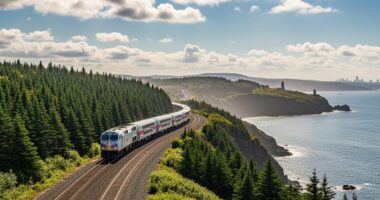
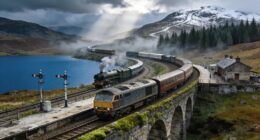
The Canadian takes the crown as Canada’s ultimate train experience, no contest. This beast of a journey stretches 4,466 kilometers across five provinces over four days and nights. Glass-domed cars showcase jaw-dropping scenery from Ontario’s wilderness to British Columbia’s mountains. Sleeper Plus and Prestige classes offer private cabins with gourmet meals that put airline food to shame. Major stops include Toronto, Winnipeg, Edmonton, Jasper, and Vancouver. There’s more to uncover about this rail adventure.

Why settle for cramped airline seats and highway traffic when Canada offers some of the world’s most spectacular train journeys? The answer isn’t simple, though it’s worth exploring. Canada’s rail network spans thousands of kilometers, and each route delivers what appears to be vastly different experiences.
The Canadian stands as the crown jewel—at least by most accounts. This luxury beast crawls 4,466 kilometers from Toronto to Vancouver over four days and four nights, with five provinces rolling past your window. The Canadian Shield gives way to endless Prairies, then erupts into the Rocky Mountains.
This luxury beast crawls 4,466 kilometers across five provinces, transforming from Canadian Shield to endless Prairies to erupting Rocky Mountains.
Those glass-domed cars frame views that regularly appear on “world’s best” lists, though you’ll pay for the privilege. Sleeper Plus and Prestige classes pamper passengers with private cabins and chef-prepared meals. Major stops in Toronto, Winnipeg, Edmonton, Jasper, and Vancouver break up what can feel like a marathon journey.
For history buffs, The Ocean claims bragging rights as North America’s oldest continuously operated named passenger train. Since the early 20th century, it’s connected Montréal and Halifax across 1,346 kilometers in roughly 22 hours.
The St. Lawrence River, New Brunswick coastline, and Nova Scotia’s maritime villages create a moving postcard. Sleeper Plus cabins let travelers absorb Acadian, francophone, and maritime heritage in comfort—that said, the pace may feel leisurely for some.
Business travelers tend to gravitate toward The Corridor. With 429 weekly trains connecting Quebec City to Windsor, it’s VIA’s workhorse. Toronto, Ottawa, Montreal, Quebec City, and Windsor get rapid daytime service with Wi-Fi and refreshments.
Views of the Great Lakes and Rideau Canal sweeten what is otherwise an efficient, no-frills ride. VIA Rail operates 497 trains weekly across its entire network, demonstrating the extensive reach of Canada’s passenger rail system.
Adventure seekers should consider the Winnipeg-Churchill route, though it’s not for everyone. It’s the only passenger train reaching Churchill, Manitoba—a town with no permanent road access.
Three days through boreal forest, muskeg, and Arctic tundra lead to polar bear and beluga whale territory. Indigenous communities dot the northern wilderness along the way.
On top of that, the Jasper-Prince Rupert line offers two days through Northern Rockies, Bulkley Valley, and Skeena River canyons. Economy seating keeps costs down while grizzly bears and moose provide free entertainment—assuming they cooperate for viewing. The route serves as an off-the-beaten-path alternative for travelers seeking Western Canada’s untamed wilderness.
The best train experience likely depends entirely on personal priorities. Want luxury? The Canadian may be your answer. Craving history? The Ocean appears to deliver.
Need efficiency? The Corridor seems built for that. Seeking adventure? Head north to Churchill or west to Prince Rupert. Many travelers add extra days at popular stops like Jasper or Vancouver to fully explore these destinations rather than rushing through. Each delivers something distinctly Canadian, even if none are perfect fits for every traveler.
Did You Know
What Is the Average Cost of Train Tickets for Popular Canadian Routes?
Train tickets across Canada’s popular routes vary dramatically.
Short hops like Toronto–Montreal run $50–$200 economy. The big kahuna, Toronto–Vancouver, hits $515–$1,000 for basic seats.
Want luxury? Prestige class costs a whopping $3,500–$10,000+.
Summer prices jump 25–40% higher than winter rates.
Montreal–Halifax and Winnipeg–Churchill fall somewhere in between, typically $150–$500 depending on season and demand.
How Far in Advance Should I Book Train Tickets for the Best Deals?
Book VIA Rail tickets 6-10 weeks ahead for best deals.
The booking window opens 10 months early, but the sweet spot hits around two months out. Early birds snag discounted Escape fares before they vanish.
Wait too long? Expect higher prices and slim pickings, especially during holidays.
Dynamic pricing means fares climb as departure nears. Monitor prices for a few days—weekly fluctuations happen.
What Luggage Restrictions Apply to Canadian Train Travel?
Canadian trains allow two carry-on items max, weighing up to 50 pounds combined.
One large suitcase or two smaller bags. Checked luggage caps at 50 pounds per piece, three extra bags allowed for fees.
Bicycles cost $25, tandems $50. Fragile electronics banned from checked bags. Remote routes get grocery boxes for $3.
Business class offers more flexibility, naturally.
Are Meals Included in Train Ticket Prices or Sold Separately?
It depends on your ticket class.
Business class passengers get meals included—lucky them. Economy riders? They’re buying everything separately.
Long-haul routes like The Canadian and The Ocean include all meals for Sleeper Plus and Prestige classes, while economy passengers still pay extra.
At least everyone can bring their own snacks and non-alcoholic drinks onboard.
Do Canadian Trains Offer Wi-Fi and Electrical Outlets for Passengers?
Canadian trains offer electrical outlets but Wi-Fi is hit-or-miss.
The Canadian route has zero Wi-Fi anywhere—passengers are basically going offline for days.
The Corridor provides Wi-Fi in Business Class, while The Ocean limits it to the lounge car only.
All trains have standard North American outlets though.
International travelers need plug adapters.
Long stretches run through dead zones with no cellular coverage whatsoever.
Parting Shot
Canada’s train travel scene boils down to two real contenders. The Rocky Mountaineer delivers luxury and jaw-dropping scenery, but you’ll pay through the nose. VIA Rail’s “The Canadian” offers cross-country adventure on a budget that won’t require selling organs. Both beat flying in terms of pure experience. Sure, trains take forever and sometimes break down, but that’s part of the charm. Pick your poison based on your wallet’s tolerance for punishment.