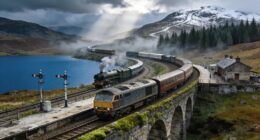
Train travel between England and Scotland is surprisingly straightforward. LNER’s Azuma trains zip from London to Edinburgh in 4 hours 20 minutes, while budget option Lumo offers cheaper fares on the same route. ScotRail handles Scottish territories, and the overnight Caledonian Sleeper lets travelers wake up in Scotland. BritRail passes provide unlimited travel across both countries. Book ahead for savings, especially during peak times. There’s more to uncover about routes, operators, and onboard experiences.

Millions of travelers figure out each year that train travel between England and Scotland isn’t just getting from point A to point B—it’s genuinely fun. The railways connecting these countries seem to offer everything from budget-friendly quick trips to luxury rolling hotels that probably cost more than your monthly rent.
Getting tickets doesn’t require a PhD in economics, though honestly, it can feel that way sometimes. The BritRail Pass gives you unlimited travel across England, Scotland, and Wales for either consecutive or flexible days. Booking ahead saves serious money on long-distance journeys. That said, peak versus off-peak fares make a real difference—traveling outside rush hours cuts costs and helps you avoid the sardine-can experience.
Train ticket pricing feels like rocket science, but booking early and dodging peak times keeps both costs and crowds manageable.
Popular routes tell their own stories. London to Edinburgh takes just 4 hours and 20 minutes on LNER Azuma high-speed trains. York, that historic gem, sits only 2 hours from London King’s Cross. Edinburgh to Glasgow runs frequent departures with around 1-hour journey times via ScotRail. The West Highland Line delivers scenic routes to Fort William and the Highlands. Even so, the Jacobite Steam Train crosses that famous Glenfinnan Viaduct from Harry Potter films. For those traveling between Manchester and London, trains depart every 15 minutes from Manchester Piccadilly to London Euston with journey times averaging around 2 hours and 38 minutes.
Major operators each appear to have their own personalities. LNER handles London-Edinburgh and continues to Scotland’s main cities. ScotRail covers Scottish territories and Highland services. Lumo offers budget London-Edinburgh service that actually competes on speed. Caledonian Sleeper runs overnight trains between London and multiple Scottish destinations, while Avanti West Coast connects London-Euston to Glasgow and northwestern England.
Onboard experiences vary wildly. Standard, First, and Premier classes depend on operators and routes. Most trains offer WiFi, power outlets, food service, and accessible seating. Quiet coaches provide refuge for travelers who prefer silence over listening to someone’s detailed weekend plans. On top of that, sleeper cabins include en-suite options and lounge cars on Caledonian Sleeper services.
Luxury options exist for those with deeper pockets, though you’ll pay for it. Belmond Royal Scotsman provides multi-day, fully inclusive luxury through Scotland. Northern Belle and British Pullman offer day trips with fine dining and themed journeys. Heritage steam lines emphasize old-world carriages and local cuisine.
Planning likely requires National Rail Enquiries for timetables and updates. Trainline and operator apps simplify ticket comparison. Reservations become essential during holidays and busy seasons—advance tickets typically aren’t refundable, but flexible options do exist. Continental travelers often start their British journey in London via Eurostar or ferry services from Europe. Choosing the right-hand side of the train on the LNER route provides spectacular coastal views of Durham Cathedral, Newcastle’s Tyne Bridge, and Berwick-Upon-Tweed.
Did You Know
Can I Bring My Bicycle on Trains in England and Scotland?
Yes, bicycles are permitted on most trains in England and Scotland, but policies vary wildly by operator.
Folding bikes get the royal treatment—no restrictions, no reservations needed.
Full-size bikes? That’s where things get messy. Most intercity lines demand advance reservations. Peak hours are brutal for cyclists, with bans during rush times.
Space is limited to 2-4 bikes per train typically.
Are There Discounts Available for Students or Seniors on Train Tickets?
Yes, both students and seniors get solid discounts on train tickets.
Students aged 16-25 can snag a Railcard for £35 annually, cutting fares by a third.
Seniors 60+ get the same deal for £30 yearly.
TOTUM cardholders score additional perks with specific operators.
The catch? Most discounts only work during off-peak hours, so forget about rush-hour savings.
What Happens if My Train Is Delayed or Cancelled?
When trains get delayed or cancelled, passengers have options.
Delay Repay offers 25-50% compensation for delays starting at 15-30 minutes, 100% for hour-plus delays. Claims must be filed within 28 days.
Cancelled trains? Full refunds available, no fees.
The catch: compensation rates vary by operator because nothing’s ever simple.
Last year saw 8.3 million claims processed—apparently delays are keeping everyone busy.
Do I Need to Reserve Seats in Advance for Train Travel?
Most travelers don’t need seat reservations. Walk-up fares like Off-Peak and Anytime tickets work fine without them.
But here’s the catch—Advance tickets absolutely require reservations, and overnight sleepers mandate them too.
Peak times, weekends, and holidays? Yeah, reservations become pretty essential unless standing for hours sounds appealing.
Rail pass holders get flexibility, though they’ll want reservations for busy routes to avoid becoming human sardines.
Are There Luggage Restrictions or Size Limits on Trains?
Yes, there are luggage restrictions.
Most UK trains allow up to three pieces of luggage at no extra charge. Items over one meter in any dimension may face charges or refusal.
Lumo’s particularly strict—just one medium suitcase and one small bag allowed. Excess luggage can cost up to half an adult fare per item.
Always check your specific operator’s rules beforehand.
Parting Shot
Train travel across Britain isn’t rocket science, but it’s not exactly simple either. The network connects most places worth visiting. Prices fluctuate wildly—sometimes a last-minute ticket costs more than flying to Europe. Book advance tickets for decent deals. ScotRail and various English operators run different routes. Mobile tickets work fine. Delays happen regularly. Food onboard ranges from mediocre to terrible. Still, trains beat driving through London traffic any day of the week.