The world’s best train experiences span from Switzerland’s ridiculously slow Glacier Express crawling through 291 bridges to Canada’s Rocky Mountaineer with its show-off glass domes. Norway’s Bergensbanen tackles ice fields like it’s no big deal, while China’s Beijing-Lhasa Express hits a breathtaking 16,640 feet altitude. Luxury seekers flock to the Venice Simplon-Orient-Express with its fancy 1920s cars. The Trans-Siberian Railway stretches an exhausting 5,772 miles across Russia. These routes offer stunning scenery that’ll make airplane windows seem pathetic by comparison.
While most people think train travel died with the steam engine, they’re pretty much dead wrong. Some of the world’s most spectacular journeys happen on rails, not highways or flight paths. These aren’t your typical commuter nightmares either.
Canada’s Rocky Mountaineer gets the spotlight for good reason. Those panoramic glass-domed cars weren’t built for show—they’re essential when you’re rolling through Banff, Jasper, and Lake Louise. Wildlife spotting comes standard, though you might need some patience. It consistently ranks among the world’s most scenic rail journeys, which says something considering the competition out there. VIA Rail’s The Canadian offers an epic cross-country alternative, spanning 2,762 miles from Toronto to Vancouver through Ontario’s forests, the Prairies, and the Rocky Mountains.
Those glass-domed cars aren’t just for show—they’re absolutely essential when you’re rolling through some of the world’s most spectacular mountain scenery.
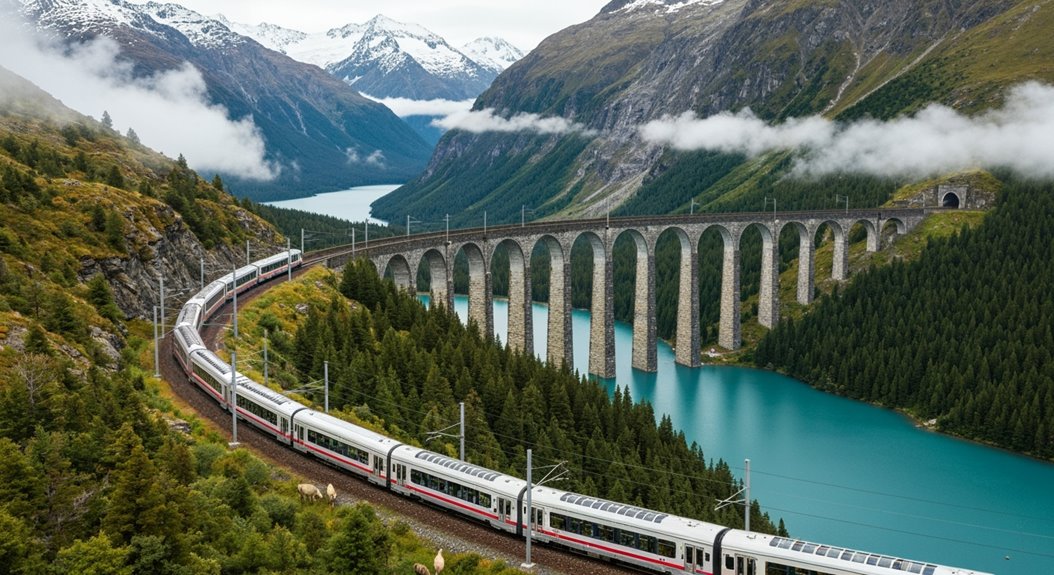
Switzerland basically owns the mountain railway game. The Glacier Express connects Zermatt to St. Moritz, and they’re not kidding when they call it the “slowest express train in the world.” It crawls across 291 bridges and through 91 tunnels—deliberately.
The Bernina Express takes a different approach, dropping 1,800 meters in four hours from Chur to Tirano. Every seat offers unobstructed views because someone actually thought about passenger experience for once.
New Zealand’s TranzAlpine cuts across the Southern Alps from Christchurch to Greymouth, where the elevation changes hit fast and hard. Norway’s Bergensbanen covers 308 miles in 6.5 hours from Oslo to Bergen, climbing through canyons and ice fields. It remains criminally underrated outside Scandinavia, though that may be changing.
Luxury trains operate in another universe entirely. The Venice Simplon-Orient-Express runs 1920s Art Deco cars between Venice, Paris, and Istanbul—it’s the stuff of classic literature and films for obvious reasons.
Africa’s Rovos Rail Pride of Africa features vintage coaches with Edwardian décor. Gets called the “world’s most luxurious train” regularly, and the price tag suggests they’re not wrong.
That said, some journeys matter more for their sheer audacity. China’s Beijing-Lhasa Express climbs to 16,640 feet, making it the world’s highest railway. India’s Darjeeling Toy Train, built in the 1880s, winds 55 miles through tea plantations on narrow-gauge tracks.
Brazil’s Serra Verde Express punches through Amazon rainforest using 14 tunnels and 30 bridges. For the ultimate endurance test, Russia’s Trans-Siberian Railway stretches 5,772 miles from Moscow to Vladivostok, requiring a full week to complete. The Golden Eagle operates this famous route, connecting passengers through an immersive cultural experience across the vast expanse.
Train travel isn’t dead. It just got infinitely more interesting than your morning commute.
Did You Know
How Much Do Luxury Train Journeys Typically Cost Compared to Regular Train Tickets?
Luxury train journeys cost dramatically more than regular tickets—we’re talking 10 to 50 times the price, sometimes more.
Regular intercity trains run $50-$300, maybe $500 for first class.
Luxury? Try $2,245 to over $8,500 per person. Day trips alone hit $550-$1,010.
But here’s the thing: luxury includes everything—meals, accommodation, excursions, drinks.
Regular tickets? Just transportation.
What’s the Best Time of Year to Book Scenic Train Routes?
The sweet spot hits late spring and early autumn – shoulder seasons dodge crowds while delivering prime lighting.
Book 6-12 months ahead for popular routes during peak times.
Swiss Alps shine June through September.
Canadian Rockies peak mid-June to late September.
New England’s foliage explodes late September to mid-October.
Japanese cherry blossoms? Good luck securing tickets 9-12 months out for that brutal two-week window.
Do I Need Special Visas for Multi-Country Train Travel Experiences?
Yes, travelers need specific visas or authorizations depending on their route and nationality.
Schengen Area allows free movement within 29 countries for visa holders, but the UK and Ireland require separate entry documents.
Starting 2025, UK visitors need £10 ETAs. ETIAS becomes mandatory for visa-exempt travelers in 2026.
Each country outside Schengen has different rules.
It’s bureaucratic chaos, honestly.
Are Meals and Accommodations Included in Premium Train Travel Packages?
Yes, premium train packages typically include everything.
Most luxury trains bundle all meals, accommodations, drinks, and even gratuities into one eye-watering price.
Rocky Mountaineer breaks the mold—passengers sleep in partnered hotels, not onboard.
High-end options like Venice Simplon-Orient-Express throw in butler service and champagne.
Basically, once you fork over $3,700-$5,200+ per night, they’ve got you covered.
How Far in Advance Should I Book Popular Scenic Train Routes?
Popular scenic routes demand serious advance planning.
The Bernina Express requires 3-6 months ahead, especially summer.
Glacier Express needs 2-4 months during peak seasons.
Flåm Railway sells out 2-3 months early in summer.
Last-minute tickets? Good luck with that.
Peak seasons, panoramic cars, and tourist hotspots create booking frenzies.
Europe’s top routes have mandatory reservations opening months out.
Wait too long, miss out completely.
Parting Shot
The world’s best train journeys span continents and budgets. Switzerland’s scenic routes cost a fortune but deliver Alpine perfection. Japan’s bullet trains are efficient marvels. India’s luxury trains offer colonial nostalgia with modern comfort. Scotland’s Highland routes showcase dramatic landscapes. Trans-Siberian remains the ultimate marathon journey across Russia. Each offers something different. Some prioritize luxury, others focus on scenery or cultural immersion. The “best” depends entirely on what travelers actually want from the experience.