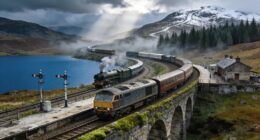
Europe’s extensive rail network connects 40 countries across 200,000 kilometers of track, making train travel surprisingly straightforward. Major operators like SNCF, Deutsche Bahn, and Trenitalia handle domestic routes, while int.bahn.de serves as the go-to planning tool for cross-border journeys. Eurail passes offer unlimited travel, though point-to-point tickets sometimes prove cheaper. High-speed trains require reservations, regional ones don’t. The coffee quality varies wildly. There’s considerably more to traversing this continental web of steel and schedules.

While Americans obsess over rental cars and highway road trips, Europeans have already figured out the obvious solution: trains. The continent’s rail network connects virtually every major city, which appears to make train travel the most sensible way to see Europe without the headache of international driving laws or airport security lines.
Major operators like SNCF in France, Deutsche Bahn in Germany, Trenitalia in Italy, Renfe in Spain, and UK’s National Rail form the backbone of European rail travel. Planning becomes surprisingly simple with int.bahn.de, which covers schedules and fare information for nearly all of Europe. It’s the one tool that actually works—even if the interface looks like it hasn’t been updated since 2005.
Despite its ancient-looking interface, int.bahn.de remains the one European rail planning tool that actually works across the entire continent.
Eurail and Interrail passes offer unlimited travel across most European networks. That said, the math doesn’t always favor passes over point-to-point tickets, especially if you’re not planning to cover serious ground. High-speed and night trains require seat reservations, while regional trains typically don’t. Booking early saves money, though this becomes painfully obvious during summer when everyone else has the same brilliant idea.
Some routes deserve special attention. The Stockholm to Narvik line cuts through the Arctic Circle with dramatic snowy landscapes that seem almost too pristine to be real. Vienna to Graz showcases Alpine scenery through 16 viaducts and 15 tunnels—engineering that might actually impress even the most jaded traveler.
Scotland’s West Highland Line offers sweeping highland vistas that make postcards seem inadequate. On top of that, Copenhagen to Malmö crosses the 16-kilometer Øresund Bridge, connecting Denmark and Sweden in one satisfying journey. Many European cities feature historic stations that serve as central transportation hubs, much like Portland’s Union Station connects multiple rail services.
Multi-country itineraries become effortless, at least in theory. Amsterdam to Milan via Bruges, Paris, and Chur combines capitals with Alpine drama. Venice to Sicily spans Renaissance art to ancient ruins, though you may find yourself questioning whether seeing everything is actually enjoying anything.
Budapest to Zagreb links Eastern European capitals in under a week. Barcelona to Lisbon covers Mediterranean to Atlantic coastlines without the usual budget airline nonsense. Portugal’s Douro Line from Porto to Pinhão passes through 30 bridges and showcases the region’s famous terraced vineyards.
Practical details matter less than expected, which comes as a relief. Luggage restrictions barely exist on regular trains—a stark contrast to airlines that seem to charge for breathing. Bicycles require reservations on high-speed routes but travel freely on regional services.
Most long-distance trains include restrooms, power sockets, and dining cars, though the quality of that dining car coffee is likely to vary wildly. The real advantage lies in train travel’s inherently eco-friendly nature, especially when compared to the carbon footprint of flying between European cities.
The biggest revelation? Main stations use predictable naming conventions that actually make sense. Look for “Centrale” in Italy, “Centraal” in the Netherlands, or “Hauptbahnhof” in Germany.
Online platforms like sncf-connect.com, trenitalia.com, and raileurope.com handle booking, though int.bahn.de remains the gold standard for planning. Even so, train travel in Europe simply works—and that alone feels revolutionary.
Did You Know
Can I Bring My Pet on European Trains?
Yes, most European trains allow pets, but the rules are all over the place.
Small pets under 6kg usually travel free in carriers.
Large dogs need tickets, leashes, and muzzles. Eurostar charges €30 for big dogs but bans all pets on London routes—because apparently the Channel Tunnel makes animals nervous.
Spain recently started allowing 40kg dogs on some high-speed trains. Always check beforehand.
What Happens if I Miss My Train Connection?
Missing a train connection isn’t the end of the world.
If delays caused the mess, travelers can usually grab the next available train from the same carrier at no extra cost through the Agreement on Journey Continuation.
But here’s the catch—it’s not actually a legal right, just goodwill.
EU passenger rights kick in for delays over 60 minutes, offering compensation or refunds.
Are There Sleeping Accommodations on Overnight Trains?
Yes, overnight trains offer three sleeping options.
Sleeper compartments are the fancy choice—real beds for 1-3 people, some with private bathrooms.
Couchettes provide basic bunk beds for 4-6 passengers sharing space.
Reclining seats are the budget option that barely recline and keep lights on all night.
Sleeper compartments include made beds and toiletries. Couchettes give you sheets to make your own bed.
Do I Need to Validate My Train Ticket Before Boarding?
It depends on the train type, frankly. High-speed trains like Frecciarossa don’t need validation—they’re tied to specific dates and seats.
Regional trains? Different story. Paper tickets must be stamped at station machines before boarding, or conductors will fine you.
E-tickets might need digital check-in through apps. Rail passes require official validation at ticket counters on first use.
Skip validation and risk fines or confiscation.
Can I Get a Refund if I Cancel My Train Ticket?
Maybe. Refund eligibility depends on the carrier, route, and ticket type—some tickets are strictly non-refundable, period.
Promo fares and discounted tickets frequently exclude refunds entirely.
Night trains typically offer more flexibility than day trains, which tend to be non-refundable across many operators.
Full refunds are available within seven days of purchase if unused; after that, expect minimum 10% fees.
Parting Shot
Train travel across Europe isn’t rocket science. Book passes online, pack light, and show up early. Stations can be confusing mazes, but signs exist for a reason. High-speed rails beat budget airlines on comfort—no crying babies at 30,000 feet. Regional trains move slower than molasses but hit every charming village. Download offline maps because WiFi disappears in tunnels. Europeans mastered rail systems decades ago. Travelers just need patience and comfortable shoes.