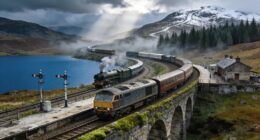
Europe dominates train travel with Switzerland’s Bernina Express cutting through glacial Alps and the Venice Simplon-Orient Express serving luxury in restored 1920s cars. Japan’s Hokkaido Shinkansen literally goes underwater, while Norway’s Bergen Line hits the country’s highest railway point. India’s Maharajas’ Express covers the golden triangle in style. The Trans-Siberian Railway stretches from Europe to Asia—the world’s longest train journey. Each route offers something planes simply can’t match, and there’s more territory to cover.

While most people groan at the thought of cramming into airplane seats, train travel offers something different entirely. Your window becomes the entertainment system. The journey? It becomes the destination.
Switzerland practically invented scenic train travel, and they’re not exactly modest about it. The Bernina Express cuts through the Alps from Chur to Tirano, serving up glacial landscapes and dramatic viaducts through those panoramic carriages.
Meanwhile, the Glacier Express crawls between Zermatt and St. Moritz at such a leisurely pace they actually call it the “slowest express train.” It crosses 291 bridges and passes through 91 tunnels—talk about taking the scenic route.
For pure luxury, nothing appears to beat the restored 1920s Art Deco cars of the Venice Simplon-Orient Express. Europe’s capitals become stops on what’s essentially a moving hotel.
The Maharajas’ Express in India takes opulence seriously, covering Delhi, Agra, and Jaipur with fine dining and curated cultural experiences. Japan’s Kyushu Seven Stars combines luxury with regional excursions across the island.
That said, adventure seekers have options too. The Trans-Siberian Railway offers the world’s longest train journey, crossing forests, grasslands, and Lake Baikal. It’s Europe to Asia the hard way.
In Africa, the Tazara Railway links Tanzania to Zambia through savannahs where wildlife spotting comes standard. Rovos Rail traverses southern Africa in vintage carriages, passing vineyards, deserts, and game reserves.
Some routes exist purely for the views. Norway’s Bergen Line travels from Oslo to Bergen, hitting the country’s highest railway point. The Bergensbanen makes this journey four times daily, connecting Norway’s capital with its historic Hanseatic port. The Flåm Line offers a renowned one-hour trip with dramatic nature views and notable engineering.
Sri Lanka’s Colombo-Badulla route winds through tea plantations and jungle. Alaska Railroad delivers mountains, glaciers, and wildlife through remote wilderness.
Modern engineering has its moments too. The Hokkaido Shinkansen passes under the sea connecting Tokyo to Hakodate.
Spain’s AVE network connects cities at high speed through picturesque countryside. The emerging Paris to Berlin daytime train speeds through vineyards and forests, offering a new transnational connection. Even so, the Eurostar links London with Paris, Brussels, and Amsterdam via underwater tunnels.
Train travel strips away the hassle of airports and security lines. Those tracks lead to places planes can’t reach, at speeds that let travelers actually see the world passing by.
Sometimes slower really is better.
Did You Know
How Much Do Train Tickets Typically Cost for Popular Routes?
Train tickets vary wildly depending on what you’re after.
Budget options like German ICE run $30-120, while high-speed routes like Shinkansen cost $100-140.
Scenic journeys get pricier—Glacier Express starts at $160, Rocky Mountaineer hits $1,500-2,000.
Luxury trains? That’s where things get ridiculous.
Venice Simplon-Orient-Express demands $3,500-7,000+ per person.
Golden Eagle’s 12-day trek costs $18,500.
Choose wisely.
What Should I Pack for a Long-Distance Train Journey?
Travelers need valid documents, tickets, and a secure bag for valuables.
Pack comfort items like blankets, pillows, earplugs, and eye masks.
Bring toiletries, medications, and layers for unpredictable temperatures.
Don’t forget entertainment—books, headphones, downloaded shows.
Stock up on snacks and drinks because dining cars aren’t always reliable.
A portable charger is essential.
Honestly, packing cubes and plastic slippers make everything easier in cramped spaces.
Are Train Stations Accessible for Passengers With Mobility Issues?
Train station accessibility? It’s a mess.
Over 40% of stations lack step-free access, and only 2% offer level boarding.
Just 11% have full-time staff, while nearly one in five assistance requests go unfulfilled.
Poor signage confuses 27% of disabled travelers, and accessible parking is often nonexistent or miles from entrances.
The infrastructure simply wasn’t built with mobility issues in mind.
Can I Bring My Pet on Board During Train Travel?
Yes, most major train companies allow dogs and cats, but forget about bringing your rabbit or parrot.
Weight limits are strict—Amtrak caps pets at 20 pounds including carrier. Larger dogs need leashes, sometimes muzzles, and their own ticket.
Advance registration is often required.
Pets can’t sit on seats, must stay in carriers or designated areas, and need current vaccinations plus health certificates.
How Far in Advance Should I Book Train Tickets for Better Prices?
Most train systems don’t require advance booking for better prices—that’s airline thinking.
Regular trains? Same price whether you book today or tomorrow.
Japan’s shinkansen reserves seats 30 days out, but unreserved cars cost the same regardless.
Europe’s high-speed trains actually get pricier closer to departure, so book those weeks ahead.
Regional trains? Just show up.
Parting Shot
Train travel isn’t dead. Far from it. Europe’s rail network remains unmatched—Switzerland’s alpine routes, Japan’s bullet trains, and Scotland’s Highland lines prove the point. India’s diverse landscape unfolds beautifully by rail. Canada’s transcontinental journey spans breathtaking wilderness. Even America, despite its car obsession, offers scenic routes through Glacier National Park and California’s coast. Sure, planes are faster. But trains? They allow travelers to truly explore the world instead of just arriving somewhere else.