How to travel by train to Portugal, from the UK is absolutely doable, and it’s possible from other countries as well. There’s no single ticket, no single website, and no direct service from London or Paris. Expect at least four separate bookings across Eurostar, SNCF, Renfe, and CP. The journey runs roughly 28–32 hours to Lisbon, longer to Porto. Missing one connection can add a full day. The good news: the full picture is a lot clearer once the route options get broken down properly. Here’s the full breakdown in detail.
Key Points
- No direct train exists from London or Paris to Portugal; connections through France and Spain are always required.
- The London–Paris–Hendaye–Lisbon corridor is the most reliable route, with splittable bookings reducing missed-connection risk.
- For Porto-bound travellers, entering via Vigo using the Celta train avoids Lisbon backtracking and saves significant time.
- Book each leg separately across multiple platforms; CP opens tickets 60 days out and requires your passport number.
- Tight connections like the ten-minute Badajoz transfer carry high disruption risk and can add 24 hours to your journey.
Can You Actually Travel to Portugal by Train From the UK and Europe Without Getting Stranded
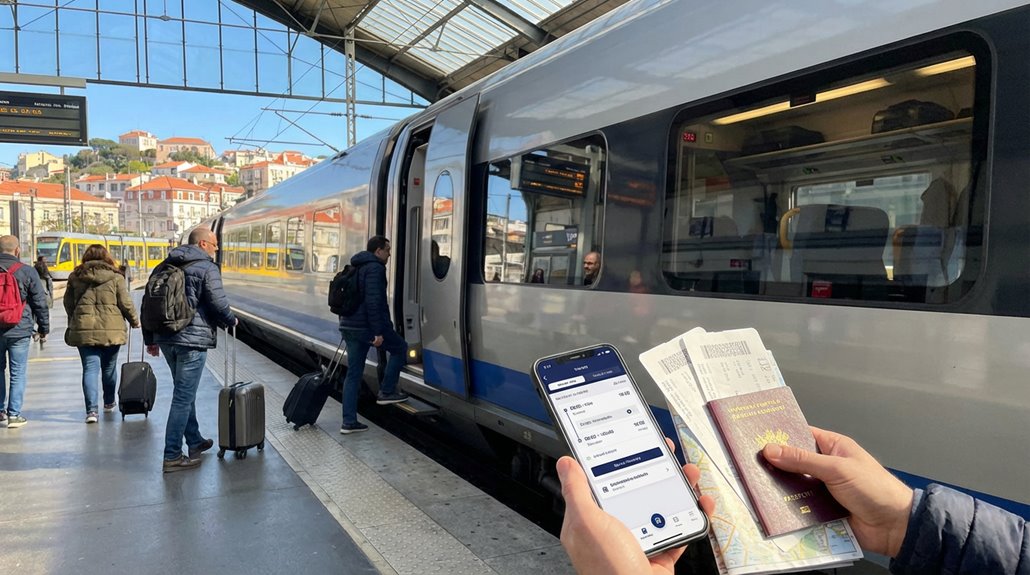
No, there is no direct train from London or Paris to Lisbon — not one, not even close.
The journey requires roughly 28 to 32 hours and four separate changes, routing through Paris, Madrid, and other connection points before a traveler even sees Portuguese soil. Rail emissions can be as low as 3 g CO2 per passenger-kilometre, making the slower journey a considerably greener choice compared to flying.
Flying takes about two and a half hours, so the train is clearly for people who want the experience of getting there, not just the destination. A high-speed rail link between Madrid and Lisbon is expected to change this landscape significantly when it opens in 2027. Travelers beginning the journey from Germany can take advantage of direct ICE or TGV services from Frankfurt to Paris, with journey times of approximately 3 to 4 hours before continuing southward.
Why Portugal Has No Direct International Train From London or Paris and What That Means for Route Planning
Despite what optimistic travel blogs might suggest, there is no direct train from London or Paris to Lisbon or Porto.
London to Portugal by train means connections. Full stop.
Portugal via Spain by train requires:
- Eurostar to Paris
- Paris south toward Spain
- Madrid hub transfer
- Onward IC combinations into Portugal
One missed connection potentially delays everything 24 hours. For the international leg from Porto into Spain, the Celta train links Porto Campanha with Vigo Guixar, operating as a collaboration between CP and RENFE Spanish railways.
A fully planned overland itinerary from London to Portugal can cover three countries and eight cities across 15 days, starting at London St Pancras and traveling through France, Spain, and into Portugal entirely without flying.
How Long the Journey Takes Compared to Flying and When Rail Makes More Sense
How long does it actually take to get from London to Portugal by train? About 30 hours.
The London to Portugal by train fastest recorded time hits 21 hours 59 minutes to Lisbon. Compare that to a 5-hour flight. Train vs flight to Portugal isn’t really close on time.
But the Lisbon to Porto train afterward? Just 2 hours 35 minutes. That part’s genuinely impressive.
The full London to Porto journey averages 37 hours 55 minutes, with the fastest services completing the route in 35 hours 49 minutes.
Best Train Routes to Portugal From the UK and Europe That Avoid Overpriced or Sold-Out Segments
Getting from the UK to Portugal by train isn’t complicated — it just punishes people who don’t plan the segments carefully.
The London–Paris–Hendaye–Lisbon corridor holds up as the most dependable route, but the Paris–Madrid leg is where travellers confidently book the wrong trains and end up scrambling for reservations they assumed were optional.
And for anyone whose actual destination is Porto rather than Lisbon, skipping the capital entirely by entering through Vigo on the Celta saves both time and the headache of backtracking north. With a minimum of four changes required across the full journey from London, identifying which interchanges carry the most risk of disruption is what separates a smooth trip from a stressful one.
Once inside Portugal, domestic connections between major cities like Lisbon and Porto run on the Alfa Pendular high-speed service, which offers air conditioning and Wi-Fi and requires advance seat reservations that typically cost around €5.
The London–Paris–Hendaye–Lisbon Corridor and Why It Remains the Most Reliable Path
Among the many ways to torture yourself getting from London to Lisbon by rail, the London–Paris–Hendaye corridor stands out as the one that actually works.
The paris to portugal by train crowd knows why:
- Cheaper domestic TGVs
- Fewer sold-out segments
- Splittable bookings
- Hourly Portuguese connections
The train from london to portugal via the london–paris–hendaye corridor just stays reliable. For deeper route planning, Europe by Rail covers over 50 key routes with practical tips on ticketing, fares, and accommodation.
Only one train daily connects Irun to Lisbon, so missing that connection means an overnight stop and a full extra day of travel before you reach Portugal.
The Paris–Madrid–Lisbon Route and Where Reservation Mistakes Catch Travellers Off Guard
The Hendaye corridor earns its reputation, but plenty of travellers skip it entirely and shoot straight for Paris–Madrid–Lisbon instead. Fair enough.
But paris to portugal by train via Madrid currently means three trains, two bookings, three tickets. The madrid to lisbon train involves a tight ten-minute Badajoz transfer with zero guaranteed connection. And reservation compulsory alvia isn’t a suggestion. Miss it. Start over.
That transfer chaos at Badajoz may not last forever, with a new cross-border station planned for the Elvas–Badajoz area on the Spain–Portugal border by 2034. The European Commission’s High Speed Rail Action Plan targets Madrid–Lisbon in three hours by 2034, which would transform this corridor beyond recognition.
When Entering Portugal via Porto Makes More Sense Than Aiming for Lisbon
Aiming straight for Lisbon is the obvious move — and that’s exactly why it causes problems. Porto Campanhã station changes everything for portugal by train travellers.
- Alfa Pendular to Lisbon sells out fast
- Porto IC fares start at €16.50 promo
- Galicia connections keep uk to portugal by train costs lower
- Less booking pressure, more availability
Simple math. Porto wins. Porto Campanhã also serves as a major intercity hub, with over 700 daily departures connecting onward journeys across Portugal and beyond. From Porto, a free Campanhã to São Bento transfer is included with your mainline ticket, valid within one hour of your train’s arrival or departure.
London to Portugal by Train: The Full Route Broken Into Bookable Stages
The full London-to-Lisbon rail journey breaks into four distinct bookable stages, and yes, most guides breeze past the details that actually matter. Eurostar gets travelers from St Pancras to Paris in around two hours and fifteen minutes — straightforward enough — but the onward connection from Paris to Hendaye or Irun is where the itinerary either holds together or quietly falls apart, because the two Paris stations are not connected by rail and passengers crossing from Gare du Nord to Gare de Lyon or Austerlitz are on their own. Eurostar departs from London St Pancras International, where border control procedures are completed before boarding, meaning travelers clear French immigration on the English side before entering the Channel Tunnel.
From the Spanish border, the route splits: south through Madrid with the Lusitania overnight train into Lisbon Santa Apolónia, or north via Vigo and the Celta regional express into Porto Campanhã — and the overnight booking trap is real, given the Lusitania runs only around three times a week, not daily. Travelers should budget at least 50 minutes for the Paris station transfer, accounting for the metro leg between Gare du Nord and Gare de Lyon.
For those prioritizing the scenic experience over speed, the route via Biarritz and San Sebastián offers a compelling alternative, with the Biarritz-to-San-Sebastián bus leg clocking in at just over one hour and the onward Alvia service to Madrid threading through the Pyrenees foothills in around five and a half hours.
Eurostar to Paris and the Onward Connection Options That Most Guides Get Wrong
From London St Pancras, 16 Eurostar trains roll out daily toward Paris Gare du Nord — and that part, at least, is straightforward.
Figuring out how to get to Portugal by train gets messier after Paris. Most guides gloss over it. Here’s what they miss:
- Journey time: 2h 22m minimum
- First train: 6:01
- Last train: 20:31
- Arrival: Gare du Nord
Europe to Portugal by train starts here. Booking early matters — Eurostar reservations open 6–8 months before departure, and fares rise as seats fill. Tickets are operated by SNCF and Eurostar, with both carriers sharing the 28 daily services that run between London and Paris.
Paris to Hendaye or Irun by TGV and What Happens at the Spanish Border
Once travelers clear Paris, the next leg drops them into TGV territory — specifically, Paris Montparnasse 1 et 2, not Gare du Nord, which is where Eurostar dumps everyone.
| Paris Hendaye Timetable | Duration |
|---|---|
| 07:05 departure | 4h 36m |
| 16:09 departure | 4h 39m |
| 18:05 departure | 4h 46m |
| 18:44 departure | 4h 39m |
| 21:40 departure | 10h 46m |
The paris to hendaye tgv runs up to 11 times daily. At Hendaye, the hendaye irun connection takes four minutes via tram. Booking second-class tickets three to four months in advance can save travelers around 35% on this leg compared to last-minute fares. For travelers on a tighter budget, TGV Prems fares start from €15 when booked up to four months in advance.
Crossing Spain to Lisbon or Porto and How to Avoid the Overnight Booking Trap
Clearing the Spanish border at Irun is the easy part. Spain to Portugal by train — that’s where plans unravel. Skip the overnight train to Portugal trap entirely. Four cleaner options exist:
- Irun → Badajoz → Lisbon (9h, daytime)
- Porto → Vigo → Madrid AVE (11h total)
- Hendaye → Vigo → Porto Campanhã
- Edinburgh to Portugal by train splits cleanly at Hendaye
No overnight chaos required. Once inside Portugal, the Alfa Pendular connects Porto to Lisbon in around 3 hours by train, with up to 11 daily departures and onboard Wi-Fi included. The route passes through Coimbra and Aveiro, making it a practical option for travellers who want to break their journey at notable stops along the way.
From Edinburgh and the Rest of the UK to Portugal by Train
Most travel guides act like everyone starts their Portugal rail adventure from London, which is a bit rich when you live in Edinburgh.
Getting to Portugal by train from Scotland means tacking on an extra leg — Edinburgh Waverley to London King’s Cross first — before even touching the Eurostar. That single planning step, easy to overlook, can add cost, time, and one more transfer to an itinerary that’s already stacking up fast. The train route from Edinburgh to Porto covers approximately 1692 kilometres, crossing rolling countryside and coastal stretches through the UK and France before reaching Portugal. Eurostar now runs three daily direct services between Amsterdam and London, a reminder of just how rapidly cross-channel rail connections are expanding across Europe.
How to Join the London–Continental Corridor Without Backtracking or Wasting a Day
From Edinburgh, the path to Portugal by train is actually less painful than it sounds.
- LNER to London King’s Cross: 4h30–5h30
- Eurostar to Paris Gare du Nord: 2h16
- Paris to Hendaye corridor entry via TGV: 4h40–5h
- Hendaye to Lisbon overnight train: 11–12h
Knowing how to book train tickets to Portugal separately per operator keeps costs down. No single website sells tickets for all European trains, so multi-operator journeys like this one typically require booking through several national or private operator sites. Simple.
Why Starting Outside London Adds a Planning Step That Most Itineraries Overlook
Every train travel guide to Portugal quietly assumes the reader is already standing in London. They’re not. Edinburgh alone sits 650 kilometres away.
| Origin | Route Summary | Approx. Duration |
|---|---|---|
| Edinburgh | Waverley → King’s Cross → Eurostar to Paris → arriving Lisbon train station | 33–35h |
| Sheffield | Extended transfer via Paris | 38h 38m |
| Bordeaux connection | Train connections to Portugal via Valença | 5h 4m final leg |
Minimum three transfers. No exceptions.
Portugal by Train via Spain: What to Verify Before Crossing the Border
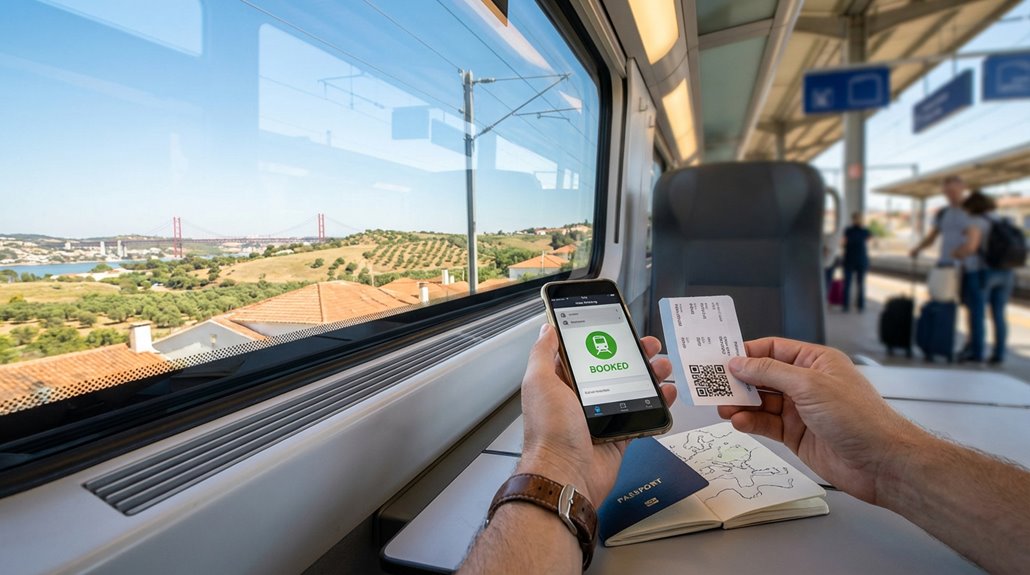
Travelers eyeing the Spain–Portugal rail corridor should know upfront: there is no direct Lisbon–Madrid train anymore, and the connection through Badajoz requires separate tickets for the Portuguese and Spanish legs.
The Lusitania Trenhotel, once the romantic overnight fix for this gap, runs only around three times a week — not daily — and has been suspended and reinstated enough times that checking current schedules on Renfe and CP’s websites before booking anything is just common sense.
Down south, Seville offers an alternative entry angle into Portugal, but cross-border rail options here are equally thin, because RENFE pulled local cross-border services roughly two years ago and left travelers with limited choices. A new rail line between Évora and Elvas is planned to open next year, which is expected to finally enable direct Lisbon–Madrid trains in around five hours.
When navigating busy train stations and public transportation hubs along this corridor, travelers should also be aware that pickpockets commonly exploit crowds when boarding or disembarking, so keeping valuables secure and avoiding standing near vehicle doors is a practical precaution throughout the journey. Many stations along this route also offer free Wi-Fi access, making it easy to confirm onward connections or monitor any schedule changes while waiting to board.
Madrid to Lisbon by Train and the Current Timetable Gaps You Should Check First
The Madrid-to-Lisbon train route in 2026 is, to put it charitably, a patchwork. No direct high-speed. Just connections. The portugal train timetable currently shows:
- Two daily madrid to lisbon train departures
- Journey times ranging 7h29m to 20h54m
- Up to three changes, including Badajoz
- Seat reservations portugal train required per segment
Verify schedules directly. They shift. The overnight Renfe service covers approximately 502 km between the two capitals, making journey planning especially dependent on which departure window you can realistically commit to. Trainline reports around 4 trains per day operating on this corridor, so confirming live availability before booking remains essential.
Seville and Southern Spain as an Alternative Entry Point Into Portugal
Madrid isn’t the only way in. Seville to Portugal is an option — just not a glamorous one.
No direct train exists. Getting to Lisbon by train from Seville takes nearly 15 hours with changes. Two trains daily. That’s it.
Seville itself is well connected by rail, and travelers arriving via the Al Andalus luxury train from Madrid can use the city as a southern staging point before continuing toward Portugal.
Alternatively, a bus to Seville from Faro runs multiple times daily, bridging southern Spain and Portugal’s Algarve coast reasonably fast. If you’re heading deeper into Portugal, intercity train services from Faro to Lisbon are available with fares from €8.
Why the Spain–Portugal Rail Connection Is Less Frequent Than Most Travellers Expect
Spain and Portugal share a border. Yet decent rail connections? Barely exist.
- Tren Celta runs Porto–Vigo. That’s it for direct trains.
- Lisbon to Madrid train options involve two changes, 10+ hours.
- Comboios de Portugal suspended overnight services in 2020. Still gone.
- Road dominates at 90.5% of cross-border travel. Rail’s basically irrelevant.
The transport sector accounts for 28% of combined Portugal and Spain greenhouse gas emissions, yet trains remain vastly underused for cross-border journeys. Plans are underway to extend the Lisbon–Porto high-speed line to Vigo and onward, with government projections targeting Lisbon to Madrid in three hours by 2034.
Verify everything before booking.
How to Book Train Tickets to Portugal Without Overpaying for Each Segment
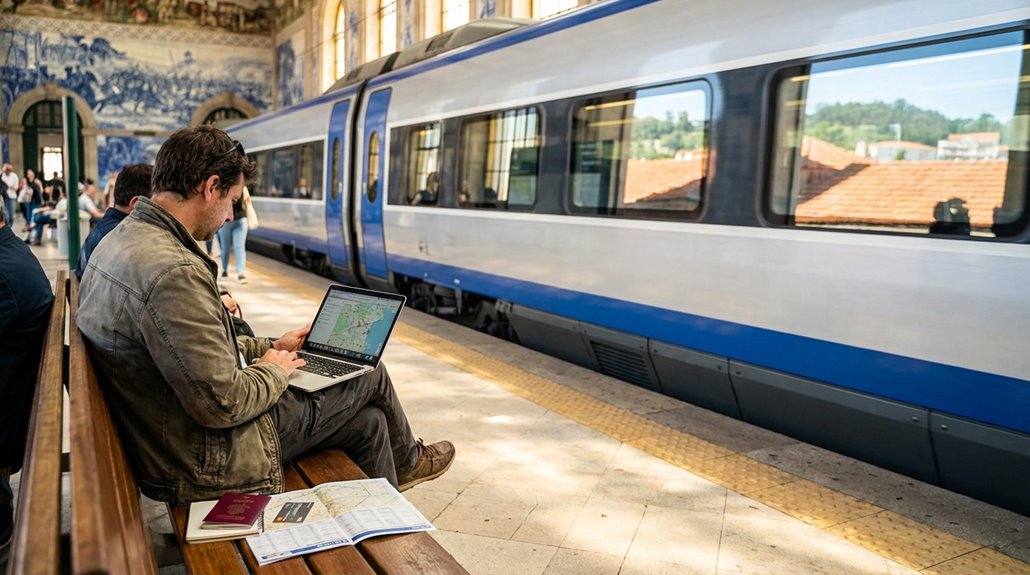
Booking a London-to-Lisbon rail journey all in one place sounds logical — it is not possible, and nobody should expect it to be.
Each segment lives on a different platform: Eurostar for London to Paris, SNCF Connect for French legs, Renfe for Spain, and CP’s own site for Portuguese trains.
Rail passes like Interrail or Eurail look attractive until the reservation fees start stacking up, at which point point-to-point tickets booked 60 to 90 days out often just win on price. The Spain-France leg alone is served by SNCF TGV INOUI and Renfe AVE high-speed trains, meaning seat reservations are mandatory and allocations for rail pass holders are limited.
Booking the Journey in Segments vs Trying to Book It All at Once
One of the first things travellers discover about booking train tickets to Portugal is that the system rewards patience and punishes procrastination.
Portugal rail booking isn’t one clean transaction. It’s fragmented.
- Combined portugal train tickets exist but aren’t guaranteed
- Regional segments often require separate same-day purchases
- Single Journey Booking vs. Separate Segments affects pricing significantly
- Third-party sites kill promo discounts. Use official platforms.
Which Platforms to Use for Each Leg: Eurostar, SNCF Connect, Renfe, CP
Getting train tickets to Portugal isn’t hard — it’s just annoying in a very specific way.
Each leg needs its own platform. Eurostar for London-Paris. SNCF Connect for the TGV south. Renfe platforms handle Spain. Then cp.pt for CP Portugal tickets — opens 60 days out, requires a passport number.
Want to travel by train to Portugal without losing your mind? Book segments separately.
When Rail Passes Like Interrail or Eurail Are Worth It and When Point-to-Point Tickets Win
Rail passes sound like a dream — one purchase, unlimited Europe, no fussing over individual tickets.
Reality? Often pricier than booking separately. For the best train route to Portugal, consider:
- Rail pass Portugal Interrail suits multi-country, spontaneous trips
- Flexi passes work for stop-heavy itineraries
- Point-to-point tickets beat passes on Spain’s competitive routes
- Advance booking saves significantly
Compare both options first.
Reservations, Seat Rules, and Overnight Segments That Can Derail Your Portugal Train Trip
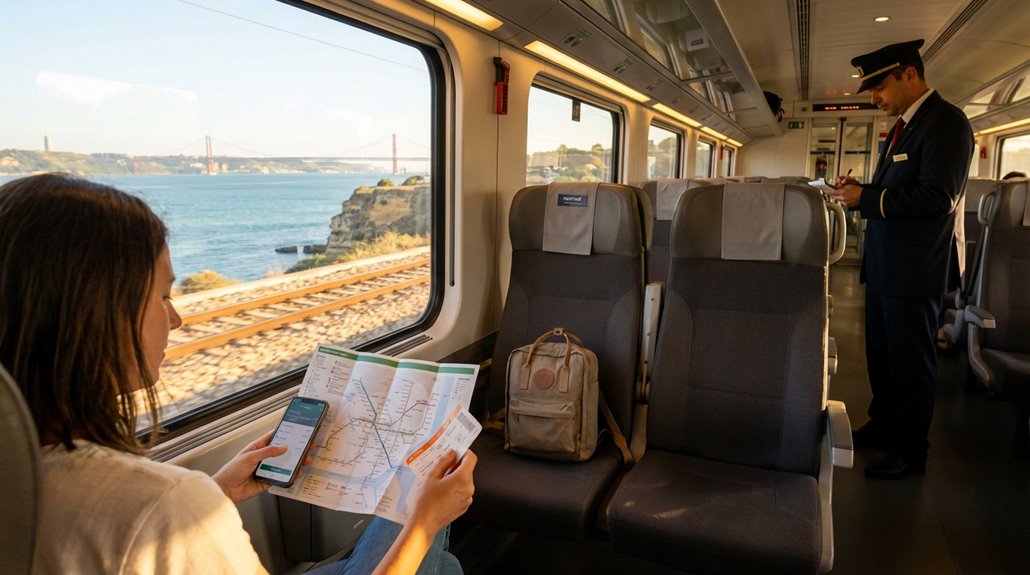
Booking a train to Portugal without understanding reservation rules is how people end up standing in an aisle for four hours, quietly furious.
Some legs are mandatory — Alfa Pendular and Intercidades trains require seat reservations, full stop — while Regional and Inter-Regional trains let passengers board without one.
Then there’s the overnight Madrid–Lisbon Lusitania Trenhotel, a service that runs only about three times a week and has a habit of disappearing from schedules entirely, so assuming it’ll be there when needed is a gamble that has burned plenty of travelers before.
For travelers who’ve used Italy’s rail network, the contrast is notable — buying tickets in advance via the Trenitalia website or app is a smoother, more reliable experience than navigating some of the cross-border Iberian booking systems.
Which Legs Require Mandatory Reservations and Which Are Open Seating
Maneuvering Portugal’s train reservation rules is the kind of thing that separates a smooth trip from a chaotic one.
- Alfa Pendular – mandatory reservation
- Intercidades Portugal – mandatory reservation
- Sleeper train Spain Portugal – mandatory reservation
- InterRegional/Regional – open seating, no reservations
Reservations cost €5. Simple. InterRegional and Regional trains? Just board. No fuss.
How Sleeper and Overnight Train Options Between France, Spain, and Portugal Actually Work
Between France, Spain, and Portugal, exactly two overnight trains do the heavy lifting: the Lusitania and the Sud Express.
The Lusitania leaves Madrid Chamartín at 21:43, arriving Lisbon Santa Apolónia at 07:30.
The Sud Express departs Hendaye at 18:35, same arrival.
Both trains merge at Medina del Campo.
Porto by train, lisbon to faro train, lisbon to sintra train — all start after this arrival.
Reservations are mandatory for sleepers.
Fixed Fares vs Flexible Fares and When Choosing Wrong Costs You More Than the Ticket
On a Portugal train trip, the fare type chosen at checkout quietly determines whether a missed connection becomes a minor inconvenience or an expensive disaster.
- Promo fares: zero refunds, zero exchanges
- Normal fares: cancellable up to 15 minutes before departure
- Advance booking cuts costs roughly 60% at 8 days out
- Lisbon to Lagos train promo tickets? Gone if plans shift.
Choose wrong. Pay twice.
Timetables, Journey Times, and How to Plan Connections Without Missing a Train
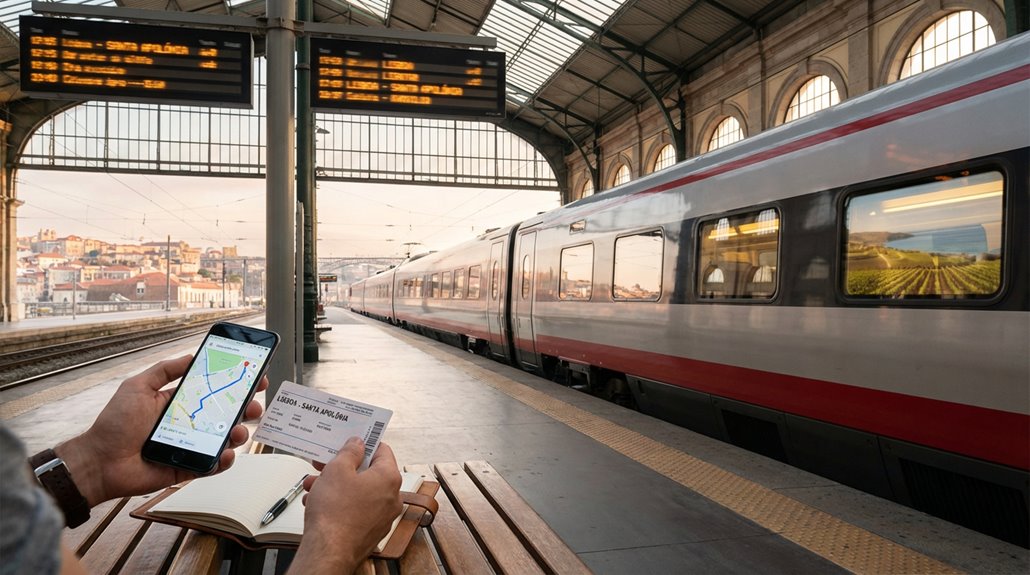
Timetable apps love to show the fastest possible connection — which, in Paris, Madrid, or Lisbon, is almost always a fantasy, and that’s the case also for travel to Portugal by train.
Gare du Nord to a TGV departure at another Paris station requires a metro ride that apps casually ignore, and Madrid Chamartín assumes a sprinting traveler with zero luggage.
CP’s own website and downloadable PDF timetables are the only honest tools here, because route guides published even a year ago are already outdated — entire lines like the Douro between Régua and Pocinho are suspended right now. For longer intercity journeys, the Alfa Pendular high-speed service between Lisbon and Porto offers a reliable and comfortable option that is worth planning your connections around.
Why Minimum Connection Times in Paris, Madrid, and Lisbon Are Not What Timetable Apps Show
Booking a train from London to Lisbon feels satisfying — until the connection math falls apart in Paris. Apps lie. Politely, but consistently.
Real minimum connection times operators actually enforce:
- Paris – 30 minutes (apps show 15)
- Madrid – 25 minutes (apps show 10)
- Lisbon – 30 minutes (apps show 12–15)
- Peak hours – add another 5–10 minutes everywhere
Apps show optimism. Operators show reality.
How to Build Buffer Time Into a Multi-Day Rail Journey to Portugal
Knowing where the connection math breaks down is one thing. Actually fixing it is another.
Frequent Lisbon–Porto departures run through the day, so missing one isn’t catastrophic. But Badajoz–Madrid requires reservations. Miss that window and the whole 9-hour chain collapses.
Douro Valley trains? Only two direct daily. Build buffers. Not suggestions — actual gaps in the schedule.
Checking Real Timetables vs Relying on Outdated Route Guides
The route guide they downloaded six months ago might as well be fiction. Timetables shift. Seasons matter.
- CP’s website shows real prices and live schedules
- Algarve trains run Daily, MFO, or SHX — not always daily
- IC trains require mandatory seat reservations
- Public holidays follow Sunday patterns
Static PDFs miss transfers entirely. Check actual travel dates on CP directly.
Train vs Flight to Portugal: When Rail Is the Smarter Choice and When It Is Not
Choosing between a train and a flight to Portugal is not as simple as checking which one is cheaper — because, more often than not, the flight wins on price and speed, full stop. A Greenpeace study found that flights were cheaper than trains on up to 95% of cross-border routes in France, Spain, and the UK, a gap driven largely by aviation fuel tax exemptions that rail operators don’t enjoy.
But rail quietly earns its place when the journey itself is the point — multiple city stopovers, lower carbon emissions, and city-center arrivals that skip the whole airport circus. On the emissions front, the case for rail is stark: trains produce up to 13 times less CO2 per passenger than flying, making the slower journey a considerably lighter one for the planet.
The Realistic Time and Cost Comparison Most Travel Sites Leave Out
Between the glossy travel blog promises of scenic rail journeys and the brutal reality of booking fees, most people never get the full picture.
Here’s what the numbers actually show:
- Flights beat trains on 54% of European cross-border routes
- Lisbon–Madrid train costs ~$70; flights run ~$40
- Lisbon–Porto train: €26.85
- Rail wins on 39% of routes
Why Rail Wins for Multi-Stop Itineraries, Scenery, and Lower-Carbon Travel
Numbers don’t lie, but they don’t tell the whole story either. Rail lets travelers stack cities — Paris, Madrid, Lisbon — without extra flights.
The scenery through Basque Country and the Tagus valley? Genuinely stunning. And environmentally, trains produce roughly 90% less CO₂ than flying. Flights are cheaper partly because kerosene isn’t taxed. That’s not a coincidence. It’s policy.
Arriving in Portugal by Train: Lisbon, Porto, and the Rail Gateways That Matter
Trains into Portugal funnel through two main gateways: Lisbon and Porto, and knowing which station receives your train matters more than most travellers realise.
In Lisbon, international trains from Madrid roll into Santa Apolónia, the oldest city-centre station, while Oriente — the big, modern hub on the eastern edge — handles most domestic connections onward to Faro, Coimbra, and Braga.
Porto’s story is simpler: express trains land at Campanhã, a quick six-minute suburban train ride from the gorgeous, tile-covered São Bento station in the historic centre. Keep in mind that most train tickets in Portugal are date-specific and non-transferable, so purchasing the correct departure date upfront is essential to avoid penalty fees or rebooking costs.
Lisbon Santa Apolónia and Oriente Stations and Which One Your Train Arrives At
Arriving in Lisbon by train means landing at one of two stations — Santa Apolónia or Oriente — and knowing the difference actually matters.
- Santa Apolónia handles international arrivals from Madrid
- Oriente serves Alfa Pendular and Algarve-bound trains
- Santa Apolónia is the oldest, built 1865, east of the historic center
- Oriente sits closer to the airport, in Parque das Nações
Porto Campanhã Station and How to Connect to the City Centre
Porto’s main train station isn’t in the city centre — and that surprises more people than it should.
Campanhã sits 2.5 kilometres east along the Douro. Lisbon trains, Alfa Pendular, intercity, regional, international — all stop here.
Getting downtown is straightforward: metro Lines A, B, C, and E connect directly from the adjacent Campanhã station.
Taxis and Uber wait outside. Simple enough.
Choosing Lisbon or Porto as Your Arrival City Based on Where You Want to Go Next
- Douro Valley, Braga, Guimarães — Porto wins
- Faro, Lagos, Albufeira — Lisbon wins
- Coimbra — either works
- Algarve coast — Lisbon, no contest
332 kilometers separates these cities. Wrong choice means backtracking. Pick your gateway based on the final destination, not habit.
Travelling Around Portugal by Train Once You Arrive
Once travellers clear the international gateways at Lisbon or Porto, Comboios de Portugal takes over — and it actually does a decent job on the main corridors.
The Alfa Pendular is the headline act, a tilting high-speed train stitching together Guimarães, Braga, Porto, Coimbra, Lisbon, and Faro, while Intercidades handles the same routes at a slower pace with fewer frills.
Go off that main north-south spine, though, and the picture gets messier fast — buses quietly fill in where the rail network simply doesn’t reach.
How Comboios de Portugal Runs Domestic Services and What Alfa Pendular and Intercidades Cover
Arriving in Lisbon or Porto, travellers quickly discover that Comboios de Portugal — the state-owned national operator running since the 1850s — actually knows what it’s doing.
Two services dominate:
- Alfa Pendular — tilting trains, 301 seats, Wi-Fi, power sockets
- Intercidades — long-distance express, two classes
- Regional/InterRegional — slower, stopping services
- Urban networks — Lisbon, Porto, Coimbra
Surprisingly functional.
Where Trains Work Well Inside Portugal and Where Buses Still Fill the Gaps
Between the coastal strips and major cities, Portugal’s rail network actually earns its keep — but step too far inland and the tracks simply stop.
| Region | Train Access | Reality Check |
|---|---|---|
| Lisbon–Porto corridor | Strong | Frequent daily services |
| Algarve coast | Limited | Tourism demand, weak supply |
| Northeast interior | None | Bus or nothing |
Rural Portugal? Buses handle what trains abandoned.
Key Train Routes Within Portugal That Connect to Your International Arrival
Once the international leg is done, the real Portugal begins — and CP’s domestic network fans out in every useful direction from Lisbon and Porto.
Alfa Pendular gets travelers from Lisbon to Porto in 2 hours 35 minutes, to Faro in 3 hours 30 minutes, and to Coimbra in just 1 hour 40 minutes — fast enough to make renting a car feel genuinely unnecessary.
The Sintra suburban line, Lagos connections via the Algarve, and Porto’s northern routes to Braga and Guimarães round out a network that actually covers most of what visitors come to Portugal to see.
Lisbon to Porto by Train: Alfa Pendular Timing, Fares, and Booking
Stepping off an international train at Lisbon’s Oriente Station, the next obvious move is north — Porto. The Alfa Pendular handles it cleanly:
- Distance: 332 km
- Speed: Up to 220 km/h
- Journey time: ~3 hours
- Starting fare: €56
No changes. Direct. Up to 38 daily departures. Book 12 weeks ahead on CP’s official site.
Lisbon to Faro by Train: Reaching the Algarve Without a Car
The Algarve doesn’t come to you — you go to it, and the train makes that surprisingly painless.
Five daily trains run Lisbon to Faro.
Two are Alfa Pendular, hitting 200 km/h and arriving in three hours flat.
Three are Intercity — slower, still fine.
Departures start around 7:14 AM.
Faro isn’t exactly hiding.
The train finds it easily enough.
Lisbon to Lagos and the Algarve Coast by Rail
Lagos isn’t the end of the line — well, actually, it is. The westernmost stop. Twenty-six daily departures from Lisbon make it doable.
- Fastest trip: 3 hours 38 minutes
- Alfa Pendular hits 220 km/h
- Change required at Tunes — every time
- Tickets from €24.15 second class
No direct trains exist. Ever. But the Algarve views? Worth the transfer.
Lisbon to Sintra: The Day Trip Nearly Every Visitor Makes
Algarve done. Now, Sintra. Rossio Station is the departure point — narrow-gauge, Sintra-only. First weekday train leaves at 5:41am. Weekends, 6:01am. Tickets start at €4, averaging €5. Journey takes roughly 40 minutes. Trains run every 20 minutes, 146 daily routes. Peak hours between 10am and noon mean queues at Rossio. Plan accordingly. A 24-hour CP urban pass costs €6.
Porto and Northern Portugal Rail Connections Including the Douro Valley
Porto gets two train stations, because apparently one wasn’t enough. São Bento handles Douro Valley trains. Campanhã handles everything else.
The Linha do Douro runs Porto to Pocinho. Key stops:
- Régua – 1h 50min from São Bento
- Pinhão – €11.95 single
- Pocinho – full terminus, 3h 20min
- Direct IR departures – 09:20 and 13:20 daily
Scenery starts after Pala. Worth knowing.
Portugal Train Tickets, Fares, and Rail Operators You Need to Know
Once travelers land in Portugal, the domestic train system is — refreshingly — not a nightmare. Comboios de Portugal (CP) runs everything, and booking is straightforward through their official site, no middleman required.
The real choice comes down to train type: Alfa Pendular is the fast, tilting high-speed option hitting 220 km/h, Intercidades connects major cities with fewer stops, and Regional trains crawl through smaller towns for those in absolutely no hurry.
CP Comboios de Portugal Ticket Types and How Pricing Works
Maneuvering CP Comboios de Portugal’s ticket system is actually pretty straightforward once the basic structure clicks. Four things matter most:
- Alfa Pendular — fastest, hits 220 km/h
- Intercidades — long-distance express
- Regional/InterRegional — slower, cheaper
- Urban trains — zone-based fares only
Two classes exist on AP and IC: Turística and Conforto. Conforto costs roughly 50% more.
Why Booking Portuguese Domestic Trains Is Simpler Than the International Legs
Compared to the international legs, booking Portuguese domestic trains is almost refreshingly simple. CP handles everything internally — no third-party detours, no operator juggling. The website has an English interface. Mobile e-tickets download instantly. Advance purchase goes up to 60 days, exclusively through CP’s own platform.
International legs involve cross-border coordination, foreign card headaches, and surcharge surprises. Domestically? Clean, direct, done.
Alfa Pendular vs Intercidades vs Regional: Which Service Fits Your Route
Picking the right Portuguese train isn’t complicated — but get it wrong and the trip feels slower and grimmer than it needed to be.
- Alfa Pendular — fastest, tilts through curves, hits 220 km/h
- Intercidades — slower, older, more stops
- Regional — cash-only, no reservations, no advance tickets
- Interrail/Eurail holders — mandatory reservations on Alfa Pendular and Intercidades
Simple enough.
Is Travelling to Portugal by Train Worth It or Should You Just Fly
Not everyone belongs on a 24-hour train ride to Lisbon, and that is just the truth. Travellers with tight schedules, zero interest in scenery, or a cheap flight already booked probably should not overthink it — the plane wins on time, full stop.
But for anyone building a multi-city European trip, chasing slow travel through Paris, Madrid, or the Basque Country, or simply wanting to arrive at Lisbon’s city centre without the airport circus, the train starts making a genuinely strong case.
Who Should Take the Train to Portugal and Who Probably Should Not
Taking the train to Portugal sounds romantic — and sometimes it genuinely is — but it is not for everyone, and pretending otherwise would be dishonest.
Train travel suits:
- Multi-country voyagers
- Low-carbon travelers
- Scenery seekers
- Flexible itinerary planners
Last-minute bookers? Budget-first travelers? Time-crunched flyers? Probably not. Tickets get expensive fast.
Flights win on speed. Simple math.
The Strongest Case for Rail: Slow Travel, Multi-City Itineraries, and Scenic Routes
For travelers who actually want to *see* the country they paid to visit, the train wins before the argument even starts.
Cork forests. Atlantic beaches. Douro Valley cliffs dropping into terraced vineyards. None of that appears through an airplane window at 35,000 feet.
Lisbon, Porto, Coimbra, Faro — all connected. Affordable, frequent, assigned seating. The network basically builds the itinerary for you.
Frequently Asked Questions
Can I Bring a Bicycle on International Trains Travelling Into Portugal?
Generally, bringing a bicycle on international trains into Portugal is an uphill battle. Standard non-folding bikes are typically prohibited, while folded or boxed bikes may qualify. Travelers should verify specific route policies with CP beforehand.
Are There Any Loyalty Programmes That Reward Frequent Rail Travellers to Portugal?
Few dedicated rail loyalty programmes exist for Portugal-bound travellers. CP offers the Green Rail Pass rather than a points system. Renfe Más Renfe rewards Spanish segments, while Trenitalia’s CartaFreccia covers Italian legs, leaving no unified frequent-traveller scheme rewarding the full journey.
Do Portuguese Trains Have Accessible Facilities for Passengers With Reduced Mobility?
CP trains offer accessible facilities for reduced mobility passengers. Alfa Pendular provides wheelchair spaces and adapted toilets, while Intercidades accommodates foldable wheelchairs. Urban services feature ramps and lifts. An Integrated Mobility Service operates 24/7, with advance booking required for wheelchair users.
Can I Store Large Luggage on Overnight Trains Between Madrid and Lisbon?
Passengers may store large luggage on the Madrid–Lisbon overnight train without baggage fees. Non-carry-on suitcases are permitted onboard. However, travellers should secure belongings carefully, as luggage theft has been reported on European overnight train services.
Are There Any Group Discount Fares Available for Train Travel Into Portugal?
Group discounts are available on CP’s Alfa Pendular and Intercidades trains, offering up to 50% off for groups of three or four. Family & Friends Weekend Tickets provide half-price fares on Saturdays and Sundays for select routes.
Conclusion
Yes, it takes longer than flying. That’s the whole point. The train to Portugal isn’t a compromise — it’s the actual experience. Cities en route, real landscapes, no airport chaos. Travellers who’ve made the journey rarely describe it as inconvenient. They describe it as the trip itself. One ticket doesn’t cover everything, planning matters, but none of it is complicated. Portugal is reachable by rail. People do it constantly.