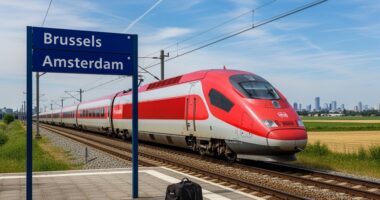
Train travel produces remarkably low carbon emissions compared to other transport modes. Diesel trains emit around 41 grams of CO₂ per passenger kilometer, while efficient electric trains like Eurostar achieve just 6 grams. That’s roughly 10 times cleaner than cars and 13 times better than planes. Rail accounts for only 1% of global transport emissions versus road transport’s hefty 70%. The numbers get even more compelling when you examine specific routes and emerging industry innovations.

The carbon footprint of train travel tells a story that appears to make cars and planes look like environmental villains. While the average diesel train emits 41g CO₂e per passenger kilometer, the most efficient electrified trains slash that figure to just 6g. That’s not a typo—some trains, like the Eurostar, actually achieve this remarkable efficiency.
The numbers get brutal when you start comparing transport modes. Train travel may emit 10 times less carbon than cars for identical journeys. Against planes? Trains are likely 13 times cleaner. Road transport seems to gobble up 70% of global transport emissions while rail sits at a measly 1%. Cars pump out 171-192g CO₂e per passenger kilometer, which makes trains look downright angelic.
Here’s where it gets interesting, though. Fully occupied electric vehicles can match trains at 12-16g CO₂e per passenger kilometer. The catch? How often is your car actually full? Train occupancy rates matter too, but trains start with higher passenger density by design.
Several factors appear to determine a train’s carbon footprint. Fuel type makes the biggest difference—diesel versus electric versus renewable power sources. Journey distance helps since longer trips spread operational efficiency across more kilometers. Even so, class matters because first-class passengers hog more space, driving up per-person emissions.
On top of that, the national electricity grid mix determines how clean electric trains actually are.
Regional differences are stark. A London to Edinburgh journey by train generates 12.5kg CO₂e per passenger. The same trip by car? 136.4kg. By plane? A whopping 165.1kg. Meanwhile, Amtrak passengers in the United States still beat domestic flights by 34% and cars by even more.
That said, the rail industry isn’t sitting still. Green travel pledges and carbon calculators now provide granular journey data. The new methodology combines granular data including engine type, fuel type, journey distance, occupancy, and carriage layout to showcase the environmental benefits of rail travel. Rail operators are adopting lighter train cars and optimizing operations. Europe’s shift toward renewable electricity continues shrinking emissions. Understanding the dynamic pricing structure across different European countries can help travelers choose the most environmentally friendly rail options.
Infrastructure energy use, rolling stock manufacturing, and regenerative braking systems all factor into the total footprint. Route electrification can substantially reduce emissions compared to diesel operations. The lifecycle approach reveals that while trains dominate most scenarios, high-occupancy electric vehicles can occasionally rival electrified train efficiency. However, infrastructure emissions from rail construction often exceed operational emissions by 141%, representing a hidden environmental cost.
Did You Know
How Does Electric Train Carbon Footprint Compare to Diesel Trains?
Electric trains absolutely crush diesel trains in carbon footprint comparisons.
Electric trains emit just 27.12 g CO₂e per passenger km, while diesel trains spew 106 g CO₂e per passenger km. That’s nearly four times worse for diesel.
Electric trains also convert up to 90% of energy efficiently, compared to diesel’s pathetic 30%.
Zero tailpipe emissions versus significant CO₂, nitrogen oxides, and particulates? No contest.
What Is the Carbon Footprint of High-Speed Trains Versus Regular Trains?
High-speed trains absolutely crush regular trains on carbon emissions.
HSR clocks in at just 3.7-8.9g CO₂ per passenger-kilometer, while traditional diesel trains belch out around 41g CO₂/pkm.
That’s roughly five times worse. The secret sauce? Electric power and packed passenger loads.
Sure, building HSR infrastructure creates more upfront emissions, but those operational savings pile up fast over decades of service.
Do Passenger Loads Affect the Carbon Footprint per Person on Trains?
Yes, passenger loads dramatically affect per-person carbon footprints on trains.
More riders mean lower emissions per passenger since fixed energy costs get divided among more people. A packed train can hit just 6g CO₂e per passenger kilometer, while nearly empty trains push emissions way up.
Business class carriages, typically less crowded, have higher per-seat footprints than economy.
Basic math, really.
How Does Train Manufacturing and Infrastructure Impact Overall Carbon Footprint?
Train manufacturing adds 5-15% to lifetime rail emissions, while infrastructure construction contributes 25-40% to overall journey footprints.
Operations still dominate at up to 91% of total emissions.
But here’s the thing – high traffic spreads those upfront construction costs across more passengers, making the math work better.
As electricity gets cleaner, infrastructure becomes a bigger slice of the shrinking pie.
What Carbon Offset Programs Exist Specifically for Train Travel?
Several rail operators offer carbon offset programs, though availability varies wildly by region.
Amtrak partners with offset providers, while European services like SNCF integrate offsets at ticket purchase.
Third-party platforms like Thrust Carbon calculate rail-specific emissions and sell offsets directly.
Business travel platforms increasingly auto-include rail offsets.
Most programs use verified standards like Gold Standard, sourcing offsets from renewable energy or reforestation projects.
Parting Shot
Train travel crushes cars and planes in terms of carbon emissions. Period. Electric trains powered by renewable energy? Even better. Diesel trains still beat most alternatives, though they’re not exactly Mother Earth’s best friend. The numbers don’t lie: trains emit roughly 45% less CO2 per passenger than cars, 75% less than planes. So yeah, hop on that train. Your carbon footprint will thank you, and so will future generations.