Costa Rica’s train system is basically a commuter line for the metro area—that’s it. The Interurbano Line connects Alajuela, Heredia, San José, and Cartago through 32 stations, running on diesel power. You can buy tickets at stations or onboard, but don’t expect scenic coastal rides or cross-country adventures. It’s designed for workers avoiding traffic jams, not tourists seeking epic rail journeys. However, an ambitious $1.5 billion electric train project promises to change everything completely.
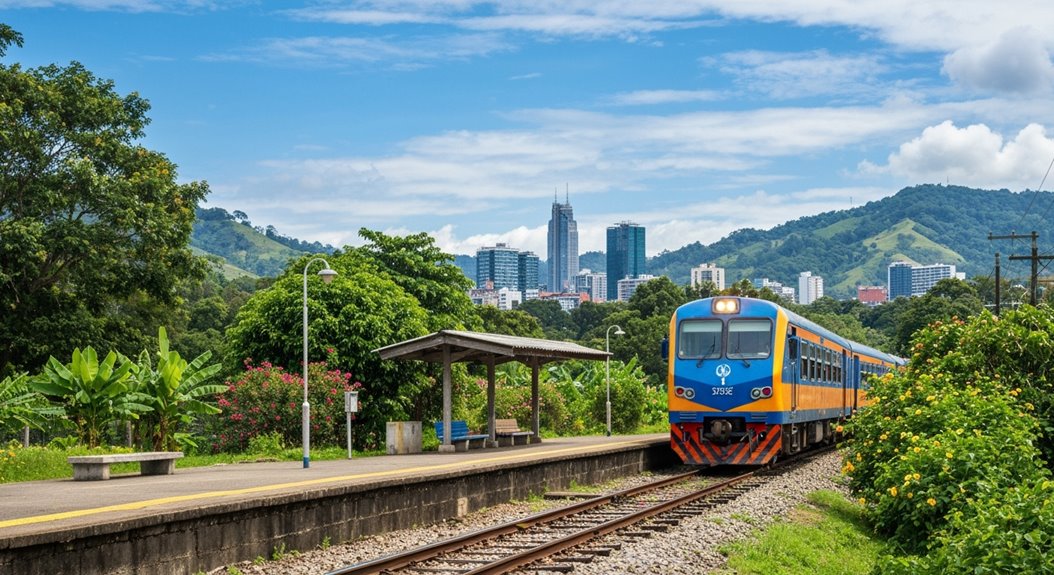
Let’s be honest—Costa Rica’s train system won’t win any awards for comprehensiveness. If you’re picturing yourself gazing out windows at rolling coffee plantations on a cross-country rail journey, you might want to adjust those expectations. Train travel here is pretty much confined to the Greater Metropolitan Area, and that’s about it.
Costa Rica’s trains stick to the metro area—forget those dreamy cross-country coffee plantation views.
The Interurbano Line does the heavy lifting as the country’s main commuter rail. It connects Alajuela, Heredia, San José, and Cartago provinces through 32 stations. That’s your lot. No coastal routes, no romantic mountain excursions—just getting office workers from suburb to city center.
Incofer, the national railway institute, runs this modest setup. The trains chug along on 1,067 mm gauge tracks using diesel power. It’s not exactly state-of-the-art, but it appears to move people reliably enough within the metro area.
Here’s where things get genuinely exciting, though. Costa Rica has something ambitious brewing: an Electric Passenger Train project that could completely reshape urban transportation. This isn’t just wishful thinking either—they’ve already secured around $550 million in CABEI loans for a project that’s likely to cost between $800 million and $1.5 billion total.
The electric system will bump service up to 46 stations, including 10 intermodal hubs where buses, taxis, and bike networks converge. Once operational, trains are expected to roll through every 3-5 minutes. The route will stretch from Paraíso de Cartago to San José, potentially serving 2.7 million inhabitants. Meta Engineering from Barcelona completed technical visits and strategic meetings in May 2024 as part of their consultancy work for the project.
The environmental case is particularly compelling. Costa Rica’s electrical grid runs on 98% renewable energy, so electrification seems like a natural fit. The project promises to slash 7.6 million tons of CO2 emissions over its lifespan while creating over 2,600 jobs. In contrast, Amtrak’s extensive network in the United States covers over 500 destinations across 46 states, demonstrating the potential scale that comprehensive rail systems can achieve.
International connections might eventually become reality too. Panama is developing a railway from Panama City to Paso Canoas on Costa Rica’s southern border. That 475-kilometer line with 14 stations could hit speeds of 180 km/h and may well boost tourism in southern Costa Rica. The ambitious Panama-David-Frontera project aims to transform a current 12-hour drive between Panama City and the Costa Rican border into just a three-hour train journey.
For now, train travel remains stubbornly limited to metro area commuting. You can grab tickets at stations or onboard, accessibility is gradually improving, and the system mainly serves workers trying to dodge GAM’s legendary traffic jams.
Did You Know
What Is the Cost of Train Tickets in Costa Rica?
Train tickets in Costa Rica cost around 550 CRC (about $1 USD) for commuter routes like San José to Cartago.
Most urban lines charge 500-600 CRC per trip – basically the same as city buses. No fancy pricing schemes here. Kids under 12 ride free with adults.
Tourist scenic tours? That’s a different story, starting at 23,000 CRC ($46 USD). Regular trains keep it simple with flat rates.
How Far in Advance Should I Book Train Reservations?
Travelers should book train tickets 24-48 hours ahead during peak seasons like December-April and July-August.
Most trains don’t require reservations, but First Class definitely benefits from advance booking.
Costa Rica’s limited rail network sells out fast during holidays and weekends.
Tickets are mainly purchased at station counters since online options are scarce. Last-minute buyers risk standing or missing out entirely.
Are There Dining Cars or Food Services Available on Trains?
No dining cars exist on Costa Rican trains. Period.
Incofer’s commuter routes are too short for meal service—think San José to Heredia, not cross-country journeys. Passengers grab food beforehand or after arrival.
Some stations have basic kiosks, but don’t count on much.
Want the train dining experience? Hit up El Wagon in Manuel Antonio—it’s a stationary restaurant in an old train car.
Can I Bring Luggage and What Are the Size Restrictions?
Passengers can bring luggage on Costa Rican trains, but there’s no official size policy posted.
The commuter-focused system works best with airline carry-on sized bags—roughly 22x14x9 inches. Rolling suitcases and travel backpacks are generally fine if kept by your seat.
Overhead racks have limited space, aisles can’t be blocked, and there’s no luggage check-in service.
Basically, pack light or deal with cramped conditions.
Do Trains Run on Weekends and Holidays in Costa Rica?
Regular commuter trains don’t run on weekends or holidays in Costa Rica. Period.
INCOFER only operates Monday through Friday during rush hours. Pretty limiting, honestly.
However, some private tourist trains occasionally run weekend trips from San José to places like Caldera.
These aren’t regular services though—they’re infrequent special excursions that require separate booking through private operators, not the standard system.
Parting Shot
Train travel in Costa Rica remains frustratingly limited. The scenic route to Caldera runs weekends only, more tourist attraction than practical transport. Urban trains serve San José’s metro area during rush hours. That’s it. No cross-country rail adventures here. Buses dominate long-distance travel because, frankly, they have to. The railway infrastructure just isn’t there. Visitors expecting European-style rail networks will be disappointed. Costa Rica’s trains are charming novelties, not serious transportation options.