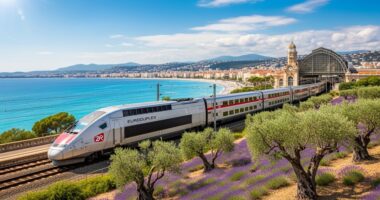
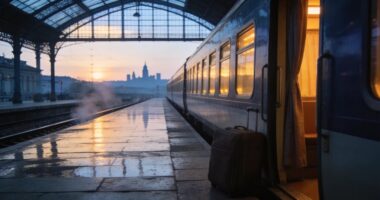
No direct train runs from New York to California—travelers must connect through Chicago. The journey spans roughly 3,000 miles across 12 states, taking 62 to 70 hours total. Start at Penn Station on either the Lake Shore Limited or Cardinal to reach Chicago in 19 to 28 hours. Then transfer to the Southwest Chief (Los Angeles) or California Zephyr (San Francisco area). Sleeper cars cost $1,000 to $1,800+ per person, while coach offers budget-friendly discomfort. This cross-country odyssey reveals America’s vastness in unexpected ways.
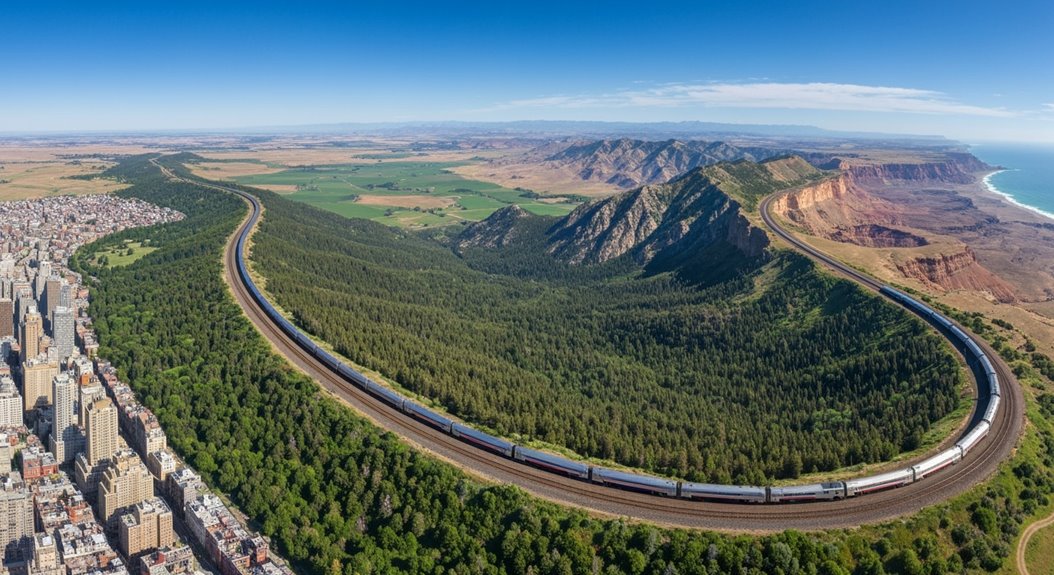
While most people assume there’s a direct train from New York to California, that’s actually not the case. No direct route exists, which means travelers must connect through Chicago. This turns the cross-country journey into a multi-day odyssey that appears to span somewhere between 2,800 to 3,000+ miles across 12 states.
Your adventure starts at New York’s Penn Station, where you’ll board either the Lake Shore Limited or Cardinal. Both trains head toward Chicago, though they take completely different paths. The Lake Shore Limited rolls through Albany, Cleveland, and Toledo—a more northern route. The Cardinal, on the other hand, meanders through Washington, Cincinnati, and Indianapolis.
Two iconic trains, two distinct American journeys—choose your path from Penn Station to the heartland.
Either way, you’re looking at 19 to 28 hours of rail time just to reach the Windy City.
Chicago serves as the mandatory pit stop where passengers transfer to westbound trains. From there, the Southwest Chief barrels toward Los Angeles, crossing the Great Plains and Rockies before hitting New Mexico and Arizona deserts. Total time? About 43 to 46 hours.
Alternatively, the California Zephyr heads to San Francisco’s Emeryville station, traversing Colorado’s Rockies, Utah’s deserts, and the Sierra Nevada mountains in roughly 51 to 53 hours.
The entire journey devours 62 to 70 hours, including layovers. That’s two to three nights sleeping on trains, which may not appeal to everyone. Coach passengers endure limited comfort and privacy while paying significantly less.
Sleeper car occupants enjoy roomettes or bedrooms with meals included, but they’ll shell out $1,000 to $1,800+ per person for the privilege—a steep price that’s likely to give many travelers pause.
Observation cars offer panoramic views of America’s diverse landscapes, though the experience isn’t without its drawbacks. WiFi remains spotty, cellular coverage disappears frequently, and delays happen because freight trains rule the rails. For those choosing other western routes like the Empire Builder, trains depart Chicago in the afternoon hours and traverse through eight states over approximately 46 hours.
Even so, summer provides ideal sightseeing conditions, especially through mountain regions.
Advance booking becomes essential for sleepers and decent fares. Metropolitan Lounge access sweetens the deal for first-class passengers in New York and Chicago. Checked baggage options exist, but limits apply per ticket.
Smart travelers pack snacks, water, and entertainment since onboard options may be limited. Power outlets exist onboard, and sleeper passengers access showers. The Coast Starlight connects with other routes for additional coastal travel options. These cross-country routes represent just a fraction of Amtrak’s more than 30 train routes available across the country. These iconic rail journeys connect major cities, small towns, and natural landmarks throughout the nation.
This isn’t a quick trip by any stretch, but it’s certainly America’s most comprehensive rail experience.
Did You Know
Can I Bring My Pet on the Train From New York to California?
No, bringing pets on trains from New York to California isn’t happening.
Amtrak only allows pets on routes lasting 7 hours or less, including layovers. Cross-country trips take way longer than that.
Plus, pets are restricted to coach class only and must stay in carriers the entire time.
Service animals are the exception – they can travel anywhere without restrictions or fees.
How Much Luggage Am I Allowed to Bring on the Cross-Country Train?
Passengers get one personal item up to 25 pounds and two carry-on bags up to 50 pounds each.
Two checked bags are free, also 50 pounds max.
Want more? Two additional carry-ons or checked bags cost $20 each.
Bags over 50 pounds? Forget it. Not happening. Repack or ship separately.
Oversized checked bags between 76-100 linear inches hit you with another $20 fee.
Are There Power Outlets Available at My Seat During the Journey?
Yes, most long-distance trains between New York and California have 120v power outlets at each seat in coach and business class.
They’re usually tucked under seats or between seat pairs. Older Superliner cars might be stingy with outlets though, offering them only at specific seats like 29 and 55.
Outlets are typically shared between adjacent passengers, so peak times might require some awkward coordination with your neighbor.
What Food Options Are Available on the Train to California?
Food options depend on your ticket type and route.
Coach passengers get café car access with prepackaged snacks, burgers, pizza, and hot dogs. Nothing fancy.
Sleeping car passengers on Western routes score traditional dining cars with made-to-order meals, three-course dinners, and that Texas French toast everyone raves about.
Vegan, vegetarian, and gluten-free options exist. You can bring your own food too.
Do I Need to Make Reservations or Can I Buy Tickets Onboard?
Advance reservations are absolutely required for all long-distance trains between New York and California.
Buying tickets onboard? Not happening. Most trains won’t even let passengers board without prior reservations.
Sure, some routes might allow onboard purchases, but they’ll charge full, undiscounted fares – basically highway robbery.
Amtrak strongly recommends booking early to avoid sold-out trains.
The pass alone won’t get anyone on board.
Parting Shot
Cross-country train travel isn’t for everyone. The journey takes days, not hours. Costs can rival flying. But for those who hate airports and love scenery, Amtrak’s route delivers. Passengers get legroom, dining cars, and views planes can’t match. It’s slower than driving, more expensive than buses. Yet something romantic persists about rolling across America by rail. The experience trumps efficiency. Sometimes the journey matters more than speed.