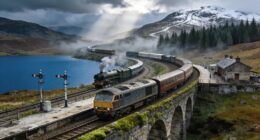
Jungfrau Railway: A Mountain Railway That Reaches Europe’s Highest Station Through Engineering Innovation
The Jungfrau Railway, a cogwheel rack railway, carries passengers through nine kilometers of mountain terrain. Engineers blasted tunnels through the Eiger and Mönch peaks using dynamite over a century ago. The railway reaches Europe’s highest station at 3,454 meters elevation, where oxygen thins and alpine vistas expand.
Key features of this mountain railway include:
- Observation windows: Carved through 1,800 meters of the Eiger’s north face in 1903, these openings transform the tunnel into a viewing gallery with balconies overlooking sheer rock walls
- Sphinx Observatory terrace: A high-speed lift transports visitors 108 meters upward in 25 seconds, placing them above the Great Aletsch Glacier, a UNESCO World Heritage site
- Kleine Scheidegg route: The 50-minute ascent covers steep gradients using a rack-and-pinion system, earning the railway its “Top of Europe” designation
The journey combines turn-of-the-century engineering with alpine geology. Passengers travel from valley stations through solid rock to reach observation points above massive ice fields. The railway operates year-round despite extreme weather conditions and avalanche risks.
Construction workers spent sixteen years drilling through the mountain using hand tools and explosives. They completed the project in 1912, creating Europe’s highest railway station and a feat of mountain engineering that remains operational today.
Interesting Fact: Construction of the Jungfrau Railway required workers to remove over 700,000 cubic meters of rock from inside the mountain, equivalent to filling 280 Olympic-sized swimming pools with solid stone debris.
Experience #1 — Jungfraujoch Summit Terminus Defies Altitude Limits at 3,454 Meters

At 3,454 meters above sea level, the Jungfraujoch railway terminus shatters boundaries. It doesn’t just push them. It obliterates them. Europe’s highest railway station runs almost entirely through an underground mountain tunnel—a passage carved straight through the Eiger and Mönch—where alpine tunnel engineering defies what you thought possible at this altitude.
How does a railway climb to a glacier observation platform perched above the clouds? Through nine kilometers of cogwheel rack technology, that’s how. The journey ascends through rock and ice, through mountain and myth, through engineering that seems to mock gravity itself; the terminus waits at the end, a gateway to the Sphinx observation terrace at 3,571 meters.
Mountain railways don’t approach this elevation. Mountain railways don’t attempt this grade. Mountain railways don’t dare this ambition—except this one does.
Imagine standing where trains meet eternal snow. The cogwheel rack grips the track with mechanical determination, pulling you higher through tunnels blasted from solid alpine stone, past geological layers that have witnessed millennia, toward a destination that exists in the realm between earth and sky. Pure extremity.
This is the Top of Europe destination, where you’ll find yourself breathing thin air and thick wonder. The Jungfraujoch doesn’t whisper its achievements: three mountains conquered, one impossible station built, a glacier platform suspended in space and time. Every meter of ascent represents human audacity carved into the Alps, every tunnel section a testament to engineering that refused to accept “impossible” as an answer. Construction began in 1896 to forge this impossible connection between valley civilization and glacial wilderness. The journey from Kleine Scheidegg takes approximately 50 minutes upward through those carved mountain passages, with the descent requiring only 35 minutes of gravity-assisted return. This remarkable route forms part of the Grand Train Tour of Switzerland, which showcases the country’s most spectacular UNESCO World Heritage locations and alpine landscapes.
Mountain railways don’t get more extreme than this.
Experience #2 — Eiger North Face Windows Transform a Mountain Tunnel into a Gallery

How does a railway tunnel become theater? In 1903, the Jungfrau Railway Company blasted windows—actual windows—straight through the Eiger’s north face. Straight through 1,800 meters of sheer rock. Straight through Europe’s most notorious wall. Then they stopped.
They blasted windows through 1,800 meters of killer rock, then stopped—leaving a gallery where passengers view what climbers die reaching.
Eigerwand station emerged as something unplanned: a gallery carved inside the mountain itself, where balconies jutted from solid stone and passengers could step onto precipices that alpinists died trying to reach.
Even Stollenloch—Door 38, a humble spoil-dumping hole—found new purpose as a rescue portal when climbers clung to the face outside.
This century-old engineering feat did more than bore through granite; it transformed functional infrastructure into a curated mountain experience, punctuating the climb from Kleine Scheidegg interchange with dramatic altitude acclimatization stops that let you pause, breathe, and stare into the abyss. Like Austria’s Semmering Line, the Jungfrau Railway stands among Europe’s great engineering feats that turned impossible terrain into accessible wonder.
The windows frame the void.
The windows frame the ice.
The windows frame death itself.
And then they frame *you*.
Because standing there—1,800 meters up, cocooned in warmth while storms rage centimeters beyond the glass—you become part of the spectacle.
The railway didn’t just conquer the Eiger: it made verticality intimate.
Short sentences quicken your pulse.
Long, winding passages mirror the train’s slow ascent through tunnels that smell of diesel and century-old blasting powder, through rock that has crushed dreams and swallowed climbers, through a mountain that refuses to forgive mistakes. The tunnels burrow deeper still toward Jungfraujoch saddle, threading between Jungfrau and Mönch in their relentless push skyward.
Then you emerge.
A vertical theater, built by dynamite.
Gallery-style balconies where rail meets rock.
The north face—no longer just a climb, but a show you watch from the inside out.
Picks and shovels—not massive boring machines—carved most of this underworld by hand, each meter a testament to human stubbornness against stone.
Experience #3 — Sphinx Observation Terrace Crowns the Journey with Glacier Panoramas
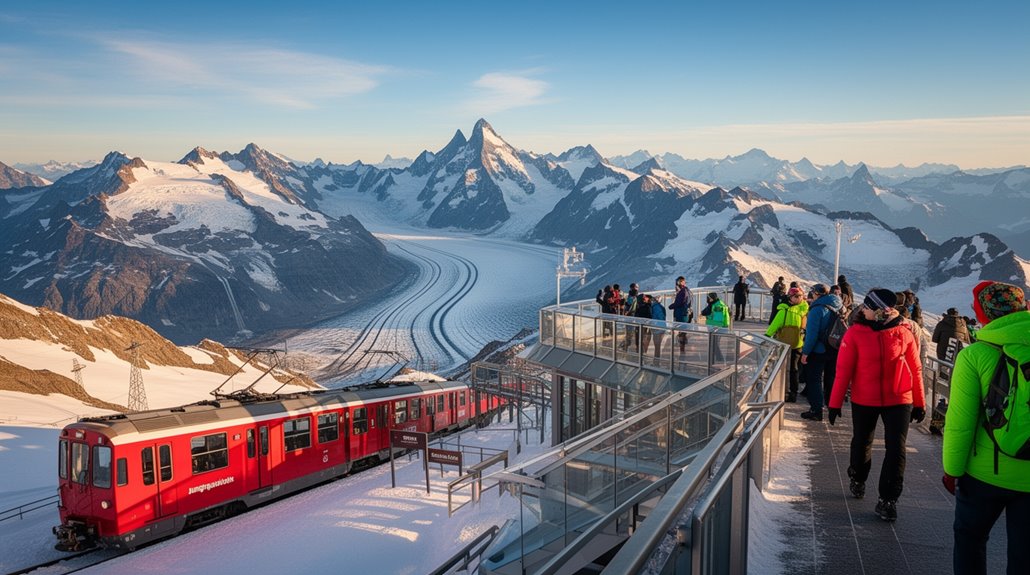
Twenty-five seconds. That’s all the time the high-speed lift needs to punch through bare rock and rise 108 meters from Jungfraujoch station, depositing you at 3,571 meters on an open-air steel platform where the wind doesn’t care about your ticket price.
The Sphinx Observation Terrace crowns the journey with glacier panoramas—sweeping, ancient, indifferent. Below stretches the Great Aletsch Glacier, the ice river that earned this landscape its UNESCO World Heritage designation; above, only sky and the sharp teeth of alpine peaks.
Panoramas. Research instruments. Panoramas. Because the terrace serves double duty: you stand where scientists measure what mountains whisper.
But here’s the catch—seasonal weather conditions slam shut views instantly. One moment you’re gazing across Europe’s longest glacier, the textured surface rippling toward distant valleys, its crevasses etched in shadow and light like a map you can’t quite read. The next? White.
Advance booking requirements collide with alpine caprice at Europe’s highest altitude mountain railways. Will the clouds part for you? Wind whips across the platform, reminding every visitor that nature holds the final ticket. The terrace doesn’t apologize. It delivers what the mountain allows: sometimes crystalline vistas stretching to the Bernese and Valais Alps, sometimes nothing but swirling mist and the metallic taste of thin air.
Still, standing at 3,571 meters—higher than most dreams climb—changes something. The glacier doesn’t perform; it simply exists, carving and creeping as it has for millennia. Inside the astronomical dome, a 76 cm telescope has tracked celestial movements through some of Europe’s clearest skies for decades. The complex has served as more than a research station; it became a filming location for the 1969 James Bond film Her Majesty’s Secret Service, immortalizing these peaks in cinematic history. Switzerland’s other panoramic alpine railways like the Glacier Express and Bernina Express have earned similar acclaim, yet this journey reaches heights they cannot touch.
Research stations hum quietly. Tourists snap photos. And the Sphinx, perched on its throne of stone, grants audience to anyone willing to ascend, book ahead, and brave whatever the sky decides to deliver.
Frequently Asked Questions
How Long Does the Complete Jungfrau Railway Journey Take From Start to Finish?
The Jungfrau Railway takes 35 minutes one-way from Kleine Scheidegg to Jungfraujoch. The complete round trip from Interlaken Ost takes 6–8 hours total.
Does the Swiss Travel Pass Provide Discounts on Jungfrau Railway Tickets?
The Swiss Travel Pass offers a 25% discount on Jungfrau Railway tickets from Grindelwald or Wengen to Jungfraujoch, with full coverage to Interlaken Ost, Grindelwald, and Wengen.
What Safety Measures Address High-Altitude Sickness During the 35-Minute Ascent?
The 35-minute ascent limits hypoxia exposure. Onboard staff monitor passengers for altitude sickness symptoms. Infrastructure allows rapid descent when necessary. Pre-trip medical screening identifies high-risk travelers needing physician clearance.
Can Visitors Access the Railway Year-Round Despite Extreme Alpine Weather Conditions?
The Jungfrau Railway operates year-round with daily service to 3,454 meters elevation. Severe storms may temporarily suspend operations, but infrastructure reliably withstands typical alpine conditions.
What Was the Original Construction Timeline for Completing the Tunnel Railway?
The original timeline planned for seven years (1896-1903) with one station opening per year. Construction actually took sixteen years, finishing in 1912—more than double the expected duration.
Parting Shot
The Jungfrau Railway isn’t just transportation—it’s proof that trains can do ridiculous things when engineers get ambitious. Sixteen years to drill through a mountain, just to put windows in a tunnel and build a station where most people can barely breathe. But that’s the whole point. These railways turned impossible destinations into day trips. No ropes, no hiking boots required. Just sit back and let century-old engineering haul you somewhere roads will never reach.