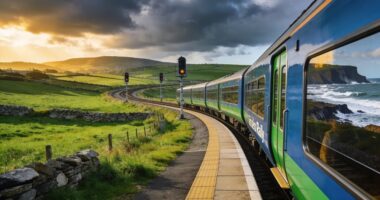
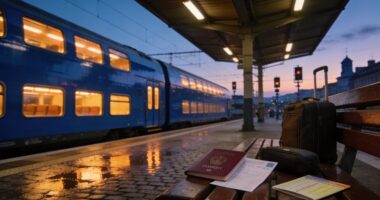
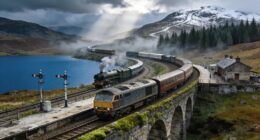
The busiest season for train travel in Europe: July and August create extreme demand that tests rail networks to their limits.
European railways face passenger volumes 40-60% above baseline during summer months. School holidays across Germany, France, and the United Kingdom release millions of families simultaneously. Deutsche Bahn, SNCF, and Trenitalia operate at maximum capacity. Fixed track infrastructure cannot expand to meet temporary demand.
- Discount fares: Eurostar and Thalys release promotional tickets that vanish within 48 hours of availability
- Price increases: Standard fares climb 20-40% compared to May or September shoulder seasons
- Booking windows: Popular routes like Paris-Barcelona and Amsterdam-Berlin sell out weeks ahead rather than months
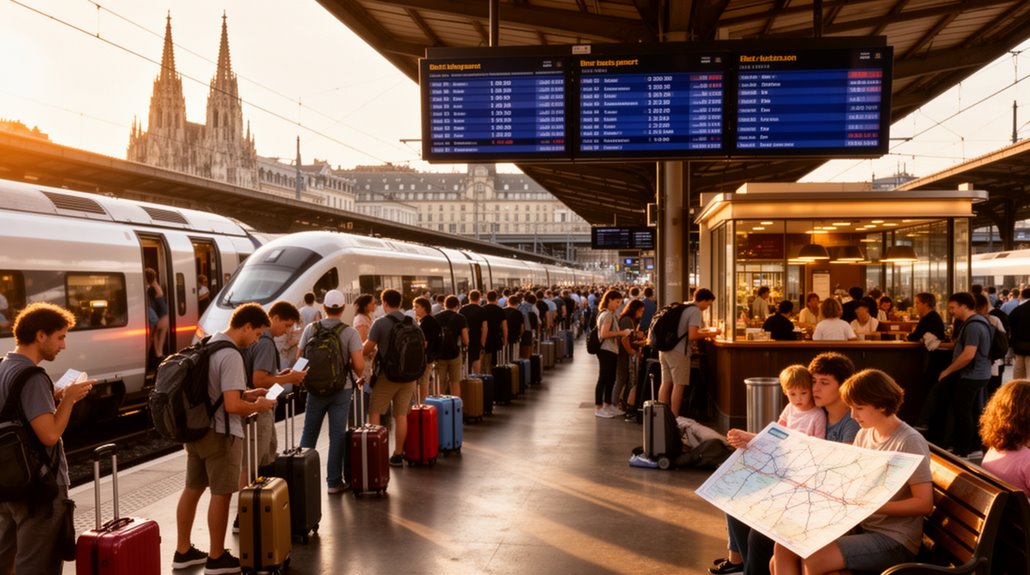
Rail Europe and Trainline report peak traffic during the last week of July. Interrail passes surge among travelers aged 18-30. Station concourses at Roma Termini, Gare du Nord, and München Hauptbahnhof reach standing-room density. Platform queues at local ticket offices stretch past thirty minutes.
The summer crush reveals infrastructure stress points. Trenitalia adds Frecciarossa services on coastal routes. SBB schedules supplementary cars through the Gotthard Base Tunnel. RENFE extends AVE frequencies between Madrid and Seville.
Fun Activity To Try: Book a scenic overnight sleeper on the Nightjet from Vienna to Venice—departing mid-week avoids the weekend rush and delivers you rested to the lagoon at dawn.
Key Points
- July–August passenger volumes surge 40–60% above normal levels, driven primarily by school holidays and peak tourist season.
- EU rail reached a record 443 billion passenger-kilometres in 2024, with Germany and France handling roughly half of all traffic.
- Fixed infrastructure and rigid timetables scheduled a year ahead prevent operators from expanding capacity to meet summer demand spikes.
- Discount fares often vanish within 48 hours during peak months, forcing latecomers to pay 20–40% higher prices.
- Major hub congestion causes approximately 55% of trains to arrive late during peak hours, increasing missed-connection risks.
Summer Holiday Passenger Volumes Surge 40-60% Above Normal Across European Rail Networks

Every summer, European rail networks brace for impact—and honestly, the July-August peak hits harder than most travelers expect.
Summer rail travel in Europe isn’t for the faint-hearted—July and August will test your patience and your planning skills.
We’re talking somewhere between 40-60% more passengers than normal, which is, well, a lot.
School holidays across the continent appear to be the main driver here, though tourist season certainly piles on.
Platforms start feeling like sardine cans, and capacity limits get tested daily, sometimes pushed right to the edge.
Reservation scarcity? That’s putting it mildly.
Trains fill up fast—think popular routes like Paris to Barcelona or the coastal lines in Italy—and snagging a last-minute seat becomes genuinely difficult.
Even so, some quieter routes may still have availability if you’re flexible. The overall demand is part of a broader trend, with EU rail reaching 443 billion passenger-kilometres in 2024, the highest since records began. Germany and France each handled around 101 billion passenger-km in 2023, together accounting for roughly half of all EU rail travel.
That said, for most people traveling during peak weeks, planning ahead seems less like a suggestion and more like a survival strategy. Using specialized apps and websites for booking can help secure seats before they disappear entirely.
Why Do Peak Period Capacity Constraints Sell Out Popular Routes Weeks in Advance?
Why do those prime summer trains vanish from booking sites so fast? Fixed infrastructure capacity simply cannot stretch—there’s only so much track, and that’s not changing anytime soon.
Timetable rigidity locks in limited paths a year ahead, which means flexibility is essentially off the table. The situation worsens when surveys reveal insufficient rerouting capacity exists to handle even 50% of existing traffic during disruptions.
Rolling stock investment cycles? They move at a glacial pace, so fleets grow slowly if they grow at all.
When the summer holiday passenger surge hits, reservation availability shortages become more or less inevitable. Even popular routes with around 14 direct services daily cannot accommodate the flood of travelers seeking passage during peak weeks.
Even so, the advance booking windows appear to be shrinking to just weeks in some cases. Seat sellout probability rates skyrocket—think trying to grab a Paris-Nice seat in late June. The math is brutal, really. Demand crushes supply every single July, though one might argue better yield management could ease the crunch somewhat.
High Season Booking Competition Compresses Reservation Windows from Months to Mere Weeks

When summer schedules drop, the scramble begins—and it appears to be getting fiercer every year. School vacation travel demand slams into limited seat availability, creating high season booking competition that’s, honestly, pretty brutal.
That said, the intensity likely varies depending on where you’re headed. Peak demand during July crowds seems to compress advance booking requirements fast. With France largely shutting down in August, holiday demand shifts to other European destinations, intensifying competition on cross-border routes.
One operator saw bookings jump 35% for 2025, which hints at just how heated things have become. Premium pricing for peak periods kicks in quick too. Those cheap fares you were eyeing for a family trip to the coast or a week in the mountains? They’re disappearing in weeks now, not months. The pressure is real—one-third of total tourism nights in 2023 occurred in just July and August alone, which shows exactly where all that demand concentrates.
Even so, it’s worth noting that travelers willing to be flexible on dates may still find some breathing room—the real crunch hits the most popular windows hardest. For cross-Channel routes especially, booking tickets well in advance becomes essential since the London to Paris journey takes just over two hours, making it a prime target for summer travelers seeking efficient city-center-to-city-center connections.
Act Fast: Discount Fare Seats Vanish Within 48 Hours During the July-August Peak

Compressed booking windows are one thing. But discount fares vanishing in 48 hours? That’s brutal.
During the July-August peak, demand appears to send passenger volumes through the roof—though some routes handle the surge better than others. Advance booking becomes something close to a blood sport.
Summer demand turns advance booking into a battlefield—some routes buckle under the pressure while others barely flinch.
The cheapest seats on routes like Paris-Nice or Berlin-Vienna? Gone. Just gone, often before you’ve even finished your morning coffee. Notable exceptions that fill quickly year-round include Nightjet sleepers and some Spanish high-speed services.
That said, booking pressure seems to intensify most sharply as route popularity spikes. Latecomers likely find themselves staring down sold-out routes and hefty price premiums. For longer journeys, a Eurail pass may offer more flexibility than hunting for individual discount fares.
Even so, it’s worth noting that flexibility with dates or departure times may soften the blow somewhat. Sustainability-focused travelers are also driving demand, as trains are promoted for lower CO2 per passenger-km compared to cars and aircraft. Welcome to summer.

European rail operators have borrowed a page from the airline playbook—yield management pricing that makes summer travelers wince. During July and August, you’re likely looking at fares running 20-40% higher than what you’d pay in shoulder season for the exact same route. Same train, same seat, just a lot more euros leaving your wallet.
What’s driving this? Peak period capacity constraints, mostly, combined with booking competition that gets fierce once everyone decides they need to be in Barcelona or Amsterdam at the same time. Summer demand appears to push capacity utilization past 90%, and operators—understandably, perhaps—cash in while they can. That said, whether this represents smart business or squeezes out budget-conscious travelers is another question entirely.
The contrast between holiday travel and shoulder season pricing hits hard. Brutal, honestly. Britain demonstrates the most extreme version of this commercial approach, where business-peak walk-up fares can reach £104 on routes like London-Sheffield while advance fares on the same route drop as low as £12.50. This premium pricing comes on top of an already expensive baseline, with UK train tickets averaging approximately 4× pricier than equivalent plane tickets according to a 2023 analysis of European travel itineraries. Even routes with frequent service like Manchester to London, where advance tickets start around £14, see dramatic price jumps when booked last-minute during peak summer periods.
You could take a Paris-to-Rome route in late June and watch the price climb steadily as you inch toward mid-July. Even so, travelers keep booking, and the trains keep filling up.
Glacier Express and Bernina Express Bookings Become Nearly Impossible During Peak Demand

Switzerland’s legendary scenic trains—the Glacier Express and Bernina Express—tend to transform from bucket-list experiences into booking nightmares once July hits. Scenic train demand appears to explode during European school holidays, and these reservation windows? They slam shut fast.
The Glacier Express runs just four summer trains daily, with only two covering the full route. That’s it. On top of that, the flood of international visitors during peak periods seems to create serious overcrowding along these tourist corridors, pushing premium pricing to CHF 49 for reservations alone. Overcrowding is likely guaranteed—though some travelers may luck out with last-minute cancellations. The Bernina Express charges 26 CHF for summer reservations during the June through September period, adding to the cost pressure facing peak-season travelers. Seat reservations for both trains become available up to 93 days ahead, making early planning essential for summer travelers hoping to secure window seats. Both routes are featured on the Grand Train Tour of Switzerland, which combines panoramic trains, buses, and boats to showcase the country’s most spectacular landscapes and UNESCO World Heritage locations.
Crowded Hub Stations Increase Missed Transfer Risks as Connection Reliability Suffers

Scenic trains aren’t the only thing making summer travel a nightmare. During peak hours, platform congestion at major hubs like Berlin Hbf appears to push roughly 55% of trains into late arrivals—that’s connection reliability stress periods doing their thing.
When delayed services pile up, standing passengers end up clogging corridors, which tends to wreck transfer times for everyone else trying to catch their next train. On top of that, festival season travel overlaps seem to make the whole situation worse. The problem is compounded by the fact that only 13% of routes between major European cities are currently served by direct trains, forcing travelers through congested hub stations in the first place.
Tourist corridor pressure, honestly, may as well guarantee that someone’s going to miss their connection. Though it’s worth noting that some travelers do manage to navigate the chaos—it likely depends on how tight your transfer window is in the first place. Understanding how to navigate train stations and reading departure boards efficiently can make the difference between catching your connection and watching it pull away.
Frequently Asked Questions
Which European Countries Have Overlapping School Holidays Creating the Peak Travel Surge?
France, Germany, Netherlands, Belgium, Switzerland, Spain, Italy, Portugal, Austria, and the UK experience overlapping school holidays during July-August. This synchronization creates simultaneous vacation windows, generating the concentrated demand surge across European rail networks.
How Do Rail Operators Adjust Staffing Requirements During the July-August Peak?
Rail operators recruit temporary staff, deploy reserve crews, reassign back-office personnel to customer-facing roles, and partner with subcontractors for security and cleaning services to handle the 40-60% passenger volume increase during peak summer months.
Are There Alternative Scenic Routes Available When Popular Alpine Trains Sell Out?
Regional trains often cover identical scenic tracks as premium services. The Glacier Express route, for example, can be traveled using regular trains between Brig, Andermatt, and Chur without mandatory reservations.
What Festival Events Contribute to Additional Travel Demand During Summer Months?
Major music festivals like Tomorrowland, Sziget, and Roskilde draw hundreds of thousands of attendees, while cultural events including Edinburgh Fringe and Dubrovnik Summer Festival create sustained rail demand spikes throughout July and August.
How Does Scandinavian Midsummer Exodus Affect Northern European Rail Capacity?
The Scandinavian midsummer exodus drives rail networks to near-full capacity during July-August, with key intercity corridors like Stockholm–Gothenburg and Oslo–Bergen operating at 90%+ occupancy, requiring additional carriages and adjusted freight schedules.
Parting Shot
The July-August peak isn’t some mystery. It’s predictable chaos. Millions of families hit the rails simultaneously, discount fares evaporate in two days, and those scenic Swiss routes? Good luck. Prices jump 20-40%, popular connections sell out weeks ahead, and crowded stations turn tight transfers into gambles. The data tells a simple story. Europe’s busiest train season rewards the prepared and punishes the procrastinators. Every single year. For those looking to explore the beautiful landscapes and rich history of the continent, winter travel discounts in Europe can be an excellent option. Not only do these discounts make travel more affordable, but they also allow for a more serene experience without the summer crowds. From the enchanting Christmas markets in Germany to the breathtaking fjords of Norway, winter offers unique adventures for every type of traveler.