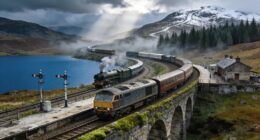
The Trans-Siberian Railway absolutely dominates this competition, stretching 9,289 kilometers from Moscow to Vladivostok—more than double the length of either competitor. The Canadian clocks in at 4,466 kilometers between Toronto and Vancouver, while Australia’s Indian Pacific covers 4,352 kilometers coast-to-coast. Journey times range from 65 hours on the Indian Pacific to a grueling 144-150 hours on the Trans-Siberian. Each route offers distinct engineering marvels, from Australia’s 478-kilometer straight track to Russia’s 4,200 bridges crossing eight time zones.
The Trans-Siberian Railway Route: 9,289 Kilometers Of Railway Infrastructure Connecting Moscow To Vladivostok

The Trans-Siberian Railway doesn’t mess around. This beast spans 9,289 kilometers from Moscow to Vladivostok, crossing eight time zones and cutting straight through Siberia like it owns the place.
Built between 1891 and 1916—a 25-year slog through some of the world’s most unforgiving terrain—the railway infrastructure includes over 4,200 bridges and 21 tunnels. Apparently permafrost and mountains weren’t challenging enough. Construction was divided into seven sections, with 62,000 workers building simultaneously to speed up the project.
The railway network systems handle both passenger train operations and critical freight traffic. It’s basically Russia’s economic lifeline, though that said, its strategic importance has only grown over the decades. Train travel offers the same convenience and cost-effectiveness that makes rail networks popular choices for long-distance journeys worldwide.
Long-distance train services take seven to eight days to complete the journey, which is either an epic adventure or a test of human endurance, depending on your perspective. Second-class tickets can be purchased for budget-conscious travelers, offering shared compartments that make the multi-day journey more accessible.
It’s the third-longest single continuous route globally. On top of that, it’s still expanding, suggesting Russia isn’t done pushing eastward just yet.
Why The Indian Pacific Train Railway Network Systems Traverse Australia Coast-To-Coast With A 478-Kilometer Straight Track

Russia’s rail monster may hold the length crown, but Australia’s Indian Pacific owns a different bragging right: the world’s longest straight railway track. Across the Nullarbor Plain, this transcontinental route doesn’t curve once for 478 kilometers—not a single bend.
The Indian Pacific slices through barren landscape at 115 km/h, turning what might be called railway operations efficiency into something of an art form.
At 115 km/h across the Nullarbor, operational efficiency becomes an unlikely art form on Australia’s flattest rail corridor.
When it opened in 1970, it finally linked Australia coast-to-coast without gauge changes, solving a logistics headache that had plagued the country for decades. That straight segment does more than look impressive on a map.
It cuts fuel costs, speeds up cross-country rail travel, and—let’s be honest—makes the rail tourism industry salivate over the novelty factor.
Even so, scenic rail journeys don’t get much stranger than this. Hours of uninterrupted flatness might sound monotonous, and perhaps it is for some travelers. While the Indian Pacific crosses vast continental distances, European travelers can experience the efficiency of high-speed trains like the Eurostar connecting Brussels to Amsterdam in under two hours.
On top of that, what counts as “scenic” is clearly in the eye of the beholder when you’re staring at endless desert scrub. The journey’s duration has improved considerably since inception, dropping from 75 hours in 1970 to just 65 hours by 2010 thanks to operational refinements. The route connects three capital cities—Perth, Adelaide, and Sydney—spanning a total distance of 4,352 kilometers.
The Canadian Train Long-Distance Train Services: Covering 4,466 Kilometers Between Toronto And Vancouver

The Canadian covers 4,466 kilometers between Toronto and Vancouver, and distance-wise, it doesn’t hold back.
You’re looking at four days and four nights on the rails—86 hours when things run on schedule, though that’s not exactly guaranteed. VIA Rail operates passenger services twice a week, but here’s where it gets interesting: freight trains claim priority on tracks the passenger service doesn’t even own.
That said, the railway experience itself delivers—Prestige Class suites in luxury sleeper cars, panoramic dome cars that showcase the Rockies in ways few other trains can match. The journey passes through key stops including Winnipeg, Edmonton, and Jasper, mixing urban exploration with stunning natural landscapes.
It appears to rank among the world’s premier scenic rail corridors, taking passengers through prairies, forests, and mountain passes. The route includes extended stops in major destinations like Jasper and Banff National Parks, allowing passengers to explore these picturesque locations along the way.
As far as overnight rail journeys go, they don’t get much more iconic than this. Travelers should avoid booking onward travel the same day and instead plan for a 24-hour buffer to accommodate potential delays.
How Transcontinental Railway Journeys Navigate Time Zone Crossings Across Eight Russian Time Zones

Managing eight Russian time zones across 9,289 kilometers sounds like a logistical nightmare.
Coordinating schedules across eleven time zones and nearly 10,000 kilometers would break most transportation systems before they even started.
And honestly, it would be—except the Trans-Siberian Railway essentially cheats the system. Russian Railways runs everything on Moscow Time. Period. Every clock, every timetable, every single departure across the entire trans-siberian railway route operates on MSK. Your train leaves at 14:00 Moscow Time whether you’re stepping aboard in Vladivostok or somewhere in Krasnoyarsk, halfway across the continent.
The operational scope appears to stay synchronized right up until you hit the trans-mongolian route and actually cross into Mongolia or China.
That’s when international sections finally switch to local time—complete with track gauge standards changes at the border, which is a whole other hassle. The route crosses 16 large rivers, including the Volga, Ob, Yenisei, and Amur, adding to the engineering complexity of maintaining consistent schedules. Climate conditions vary dramatically as well, shifting from mild continental in Central Russia to Musson continental in the Russian Far East. While the Trans-Siberian operates on a unified time system, Amtrak’s network manages time zones differently across its extensive routes covering 46 states. On the one hand, it’s simple. On the other, it’s brutal. But you have to admit, it’s effective.
Long-Distance Train Services Deliver Railway Passenger Experience Through Multi-Day Adventures Ranging From 65 To 144 Hours

Three trains tend to dominate conversations about transcontinental rail travel, and the time commitments alone explain why. The Trans-Siberian Railway demands somewhere between 144 and 150 hours of your life—essentially a full week spent watching Russia unfold outside your window.
The Canadian takes 96 hours to cross boreal forests and wind through the Rockies.
Australia’s Indian Pacific wraps things up in what feels like a comparatively brisk 65 hours across the Nullarbor Plain.
These epic journeys represent railway construction history at its finest, though modern luxury train operators have certainly transformed the experience beyond what early passengers would recognize. The Trans-Siberian Railway alone took 25 years to construct, with over 90,000 workers completing the line in 1904.
Today’s transcontinental adventures deliver the full onboard experience—sleeper cabins, dining cars, and panoramic viewing opportunities that earlier travelers could only dream about. These routes now compete with luxury experiences like the Venice Simplon-Orient-Express with its authentic 1920s Art Deco elegance and opulent amenities.
What started as historic railroad lines built for transportation networks have evolved into bucket-list experiences.
That said, beneath all the polish and marketing, you’re still fundamentally riding the same transcontinental routes that shaped how entire continents connected to themselves. The Trans-Siberian journey alone covers eight time zones, a span that illustrates just how vast these continental crossings truly are.
What Makes Cross-Country Rail Travel Support The Rail Tourism Industry Through Luxury Heritage Experiences

While budget backpackers stuff themselves into third-class platzkartny carriages on the Trans-Siberian, luxury rail tourism has exploded into something else entirely.
Heritage train routes like the Canadian Pacific Railway and Indian Pacific now rake in passengers spending 70% more on restaurants and 96% more on retail than regular tourists. That said, these historical routes capitalize on nostalgia hard—gourmet dining, private suites, the whole nine yards.
Rail tourism spending jumped 59% since 2019, crushing regular tourism’s measly 18% growth. The rolling stock equipment itself becomes the attraction, not just transport. Peru’s Belmond trains exemplify this trend with sophisticated dining and panoramic viewing cars traversing some of the world’s highest railway routes through the Andes.
On top of that, luxury experiences appear to mean serious money for local economies. Even so, it’s worth noting that these figures likely skew toward already-wealthy destinations that can support premium pricing.
The model works, but it’s not exactly accessible to every historic rail corridor struggling to stay afloat. Train journeys inherently link multiple destinations together, spreading tourist dollars across regions that might otherwise see minimal visitor traffic. Discerning travelers are increasingly drawn to themed journeys focusing on culinary tours, historical expeditions, or wellness experiences that feature onboard yoga and spa treatments.
The Indian Pacific Railway Network Systems: Track Gauge Standards That Unified Australia’s 4,352-Kilometer Transcontinental Service In 1970

Australia’s railway network was an absolute mess for over a century—and not in any charming way.
Three incompatible gauge standards—narrow, standard, and broad—meant travelers had to switch trains eight times just to get from Brisbane to Perth. Completely absurd.
When standard gauge tracks finally connected the continent in 1970, the Indian Pacific could at last run uninterrupted service, linking Sydney to Perth across 4,352 kilometers. National integration had arrived, though decades later than it should have.
The impact on freight appears to have been dramatic—volume may have increased sixfold within ten years, though the exact factors behind that growth are worth examining.
Even so, there’s no question the transcontinental line eliminated the gauge breaks that had strangled commerce and military logistics since colonial times. In fact, military defense reports from 1889 advocated for uniform gauge efficiency, recognizing how gauge differences compromised strategic mobility.
On top of that, passengers no longer faced the irritation of hauling luggage between platforms in the middle of nowhere. While Australia was solving its gauge nightmare, countries like Germany were already demonstrating how unified rail systems could efficiently connect passengers across vast distances with proper train stations and seamless transfers.
Australia’s rails finally worked the way they should’ve from day one.
That said, it’s hard not to wonder how different the country’s development might have been if the colonies had simply agreed on one gauge standard from the start. The inaugural passenger service departed from Sydney’s Central station on 12 January 1970, marking the culmination of decades of standardization efforts.
Did You Know
How Do Ticket Prices Compare Between Trans-Siberian Railway and Indian Pacific?
The Trans-Siberian crushes the Indian Pacific on price.
Third-class platskart tickets run $120–$270 Moscow to Vladivostok—bare bones, no meals.
The Indian Pacific? Gold Service starts around AU$3,599 (~US$2,350), all-inclusive with gourmet food and excursions.
No budget option exists.
Luxury flips the script: Trans-Siberian’s Golden Eagle hits €14,000+, while Indian Pacific Platinum maxes at AU$10,699.
Different leagues entirely.
What Wildlife Can Passengers See Along the Canadian Train Route?
Passengers spot black bears, grizzly bears, moose, and elk throughout the journey—especially near the Rockies.
Bald eagles and ospreys circle above rivers and valleys.
Bighorn sheep cling to rocky slopes while mountain goats navigate alpine terrain.
Deer graze near rivers. Coyotes prowl open grasslands. Wolves? Rarely seen.
Spring brings peak bird activity.
Summer offers the best wildlife viewing overall, particularly around Banff and Jasper.
Can Travelers Stop at Stations During Transcontinental Railway Journeys?
Yes, but it’s complicated.
The Trans-Siberian and The Canadian allow travelers to hop off at major cities with separate tickets for each leg—flexibility exists but requires planning.
The Indian Pacific? Not so much. It’s mostly point-to-point with scheduled excursions baked into the fare.
Want spontaneous platform exploration? Forget it. Brief stops barely allow time to stretch.
Bottom line: stopovers are possible, just not spontaneous.
Which Train Route Offers the Best Dining Car Experience?
The Indian Pacific takes the crown for dining car excellence. Its Queen Adelaide Restaurant serves up gourmet Australian fare—kangaroo fillet, barramundi, Margaret River cheese—with complimentary drinks and three-course plated meals.
The Canadian runs a close second with award-winning VIA Rail cuisine featuring Alberta beef and Quebec duck.
The Trans-Siberian? Luxury trains like the Golden Eagle compete, but standard services offer more basic Russian grub.
Do These Iconic Train Routes Operate Year-Round in Extreme Weather?
Yes, all three operate year-round despite brutal conditions.
The Trans-Siberian battles -50°C winters with heated carriages and snow barriers.
The Indian Pacific crosses 40°C+ desert heat with standard air conditioning.
The Canadian powers through -30°C Prairie blizzards using snow plows and heated switches.
Each route adapts infrastructure for extreme climates—premium cabins handle temperature swings better than economy classes, naturally.
Parting Shot
These three railways couldn’t be more different in purpose. Russia’s Trans-Siberian hauls freight and passengers alike—a working beast moving thirty percent of national exports while tourists snap photos. Australia and Canada? Pure luxury tourism. Different continents, different priorities. One’s infrastructure, the others are Instagram fodder. Each route conquered impossible geography through sheer engineering will. The Trans-Siberian wins on distance, but all three earned their legendary status through scale alone.