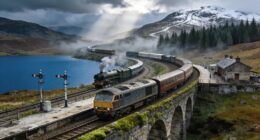
Rail Escapades Around the Globe: Seven legendary train journeys prove that rail travel still surpasses air travel when the experience matters.
The Indian Pacific**, a transcontinental train, traverses 4,352 kilometers from Perth to Sydney across the Nullarbor Plain in 65 hours**. The Rocky Mountaineer**, a daylight-only service, winds through the Canadian Rockies** to Banff with panoramic views. The Trans-Siberian Railway**, the world’s longest train route, covers 9,289 kilometers** and seven time zones in eight days.
These iconic routes offer what airport terminals never will. The Glacier Express climbs to 2,033 meters through Swiss Alpine passes over eight hours. The Ghan crosses 2,979 kilometers of Australian desert from Adelaide to Darwin. The Venice Simplon-Orient-Express operates in restored 1920s carriages with Art Deco interiors. The Caledonian Sleeper departs London at night and arrives in the Scottish Highlands by dawn.
Each journey transforms travel into an experience. Passengers witness landscapes change from coastal cities to vast deserts, from mountain peaks to dense forests. The routes connect continents, cross time zones, and showcase terrain that aviation simply flies over.
Rail travel at this scale demands patience. Yet this slowness creates value. Travelers dine in restaurant cars, sleep in private cabins, and watch scenery unfold through wide windows. The journey becomes the destination.
These trains represent engineering achievement. They conquer extreme environments: the Nullarbor’s aridity, Siberia’s winter cold, the Alps’ steep gradients. Modern amenities blend with historic charm aboard many services.
Interesting Fact: The Indian Pacific crosses the Nullarbor Plain on the world’s longest straight stretch of railway track, measuring 478 kilometers without a single curve.
Escapade #1 — Transcontinental Train Journeys on Indian Pacific Australia Span 4,352km Perth to Sydney

The Indian Pacific isn’t just a train. It’s a 4,352-kilometer iron ribbon stitching together two oceans, a beast of luxury and endurance hauling you across the vast Australian continent in 65 hours of rolling spectacle. Perth to Sydney. Ocean to ocean. Can any journey match this?
This is transcontinental travel; this is transcontinental wonder; this is transcontinental Australia at its most hypnotic. The route crosses the Nullarbor Plain—that famous emptiness where the horizon forgets to curve and the track runs straighter than geometry allows. Adelaide offers a stopover, a breath between vastnesses. Then the rails resume their eastward pull.
Distance becomes the show. You watch it unfold from your sleeper cabin: red dirt yielding to golden grassland, grassland dissolving into ranges, ranges giving way to coastal green. The rhythm varies—sometimes the train clicks fast through settled country, sometimes it slows to a meditative crawl across terrain so ancient that time itself seems negotiable. One of Earth’s great routes, this overnight odyssey makes kilometers feel like chapters in a book you can’t put down. Like the Glacier Express in Switzerland with its UNESCO World Heritage alpine scenery, the Indian Pacific proves that the world’s most memorable rail journeys reward those who surrender to the landscape.
Sixty-five hours sounds long. But here’s the truth: the Indian Pacific earns every minute. It earns them with sunrises over landscapes older than memory, with dining-car meals served as the world scrolls past your window, with the peculiar luxury of surrendering to slowness. At an average speed of 85 km/hr, the train moves with deliberate grace, never rushing the immensity it traverses. The journey sweeps through three states and three time zones, a testament to the sheer scale of the Australian landmass. Two oceans wait at either end—the Indian, the Pacific—and between them lies a continent conquered not by speed but by steel and patience.
Pure spectacle.
Escapade #2 — Scenic Railway Adventures Aboard Rocky Mountaineer Reveal Lake Louise and Banff

The Rocky Mountaineer runs only in daylight.
Why? Because missing this scenery would be criminal.
From Vancouver to the peaks, these trains refuse the cover of darkness—every mile demands your eyes wide open, every turn through the Rockies begs to be witnessed in full sun.
The Rockies demand daylight—every canyon, every peak, every impossible vista refusing to be missed in shadow.
Picture this: observation cars with glass domes, rivers carving through ancient canyons below, and towering peaks that scrape the sky as you glide past in climate-controlled comfort.
Four scenic routes thread through the mountains over two to three days, each one aimed at Lake Louise and Banff—those postcard-perfect jewels of the Canadian Rockies that no photograph ever quite captures the way the human eye does.
GoldLeaf Service handles your luggage; you handle nothing but a camera and maybe a glass of wine.
The train pauses for hotel stops in Kamloops, where you’ll sleep in a real bed, not a cramped sleeper car, then wake refreshed for another day of panoramic wonder rolling past your window.
Off-train excursions let you stretch your legs, breathe that alpine air, touch the wilderness you’ve been watching.
This is mountain railways done right.
Done right.
Done right.
Not rushed, not overlooked in the dark, not crammed into a single exhausting sprint.
Breakfast and lunch are served each travel day, fuel for eyes that never tire of what’s outside. Gourmet meals paired with local wines elevate the journey from scenic tour to culinary experience.
The 2026 schedule runs from April through October, giving you months of seasonal windows to catch these peaks in their full glory.
Pure scenery.
Pure time.
Pure Rocky Mountain magic unfolding at exactly the pace it deserves—slow enough to savor, grand enough to remember forever.
Escapade #3 — Luxury Sleeper Expeditions via Trans-Siberian Railway Cross Seven Time Zones

Moscow to Vladivostok. That’s the route. Spanning 9,289 kilometers of steel and ambition, the Trans-Siberian Railway doesn’t just cross distance—it devours it, swallowing seven time zones in a journey that makes every other train trek look quaint by comparison.
Seven to eight days: that’s how long luxury sleeper expeditions need to complete this continental crossing, their high-speed trains racing across landscapes few travelers will witness from ground level. Inside your sleeper cabin, warmth wraps around you even as Siberian winters outside plunge to -25°C; climate-controlled comfort meets raw wilderness, modern engineering meets ancient tundra, speed meets the slowness of watching an entire continent unfold through double-paned glass.
Can you imagine it? Eight time zones compressed into one week. One week. The numbers alone seduce: nearly ten thousand kilometers of track, temperatures dropping twenty-five degrees below zero, sleeper cars holding steady against the cold. Like overnight sleeper trains traversing multiple continents, this journey transforms transit time into an experience of immersive discovery.
These overnight journeys traverse route landscapes—Ural peaks, Siberian forests, Lake Baikal’s frozen shores—that few cross-country rail treks can match. The railway’s steel spine crosses 16 large rivers, including the mighty Volga, Ob, Yenisei, and Amur, each crossing a testament to the engineering ambition that brought this route to life. Between Irkutsk and Ulan-Ude, the train hugs the southern shore of Lake Baikal, where ancient waters meet modern rails in one of the journey’s most breathtaking passages.
From the Golden Ring cities you slip into birch forests. Through the forests you emerge onto steppe. Beyond the steppe: mountains, ice, the edge of the world. Then Vladivostok rises from the Pacific coast, seven days and seven time zones away from where you began.
This is travel that swallows you whole. Distance, redefined.
Escapade #4 — Mountain Pass Crossings on Glacier Express Climb 2,033m to Oberalp Summit

Climbing 2,033 meters to Oberalp Pass Summit isn’t just about altitude.
It’s about watching Switzerland fold itself into impossible shapes beneath your window.
It’s about eight hours of Alpine engineering madness.
Because the Glacier Express traverses 291 kilometers of terrain that should not—could not—exist.
Consider the numbers: 291 bridges, 91 tunnels, one 15.4-kilometer bore through the Furka.
The Landwasser Viaduct soars 213 feet above nothing but air and faith.
Do you think engineers in 1982 knew they were creating poetry in steel?
Mountain pass crossings transform with the seasons—summer brings grazing cows and alpine flower gardens bursting with color; winter dumps meter-high snow that buries everything except the tracks; spring reveals frozen lakes still clinging to ice while the Rhine Gorge cliffs stand eternal, indifferent to time.
Then the train slows.
Station stopovers let *you* breathe it in.
The panoramic observation tours offer glass on three sides, floor to ceiling.
Year-round service means you choose your Switzerland: green or white, warm or frozen, pastoral or stark.
Journey duration averages eight hours at 42 km/h—slow enough to see, fast enough to cover ground.
Through tunnels you rush; across viaducts you glide with nothing below but gorge and air and the certainty that Swiss precision built this right.
The crescendo builds as elevation climbs, valley after valley, pass after pass, bridge after impossible bridge.
At winter’s peak, the pass reveals a frozen lake locked in ice, while summer transforms the same vista into grazing land for cattle wandering beneath endless sky.
Until Oberalp Summit.
There, 2,033 meters up, the world spreads flat and white and endless—or green and gold, depending when you ride.
Near the summit, Lake Toma’s lighthouse marks where the Rhine begins its journey from source to sea.
This route forms part of the Grand Train Tour of Switzerland, combining panoramic trains with buses and boats to showcase the country’s most spectacular UNESCO World Heritage locations.
Escapade #5 — Desert Rail Odysseys on The Ghan Traverse 2,979km Australian Red Centre

Swiss trains climb mountains. European rails chase coastlines. The Ghan does something harder: it crosses 2,979 kilometers of Australian nothingness.
This is desert rail odyssey. This is transcontinental train journey. This is four days slicing through outback that killed pioneers—and it ranks among history’s boldest rides.
Can you imagine rolling through endless red dirt for nearly three thousand kilometers, watching the Australian interior unfold in ways camels once ruled and settlers once feared?
The Ghan delivers exactly that: a traverse of the Red Centre where comfort meets desolation, where Platinum Service and Gold Service cabins cocoon you against the vast emptiness beyond your window.
You’ll find dining that beats anything expected from a train crossing such unforgiving terrain; meals arrive with white linens, regional wines, and courses that belong in city restaurants, not rolling stock.
The journey builds slowly—rust-colored earth, spinifex grass, horizons that refuse to break, heat shimmer dancing across salt flats.
Then Adelaide appears. Or Darwin. Or Alice Springs, depending on your direction.
Pure contrast.
Because that’s what The Ghan offers: the impossible pairing of luxury and wilderness, the paradox of fine service delivered through landscape that remains, even now, largely unconquered. While North America’s Rocky Mountaineer showcases dramatic mountain scenery through dome observation windows, The Ghan reveals a different kind of grandeur—the hypnotic emptiness of continental interior.
The nickname itself honors the Afghan cameleers who opened this brutal interior to the world before steel rails arrived.
Where European trains showcase civilization’s triumph over geography, this Australian icon does the opposite—it shows you how small civilization remains, how the Red Centre still dominates, how 2,979 kilometers of track is merely a thread through immensity.
The outback doesn’t yield. It tolerates.
And The Ghan carries you through it in style.
The train stretches an average 774 meters long, a ribbon of steel and comfort snaking through terrain that humbles even modern engineering.
Escapade #6 — Heritage Steam Excursions on Orient Express Revive 1920s Venice-to-Paris Glamour

October 4, 1883. The Express d’Orient steamed out of Paris Gare de l’Est, carrying forty passengers toward Constantinople. Nobody called it heritage. It was simply the fastest way east.
Today? Everything has changed.
The Venice Simplon-Orient-Express runs heritage steam excursions March through November, blending all-inclusive dining with historic railway pilgrimages on restored 1920s carriages that gleam with original marquetry, brass, and Lalique glass.
These aren’t ordinary trains; they are rolling palaces where white-gloved stewards serve champagne in carriages that once carried counts, spies, and debutantes across a continent untouched by highways. Station connections link heritage railways across Europe’s most glamorous route—the same mountains, the same valleys, the same Alpine tunnels that thrilled passengers a century ago.
Can you imagine settling into your compartment as the locomotive’s whistle cuts the air?
You’ll dine on French cuisine in a carriage where every detail sings: the marquetry panels sing, the crystal chandeliers sing, the very wheels on the rails sing a rhythm your great-grandparents knew. The restored carriages showcase authentic Art Deco elegance that transport passengers back to the golden age of rail travel.
March brings you misty mornings through the Dolomites; November offers snow-dusted passes and early darkness that turns the dining car into an amber jewel racing through the night. Each journey follows the original 1920s timetable, each stop a deliberate echo of that first departure 140 years ago. The train has no dedicated motive power, relying instead on state railways or private operators to haul these historic carriages through each country along the route. The sleeping cars themselves were primarily built between 1927 and 1929, featuring wood-paneled designs that defined an era of transcontinental elegance.
Heritage steam excursions demand patience—slower speeds, longer routes, frequent photo stops.
But that’s the point.
This isn’t transport. It’s pilgrimage, glamour, and time travel wrapped in polished wood and steam.
Escapade #7 — Overnight Sleeper Routes on Caledonian Sleeper Deliver Scottish Highlands by Dawn

By 21:15 most Londoners have settled into their couches. They’re scrolling. Debating whether another episode is worth the late night. That’s when the Highland Sleeper pulls out of Euston—while you’re reaching for the remote, this train is already rolling toward Fort William and Inverness, carrying passengers through the darkness in window seats that face wilderness.
Want to book? Reservations open twelve months ahead: generous windows for planning, generous windows for class upgrades, generous windows for securing your berth before the routes fill. Then the pattern breaks—travel passes accepted, too.
The train offers class options; the train offers reclining comfort; the train offers something streaming services never will. Dawn over Scotland.
You board in London’s electric hum, surrender to the rhythm of the rails, let the locomotive carry you north through hours you’d otherwise spend half-awake on the sofa, and wake to a different country entirely—mountains where there were office towers, lochs where there was pavement, air that tastes of heather instead of exhaust. Edinburgh by dawn. Fort William by breakfast. The Highlands delivered while you slept. The train splits at Edinburgh into three separate portions, each heading to its final destination while most of Britain still sleeps. Between stops, you’ll find charging points for devices, luggage space for oversized bags, and WiFi that keeps you connected even as civilization falls away outside. From Fort William, ferry connections allow travelers to continue their journey to the Scottish islands for an extended adventure.
This is travel as time travel: board in one world, step off into another. No jet lag, no airport queues, no three-ounce liquids. Just the oldest magic—close your eyes in the city, open them in the wild.
Frequently Asked Questions
What Accessibility Features Does Indian Pacific Australia Provide for Mobility-Impaired Travelers?
Gold Access Cabins feature 85cm wheelchair-accessible doors, ensuite bathrooms with handrails and shower chairs, onboard push wheelchairs, crew assistance, refrigerated medication storage, and terminal people movers at major stations.
How Many Departures per Week Does Indian Pacific Operate Each Direction?
The Indian Pacific operates one departure per week in each direction, with possible increases to twice-weekly during peak seasons.
Are Solo Traveler Cabins Available on Indian Pacific Australia Trains?
Yes. The Indian Pacific offers Gold Single cabins for solo travelers with no single supplement, shared bathrooms, and all-inclusive dining in communal spaces.
What Is Included in Indian Pacific’s All-Inclusive Fare Structure Pricing?
Private cabin accommodation, gourmet meals in restaurant cars, complimentary Australian wines and beers, off-train excursions at stops, and lounge access with panoramic viewing areas.
Does Indian Pacific Australia Offer Onboard Wi-Fi During the Journey?
No, Wi-Fi is not widely available. Limited connectivity exists only in Outback Exploration Lounges and Platinum Club carriages, subject to mobile network coverage. Most of the journey lacks wireless access due to remote Outback terrain, especially across the Nullarbor Plain.
Parting Shot
These seven rail journeys prove trains aren’t dead—they’re thriving as luxury experiences. From Australia’s continent-crossing routes to Europe’s mountain passes, these services transformed basic transportation into destination travel. Sure, flying gets you there faster. But nobody writes home about airport terminals. Meanwhile, passengers on these trains witness remote landscapes, heritage sites, and regional cultures most tourists never access. The price tags reflect it. These aren’t budget backpacker adventures. They’re all-inclusive expeditions where the journey legitimately matters more than arrival.