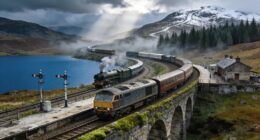
The Orient Express became legendary by turning brutal multi-day rail travel into a mobile palace on wheels. Launched in 1883 by Georges Nagelmackers’ Compagnie Internationale Des Wagons Lits, it featured wood-paneled sleeping compartments that converted from sitting rooms to bedrooms, ten-course gourmet meals in dedicated dining cars with Lalique glasswork, and Art Deco marquetry throughout. While regular passengers endured hard benches and cold sandwiches, this train connected seven countries across 1,700 miles with hotel-level luxury reserved exclusively for aristocrats and royalty. The full story behind Europe’s most opulent railroad reveals even more extravagant details.
Luxury Sleeper Services With Sleeping Car Compartments Transformed The Orient Express Into Europe’s First Traveling Palace Hotel
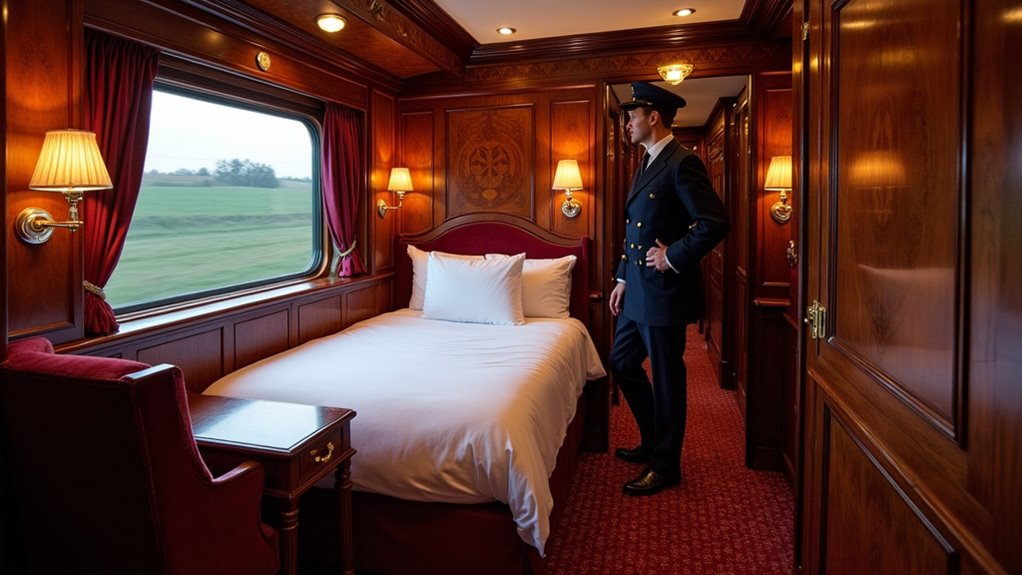
The overnight sleeper compartment sounds obvious now, but back in 1883 it was genuinely groundbreaking.
Luxury sleeper services transformed how people thought about passenger rail by offering wood-paneled rooms that converted from sitting areas into bedrooms.
Convertible wood-paneled compartments revolutionized rail travel by merging daytime comfort with nighttime functionality in a single ingenious space.
These sleeping car compartments featured upper and lower berths, washbasins, and dedicated attendants—essentially a hotel on wheels. Premium dining cars rounded out the experience.
The later LX-type cars from 1929 likely represented peak opulence in historic rolling stock.
We’re talking Art Deco marquetry and en-suite bathrooms in the Grand Suites.
That said, not everyone traveled in such splendor—travel class categories clearly separated sleepers from the cheaper couchettes. Compartments could be shared among passengers, with solo occupancy available at a premium.
The Orient Express attracted celebrities and literary figures, becoming integral to popular culture through numerous books and films.
Modern luxury trains like Peru’s Belmond services continue this tradition with panoramic views and sophisticated dining across breathtaking mountain landscapes.
Even so, railway heritage preservation keeps these magnificent carriages alive today, maintaining the onboard service standards that once defined European luxury.
Why Compagnie Internationale Des Wagons Lits Created The Historic Railway Journey That Redefined European Geography In 1883

Georges Nagelmackers stepped off that steamship from America in 1868 with more than souvenirs tucked in his luggage—he carried an obsession with Pullman sleeping cars that would, quite literally, reshape the European continent.
The Belgian engineer founded Compagnie Internationale des Wagons Lits in 1876, hell-bent on linking Paris to Constantinople. His Orient Express launched on October 4, 1883. That single train appears to have forced feuding nations to do something almost unthinkable: cooperate on international rail routes.
Suddenly, aristocrats could glide across borders without the usual misery. Short trips gave way to epic journeys. The sleeping cars inspired by American models transformed travel from an ordeal into a sanctuary of comfort and safety.
The company expanded beyond rails, establishing Les Grands Hôtels des Wagons-Lits to ensure travelers enjoyed the same luxury standards at their destinations as they did aboard the trains.
On top of that, the historic railway sparked continental express networks, standardized how entire countries approached transportation infrastructure development, and essentially birthed the rail tourism industry as we know it. The Orient Express set the gold standard for what we now recognize as luxury train experiences, establishing principles that continue to define premium rail travel worldwide.
Geography became negotiable—or at least, the barriers that geography had always imposed started to feel that way.
Venice Simplon Orient Express: The Golden Age Train That Preserves The King Of Trains Through 1920s Art Deco Masterpieces

James B. Sherwood launched the Venice Simplon Orient Express in 1982, plucking original 1920s and 1930s carriages from what seemed like certain oblivion.
The restoration preserved authentic Art Deco design—marquetry panels, Lalique glass, that distinctive deep blue livery. First class compartments still maintain period-authentic interiors, complete with brass fittings and hand-crafted lamps that appear untouched by time.
The dining car serves multi-course gourmet cuisine while staff enforce evening wear—a detail that might strike some as theatrical, though it’s entirely faithful to the original experience.
Formal attire remains mandatory in the dining car, blurring the line between historical authenticity and carefully staged performance.
On top of that, the bar car features a baby grand piano. Short trips punctuated by long stretches of luxury.
This isn’t mere nostalgia, though. It’s closer to a living monument to golden age trains, functioning exactly as it once did.
The cultural legacy remains intact through 24-hour journeys across Europe, preserving the culinary and on-board experience aristocrats once enjoyed. The train echoes routes that once drew royalty and upper classes as frequent passengers during the 1930s, when the Orient Express acquired its reputation for unparalleled comfort. Guests board in Venice via water taxi arrivals, maintaining the personal touch that defined luxury travel from the era. While the Orient Express represents European luxury rail travel, Canada offers its own spectacular train experiences, including VIA Rail’s routes that traverse thousands of miles through forests, prairies, and the Rocky Mountains. Among the most scenic train journeys worldwide, the Glacier Express in Switzerland offers breathtaking views of the Swiss Alps, making it a must-do for any travel enthusiast. Similarly, the Kanazawa to Kyoto route in Japan takes passengers through stunning landscapes dotted with historic temples and picturesque villages. Each journey promises not just a means of transport, but an unforgettable adventure through some of the world’s most beautiful terrains.
That said, whether today’s passengers are reliving history or simply paying for an elaborate performance of it is likely a matter of perspective.
First Class Compartments With Travel Class Categories Established The Orient Express As The World’s Most Luxurious Rail Experience

How do you create a monopoly on luxury? Simple: refuse to offer anything less. The Orient Express literally didn’t provide second or third class travel—first class compartments only. It was an audacious move, and passenger railway companies watched as it worked brilliantly.
The compartment design told the whole story. Wood paneling, intricate marquetry, daytime lounges that converted for sleeping. On top of that, the Orient Express introduced restaurant cars—revolutionary for overnight trains at the time. These service innovations brought genuine prestige.
Social exclusivity followed naturally. Aristocrats and diplomats flocked to the service, drawn by both the amenities and the carefully cultivated elite positioning. The dining experiences reinforced all of this, turning meals into events that cemented the train’s reputation. Modern luxury trains like Rovos Rail continue this tradition of combining elegant dining with carefully curated exclusivity. Georges Nagelmackers drew inspiration from American sleeping cars he encountered during his time in the United States before launching his vision in Europe.
That said, calling travel classes “irrelevant” might be oversimplifying things. They became irrelevant because the Orient Express deliberately made itself the only option for a specific clientele—anyone seeking luxury rail travel simply had nowhere else to turn.
The lasting legacy in railway luxury? Exclusivity sells. Whether that’s entirely admirable or simply effective marketing is another question, but the strategy undeniably worked. By the 1930s, the service had expanded to five European routes, demonstrating how effective this luxury-first approach had become.
What Made Premium Dining Cars With Dining Car Facilities Revolutionize The Orient Express Into A Gourmet Restaurant Spanning Seven Countries

Before the Orient Express came along, train travel meant cold sandwiches and whatever you could snag during brief station stops. That all changed with the introduction of dedicated dining cars.
Suddenly, passengers found themselves sitting down to ten-course gourmet meals—we’re talking oysters, caviar, lobster, the works—transforming what had been a simple rail journey into something closer to a gastronomic adventure spanning international borders.
The interiors were sumptuous, to put it mildly. Lalique glasswork and intricate marquetry panels made these dining cars feel like they could rival Europe’s finest restaurants.
Even so, it wasn’t just about luxury for luxury’s sake. The culinary variety appears to have been genuinely thoughtful, adapting across the seven countries the route traversed—Hungarian goulash here, Viennese pastries there, Turkish desserts further along the line.
Professional chefs somehow managed to work their magic in surprisingly compact kitchens while diners sat surrounded by Baccarat crystal and crisp white damask linens. The menus themselves were printed in French and German, reflecting the cosmopolitan nature of the clientele and the railway’s international operations.
This architectural innovation—if you can call a train car architecture—transformed what might have been ordinary vintage observation cars into moving palaces. The reimagined Dining Car features a mirrored ceiling that amplifies the sense of grandeur and space. Today’s Venice Simplon-Orient-Express continues this legacy with its authentic 1920s Art Deco elegance that harks back to the original golden age of luxury rail travel.
On top of that, it shifted the entire psychology of rail travel. The train itself became the destination, not just the means of getting somewhere.
The Continental Express Networks Through International Rail Routes That Made The Orient Express The Longest Luxury Train Connecting East And West

Most luxury train services stuck to a single country—maybe two if passengers were lucky.
The Orient Express? It laughed at borders, connecting seven countries across what appears to have been 1,700 miles of continental railway networks. France, Germany, Austria, Slovakia, Hungary, Romania, Bulgaria—straight through to Turkey.
Cross border rail agreements made it possible, though timetable coordination systems were nightmares. Customs stops at every frontier didn’t help.
That said, the 1906 Simplon Tunnel shortcut through the Alps was a game-changer, avoiding those scenic mountain railways that, beautiful as they were, slowed everything down considerably.
Heritage steam locomotives pulled these transcontinental train routes between railway station terminals. The journey began at Paris Gare de l’Est, which opened in 1849 and was officially inaugurated in 1850 by Louis-Napoléon Bonaparte.
The Compagnie Internationale des Wagons-Lits operated the service from its inaugural run on 5 June 1883 until 2009, establishing the standard for international luxury rail travel. Passengers could enjoy scenic views from their compartments while crossing diverse landscapes across the continent.
On top of that, they rewrote what luxury train services could actually accomplish across Europe’s fractured map—no small feat given the political complexities of the era.
International Rail Connections Via Simplon Tunnel Route Established The Venice Gateway As The Most Celebrated Iteration In History

The 1906 completion of the Simplon Tunnel changed everything. This 12.3-mile engineering marvel beneath the Alps created direct international rail connections from Paris through Venice to Istanbul—a genuinely transformative route. The hidden secrets of the Simplon Tunnel reveal not just its engineering triumph, but also the strategic foresight that made it a vital artery for trade and travel. As travelers ventured through the tunnel, they were enveloped by the rich history and innovation that shaped Europe’s transit landscape. Today, it stands as a testament to human ingenuity and the unyielding spirit of exploration.
The Simplon Tunnel’s completion revolutionized European rail travel, establishing Venice as the premier gateway between Paris and Istanbul.
When the Simplon Orient Express launched in 1919, it made the Venice gateway the fastest and arguably most scenic route east. The old Vienna line simply couldn’t compete in terms of prestige.
Luxury rail travel appears to have hit peak glamour during the 1920s and 30s. Restored rolling stock featured onboard amenities that were unmatched for the era, and Venice became synonymous with a certain kind of sophistication. The train attracted the social elite of the time, who sought the unique travel experiences that only this iconic service could provide.
That said, the impact went beyond mere comfort. These streamline express services cemented a cultural legacy that still defines the Orient Express mystique today, even if the reality of early twentieth-century travel was likely more complex than the romance suggests. Modern high-speed rail services like the ICE and TGV demonstrate how international train travel continues to evolve with journey times of just 3 to 4 hours between major European cities. The service maintained its legendary status until closed frontiers and the outbreak of the Second World War brought operations to a halt.
Did You Know
How Much Does a Ticket on the Venice Simplon Orient Express Cost Today?
Tickets on the Venice Simplon-Orient-Express start around £3,530 per person for a standard historic cabin on one-night routes in 2025.
That’s roughly $4,500 or €4,120.
Grand Suites? They’ll set you back upwards of $15,430 per night.
The flagship Paris to Istanbul journey costs from £17,500 per person.
All fares include meals, champagne, and white-glove service—but they’re priced per person, not per cabin.
Can You Still Ride the Original Orient Express Route From Paris to Istanbul?
Not really.
The original direct Paris–Istanbul route died in 2009 after nearly a century.
Sure, the Venice Simplon-Orient-Express runs a luxury version twice yearly—end of May and September—but it’s a five-to-six-day nostalgia trip, not regular service. Costs range from £3,530 to a bonkers £61,200 for Grand Suites.
Alternatively, determined travelers can cobble together the route using multiple local trains over roughly fifteen days.
Different vibe entirely.
What Happened to the Original Orient Express Carriages From the 1880S?
Most original 1880s carriages? Gone. Scrapped, repurposed, lost to time.
No complete train survived intact. James Sherwood tracked down two carriages at auction in 1977, then hunted 25 more over six years.
These became the Venice Simplon-Orient-Express—though mostly 1920s-1930s stock, not 1880s originals.
Some have wild histories: carriage 3544 served as a World War II brothel.
A few sit in museums. The rest vanished.
How Does the Orient Express Compare to the Trans-Siberian Railway?
The Orient Express is all about European elegance—art deco glamour, gourmet dining, and a 2,740 km Paris-to-Istanbul route steeped in literary mystique.
The Trans-Siberian Railway? That’s a 9,289 km beast crossing eight time zones, showcasing raw Siberian wilderness and Lake Baikal’s vastness.
Orient Express caters to luxury romantics chasing 1920s nostalgia.
Trans-Siberian attracts adventure seekers wanting cultural immersion across Russia’s sprawling landscapes.
Different vibes entirely.
What Famous People Traveled on the Orient Express During Its Golden Age?
Royalty like Bulgarian King Ferdinand I and Russian Tsar Nicholas II rode the rails, along with spies including Mata Hari and Lord Baden-Powell.
Writers Agatha Christie and Leo Tolstoy took inspiration aboard.
French President Paul Deschanel literally fell off the train in his pajamas.
Marlene Dietrich, Josephine Baker, and Lawrence of Arabia all traveled the route.
Basically, if you were famous, powerful, or scandalous between 1883 and the 1960s, you probably rode the Orient Express.
Parting Shot
The Orient Express didn’t just move people across Europe—it moved the entire concept of what train travel could be. Seven countries, 1,700 miles, Art Deco everything. It was luxury you could measure in Lalique glass and sleeping compartments, but also in something harder to pin down: pure mystique. Christie wrote about it, Hollywood filmed it, and everyone else just tried copying it. Still the standard.