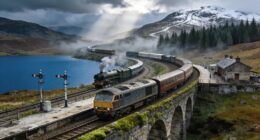
Japan’s Shinkansen kicked off the high-speed rail transformation in 1964, hitting 256 km/h and proving trains could actually compete with planes. France’s TGV followed in 1981, slashing Paris-Lyon travel to two hours and killing off half the competing flights within a decade. The Trans-Siberian Railway took a different approach—9,289 kilometers of slow, scenic transportation across eight time zones. China’s modern Fuxing trains now reach 350 km/h, while the Orient Express defined luxury rail since 1883. These networks reveal how rails reshaped global travel.
Railway #1 Japan’s Shinkansen Pioneered 200 mph Bullet Train Speed Records

The Shinkansen didn’t just materialize overnight. Planning took five years before the 1964 launch—which came just nine days before Tokyo hosted the Olympics. Chief engineer Hideo Shima shepherded the Japanese bullet train network from initial concept through to reality.
That first 515-kilometer Tokyo-Osaka route transformed what high-speed rail could be, offering unprecedented passenger comfort with air conditioning, advanced suspension systems, the works. The line achieved 100 million passengers within just three years of operation.
From there, bullet train technology evolved rapidly. Speed records kept tumbling: 256 km/h in 1963, then 319 km/h by 1979, jumping to 443 km/h in 1996.
Today’s E5 Series reaches 320 km/h in regular commercial service. The network now spans major cities across Honshu and Kyushu, with popular routes like Tokyo to Kyoto taking about 2 hours 30 minutes. It’s fair to say transportation history shifted in a fundamental way.
Even so, what really stands out is the safety record. Zero passenger fatalities across sixty years suggests that railway engineering excellence may matter more than operational efficiency bragging rights—though that’s probably debatable depending on what metrics you prioritize. The original bullet trains maintained remarkable punctuality, with average arrivals within 24 seconds of scheduled times.
Railway #2 France’s TGV Cut Paris-Lyon Travel Time to Under Two Hours

France’s TGV launched Paris–Lyon high-speed service on September 27, 1981, and basically rewrote the rulebook on intercity travel.
Journey times plummeted from over four hours to just two hours across 427 kilometers—an engineering feat that appears to have devastated air competition. Flights dropped 50% within a decade. That said, the numbers tell an even more compelling story: first-year ridership hit 10 million passengers, and today nearly 300 daily trains carry 50 million people annually.
Journey times collapsed to two hours—and within ten years, air travel fell 50% as ridership soared to unprecedented levels.
The TGV proved that railway technology could dominate for distances under 800 km, at least in the European context. It sparked high-speed rail expansion across the continent and cemented the train’s cultural significance in a way that’s hard to overstate. The line’s success freed capacity on legacy rail networks, inspiring similar high-speed projects throughout Spain and Italy.
The network expanded to include TGV Atlantique linking Paris with Brittany and western France, TGV Méditerranée connecting to Southeast France, and TGV Nord-Europe traveling north to Dunkerque and Calais. The TGV’s success also paved the way for international connections, with the Eurostar service utilizing similar high-speed technology to link London St Pancras International to Paris Gare du Nord through the Channel Tunnel. Even so, the real achievement may be simpler than all that: the TGV showed that people would choose trains over planes when the experience was fast enough and comfortable enough. Railway history changed forever. Transportation networks would never look the same.
Railway #3 Trans-Siberian Railway Spans 9,289 Kilometers Across Eight Time Zones

When Russia decided to connect Moscow to its Pacific coast in 1891, Emperor Alexander III wasn’t messing around. He demanded total state control, likely to keep foreign powers from gaining any advantage over the project.
The Trans-Siberian Railway now stretches 9,289 kilometers across eight time zones—a staggering distance that handles 30% of Russia’s exports. It’s both a logistics artery and military transport backbone, though those two roles don’t always sit comfortably together.
The travel experience? Six to eight days through panoramic views that shift from European Russia to Siberian steppe, then on to Lake Baikal’s shores.
Railway tourism thrives on this heritage railway, and it’s easy to see why. Taiga forests and vast landscapes roll past your window for days on end, making it a bucket-list journey for rail enthusiasts worldwide. The route crosses 16 large rivers, including the Volga, Ob, Yenisei, and Amur, showcasing the engineering ambition required to span such diverse terrain.
Construction began with an inaugural ceremony on 19 May 1891, led by Tsarevich Nicholas in Vladivostok.
While the Trans-Siberian offers an epic cross-continental adventure, Canada’s VIA Rail provides equally spectacular journeys connecting Toronto to Vancouver through the Rocky Mountains and pristine forests.
That said, the sheer length of the trip isn’t for everyone—it takes a particular kind of traveler to appreciate what amounts to nearly a week on rails.
Railway #4 China’s Fuxing Reaches 350 km/h on Beijing-Shanghai High-Speed Route

While Russia’s Trans-Siberian stretched endurance to its limits with week-long journeys, China decided speed mattered more than scenery.
The Fuxing bullet train slashes the Beijing-Shanghai route in just over four hours, cruising at 350 km/h—what appears to be the fastest commercial operation globally. Maximum test speeds hit 400 km/h. Short trip. Big numbers.
This high-speed railway handles over 100 million passengers annually, proving railway innovation isn’t dead—or at least suggesting it’s alive and well in China.
The trains offer passenger comfort with WiFi and USB ports, because apparently that matters at 350 km/h. Then again, maybe it does when you’re traveling for four hours. Power consumption runs 10% lower per 100 km compared to the previous Hexie 380 model.
With 3.1 billion operational mileage kilometers logged, Fuxing’s global impact extends to exports across multiple continents.
Development required four years of planning, design, and construction before the trains debued in 2016, engineered specifically to adapt to China’s varying climates and landscapes. By comparison, Japan’s Nozomi Shinkansen connects Tokyo and Osaka in approximately 2 hours and 30 minutes, demonstrating how different high-speed networks optimize for their specific routes.
That said, whether speed alone defines success in rail travel remains up for debate—but China’s clearly betting on it.
Railway #5 Orient Express Defines Luxury Rail Travel Standards Since 1883

The Orient Express pulled out of Paris on October 4, 1883, with 40 passengers aboard and—reportedly—enough crystal chandeliers to make anyone traveling coach today a bit envious.
Georges Nagelmackers got the idea after riding American Pullman cars, then essentially went all-in on the luxury angle. We’re talking piano lounges, oysters, game dishes on fine china—the works.
Nagelmackers didn’t just copy Pullman—he cranked the luxury dial to eleven with pianos, oysters, and zero apologies.
This wasn’t just about getting from point A to point B faster. It was luxury on wheels, plain and simple.
The route ran from Paris to Constantinople, reshaping how Europeans thought about travel and what railway heritage could mean. Direct travel to Constantinople didn’t actually start until 1889, requiring passengers to take a ship across the Black Sea before then.
Kings rode it. So did spies and diplomats. Agatha Christie made it famous in fiction, which probably didn’t hurt its mystique.
The train hit its stride in the 1930s, when three service lines—Orient Express, Simplon Orient Express, and Arlberg Orient Express—were all running simultaneously.
The original service shut down in 1977, though train tourism keeps trying to bring back some version of it. Today’s Venice Simplon-Orient-Express continues this tradition with its authentic 1920s Art Deco elegance and opulent amenities. Cultural heritage seems to demand these resurrections, even if they’re never quite the same as the original.
Frequently Asked Questions
How Does Shinkansen’s Punctuality Compare to France’s TGV Operational Reliability?
Shinkansen demonstrates significantly superior punctuality, averaging delays under 1.6 minutes with strict precision standards, while TGV’s operational reliability ranges 80-90% punctuality within 5-15 minutes, reflecting more generous delay tolerance and shared infrastructure challenges.
What Are Ticket Price Differences Between Shinkansen and China’s Fuxing Trains?
Shinkansen tickets cost 2–3 times more per kilometer than Fuxing trains. Tokyo–Osaka costs approximately ¥14,000–15,000, while Beijing–Shanghai’s longer route costs only ¥550 second-class, reflecting different pricing structures and government subsidies. Shinkansen efficiency for Japanese travel is unmatched, offering a seamless experience through punctuality and comfort. This high level of service justifies the premium pricing, as travelers benefit from reduced travel times and enhanced amenities. In contrast, Fuxing trains prioritize affordability, catering to a different segment of the market that values cost-efficiency over speed and luxury.
Can Shinkansen Technology Operate in Extreme Cold Like Trans-Siberian Conditions?
Shinkansen technology can operate in cold conditions down to -20°C, but Trans-Siberian extremes below -40°C would require significant modifications to sealing, heating, insulation, and control systems beyond current cold-weather variants like the H5 series.
How Do Luxury Amenities Compare Between Shinkansen Green Car and Orient Express?
Shinkansen Green Car prioritizes modern efficiency with power outlets, WiFi, and 2×2 seating configuration, while Orient Express emphasizes vintage luxury through ornate dining cars, period décor, and full-service hospitality, reflecting fundamentally different transportation philosophies.
Which High-Speed Railway System Has the Lowest Environmental Carbon Footprint?
The Japanese Shinkansen demonstrates the lowest carbon footprint among high-speed rail systems, emitting approximately 15-20 grams of CO₂ per passenger-kilometer. High traffic volumes, large train capacity, and clean electricity sources contribute to this industry-leading environmental efficiency.
Parting Shot
These five railways changed everything—though in wildly different ways. The Shinkansen kicked it off in 1964, proving high-speed rail could actually work at scale. France and China followed with their own speed demons, each pushing the limits further. Russia, on the other hand, went the opposite direction: forget speed, just go really, really far. And the Orient Express? It’s still coasting on that luxury reputation from 140 years ago, even if the reality doesn’t always match the mystique.
That said, together they’ve moved billions of passengers. They set the benchmarks everyone else chases, for better or worse. Some of those standards are about engineering and efficiency. Others might be more about image and ambition. Either way, that’s the legacy—messy, uneven, but undeniably influential.