
The Rhine Valley Route: A Journey Through Medieval Castles, Vineyard Landscapes, Riverside Villages
The Upper Middle Rhine Valley, a UNESCO heritage corridor, connects Koblenz to Bingen across 65 kilometers. This rail journey offers passengers views of fortress ruins, terraced vineyards, and river reflections. The route ranks among Europe’s most popular train experiences for couples.
Three key destinations define this romantic railway:
- Bacharach serves travelers seeking medieval architecture and wine cellars
- St. Goar positions visitors opposite the Lorelei rock formation
- Bingen marks the southern terminus where the Rhine meets the Nahe River
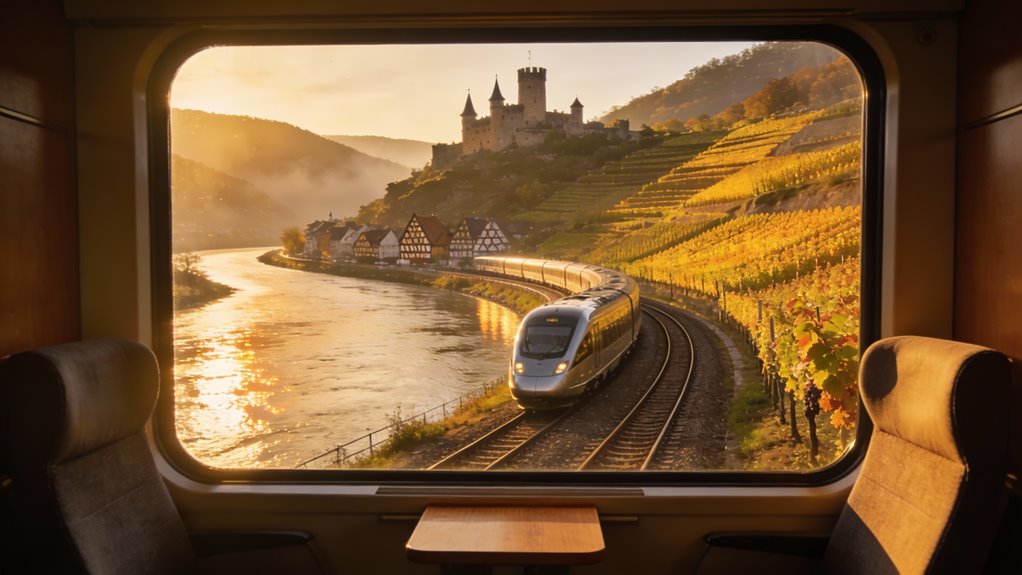
The valley holds forty castles built between the 11th and 14th centuries. Burg Katz and Burg Maus stand on opposing riverbanks, their towers watching over narrow water passages. Panoramic train cars provide unobstructed sightlines. Golden hour illuminates the terraced Riesling vineyards that climb steep hillsides.
River cruises complement rail travel. Passengers disembark at stone-paved villages where wine taverns offer local tastings. The water reflects castle silhouettes during calm twilight periods, creating doubled images. This mirroring effect occurs most reliably in early morning and late evening hours.
The route operates year-round on standard railway schedules. Spring brings vineyard blooms while autumn delivers harvest colors across the slopes. Winter transforms the valley with occasional snow cover on fortress walls.
Interesting Fact: The Rhine Valley produces over 60% of Germany’s Riesling wine, with vines planted on slopes reaching 60-degree angles—some of the steepest vineyard terrain in Europe.
Upper Middle Rhine Valley: Watch 40+ Castles Glow Orange Across the Twilight Panorama

Forty castles. Forty fortresses. Forty stone sentinels crowning the cliffs between Koblenz and Bingen—one every mile and a half along the Upper Middle Rhine Valley. Nowhere else does a river pack medieval stonework this dense.
Why do these fortifications mesmerize you? The gorges lift them high, stacking silhouettes against twilight in layers that shift as you drift downstream. Specialized rail apps can help you time your journey perfectly to catch the castles bathed in golden light.
During golden hour, when vineyard terraces glow amber and the river bends into shadow, the valley transforms: the “Rhein in Flammen” events ignite the cliffs in Bengal light—red, orange, impossible. Marksburg Castle blazes against the dusk; ancient walls drink the flame; ridges pulse with color until the entire 65-kilometer stretch becomes a storybook come alive. Then darkness.
You won’t find this concentration of castles anywhere else on Earth. Steep slopes positioned each fortress for maximum dominance, and centuries later those same heights position *you* for maximum wonder.
The ruins tell stories. The intact strongholds guard memories. The twilight pulls them all together into a single panoramic sweep that catches your breath and holds it. For two centuries, this very panorama has shaped the work of poets, painters and composers who journeyed here seeking inspiration in the valley’s dramatic beauty. The gorge itself generates a distinct microclimate that shelters species found nowhere else in the surrounding region.
What Creates Golden Hour Magic? Vineyard Terraces Bathed in Amber Light on UNESCO Hillsides

Yes, the castles catch fire at dusk. But the real blaze? It rolls across the hillsides beneath them.
Low-angle sunlight wraps each vineyard terrace in amber, turning stone walls and autumn vines copper-gold.
Low-angle sunlight wraps each vineyard terrace in amber, turning stone walls and autumn vines copper-gold.
The light transforms.
The hillsides transform.
The very air transforms—and when scattered blues vanish, warm tones rule.
During golden hour, river bends reveal these UNESCO heritage zones precisely when you need them most: that fleeting window when geometry conspires with atmosphere.
Consider the physics—low solar angle (0–6°) wraps terraces in side-light, enriching every slope with deep amber glow; Rayleigh scattering filters harsh blues, leaving only the warm spectrum for sunset river reflections and slope illumination; terrace geometry creates horizontal bands that catch simultaneous beams, painting luminous stripes across entire hillsides.
Then autumn leaf pigments amplify it all, yellowing foliage turning copper-gold tones into memories you’ll share for years.
What makes this magic?
The horizontal bands catch light together.
Simultaneous.
Each terrace becomes a ribbon of fire, stacked one atop another in glowing layers—vineyard terrace romance written in photons and stone.
You don’t need a castle to witness romance here; you need timing, that brief alignment when the sun skims low and the vines wear their autumn best.
The effect dominates: harsh daylight softens into honey, shadows stretch long and forgiving, river water mirrors the copper sky.
Every element conspires—solar angle, atmospheric scatter, architectural lines, seasonal pigment—to deliver one luminous striped effect that scenic timing alone can orchestrate.
Shared experience memories begin here, in amber light.
The harvest zones glow.
The stone walls glow.
The rivers glow.
This luminous display rivals the UNESCO World Heritage engineering marvels found along Austria’s Semmering Line, where mountain vistas meet historic rail design.
Photographers chase this moment relentlessly, with 296 million stock photos documenting valley sunsets across every season and weather condition.
Pro subscribers can access thousands of these vineyard row images for their own travel journals and romantic keepsakes.
And you stand there, watching UNESCO heritage burn gold without flame.
Hear the Lorelei Rock Legend Where a Maiden’s Enchanting Song Lured Sailors to Their Fate

A slate cliff rises 132 meters above the Rhine at kilometer 555. Two centuries of romance. For two hundred years, this rock has been sold as enchantment—the Lorelei legend claims a maiden combed golden hair while singing sailors to their doom, yet the real hazards were narrow channels and reefs that cared nothing for beauty or song.
The legend endures. The legend sells. The legend frames every photograph snapped from panoramic observation car seating.
But what actually lures you here?
Twilight departure routes between St Goar and Bacharach reveal the answer: couples watch castle silhouettes crown hilltops, medieval villages approach slowly along the water, river moments unfold in that blue hour when stone and current merge.
From those observation cars, you’ll see passages that seem designed for romance—not by the mythical maiden, but by centuries of travelers who needed the Rhine to mean something more than commerce. They needed magic.
So the storytelling tradition gave it to them.
Now the romantic stops deliver precisely what two centuries have promised: golden light on medieval charm, hillside castles framing each bend, the kind of scenery that makes even skeptics reach for their cameras. For those seeking equally dramatic alpine views, Switzerland’s Glacier Express offers panoramic windows through mountain landscapes that rival the Rhine’s romantic appeal.
Short moments. Long memories. The Lorelei works her spell still—though she never existed, though sailors drowned for geology not song, though the narrow channels below hold only navigation markers now.
Pure marketing genius, really.
Yet standing there at twilight, watching the river carry both light and shadow past those ancient stones, does it matter whether the maiden was real? Clemens Brentano shaped the essentials of this legend in his ballad “Zu Bacharach am Rheine”, weaving despair and transformation into the rock’s echo. The hazard was always the same: we see what we want to see, we hear the song we came to hear. Below the cliff, a 16-foot bronze statue installed in 1983 stands on a narrow piece of land jutting into the Rhine, offering tourists their own enduring monument to a fiction that outlasted truth.
Bacharach: Stop for Medieval Charm with Stahleck Castle and Candlelit Wine Tavern Dinners

Trains slow through Bacharach. What do passengers see? Two centuries of Rhine tourism made real: half-timbered houses stacked along narrow streets, medieval walls hugging the riverbank, and Stahleck Castle perched 160 meters above it all—a prop from central casting.
From train windows, Rhine romance crystallizes: half-timbered facades, medieval walls, and castle heights staging two centuries of postcard perfection.
These village stops deliver intimacy. They deliver it through vineyard paths that climb toward castle passages, through timber-beamed Weinstuben where Riesling flows freely, through candlelit evenings when couples descend from their explorations to find riverside tables waiting beneath half-timbered facades that have watched over this same scene for centuries.
They deliver it, and you feel it.
Slow travel rewards patience; here the reward unfolds in layers. First come the cobblestone streets, narrow and winding. Then the medieval walls appear, still intact after all these years.
Finally Stahleck reveals itself above, a fortress commanding the valley with stone authority that makes modern travelers pause and remember what defense once meant.
You climb. The vineyard terraces rise steeply, switchback after switchback carving through Riesling vines that cling to slopes the Romans first planted. This immersive natural landscape ranks among Europe’s most dramatic stretches of scenic rail travel.
Castle passages open onto views—the Rhine curving silver below, villages dotting both banks, barges pushing upstream against the current. The strategic position once controlled Rhine River traffic, giving Stahleck its medieval power during an era of constant regional warfare.
Descent brings different pleasures.
In the Weinstuben, timber beams frame the evening: dark wood overhead, white plaster between, candles throwing shadows across tables where locals and travelers share benches.
The wine comes in traditional glasses. The conversation comes easily.
The hours come and go while Rhine mist settles over the village outside, and somewhere above, Stahleck keeps its ancient watch. The castle sits at the mouth of the Steeg valley, where medieval architects chose their promontory with precision—160 meters of vertical advantage translated to centuries of control.
Experience River Bend Reveals Opening to Burg Katz and Burg Maus Standing Guard Opposite

Northbound from Bacharach, the valley tightens. The Rhine bends. Near Sankt Goar, that bend reveals Burg Katz and Burg Maus standing guard on opposite banks—castles that frame romance, power, and medieval rivalry in a single glance. Do you see why proposal moments happen here? Window seat selection matters: it matters for the view, it matters for the light, it matters because panoramic window coaches frame both fortresses simultaneously. Then twilight routes transform these stones into legend.
Consider the history. Burg Katz rose in 1371, a toll-control stronghold broadcasting Katzenelnbogen power across the river; Burg Maus came earlier—1356 to 1386—built by Trier as a counter-fortress, defiance in stone. Observation seating grants you slow travel’s greatest advantage. Both visible from the train. The high-speed ICE trains race through Germany’s major cities, but Regional Express services along the Rhine allow passengers to absorb these medieval vistas at a pace worthy of their grandeur.
The valley tightens, the river bends, the castles appear. Perfect.
From your seat you’ll watch centuries unfold: Katz the predator, Maus the mouse, locked in an architectural stare that has lasted 650 years. One rhetorical question haunts every passage through this gorge—which architect knew his fortress would become a postcard, a backdrop, a reason to choose the window side? These romantic journeys depend on timing, angle, and awareness. The train slows. You look up. There they stand: gatekeepers of the Middle Rhine, toll collectors turned tourist magnets, reminders that power once meant controlling a river bend and everyone who dared sail through it. Napoleon’s engineers obliterated Burg Katz in 1806, reducing it to ruins before restoration efforts rebuilt what you see today. The Counts of Katzenelnbogen planted the first Riesling grapes here in 1435, making these slopes the birthplace of wine culture that still defines the valley today.
Step Off at Oberwesel or St Goar for Romantic Riesling Tastings Perfectly Designed for Two

Step off at Oberwesel. Step off at St. Goar. Step off for romance bottled in Riesling.
Between these twin Rhine villages, DB Regio scenic services carry couples straight into UNESCO-protected vineyards where slow travel meets steep-slope terroir—and where wine excursions unfold at a pace designed for two.
Historic station architecture greets you first: vaulted ceilings, ironwork, old-world arrivals that feel like stepping into a honeymoon postcard.
Then come the tastings. Weingut Lanius-Knab offers hour-long Riesling sessions for 25 EUR, a price point honeymoon itinerary suggestions highlight again and again; Burghotel Schönburg counters with anniversary celebration packages that include four-wine flights, castle views, and enough candlelight to make any milestone shimmer.
These aren’t just couples excursion options—they’re proposal destination journey points, moments engineered for kneeling and cork-popping and forever.
Why do you think vineyard slopes this steep produce wine this memorable? Because struggle yields character.
The vines cling; the roots dig deep; the fruit concentrates all that sun and stone into liquid poetry.
You taste it in every glass: minerality, acidity, the Rhine itself distilled.
Nothing says forever like terroir.
Arrive by train, depart engaged—or at least enchanted.
The DB Regio route doesn’t rush you through; it delivers you *to* the experience, lets the landscape build anticipation through every bend of the river.
Oberwesel’s medieval towers rise on one bank, St. Goar’s clifftop fortresses command the other, and between them stretch the vineyards that have seduced travelers for centuries.
Slow down here. Sip here. Let the Riesling work its alchemy: turning grapes into gold, strangers into lovers, ordinary afternoons into stories worth retelling. For those dreaming of even grander rail romance, the Venice Simplon-Orient-Express offers authentic 1920s Art Deco elegance that elevates couples’ journeys to legendary status. For couples craving deeper immersion, Monday and Friday 5:00 p.m. cellar tours trace the grape-to-bottle journey through vaulted underground halls before concluding with six wines across quality tiers. For couples seeking extended romance, winter weekend stays include arrival Friday, departure Sunday, wrapping two nights of castle luxury around Saturday vineyard explorations that need no interruption.
Sunset Reflections: Castle Silhouettes Double on Mirror-Still Rhine Waters at Day’s End

The wine session ends. Golden hour arrives, and window-seat couples lean forward, eyes fixed on the spectacle unfolding below—castle silhouettes double perfectly on mirror-still Rhine waters, each stone tower finding its twin in the glassy surface.
Between Bingen and Koblenz, the Upper Middle Rhine Valley UNESCO gorge cradles the river in perfect calm, sheltering it from wind, creating conditions so still you could mistake water for polished steel.
Train dining cars time their champagne service for this moment; river cruise decks position their vantage points to catch Pfalzgrafenstein fortress mirrored mid-stream, the ancient toll castle appearing twice as grand when reflection joins reality.
Autumn intensifies the warm tones: amber, copper, gold.
Can you imagine a more perfect setting for romance?
Here’s what happens at twilight—one castle becomes two. One castle becomes two on the water.
One castle becomes two, and suddenly the gorge holds twice the magic. Then darkness swallows the doubled world.
You watch the transformation unfold in real time, the fading light painting everything in shades of rose and violet before surrendering to dusk.
Romantic proposals multiply at these points along the Rhine: the moment when stone and sky and water align, when medieval fortress walls stand sentinel above while their liquid echoes shimmer below, when champagne bubbles catch the last rays and couples raise their glasses to perfection.
The river refuses to ripple. Passengers crowd the rails—photographers, honeymooners, dreamers all seeking that flawless doubling, that brief window when the Rhine becomes a mirror and castles float between two worlds. Photographers scroll through stock photos and images on their devices, comparing their captures to professional shots of the same legendary vista.
Morning light returns differently, with Rüdesheim’s vine-covered walls glowing in the dawn, but twilight holds the valley’s most enchanting secret. For those beginning their European rail adventure, direct Eurostar routes from London provide quick connections to the continent before continuing onward to the Rhine.
Worth every mile of the journey.
Frequently Asked Questions
What Are the Best Months to Experience Rhine Valley Romance?
Late April through June features lush vineyards and moderate crowds. September-October brings golden harvest colors and comfortable temperatures. Early December offers traditional Christmas markets.
How Much Do Romantic Rhine Valley Train Tickets Cost for Couples?
Romantic Rhine Valley train tickets for couples cost €36–€110 in second class (advance booking), €70–€110 for same-day flexible fares, and €100–€180 for first-class upgrades.
Which Castles Offer Overnight Stays for Honeymooning Couples?
Burghotel auf Schönburg in Oberwesel, Romantik Hotel Schloss Rheinfels in St. Goar, Burg Gutenfels in Kaub, Hotel Castle Liebenstein in Kamp-Bornhofen, and Burg Reichenstein in Trechtingshausen.
Are There Guided Romantic Tours Available Along the Rhine Route?
Yes. River cruise operators offer “Romantic Rhine” itineraries with shore excursions. Rail agencies provide escorted packages combining scenic trains with hotel stays. Day tours include castle visits and wine tastings.
What Romantic Dining Options Exist Onboard the Rhine Valley Trains?
ICE trains feature Bordrestaurant dining cars with seasonal German cuisine and regional wines, plus Bordbistro snack bars. Window-side tables for two provide castle and vineyard views during scenic Rhine Valley passages.
Parting Shot
The Rhine Valley delivers what it promises—40 castles, medieval towns, and that legendary rock where some siren supposedly wrecked sailors. Couples get their golden hour vineyard glow, their candlelit wine cellars, their double-image sunset reflections. It’s concentrated romance on rails, packed into 65 kilometers of UNESCO-certified scenery. DB Regio trains make it stupidly accessible. No wonder this route owns the European romantic railway crown. It just works.