European Train Travel by Season: How to Ride the Right Routes at the Right Time
European rail networks: these vast systems offer dramatically different experiences depending on seasonal timing. The Alpine routes transform between winter and summer months. Spring snowmelt creates cascading waterfalls along mountain passes. Autumn foliage turns Scottish highland journeys into visual spectacles worth planning around.
- The Glacier Express route: this Swiss journey delivers snow-covered Alpine panoramas in winter months, while summer reveals green valleys and grazing livestock
- The Bernina line: this railway crosses from Switzerland into Italy, showcasing spring waterfalls and summer wildflower meadows at high elevation
- The West Highland Line: this Scottish route winds through lochs and moorland, reaching peak beauty during October’s golden foliage season
Seasonal timing affects everything from scenery to crowd levels. Winter travel brings quiet carriages and frost-covered landscapes. Summer months pack trains with travelers seeking Mediterranean coastal views. The shoulder seasons—April through May and September through October—balance pleasant weather with fewer passengers.
Smart travelers match destinations to optimal months. Coastal routes along the French Riviera shine brightest in late spring. Norwegian fjord railways deliver midnight sun in June. Central European routes through the Danube Valley peak during grape harvest season.
Rail passes work year-round, but value depends on route selection and timing. Mountain journeys demand clear weather. Coastal trips benefit from warm temperatures. Forest routes reward autumn visitors with spectacular color displays.
Interesting Fact: The Bernina Express route holds UNESCO World Heritage status and crosses 196 bridges while passing through 55 tunnels between Chur and Tirano.
Seasonal European Train Routes: Month-by-Month Calendar

January arrives. The new year stirs. European rail networks awaken with purpose.
On January 6, the unified Baltic connection finally launches—a ribbon of steel threading Vilnius to Riga to Tallinn. Finally. For years, travelers pieced together this route with buses and patience; now a single train carries you through three capitals, three cultures, three histories unfolding beyond frosted windows. The wait is over.
What happens when winter grips the continent? Trains keep running. Snow blankets the Alps, ice glazes the North Sea coast, temperatures plummet across the plains—yet the wheels turn, the schedules hold, the journeys continue. No surprises there. European rail was built for this: reliable, resilient, relentless in its rhythm.
Winter tests everything—but European rail answers with wheels turning, schedules holding, journeys continuing through snow and ice.
But here’s where the calendar truly transforms.
Summer explodes with possibility, and the month-by-month rail calendar becomes a treasure map of seasonal routes stretching across borders you never thought to cross. Consider the Warsaw-Rijeka night train: you board in Poland’s capital at dusk, fall asleep somewhere over the Hungarian plain, and wake to the Adriatic glittering outside your window. That single journey—a thousand kilometers of darkness punctuated by border crossings and shifting landscapes—delivers you from Central Europe to Croatia’s coast before breakfast. For frequent cross-border travelers, rail passes like Eurail can offer significant savings and flexibility across multiple countries.
Can you picture it? The compartment swaying gently; the distant rhythm of wheels on track; dawn breaking gold and pink over the sea.
This is what seasonal European train routes offer: connection, adventure, the pure satisfaction of watching a continent scroll past. Winter runs steady and true. Summer bursts with wanderlust. Spring and autumn bridge the extremes, each month adding new lines, new destinations, new reasons to consult the timetable. When planning these journeys, the Deutsche Bahn site contains schedules for virtually all of Europe, making it your essential starting point for any cross-border adventure. For speed demons, the London to Paris route takes just 2 hours and 16 minutes, making it one of the continent’s most efficient connections.
The unified Baltic link launches January 6. The night train to Rijeka awaits in summer. Between them stretches an entire year of possibilities—and every one of them moves on rails.
Ride Europe’s Best Trains at the Perfect Time of Year
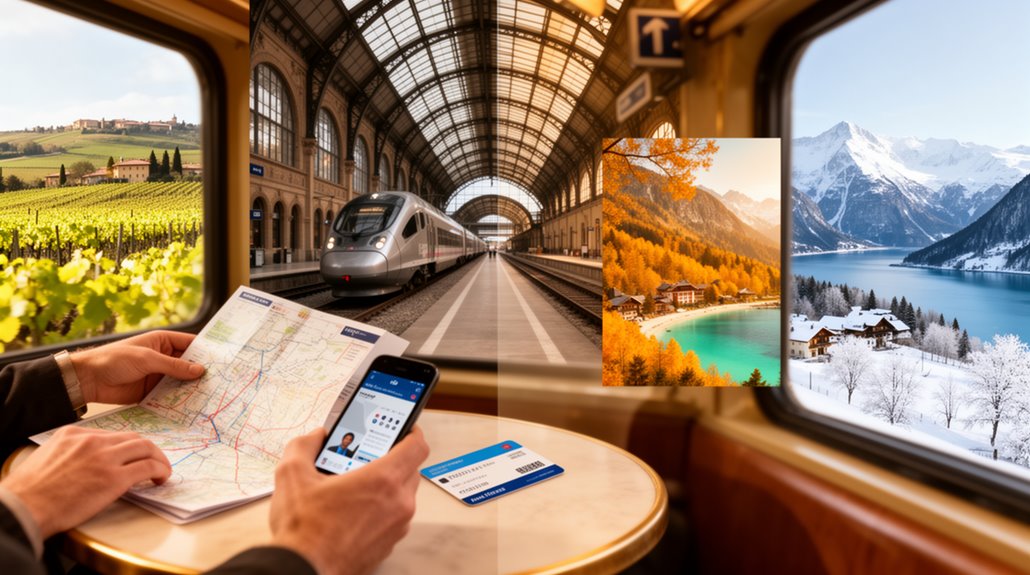
When should you catch Europe’s most spectacular rail journeys? The answer shifts with the seasons. It bends with your desires. It transforms with every mountain pass and coastal curve. As you navigate your own adventure, consider the train travel advantages in Sweden. The scenic routes offer breathtaking views of lakes and forests, making each journey a memorable experience. Whether you’re heading to Stockholm or exploring the picturesque countryside, the comfort of train travel enhances your exploration.
Consider what moves you—snow-draped peaks or sun-warmed shores; spring wildflowers carpeting alpine meadows or summer light stretching across Nordic highlands. The best time for European train travel depends entirely on the scenery that stirs your soul.
Winter wraps the Glacier Express in white silence, its windows framing a frozen wonderland from November through February. Spring awakens the Bernina Express, where blooms burst across Swiss slopes in delicate rebellion against the fading cold. Summer calls you toward the Rauma Line; mountain views sharpen under endless Scandinavian daylight from June through August, and coastal routes gleam with Mediterranean brilliance. Each season offers its own rhythm. In Italy, the Cinque Terre Express connects five UNESCO-listed villages along the stunning coastline, making summer the ideal time to witness the Mediterranean at its most radiant.
| Season | Route Type | Best Example |
|---|---|---|
| Spring | Alpine blooms | Bernina Express |
| Summer | Mountain views | Rauma Line |
| Winter | Snowy scenery | Glacier Express |
Picture yourself aboard: the train climbs, the landscape shifts, and suddenly you understand why travelers return to these routes year after year—not despite the changing seasons but because of them. Alpine routes demand winter’s drama. Alpine routes reward spring’s renewal. Alpine routes deliver summer’s clarity. Then autumn arrives with its own quiet magic.
Snow transforms a journey into meditation; warmth invites adventure. Between these extremes lies every shade of European wonder. Perhaps you’ll chase the Glacier Express through December’s hush, or maybe the Bernina’s spring palette calls louder. The choice shapes everything. For the ultimate winter magic, board the Santa Claus Express from Helsinki to the Arctic Circle, where you can witness the northern lights and visit Santa’s home.
Plan by season: snowy alpine routes peak November through February, mountain and coastal lines shine June through August, and spring blooms paint the passes between. For French mountain scenery, La Ligne des Cévennes offers its finest wildflower displays mid-March to mid-June. One continent, countless journeys. Your timing decides the story.
Which Month Unlocks Europe’s Hidden Train Magic?

Which month unlocks Europe’s hidden train magic?
The answer depends on what you seek.
It depends on the season.
It depends on the light falling across ancient valleys.
In January, the Swiss Alps transform.
Snow blankets every peak, every pine, every frozen stream rushing beneath stone bridges; the Glacier Express crawls through a world that feels less like Switzerland and more like Narnia itself—silent, white, impossibly still.
You press your face to the glass.
Magic.
June arrives differently.
Spring scenic railways across Europe burst with motion: waterfalls thunder down cliffsides, meadows erupt in color, and blooming valleys stretch toward horizons you can’t quite reach.
Everything moves.
Everything breathes.
But wait—have you considered autumn?
September belongs to Scotland.
The West Highland Line carries you through landscapes painted in rust and amber, mist curling around lochs like secrets unwilling to be told.
This is the most beautiful autumn train ride in Europe.
Hands down.
Then comes October.
Shoulder season.
The crowds thin; the golden light thickens.
Fewer tourists pack the carriages, fewer cameras block your view, and Europe exhales—offering its quieter beauty to those patient enough to find it.
Along Portugal’s Douro Line, warm harvest-season glow illuminates vine-covered hills as wine festivals fill the terraced valleys.
The Centovalli Express between Locarno and Domodossola is recommended for autumn when spectacular foliage transforms the journey through its 83 bridges and 34 tunnels.
You get the window seat.
You get the silence.
You get it all.
So which month matters most?
January for wonder.
June for renewal.
September for drama.
October for peace.
Each season reshapes the tracks beneath you, turning an ordinary journey into something that lingers long after the train stops.
The rails remain the same.
The mountains don’t move.
Yet everything changes—the color, the crowd, the feeling in your chest as another valley opens before you.
For those seeking the ultimate Swiss experience, the Grand Train Tour of Switzerland combines panoramic trains, buses, and boats to showcase the country’s most stunning UNESCO World Heritage locations across any season.
Choose your month.
Book the ticket.
The magic waits.
4 Peak and Off-Peak Windows for European Rail Travel

Glossy brochures promise romance. Instagram posts sell the dream. But try boarding a train in July.
The reality hits differently.
European rail travel during peak summer months transforms from leisurely adventure into something far more chaotic—platforms swelling with tourists, seats vanishing within minutes of release, and prices climbing to heights that make budget travelers wince.
You imagine yourself gliding past Alpine meadows in a half-empty carriage; you find yourself wedged between backpacks in a corridor instead.
August brings the same crushing crowds, the same inflated fares, the same scramble for reservations that sold out weeks ago.
Then comes the crash.
Shoulder season arrives.
Q1 2023 told a compelling story: 29.1% growth in rail bookings.
Why such a surge?
Savvy travelers discovered what veterans have long known—those magical windows between peak and off-peak exist, and they reward the patient.
Q2 through Q4 brought moderate increases of 6.6-9.1%, steadier rhythms for steadier journeys.
The pattern reveals itself clearly.
Peak season demands; off-peak delivers.
Understanding this difference matters more than any guidebook advice.
Consider your options: spring’s awakening landscapes, autumn’s golden light, winter’s uncrowded platforms.
Each offers cheaper fares, available seats, breathing room.
The cheapest months for train travel align precisely with these shoulder seasons—not the sweltering July crowds, not the August exodus. Understanding how dynamic pricing works across various countries helps travelers lock in better fares during these quieter periods.
Planning by season requires attention to these peak and off-peak windows across Europe. The numbers confirm the appeal: 2023 marked a record year with 429 billion kilometres traveled by rail passengers across the EU. This represented a full 4.4% above pre-pandemic levels, signaling that European rail has not just recovered but surged past its former peak.
Study them.
Learn them.
Use them.
A simple truth emerges from the data and the experience alike.
Romance exists on European rails.
It simply hides from summer’s chaos, waiting in quieter months for those wise enough to seek it there.
Winter Trains Through Snow-Covered Alpine Passes

Between December and March, something almost absurd unfolds across the Alps.
Snow blankets the peaks.
Ice grips the passes.
And yet—trains barrel through these frozen landscapes like it’s nothing at all.
Consider what these alpine routes deliver.
The Glacier Express carves through Switzerland for seven unhurried hours, crossing 291 bridges while winter light spills across valleys you never knew existed;
the Bernina Express climbs toward 4,000-meter peaks, no reservations needed, threading between Switzerland and Italy as if borders were merely suggestions.
This iconic journey through the Swiss-Italian Alps offers passengers immersive natural landscapes that transform into a winter wonderland during the colder months.
Along Austria’s Semmering Railway, UNESCO-listed engineering from another century still carries passengers through terrain that once seemed impossible.
This historic route connects Vienna to Graz in just two and a half hours, making it an ideal day trip for those seeking 19th-century engineering marvels wrapped in winter white.
Then there’s the Centovalli Railway—83 bridges, zero border hassle, pure spectacle.
Four routes.
Four ways to watch winter reveal itself.
Have you ever pressed your face to cold glass while a frozen world slides past?
That’s what these journeys offer: not transportation, but transformation.
Swiss winter rail travel hits different, as they say.
The rhythm of wheels on track; the hush of snow-heavy forests; the sudden burst of a sunlit glacier—these moments stack upon each other until you forget you’re simply getting from here to there.
You board as a passenger.
You arrive as someone who has witnessed something rare.
Winter train routes across Europe promise scenic beauty, yes.
But these alpine passages?
They deliver wonder: raw, crystalline, unmatched.
The cold outside makes the warmth inside sweeter.
The engineering makes the impossible feel routine.
And the views—stretching from valley floor to jagged summit—make you understand why humans first looked at these mountains and decided to build anyway.
The Glacier Express journey also threads through 91 tunnels, each one a testament to Swiss determination to conquer the mountain terrain.
Book a seat.
Watch the snow fall.
Let the Alps do the rest.
Winter Trains Through Snow-Covered Alpine Passes
Snow falls. Snow drifts. Snow piles high across the Alps every winter, burying ancient peaks in white silence.
Through this frozen world, the Bernina Express carves its path from Switzerland into Italy, threading tunnels and crossing viaducts while passengers press faces to frost-edged windows; the journey unfolds like a moving postcard, each curve revealing another vista of glaciers and pine forests draped in crystalline stillness. This remarkable route has earned UNESCO World Heritage status for its breathtaking engineering and scenery.
Can any scenic railway in Europe rival this? Not likely.
You feel it—that pull toward something slower, something deliberate.
The Glacier Express answers. For nearly eight hours, this train crawls through the mountains, earning its paradoxical title: the world’s slowest express. It traverses 291 bridges and 91 tunnels as it winds through the Swiss Alps.
Eight hours of alpine meditation. Eight hours of peaks rising and falling outside panoramic glass. Pure magic.
When December arrives, festive rail travel transforms these routes into something else entirely—steam trains climb Germany’s Brocken peak, their engines huffing through fairy-tale forests.
Smoke curling into cold air like breath made visible. The whistle echoes. Passengers clutch hot drinks and watch the snow-laden trees blur past, and you realize this is why people chase winter: not despite the cold, but because of it.
Mountain train rides through Europe deliver what planes cannot: time to absorb the landscape, to let grandeur sink into your bones. The Swiss rail network extends beyond traditional trains to include rack railways, trams, and funiculars that open access to glaciers and alpine summits.
Holiday rail journeys here promise more than transport; they offer transformation—a chance to slow down when the world insists on speed, to witness nature’s architecture from heated carriages while storms rage harmlessly beyond the glass.
These alpine passages wait for you.
The tracks are laid. The schedules are set. Winter has arrived, and the trains are running through some of the most spectacular terrain on Earth, carrying travelers who understand that the journey itself is the destination.
Board one this season.
You won’t regret it.
Mediterranean Coastal Trains: Best Summer Rail Routes
Mediterranean Coastal Trains: Best Summer Rail Routes
Where else can a train window become a frame for endless blue? Nowhere quite like this. The Mediterranean delivers something rare—coastlines that unfold like living paintings, kilometer after kilometer, while you sit and simply watch.
Summer travelers chase these routes. They chase the light on the water. They chase the cliffs dropping into turquoise depths. And they find it all. Be prepared for temperatures reaching 40°C in some coastal cities during peak summer months.
Consider the Côte d’Azur Route, stretching 100 kilometers past white sand beaches that shimmer under relentless sun; imagine the Blue Coast Train threading through 23 tunnels and crossing 18 viaducts, each emergence into daylight revealing another vista more dramatic than the last; picture yourself gliding along tracks carved into cliffsides, the sea so close you could almost trail your fingers through the foam. From Paris, high-speed TGV Duplex trains can whisk you to Nice in as little as 5 hours and 40 minutes, delivering you directly to these coastal wonders.
Breathtaking.
Along Italy’s Riviera, the Cinque Terre villages cling to hillsides—colorful, improbable, unforgettable. You round a bend; a pastel village appears. The ochre, yellow, and pink houses pressed into Ligurian cliffs are part of Parco Nazionale delle Cinque Terre.
Another tunnel swallows you briefly.
Then: lemon groves, terraced vineyards, fishing boats bobbing in tiny harbors.
The Amalfi Coast and Sorrento routes offer something different still.
Here, lemon groves meet sea breezes.
The air itself changes.
Sweeter. Warmer. Alive with Mediterranean summer.
Why do these journeys resonate so deeply?
Perhaps because trains force you to slow down, to notice.
No rushing. No highways.
Just rhythm: the click of wheels, the flash of blue between hills, the long exhale of coastline after coastline.
Four routes await you this summer—each distinct, each magnificent.
The Côte d’Azur for glamour; the Blue Coast for engineering marvels; the Italian Riviera for village charm; Amalfi for sensory immersion.
Book a window seat. Watch the Mediterranean reveal itself. Frame by frame.
Plan Your First Rail Trip Around Europe’s Best Months
Summer arrives, and so does everyone else.
The crowds surge. The prices climb.
August trips run 2.4 times higher than January’s ghost-town vibes—a staggering difference that transforms romantic platforms into sardine cans of stressed travelers clutching overpriced tickets.
But here’s the secret that seasoned rail wanderers know.
Shoulder season exists for a reason.
April offers you blooming landscapes and breathing room; October wraps you in golden light and quiet carriages.
These months sit perfectly between the extremes, neither frozen nor frantic, neither empty nor impossibly full.
They wait. They welcome. They reward those wise enough to choose them.
So when should you actually book?
For peak summer tickets, three months out remains the golden rule—mark your calendar, set your reminders, and don’t hesitate when seats open.
Your europe train itinerary demands this discipline.
Procrastination costs money; planning saves it.
Now consider September.
Sweet spot.
This single month delivers what first-timers desperately need: lingering warmth without August’s chaos, shorter queues at every station, locals returning to their rhythms as tourists thin out like morning fog burning off the tracks.
The platforms feel yours again. September understands the assignment.
Timing, you’ll discover, matters more than you think for beginner rail travel.
It shapes everything—from whether you snag a window seat to whether your budget survives the journey intact.
Choose wrong, and frustration follows; choose right, and Europe unfolds like a story written just for you.
The best months for your first train trip aren’t mysteries hidden in travel guides.
They’re April. They’re September. They’re October. Simple as that.
Ghost-town January has its charm for the bold.
Packed August works for those who thrive in chaos. France largely shuts down in August, shifting holiday demand across the continent and intensifying competition for seats elsewhere.
But for your first adventure across European rails, shoulder season offers something better: the continent as it should be experienced.
Unhurried. Affordable. Unforgettable.
Travelers aged 65 and older already understand this wisdom, showing higher travel in spring and autumn while younger tourists crowd the summer months. The London to Paris route takes just about two hours fifteen minutes, making spontaneous cross-channel day trips perfectly viable during quieter shoulder months.
Frequently Asked Questions
Do European Trains Have Wi-Fi and Power Outlets for Charging Devices?
Yes, many European trains offer Wi-Fi and power outlets. Eurostar, TGV, and ICE provide free Wi-Fi and charging sockets. Availability varies by operator and travel class.
Can I Bring My Bicycle on European Trains Without Extra Fees?
Can I Bring My Bicycle on European Trains Without Extra Fees?
Yes, on many regional trains in France, Spain, and Sweden. Long-distance services typically charge fees. Folding bikes travel free as luggage when properly folded.
How Far in Advance Should I Book European Train Tickets for Discounts?
Book European train tickets 7-12 weeks in advance to capture the best discounts, averaging 43% savings across major routes. Eurostar advance fares cost £69 compared to £279 same-day.
Are European Train Stations Accessible for Travelers With Mobility Challenges?
Are European Train Stations Accessible for Travelers With Mobility Challenges?
Accessibility varies significantly across European train stations. Sweden and Norway have 99% wheelchair-accessible stations. Belgium, Denmark, Czechia, and Italy have 25% or fewer accessible stations.
What Happens if I Miss My Scheduled European Train Departure?
If you miss your scheduled European train departure, your ticket typically becomes invalid for later trains. Some operators may allow rebooking depending on your ticket type and fare conditions—check your specific railway company’s policy.
Parting Shot
Like Odysseus charting his course by the stars, savvy rail travelers let the seasons guide their journeys. Winter’s Alpine passes. Summer’s sun-drenched coasts. Autumn’s fiery Highland colors. It’s not rocket science. The trains run year-round, but the magic? That’s seasonal. Book early for peak times. Or don’t, and enjoy those cramped corridors. Europe’s rails wait for no one. The calendar, though—that’s the real ticket. Planning ahead with seasonal train travel tips for Europe can help you uncover hidden gems and avoid the crowds. Embrace the unique experiences each season offers—like savoring mulled wine on winter trips or indulging in vibrant spring festivals. Make the most of your journey by adapting your itinerary to coincide with local events and seasonal attractions.