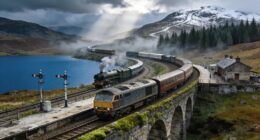
Switzerland’s rail network makes alpine planning unusually straightforward: a dense national + regional system covering about 5,317 km of track—so you can stitch together big-name panoramic trains with “locals-only” mountain lines without renting a car. (Source)
The Glacier Express is the spine of this itinerary. It connects Zermatt ↔ St. Moritz over a 291 km route, typically taking about 8 hours, crossing 291 bridges and 91 tunnels, and topping out at the Oberalp Pass (2,033 m). (Source)
The “hidden” routes deliver textures the headline train can’t—like the Centovalli Railway (Locarno ↔ Domodossola), where waterfalls, chestnut forests, and old stone villages roll right past your window. (Source) As you travel, be captivated by the scenic views along the glacier express, where stunning landscapes unfold around every bend. From the majestic peaks to the serene valleys, each moment is a feast for the eyes. Traveling through this breathtaking scenery, you may spot quaint villages nestled in the mountains, adding a touch of charm to your journey.
And if you want the iconic engineering + altitude drama, build around the Rhaetian Railway’s Albula/Bernina landscapes—a UNESCO World Heritage railway corridor with two historic Alpine lines (Albula + Bernina). (Source)
Quick add-on highlights (pick what fits your days):
- Rhaetian Railway (Albula/Bernina): UNESCO-listed rail engineering through two Alpine passes. (Source)
- Bernina Line high point: Ospizio Bernina (2,253 m) — the highest point on the RhB network. (Source)
- Jungfrau Railway: Jungfraujoch (3,454 m) — Europe’s highest railway station. (Source)
- Pilatus Railway: climbs at up to 48% gradient — the steepest cogwheel railway in the world. (Source)
The Matterhorn Gotthard Bahn: departs from Brig and crosses the Furka Pass where James Bond filmed in Goldfinger. Swiss Travel System passes: unlock unlimited access to most routes. Zermatt’s car-free village: serves as the ideal base for Glacier Express departures.
Local operators like Bergbahnen Grindelwald: run connecting services to remote valleys. The GoldenPass Line: links Lucerne to Montreux through three distinct Alpine landscapes. Spring and autumn: provide clearer views and smaller crowds than peak summer months.
Fun Activity To Try: Book a window seat on the Bernina Express panoramic car and photograph the Landwasser Viaduct—a 65-meter-high curved stone bridge that appears in every Swiss railway documentary.
Fast Links:
Starter pack PDFRail-map
Glacier-express-Postcard-WeekBernina-slow-stayPass-vs-tickets
Winter-optionsFamily-friendly
Free PDF: Swiss Alps Scenic Rail Starter Pack (4-Day Plan)
If you want a simple “start here” plan, grab my free PDF that matches this guide.
What’s inside (exactly what you came for):
- Route map (Glacier Express + the key add-on lines)
- Best seat side for the iconic view segments
- Photo windows (timing landmarks so you don’t miss the big moments)
- Hour-by-hour plan (plus disruption fallbacks)
👉 Download the free Starter Pack here: Swiss Alps Scenic Rail Starter Pack
How to use the Starter Pack with this article (60 seconds)
- Start with the route map to choose your “spine” (Glacier Express) and your add-ons.
- Use the seat-side + photo windows table to pick the best views without guesswork.
- Follow the hour-by-hour plan to keep transfers realistic (and use the fallbacks if disruptions hit).
- Then come back to this page to decide which “hidden mountain lines” fit your time, budget, and season.
If the form doesn’t load on mobile, refresh once or open in a new tab and the download link will appear.
Short on time? Jump straight to the Swiss Alps Scenic Rail Map (overview of the Glacier Express spine + key add-ons) → see the map below.
Glacier Express Itinerary Anchors Your Swiss Alps By Train Itinerary Spine

The spine. That’s what the Glacier Express really is—the backbone threading through 291 kilometers of Alps that somehow manages to connect everything in your scenic train itinerary.
You’ve got this panoramic train weaving through some genuinely spectacular territory, including those Landwasser Viaduct moments that’ll probably end up as your desktop wallpaper. The journey takes 7 hours to complete, running at Europe’s slowest express train pace of 24 mph.
And here’s where it gets interesting: at St. Moritz, you can seamlessly hop onto the Bernina Express if you’re so inclined. The St. Moritz route specifically showcases the Engadine scenery that surrounds this prestigious alpine resort town.
Look at any route map and you’ll see what appears to be a spider’s web of connections.
Chur, Brig, Disentis—they’re all nodes where the Glacier Express intersects with other Swiss railways. The journey through Oberalp Pass reaches the route’s highest point at 2,033 meters, creating a natural alpine gateway between regions.
This isn’t about taking isolated trips anymore. Planning to tackle the Jungfrau Railway? Want to experience the GoldenPass Express?
Well, they all seem to branch off from this central artery, though admittedly the connections might require a bit more planning than the marketing suggests.
Arosa Line Itinerary Hidden Gorge Climb On Rhaetian Railway From Chur

Sure, everyone talks about the Glacier Express. But the Arosa Line from Chur? This sneaky little route might actually pack more drama per kilometer.
The Rhaetian Railway climbs 1,154 meters through Schanfigg gorge in just 25 kilometers—that’s insane when you think about it. The engineering feat includes 41 bridges, 19 tunnels, and 12 avalanche-protection galleries carved into the mountainside. This line features 6% gradients, making it one of the steepest adhesion railways in the network.
1,154 meters of elevation gain crammed into 25 kilometers of track—the math alone makes your head spin.
The Langwieser Viaduct alone? Worth the ticket price.
You’ve got mixed traffic sharing the tracks, panoramic views that seem to shift every few minutes, and scenic trains that appear to corkscrew up the valley walls like something out of a model railway set. The modern Allegra trainsets cruise this historic route in just one hour, a significant improvement from the original 80-85 minute journey time.
That said, it’s probably not for anyone with vertigo issues.
Your Chur itinerary just got a lot more interesting. Even so, the relative obscurity of this line compared to its famous cousin might actually work in your favor—fewer crowds, more authentic alpine rail experience.
Quick shortcut: Want the clean, printable version of this plan?
The free Starter Pack includes the route map, best seat side, photo windows, and an hour-by-hour plan (with disruption fallbacks).
👉 [DOWNLOAD LINK / OPT-IN]
Planning shortcuts (so you don’t overthink this)
If you’re trying to plan fast, these shortcuts usually work:
- Pick one spine (Glacier Express) + one add-on (Arosa or Bernina)
- Keep hotel moves to 2–3 total for a 6–7 day trip
- Book any “must-have” panoramic time slots early in peak season
- Use the hour-by-hour plan in the free Starter Pack to keep transfers realistic
- If you’re stuck, start with the route map and build outward
👉 Want the printable version with the route map + hour-by-hour plan? Download the free Swiss Alps Scenic Rail Starter Pack here: Swiss Alps Scenic Rail Starter Pack
Loetschberg Line Itinerary With Goldenpass Express For Interlaken Hub Mountain Traverse

While the Glacier Express hogs all the Instagram posts, the Lötschberg Line quietly delivers one of Switzerland’s most dramatic mountain crossings. Nobody seems to talk about it.
This Bern–Brig railway might just be the best scenic deal in the country—panoramic views without tourist markup. The route spirals through some genuinely spectacular terrain. The journey takes 1h40 on the scenic mountain route versus just 1h10 through the base tunnel.
You can hop off at Kandersteg to reach Lake Oeschinen, though most people seem to miss this option entirely. The historic mountain route, which bypasses the newer base tunnel, arguably offers better views—assuming you’re not in a rush. The train runs through the older Lötschberg tunnel, offering glimpses of traditional timber houses weathered by centuries of alpine sun. The route crosses the Kander Viaduct and passes near Felsenburg Castle, engineering feats that defined Swiss railway history.
And if you’re planning an Interlaken-based itinerary? The GoldenPass connections make this route particularly useful.
Swiss scenic trains don’t get more underrated. That said, “underrated” might be exactly how locals prefer it.
🗺️ Swiss Alps Scenic Rail Map (One Overview)

Map overview: Glacier Express “spine” + key connections. Tap/zoom to enlarge. Printable version is included in the free Starter Pack below.
This map is the fastest way to understand how the Swiss Alps scenic rail “spiderweb” fits together.
How to use it (fast):
- Pick your spine first (Glacier Express corridor)
- Choose one add-on based on your time (e.g., a short scenic loop or a Bernina-style extension)
- Then use the itinerary section below to build a calm, realistic week without backtracking
Want the printable version (plus the full planning tools)?
The free Swiss Alps Scenic Rail Starter Pack includes the route map, best seat side, photo windows, and an hour-by-hour plan.
👉 Download the free Starter Pack here: Swiss Alps Scenic Rail Starter Pack
✅ Glacier Express “Postcard Week” — 6–7 Day Sample Itinerary (Copy-and-Go)
If you want a ready-made plan (without overthinking the Swiss rail spiderweb), here’s a simple 6–7 day “postcard week” built around the Glacier Express spine. It’s designed to keep transfers realistic and give you two scenic “anchor rides” plus time in a couple of base towns.
Route plan at a glance (the spine + two add-ons)
Zermatt → (Glacier Express spine) → Chur → (optional Arosa day trip) → St. Moritz → (Bernina day trip) → return / onward
You can run this in either direction (start in Zermatt or St. Moritz) depending on flights and hotel prices.
Day 1 — Arrive + Zermatt base (Matterhorn day)
- Arrive in Switzerland and travel to Zermatt (car-free, easy base)
- Keep the day light: village stroll, viewpoints, early night
Why here: Zermatt is the cleanest start for the Glacier Express spine.
Day 2 — Zermatt “big views” day (optional)
Choose one:
- Gornergrat for the iconic panorama day, or
- a short, easy walk + mountain lift depending on season
Planning note: If you’re traveling in peak season, this is a good day to book early.
Day 3 — Glacier Express spine: Zermatt → Chur (scenic core day)
- Ride the Glacier Express or take the same route via regular trains if you prefer flexibility/budget
- Overnight in Chur (or nearby)
Why Chur: It’s the best hub for a quick scenic add-on without long detours.
Day 4 — Add-on day: Arosa Line (easy day trip from Chur)
- Day trip on the Arosa Line (return to Chur)
- Flexible pacing: café time, short walks, easy views
Why this works: It adds a “hidden scenic line” day without changing hotels.
Day 5 — Chur → St. Moritz (short scenic transfer + alpine base)
- Travel to St. Moritz (easy connection)
- Afternoon: lake walk or easy viewpoints
Why St. Moritz: It sets you up perfectly for a Bernina scenery day.
Day 6 — Add-on day: Bernina scenery (day trip option)
Choose one (depending on time/budget):
- Bernina Express segments for the famous scenery, or
- regular trains on the same line for flexibility
Return to St. Moritz for the night.
Day 7 — Buffer day (choose your ending)
Use this as your “flex” day based on where you’re flying out:
- Return toward Zurich / Lucerne
- Or add a final scenic stop en route
Why this matters: Swiss rail is reliable, but this buffer makes your week feel calm.
If you only have 6 days…
Combine Day 1 + Day 2 into a single Zermatt day (arrive early), or skip the Arosa day trip and keep one base town.
If you want a more relaxed “slow stays” week…
Do 2 nights Zermatt + 2 nights Chur + 2 nights St. Moritz and treat transfers as half-days, not full travel days.
Booking and realism notes (quick)
- The Glacier Express route can be done via regular trains if you want more flexibility and less reservation friction.
- For the panoramic “named trains,” check seat reservations early in peak season.
- If you like calm pacing, prioritise fewer hotel changes over collecting every scenic line.
Centovalli Railway Itinerary To Bernina Express Southern Alps Crossover Without Backtracking

Most Swiss train itineraries? They’ll have you backtracking like crazy—particularly if you’re trying to connect the Glacier Express with those southern routes.
Here’s where the Centovalli Railway itinerary might just save your sanity. The panoramic coaches glide from Domodossola straight through to Locarno, no reversing needed. The journey climbs from 204 meters at Domodossola to 836 meters at S. Maria Maggiore before descending to Lake Maggiore.
That transfer connection appears to work seamlessly too—St. Gallen to Lucerne, then heading south.
Even better, the train frequencies seem to match up with the travel timetable, though you’ll want to double-check during peak season. The entire 52.1 kilometer route crosses the Italian-Swiss border between Ribellasca and Camedo.
The scenic views? They’ll likely exceed whatever you’re expecting. Best appreciated from the right side when heading toward Locarno, the landscapes unfold dramatically through the hundred valleys.
Mind you, there’s no luggage service, which could be a hassle for some travelers.
Then again, once you reach the other side—the Bernina Express is right there waiting.
🏔 Bernina Express + Alpine Villages (Slow-Stay Version: 2–4 Nights)
If you’re drawn to the Bernina scenery but don’t want a rushed “hop on / hop off” day, this is the slower, village-first way to do it. Think: one small base town, short rail rides, and plenty of time for views and simple walks.
Route plan at a glance (how it fits the Glacier Express spine)
Glacier Express spine → St. Moritz (base) → Bernina scenery day(s) → continue / return
If you’re already using the Glacier Express as your backbone, St. Moritz is the cleanest handoff point into Bernina scenery.
Choose your base: 3 great “alpine village” stays (pick one)
Below are three bases that work well for a slow-stay Bernina-focused mini-trip. The key is to sleep in one place and use the trains for easy day loops.
Option A — Pontresina (quiet base near St. Moritz)
A calmer alternative to staying in St. Moritz itself—easy access to the same scenery, but with a more village feel.
Good for: relaxed pacing + easy access to Bernina segments
Stay length: 1–2 nights minimum
Option B — Bergün / Bravuogn (classic small village on the Albula line)
This is a proper “Swiss village” base with a strong rail identity. Great if you want a quieter stay and scenic rail vibes without the resort feel.
Good for: village atmosphere + rail engineering scenery
Stay length: 1–2 nights
Option C — Samedan (low-key, practical base in the Engadin)
Often more practical (and sometimes better value) while still putting you close to the Bernina scenery and Engadin villages.
Good for: value + convenience + easy connections
Stay length: 1–2 nights
3 “slow-stay” day ideas (mix & match)
Pick one per day — these are designed to feel unhurried.
- Bernina scenery day (out-and-back, no stress)
Ride the Bernina line for the famous viewpoints, then return to your base for a calm afternoon.
Why it works: you get the big scenery without moving hotels. - Village day (short rides + long stops)
Choose two nearby villages and spend more time off the train than on it—coffee, short walks, lake views, slow photos.
Why it works: this turns “transport” into “travel.” - Scenic rail + easy walk pairing
Do one scenic rail segment in the morning, then keep the afternoon for an easy lakeside stroll or viewpoint lift (season-dependent).
Why it works: you get both the rail wow-factor and a “slow travel” day.
The simple pacing rule (this is what makes it “slow stays”)
If you want this to feel like a real alpine village trip, use one of these rhythms:
- 2 nights in one base (1 full day loop + 1 transfer day)
- 3 nights in one base (2 full day loops + 1 easy arrival/departure)
This is the difference between “I rode the Bernina” and “I lived the Engadin for a few days.”
Practical note (so expectations are set correctly)
You can ride the same scenic Bernina route using regular trains for flexibility, or choose the named panoramic service if you prefer the curated experience. Either way, the scenery is the point — the slow-stay structure is what makes it feel special.
Gornergrat Railway Itinerary With Matterhorn Gotthard Bahn For Zermatt Summit Panoramas

The Gornergrat Railway climbs from Zermatt to 3,089 meters—a 1,485-meter altitude gain that takes roughly 33 minutes. Pretty steep, right? This mountain railway connects seamlessly with Matterhorn Gotthard Bahn terminals, though you’ll probably spend more time gawking at the views than worrying about connections.
Mountain railway climbs 1,485 meters in 33 minutes while you gawk at views instead of worrying about connections.
And yeah, panoramic views hit different here.
Some practical stuff worth knowing: Those right-side seats? They tend to deliver the prime Matterhorn angles, though honestly, you can’t really go wrong either way.
The panoramic coach windows stay heated year-round—a detail you’ll appreciate when it’s minus ten outside. Your day trip ticket includes unlimited stops, so you can hop off wherever catches your eye.
Experience improvements? Well, the Zermatt itinerary basically plans itself. That said, you might want to start early to beat the crowds, especially if you’re visiting during peak season.
🎟 Swiss Travel Pass vs Point-to-Point Tickets (Quick Decision + Real Route Examples)
This is one of the most common Switzerland planning questions — and it’s easy to overpay if you choose a pass that doesn’t match your routing style. Here’s the simplest way to decide.
Quick decision rule (60 seconds)
Choose a Swiss Travel Pass if most of these are true:
- You’ll be taking multiple long-distance train days (not just one scenic ride)
- You value simplicity (hop-on flexibility + less ticket admin)
- You’ll also use local transport (buses, trams) and want it bundled
Choose point-to-point tickets if most of these are true:
- You’re doing fewer travel days (or staying put in one base town)
- You’re happy committing to specific trains to save money
- You’re mostly paying for one or two big scenic legs, not lots of daily rail
Reality check (important): some premium panoramic services may still require a seat reservation / supplement fee even if you have a pass. The scenery is included — the seat booking sometimes isn’t.
7 itinerary patterns (choose pass vs tickets fast)
These aren’t perfect mathematical proofs — they’re practical “pattern matches” so you can choose confidently.
| Example trip pattern | Typical best-value choice | Why |
|---|---|---|
| 1) Postcard Week (Zermatt → Glacier spine → Chur → St. Moritz + 1–2 day trips) | Pass often wins | Multiple travel days + day trips + flexibility |
| 2) One scenic ride only (just the Glacier route, then you stop traveling) | Point-to-point often wins | Paying for a full pass can be overkill |
| 3) Base-town week (Zermatt 4 nights, minimal long-distance rail) | Point-to-point often wins | Few travel days; local spend is limited |
| 4) Engadin slow-stay (2–3 nights Pontresina/Samedan + Bernina loops) | Point-to-point often wins | Lots of short segments; you can target tickets |
| 5) High-mobility trip (changing towns every 1–2 nights) | Pass often wins | Convenience + many train legs |
| 6) Family pacing (short travel days + avoiding tight connections) | Pass often wins | Flexibility reduces stress and re-booking friction |
| 7) Mixed modes (trains + city transport + boats/cable cars) | Pass often wins | Bundled transport value increases |
The “don’t get surprised” note (reservations)
Even with a pass, named panoramic trains can involve seat reservations (and sometimes supplements). If you care about a specific time window, book early in peak season. If you prefer flexibility, consider riding the same route on regular trains where possible.
Quick takeaway
If you want simplicity + flexibility (and you’re moving around), passes usually feel “worth it.”
If you’re doing few travel days or staying put, point-to-point tickets often cost less.
❄️ Best Seasons for the Swiss Alps by Train (Including Winter “Reality Check” + Easy Winter Options)
Switzerland is scenic year-round, but the experience changes a lot by season — crowds, daylight, reservation pressure, and how “relaxed” your itinerary feels. Here’s the simplest way to choose.
Quick season pick (what I’d choose, and why)
- Spring (Apr–Jun): fewer crowds, fresh scenery, good value. Great for “spine + add-ons” planning without the peak-season stress.
- Summer (Jul–Aug): maximum access and long daylight, but it’s the busiest and most expensive. Book earlier and expect more reservation friction.
- Autumn (Sep–Oct): one of the best blends of scenery + calmer travel. Shoulder-season energy with strong photo light.
- Winter (Dec–Mar): magical if you want snow + cosy villages — but plan with more buffer and shorter daylight.
Winter reality check (so you enjoy it instead of fighting it)
Winter trips work best when you:
- build in buffer time (snow + weather changes can ripple into connections)
- keep fewer hotel moves (base-town travel is smoother)
- treat “named panoramic trains” as nice-to-have and stay flexible on timing
- plan around shorter daylight (views still happen — just earlier)
✅ Winter-friendly “Swiss Alps by train” mini-itinerary options (copy-and-go)
If you want a winter version that stays realistic, here are three simple options that still fit the core logic of this article (a “spine” + easy add-ons).
Option A — Cosy base-town winter (3–4 days)
Pick one base: Zermatt or St. Moritz
- Day 1: arrive + short village wander
- Day 2: big-view day (mountain lift / viewpoint)
- Day 3: scenic rail day (out-and-back)
- Day 4 (optional): second scenic rail or slower village day
Why it works: minimal transfers, maximum winter vibe.
Option B — Winter “spine” with one add-on (5–6 days)
Zermatt → (Glacier spine segment) → Chur → St. Moritz (base)
- Keep hotel moves to 2–3 total
- Add one scenic loop (Arosa or Bernina segment) depending on weather
Why it works: you still get the famous spine logic without stacking tight connections.
Option C — Winter “calm and scenic” (2–3 days)
If you’re short on time, choose one scenic day and one cosy day:
- Day 1: arrive + village + slow evening
- Day 2: scenic rail out-and-back
- Day 3: depart
Why it works: winter trips feel best when they’re unhurried.
Winter booking note (keep expectations honest)
In winter and peak holiday weeks, some services can book out earlier. If you care about a specific time slot, reserve early. If you want flexibility, prioritise routes where regular trains provide the same scenery.
❄️ Winter “Wonderland” moments: snowy cabins + frozen lakes (the easy version)
If your dream winter trip is snowy cabins and frozen lakes, plan around two simple “no-stress” ingredients: a cosy base town + one iconic winter scene per day.
- Snowy cabins / cosy stays: Choose a base with an alpine “cabin vibe” (wood interiors, quiet nights, big-window views). In winter, the best experiences come from staying put 2–3 nights rather than hopping towns daily.
- Frozen-lake scenes (when conditions allow): In deeper winter cold snaps, Engadin lakes near St. Moritz (like Lake St. Moritz / Silvaplana / Sils) can freeze and create that classic “walk-across-the-snowy-lake” feeling.
- Low-effort winter itinerary move: Pair a short scenic rail day with a lake promenade + hot-chocolate afternoon—it’s the easiest way to get winter magic without overplanning.
👨👩👧👦 Family-Friendly Swiss Alps by Train (Low-Stress Route + Kid-Easy Stops)
Doing the Swiss Alps by train with kids can be amazing — if you plan for pacing, short transfer days, and “big views without long effort.” Here’s a family-friendly version of the Glacier Express “spine” concept that keeps things simple.
Family route plan at a glance (low-stress version)
Zermatt (2 nights) → Chur (2 nights) → St. Moritz / Engadin (2 nights)
This keeps hotel changes minimal and turns scenic rail into the highlight instead of a logistical grind.
A 6-day family-friendly itinerary (copy-and-go)
Day 1 — Arrive + settle (keep it easy)
- Travel to your first base town and keep the rest of the day light.
Family win: you avoid “arrive + big day” burnout.
Day 2 — Big views, low effort (choose one highlight)
Pick one easy “wow day” near your base:
- a short mountain railway / lift day, or
- a village day with parks + viewpoints
Family win: big scenery without long hiking.
Day 3 — Scenic transfer day (make the train the main event)
Do your main scenic rail leg for the week, then keep the afternoon calm (snack + short walk + early dinner).
Family win: one “big train day,” not multiple hard days in a row.
Day 4 — Base-town rest day (flex day)
This is your built-in “reset” day:
- playground time, lake stroll, easy museum, short train hop
Family win: prevents the mid-trip crash.
Day 5 — Second scenic day (shorter loop)
Choose an easy out-and-back rail loop (1–2 hours each way max), then return early.
Family win: structure + early bedtime.
Day 6 — Depart day (buffer included)
Keep departure day simple and avoid tight connections when possible.
Family win: reduces stress and missed-train risk.
5 kid-easy stops and ideas (big payoff, minimal effort)
These are the types of stops that work well for families because they’re simple, scenic, and low-friction:
- Car-free village base (easy walking, fewer safety worries, calmer pacing)
- Lake promenade stop (strollers-friendly, snack breaks, “throw rocks in water” magic)
- Short mountain railway / lift (views without long climbs)
- Easy scenic rail out-and-back (same bed at night, minimal logistics)
- One “treat stop” per day (bakery, hot chocolate, small play area) — this keeps morale high
(You can plug these into Zermatt, Chur-area day trips, and Engadin villages without overcomplicating the week.)
Family pacing rules (this is what makes it work)
- One big transfer day max every 2 days
- Keep most train segments to ~2 hours or less for sanity
- Build a daily snack + bathroom plan (sounds basic, saves trips)
- Plan one highlight per day, not three
- Keep at least one flex day every 3 days
Money + tickets note for families (quick)
If you’re moving around and doing multiple travel days, a pass can reduce friction. If you’re staying in one base with only a couple of big legs, point-to-point tickets can be cheaper. (This is covered in the pass vs tickets section above.)
Gotthard Panorama Itinerary On Gotthard Panorama Express Connects Lucerne And Ticino

From mountain peaks to lakeside departures, Switzerland’s scenic rail journeys keep shifting gears.
The Gotthard Panorama itinerary? It blends boat and mountain railway magic in a way that seems almost too perfect to be real.
Your journey likely begins in Lucerne with those paddle steamers crossing alpine sights—though calling them just “sights” hardly does justice to what you’ll see.
Then comes the panoramic train, which tackles what might be the most fascinating part: the historical context of that 1882 engineering marvel.
Mind you, Swiss Travel Pass holders still face reservation fees. That mandatory 24 CHF catches some travelers off guard.
The scenic experience itself revolves around those spiral tunnels and looping views that photographers probably dream about.
Just remember—ticketing and reservations aren’t optional here.
Even so, when you’re watching the landscape twist and turn through those famous loops, the paperwork feels worth it.
Albula Line With Pilatus Railway Itinerary UNESCO Engineering And Lucerne Peak

UNESCO recognition doesn’t come easily, but those 55 bridges and 42 tunnels along the Albula Line earned it fair and square.
Every engineering marvel has its moment, and this mountain railway’s spiral tunnels—well, they handle gradients that seem almost impossible. That said, the engineering probably looked like insanity on paper before anyone proved it could work.
Over in Lucerne, the transport hub does what Swiss stations do best: it launches tourists straight toward their next adventure.
In this case, that’s the Pilatus Railway with its frankly ridiculous 48% slopes.
- The alpine tunnel through Albula runs for 5,866 meters—not a short journey by any stretch
- Sure, the panoramic views might justify all that engineering madness, though you’d have to ask the original builders if they’d agree
- From Lucerne’s lakefront, Pilatus connects so seamlessly you’d think they planned it that way from the start
Before you go — get the free 4-day Starter Pack
If you’re building your Swiss Alps by-train itinerary from this page, the PDF saves time and prevents mistakes.
✅ Includes: Route map • Best seat side • Photo windows • Hour-by-hour plan
👉 Download here: Swiss Alps Scenic Rail Starter Pack
Frequently Asked Questions
Q: What makes the Glacier Express journey through Switzerland one of the most breathtaking alpine train experiences?
A: The Glacier Express offers an unforgettable train journey through the heart of the Swiss Alps, connecting St. Moritz and Zermatt through spectacular mountain scenery. This iconic switzerland train route crosses 291 bridges and passes through 91 tunnels during its eight-hour voyage, showcasing majestic alpine peaks, deep gorges including the Swiss Grand Canyon, and pristine valleys. The panoramic windows provide stunning views of the Bernese Alps, allowing passengers to witness the breathtaking landscape transform from lush meadows to dramatic glacial terrain, making it a quintessential trip to switzerland for rail enthusiasts.
Q: Which hidden mountain railways should be included in a comprehensive switzerland train itinerary beyond the Glacier Express?
A: A complete rail itinerary should include several remarkable cogwheel train routes that complement the Glacier Express journey. The Gornergrat cogwheel railway from Zermatt provides the best view of the Matterhorn and surrounding alpine peaks. The Jungfrau Railway offers a ride to the summit of Europe’s highest railway station at 3,454 meters in the Jungfrau region. The Pilatus Railway near Lake Lucerne is the world’s steepest cogwheel train, while the Bernina Express crosses the stunning Bernina Pass. These hidden gems showcase different aspects of Switzerland’s magnificent mountain scenery and perfectly complement the grand train tour experience.
Q: How can travelers combine the Glacier Express with visits to Switzerland’s most scenic lakeside destinations like Montreux and Lake Geneva?
A: An ideal tour highlights both alpine railways and Switzerland’s beautiful lakeside towns. Begin your excursion in Zurich, then travel by train to Lake Lucerne for a boat ride and cogwheel train experience. Continue to the Glacier Express route, then extend your journey to include the shores of Lake Geneva. Montreux, situated on these picturesque shores, offers a stunning terrace promenade, the famous Chillon Castle, and easy access to mountain railways via cable car. A boat trip on Lake Geneva provides breathtaking views of the majestic Alps, while the area also serves as a gateway to Lake Lugano. This combination creates a comprehensive journey through the heart of Switzerland’s most beautiful regions.
Q: What is the best way to plan your trip to Switzerland to experience both the Glacier Express and the Bernina Express in one alpine adventure?
A: To optimize your switzerland by train experience, plan a route that connects these two spectacular train journeys. Start in Zurich or arrive at Zurich Airport, then travel to St. Moritz, where both routes intersect. Take the Bernina Express first, which crosses the dramatic Bernina Pass into Italy, offering stunning views of glaciers and the pristine Lake Lugano region. Return to St. Moritz and board the Glacier Express heading west through the Swiss Grand Canyon and past the magnificent Aletsch Glacier. This rail itinerary allows you to experience two of Switzerland’s most breathtaking train rides while maximizing your exposure to diverse alpine landscape scenery. Consider purchasing a Swiss Travel Pass and Swiss Family Card for cost-effective unlimited travel.
Q: What are the top tour highlights when taking a train to Zermatt for views of the iconic Matterhorn?
A: The train trip to Zermatt culminates in one of Switzerland’s most spectacular destinations. Upon arrival in this car-free village, take the Gornergrat cogwheel railway for the best view of the Matterhorn and surrounding alpine peaks. The journey to the top takes approximately 33 minutes and provides breathtaking panoramic vistas of over 20 four-thousand-meter peaks. From the summit terrace, you’ll enjoy an unparalleled view of the matterhorn in all its majestic glory. Additional excursions include the Matterhorn Glacier Paradise cable car, offering the highest viewpoint, and walking tours through the charming old town. The combination of accessible mountain railways and the iconic Matterhorn makes this a must-visit destination on any trip to switzerland.
Q: How does traveling through Switzerland by train offer a unique perspective of the alpine landscape compared to other transportation methods?
A: A train journey through Switzerland provides an intimate and continuously breathtaking experience of the country’s majestic mountain scenery. Unlike flying or driving, trains in switzerland follow routes specifically designed to showcase the most stunning views, often running along mountainsides, crossing dramatic viaducts, and tunneling through peaks. The panoramic windows of modern swiss trains like the Glacier Express ensure unobstructed vistas of alpine peaks, pristine lakes including Lake Lucerne and Lake Geneva, and charming villages. The cogwheel train technology allows access to otherwise unreachable heights, providing spectacular bird’s-eye perspectives. This relaxed mode of travel lets you absorb the landscape without driving stress, enjoy swiss dishes in dining cars, and capture the breathtaking scenery of switzerland while traveling comfortably through the heart of the Alps.
Q: What should be included in a comprehensive rail itinerary that covers the grand train tour of Switzerland’s most spectacular alpine routes?
A: A complete grand train tour should span 7-10 days and incorporate Switzerland’s most scenic train rides. Begin in Zurich, then travel to Lake Lucerne for cogwheel train excursions on Mount Pilatus or Mount Rigi. Journey through the Bernese Alps to Interlaken, exploring the Jungfrau region with its ride to the summit of Europe. Continue to Montreux on the shores of lake Geneva for lakeside beauty and mountain access via cable car. Cross the Alps aboard the Glacier Express from St. Moritz to Zermatt, experiencing 91 tunnels and the Swiss Grand Canyon. Include the Bernina Express over Bernina Pass, and consider a boat trip on Lake Lucerne or Lake Geneva. This itinerary showcases trains in switzerland at their finest, combining cogwheel railways, panoramic routes, and breathtaking alpine landscape throughout your journey through the heart of Swiss mountain territory.
Q: What practical tips should travelers know about using cogwheel trains and cable cars to reach Switzerland’s alpine peaks and summit viewpoints?
A: When planning excursions to Switzerland’s mountain summits, understand that cogwheel train and cable car systems operate on specific schedules that vary by season. Book your train ride to popular destinations like the Gornergrat for the view of the Matterhorn or the journey to the top of Jungfraujoch in advance during peak season. Weather significantly impacts visibility, so check forecasts before your excursion and plan flexible dates for summit visits. The Swiss Travel Pass covers many cogwheel trains and offers discounts on others, while the Swiss Family Card provides free travel for children. Dress in layers as temperatures drop significantly at altitude, even in summer. Most summit stations feature heated viewing terraces, restaurants serving swiss dishes, and gift shops. Start your train trip early for the best view when alpine peaks are clearest, and allow time to explore the old town areas of base villages like Zermatt or Grindelwald before your ascent into the majestic mountains.
Q: Where do I get the free Swiss Alps Scenic Rail Starter Pack?
You can download it free on this page. The Starter Pack includes: Route map • Best seat side • Photo windows • Hour-by-hour plan (plus checklists and quick planning notes).
👉 Download the free Starter Pack here: Swiss Alps Scenic Rail Starter Pack
If the form doesn’t load on mobile, refresh once or open in a new tab and the download link will appear.
Parting Shot
A British couple ditched their original plan for just the Glacier Express. Smart move. Through Switzerland’s heart, they discovered something better—the Arosa Line threading out from Chur, its red carriages climbing through pine forests where the air gets thin and thoughts get clear. Up the Gornergrat they rode, ascending to 3,089 meters where the Matterhorn pierces the sky like a stone cathedral, where clouds drift below you and the world seems impossibly small, where every photograph fails to capture what your eyes already know. Then westward through Centovalli‘s hundred valleys, crossing that invisible line into Italy where the coffee gets stronger and the mountains speak a different language.
Done.
Eight days; five different mountain railways; zero regrets. Can you imagine a simpler equation for Alpine perfection? These meter-gauge lines actually connect—Chur to Arosa, Zermatt to Gornergrat, Locarno through valleys unnamed. No rental car hassles plague your journey. No GPS arguments. No parking nightmares. Just trains. Swiss trains. Trains that show up when they’re supposed to, minute by minute, hour by hour, day after day.
Why does this Swiss Alps by train itinerary work so brilliantly? Because Switzerland built its railways like it builds its watches: precise, interconnected, beautiful. From valley floors to mountain peaks, these tracks climb where roads fear to tread. You sit, you watch, you breathe. The mountains come to you through panoramic windows while someone else navigates the hairpin turns. In first class or second—it doesn’t matter—the Alps deliver their sermon in stone and snow.
This is how you see Switzerland. Not through a windshield, fighting traffic. Through glass walls, holding coffee, watching glaciers slide past at twenty-five kilometers per hour.
Perfect.