European Christmas Market Train Routes: High-Speed Connections Between Market Cities, Peak Season Capacity Constraints, Winter Weather Disruption Patterns during the summer months, travelers can explore the best routes through Europe in summer, taking advantage of vibrant festivals and picturesque landscapes. Scenic rail journeys connect major cities, offering a unique opportunity to discover local cultures and cuisines. With extended daylight hours, the experience is enhanced by the allure of charming towns and stunning natural vistas along the way. as travelers gear up for the start of train season in europe, they can expect a surge in festive activities and markets in various cities. This time of year transforms the train routes into a magical tapestry of twinkling lights and holiday cheer, inviting visitors to hop from one enchanting destination to another. It’s the perfect opportunity to experience unique traditions and seasonal delights that make winter travel in Europe truly unforgettable.
A seasonal train travel guide serves Christmas market visitors during a critical window. The Advent season, a period lasting thirty-two days from late November through December 23, creates unique challenges. Rail networks operate at ninety percent capacity on peak weekends.
High-speed train services connect major market destinations:
- Intercity Express trains reach speeds of three hundred kilometers per hour
- Train à Grande Vitesse services link French market cities across borders
- International high-speed rail operates between London and continental Europe
Operators increase service by twenty percent on market corridors. Tickets disappear weeks before departure dates. Passengers must book before October to secure seats.
Winter conditions create disruptions. Sub-zero temperatures affect operations. Alpine snowstorms halt services. Darkness falls at four in the afternoon.
Regional trains fill beyond capacity. Overnight sleeper compartments sell out early. Platform chaos strikes unprepared travelers.
The guide provides timing data. Route capacity appears in detail. Weather hazard patterns help planning. Market-hopping requires advance preparation.
Central European rail hubs include Vienna, Prague, and Munich. Rhine Valley routes serve multiple markets. Alpine crossings demand weather awareness.
Interesting Fact: Cologne Central Station processes over three hundred thousand passengers daily during Christmas market season, making advance reservations essential for any market route passing through the Rhineland region.
Christmas Market Routes: ICE, TGV, and Eurostar Connect Europe’s Top Festive Cities
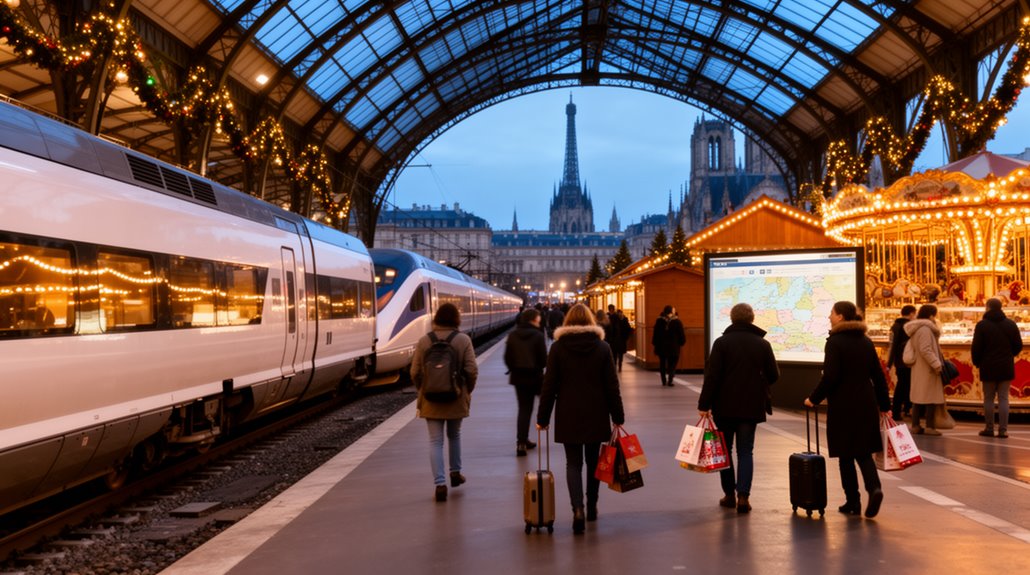
December arrives. Europe’s high-speed rail network transforms into something remarkable: the continent’s most efficient Christmas market delivery system.
Want to ride from Cologne’s market circuit to Nuremberg’s legendary Christkindlesmarkt? ICE winter schedules make it happen in hours.
Eurostar whisks you straight into French marché de Noël territory—no transfers, no hassle, no delays. The London to Paris journey takes just two hours and fifteen minutes, depositing you at Gare du Nord ready to explore the city’s festive offerings. When considering Eurostar travel tips for firsttimers, it’s important to arrive at the station early to navigate through security smoothly. Additionally, check your ticket and platform information in advance to avoid any last-minute scrambles. Lastly, packing some snacks and a cozy blanket can make your journey even more enjoyable as you head to your holiday destination.
Meanwhile, seasonal train services handle the Christmas market routes with surgical precision; Strasbourg market access opens 3-4 months ahead, giving you plenty of time to plan your festive adventure through twinkling cities and cobblestone squares draped in lights.
These trains connect the markets. These trains transport the crowds. These trains deliver the holiday magic. And they do it faster than any car ever could.
But here’s the catch—holiday peak booking demands strategy.
You need to reserve early.
Advent weekends hit 90% capacity: families claiming window seats, couples securing dinner reservations, solo travelers grabbing the last available departures.
Miss the booking window and you’ll find yourself scrolling through sold-out routes, refreshing pages at midnight, hoping for cancellations that rarely come.
The high-speed network doesn’t expand for Christmas; it simply fills up, carriage by carriage, until every seat from Paris to Prague disappears from the system.
So act now.
Check the schedules.
Lock in your tickets before October ends and the real rush begins.
Because when those Advent weekends arrive—when Cologne’s cathedral glows against winter darkness, when Nuremberg’s Christkindlesmarkt opens its wooden stalls, when Strasbourg transforms into an Alsatian wonderland—you’ll already be aboard, watching Europe blur past your window at 300 kilometers per hour. Christmas train tickets get released each summer, giving savvy travelers the jump on festive season bookings before demand peaks. Eurostar Standard, Plus or Premier offer different service levels to match every traveler’s needs and budget.
When Are Markets Open? November 22 Through December 23 Defines the Advent Season Window

High-speed trains connect the markets.
The markets themselves, however, run on a strict calendar—one you cannot negotiate or extend. Late November openings cluster around November 22, wrapping up by December 23 in most Christmas market destinations across Europe; this is the Advent season window, and it governs everything.
Advent governs market opening dates. Advent governs weekend planning. Advent governs festive period bookings and the entire rhythm of holiday travel demand, which peaks hard in early December when visitors flood cobblestone plazas and timber stalls lit by strings of golden bulbs.
Miss this window, miss everything.
When can *you* visit? Between November 22 and December 23: that’s your slot. Market-hopping itineraries work only inside this narrow frame, so plan carefully or risk arriving to shuttered booths and empty squares. Tools like the Eurail Planner and apps including Omio can help you map routes between market destinations with real-time scheduling information.
December travel demand doesn’t merely rise—it surges, crashes, overwhelms. Book early. The festive period fills fast with travelers chasing glühwein, handmade ornaments, and the scent of roasted almonds drifting through winter air. Do *you* have your dates locked in yet?
Because Advent season timing is everything. Routes must align with opening schedules; trains must sync with market hours; hotels near the best destinations vanish weeks in advance. This isn’t flexible. This isn’t forgiving.
The calendar dictates your movements, your bookings, your entire trip architecture. November 22 marks the start. December 23 marks the end. Between those dates lies magic—spiced cider, carol singers, snow dusting medieval rooftops. Outside those dates? Silence.
Organized tours fill quickly too, with group sizes averaging 37 travelers and departures scheduled to maximize market access during peak Advent weeks. Authentic Christmas markets offer always free admission, making them accessible to families seeking genuine holiday traditions without budget strain.
Book Germany’s Christmas Express and Austria’s Advent Specials for Festive Train Experiences

Picture yourself gliding through winter’s heart aboard Germany’s Christmas Express. Berlin whisks you toward Dresden, then onward to Nuremberg—a 7-day circuit on sleek ICE trains threading the country’s most storied Christmas markets. The journey begins; the journey delights; the journey transforms. Pure magic.
Seven days threading winter’s heart—Berlin to Dresden to Nuremberg—where sleek trains carry you through Germany’s storied Christmas magic.
From Hamburg, alpine holiday trains climb toward Munich and Innsbruck, carrying you to Tyrolean gateways where snow-dusted peaks frame centuries-old Advent traditions. Regional connections depart Frankfurt, winding through forests and valleys to deliver you at Rothenburg‘s medieval gates: half-timbered houses, cobblestone squares, the scent of roasted almonds drifting through lamplit lanes. Short hops unlock timeless wonders.
Can you imagine a richer holiday than weaving together two countries in one festive sweep? Cross-border EC trains make dual-country itineraries seamless—Germany’s Christmas markets blend effortlessly into Austria’s Advent specials, each station a doorway to gingerbread stalls, handcrafted ornaments, mulled wine steaming in ceramic mugs. These aren’t mere train rides; they’re passages through living postcards, where conductors punch tickets and December works its quiet spell on your soul.
You’ll find routes for every appetite: the express circuits racing between major cities, the alpine climbs that slow as gradients steepen and vistas open, the regional charmers stopping at villages that appear in no guidebook. Seven days or seventy kilometers—each journey hums with its own tempo. Book the Christmas Express for velocity and variety. Book Austria’s Advent routes for peaks and stillness. Book both, and you’ll carry the rhythm of twin traditions home: bratwurst and Sachertorte, Glühwein and Punsch, carols sung in two tongues under a single winter sky. Germany’s high-speed ICE trains make these festive circuits possible, connecting major cities with remarkable efficiency while you relax and watch winter landscapes unfold. In Cologne, the Christmas Market Express operates on a hop-on-hop-off format, connecting four central markets with departures every 15 minutes and onboard commentary that brings the city’s festive heritage to life. The Holiday Express departs in the evening, letting you settle into your warm compartment as darkness falls and the night train begins its traverse through snow-covered forests and illuminated villages.
Winter Conditions: Alpine Snow Delays and 4pm Central European Darkness Require Preparation

Alpine snowstorms don’t respect holiday calendars. Sub-zero cold doesn’t either. Every Christmas market rail itinerary must reckon with a hard truth: trains don’t always run on time—and sometimes don’t run at all.
Winter conditions on market routes hit hard, they hit fast, and they hit without warning. Heavy snow shuts the switches; ice freezes overhead lines solid; 4pm darkness transforms your platform transfer into a treacherous obstacle course where you can barely see the track numbers, let alone navigate icy stairs with luggage in tow, all while announcements crackle unintelligibly through ancient speakers and delays stack up like snowdrifts against the station walls.
Then it happens.
Service canceled.
What separates winter wonderland excursions from stranded-in-Stuttgart disasters? Preparation does. Flexibility does. Smart planning does. You need seasonal timetable change alerts bookmarked on your phone. You need weather-appropriate packing: thermal layers, waterproof boots, gloves that actually work. You need flexible holiday timing—because that direct connection you booked three months ago might vanish when Alpine snow blankets the Brenner Pass at midnight.
Consider the trifecta of December rail travel: frozen infrastructure, abbreviated daylight, unpredictable storms. Will your tight connection survive when temperatures plummet? Switzerland’s recent deep freeze saw switch-heater failures cripple morning commuter services across multiple corridors, proving that even world-class rail networks buckle under extreme cold. Glasgow’s subway system suspended operations entirely after frozen tracks caused cascading power failures, a stark reminder that winter strikes urban transit just as ruthlessly as mountain routes. Pay close attention to trains that split mid-journey for different destinations, as winter confusion at unfamiliar platforms can land you in the wrong Alpine valley entirely. Pack backup routes. Pack patience. Most importantly, pack the understanding that Alpine winter refuses to bend to your itinerary, no matter how meticulously you’ve color-coded your spreadsheet or how expensive your first-class reservation was.
Because when overhead lines ice over at 2,000 meters, even the legendary Swiss efficiency grinds to a halt.
Expect 90% Train Capacity During Advent Weekends When December Demand Peaks Across Germany

Alpine delays? They’re waiting. Four o’clock darkness? Already creeping across the Bavarian sky. But the real obstacle to your Christmas market rail adventure isn’t terrain or twilight—it’s the sheer number of people thinking exactly what you’re thinking.
Advent weekends hit differently across Germany’s Christmas market heartland. Nuremberg fills first. Munich follows close behind. Cologne swells next. And on every intercity train connecting these glittering hubs, load factors surge to 90% capacity; carriages that felt spacious in October now feel like holiday-themed sardine tins, with standing passengers wedged between suitcases and the scent of mulled wine regret.
When do conditions peak? Friday evenings funnel office workers and tourists onto the same trunk lines, creating congestion that cascades through every junction from Frankfurt to Dresden.
Friday evenings create perfect storms—office workers meet tourists on trunk lines, triggering cascading delays from Frankfurt clear through to Dresden.
Sunday afternoons reverse the tide—everyone racing home before Monday, everyone hoping for a seat, everyone discovering that hope isn’t a booking strategy.
Regional trains abandon all pretense: standing-room becomes the standard, not the exception, as day-trippers pack in shoulder-to-shoulder for the twenty-minute ride that feels like forty. The Rothenburg route takes about 2 hours through Bavarian countryside, giving you plenty of time to regret not securing that window seat. Some savvy travelers base themselves strategically—Bamberg pulls double duty as both market destination and launch point for Franconia, reaching Nuremberg, Würzburg, and Regensburg without fighting trunk-line crowds. Smart travelers pack light to navigate crowded platforms and tight carriage spaces without becoming an obstacle themselves.
Without seat reservations locked in for your pre-planned rail segments, spontaneous market hopping transforms from romantic adventure into crowded nightmare.
You’ll stand in aisles. You’ll miss connections. You’ll wonder why nobody warned you.
So here’s your warning: Book early. Secure those reservations weeks ahead—not days, not the night before departure. Or accept the alternative.
Stand the entire way.
Check ICE and ÖBB Winter Schedules Adding 20% More Market Route Frequencies in December

The second Sunday in December arrives. Timetables flip.
Across Germany and Austria, rail networks execute something far more deliberate than a shuffle—they orchestrate a synchronized overhaul that drops real capacity exactly where Christmas market crowds will crush platforms and pack carriages.
Deutsche Bahn and ÖBB don’t guess; they coordinate seasonal changes that boost frequencies 15–25% on the core axes you actually need: Vienna Christmas markets, Dresden Striezelmarkt, Prague Christmas markets, Basel market routes.
These are real Christmas special trains, deployed for one purpose—holiday crowd management.
Not a token gesture.
A logistics operation.
When festive travel peaks, when mulled wine steams and wooden stalls glow, when half of Central Europe decides to visit the same medieval square on the same weekend, the railways respond with additional departures linking the markets that matter most.
The networks add morning expresses; they add evening returns; they add midday ICE and ÖBB Railjet services that didn’t exist in November.
Why? Because December demand isn’t a trend—it’s a spike, a surge, a predictable avalanche of travelers who will board trains whether capacity exists or not.
Vienna’s markets alone run from early November through early January, with Schönbrunn Palace extending its season until January 6th, creating sustained demand across the entire winter timetable period. The Vienna to Bratislava route offers about 15 daily departures with journey times under an hour, making it easy to combine Austrian and Slovak Christmas market visits in a single day.
You can check the published winter schedules now.
You’ll see the frequency jumps coded into every major Christmas market corridor: extra rotations, tighter intervals, coordinated connections. The Munich–Verona line feeds regional services to markets like Merano every thirty minutes, with Trenitalia, DB, and ÖBB all publishing integrated schedules for cross-border travelers.
The seasonal timetable changes aren’t reactive—they’re preemptive.
Deutsche Bahn and ÖBB have run these markets for decades; they know when the crowds come, where they go, how many seats vanish in a December afternoon.
The result? Twenty percent more service on the routes that link Christmas magic to rail reality.
Vienna-Salzburg-Munich: A Market Hopping Itinerary Covering 3 Cities in 4 Days

Four days—that’s all you need.
Vienna’s Rathausplatz market kicks off this Austrian sprint through festive traditions, pulling you forward to Salzburg’s Domplatz, then sweeping you into Munich’s Marienplatz: three cities, three Christmas markets, roughly 500 km of train journeys decorated with anticipation and mulled wine.
Morning transfers, evening markets.
Morning transfers, evening markets.
Morning transfers, evening markets—then break the pattern with a late-afternoon arrival that lets twilight ignite the stalls.
Planning your advent calendar trip means working backward from ski connections or New Year’s Eve itineraries; you calculate which festival dates anchor your route, which train windows permit unhurried wandering through wooden booths dripping with ornaments and roasted chestnuts, which hotels still have rooms during peak season when every traveler in Europe seems to chase the same glowing dream.
Book 4–6 weeks ahead.
Do you want to secure your place among the throngs, or will you risk last-minute scrambles?
The math is simple, really.
Vienna offers imperial grandeur—chandeliers of lights strung across gothic arches.
Salzburg delivers alpine intimacy.
Munich? Pure Bavarian exuberance, foam-topped steins traded for cinnamon stars and gingerbread hearts.
Each market builds on the last: a crescendo of carols, crowds, and cravings for Glühwein that warms you from sternum to fingertips.
Train connections hum along at two-hour intervals; schedules align like gears in a Swiss watch, clicking you from one cobblestone square to the next. The Vienna to Salzburg leg alone covers 309 km in roughly two and a half hours, with departures at least every thirty minutes throughout the day.
Pack light.
The rhythm accelerates when you’re hauling luggage up narrow hostel stairs at midnight.
Between cities, let yourself slow—watch snowy fields blur past the window, savor a pretzel, breathe.
Expert-led itineraries often pair Schönbrunn Palace tours with classical concerts in the Orangery, weaving history and performance into a single evening before you roll onward to the next market stop.
If you prefer someone else to orchestrate the logistics, organized tours cap groups at 12 travelers to preserve that intimate market experience without the solo navigation.
Three cities.
Four days.
One seamless ribbon of tradition winding through Central Europe’s festive heart.
Frequently Asked Questions
Are Christmas Market Train Routes Accessible for Travelers With Mobility Limitations?
Yes, major Christmas market rail routes provide accessible infrastructure including step-free access, wheelchair spaces, and assistance services at flagship stations. Travelers with mobility limitations should book in advance, select appropriate operators, and plan routes carefully for seasonal travel.
Can I Store Luggage at Train Stations While Visiting Christmas Markets?
Yes. Most major European train stations offer luggage storage via self-service lockers or staffed facilities for €4–€10 per 24 hours.
Do Festive Trains Offer Onboard Christmas Refreshments Like Glühwein or Treats?
Many European Christmas trains serve Glühwein, mulled wine, hot chocolate, cookies, and traditional treats through onboard bar or dining cars. Luxury and themed services feature full seasonal menus. Standard intercity trains offer basic café items with minimal festive additions.
Which Christmas Markets Are UNESCO Intangible Cultural Heritage Sites in Europe?
No European Christmas markets currently hold UNESCO Intangible Cultural Heritage status. Austria’s market traditions, Dresden’s Striezelmarkt, Nuremberg’s Christkindlesmarkt, and Erzgebirge regional customs appear on national inventories for potential future recognition.
Are Advance Reservations Required or Recommended for Christmas Market Train Routes?
Yes, advance reservations are mandatory on international high-speed services like Eurostar and strongly recommended for all Christmas market routes. Peak advent weekend demand reaches 90% capacity, with popular times selling out weeks in advance.
Parting Shot
European Christmas market routes don’t work like normal train travel. Period. The 32-day advent window is brutal—90% capacity, coordinated connections across three countries, markets closing before New Year’s. Miss the 4-6 week booking window? Good luck finding seats during peak weekends. A specialized seasonal guide isn’t some luxury add-on. It’s the difference between hitting Nuremberg, Strasbourg, and Vienna’s markets or watching delays derail everything from a cold platform.