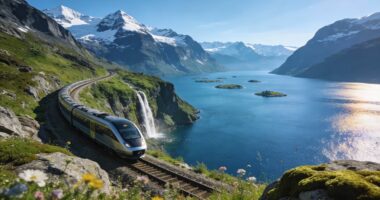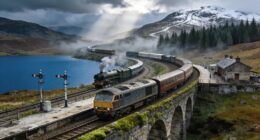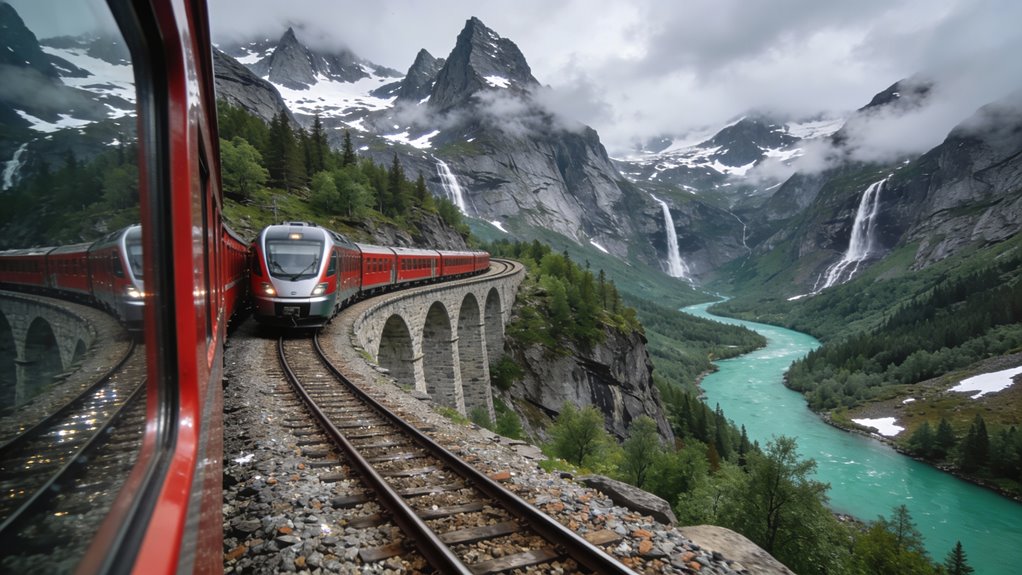
Scenic Train Rides Europe on the Rauma Line Norway: Natural Beauty Revelations Through Mountain Passages, River Valleys, and Geological Formations Breathtaking views of Norwegian fjords await travelers as they journey through this stunning landscape. Each twist and turn reveals dramatic cliffs, serene waters, and charming villages nestled along the coast. This unforgettable experience captures the essence of nature’s grandeur, making it a highlight of any visit to Norway.
The Rauma Line, a railway route spanning 114 kilometers, connects Dombås to Åndalsnes. This Norwegian journey showcases natural beauty through dramatic landscapes. Lonely Planet named it the world’s most scenic train route in 2023.
Key features along this route include:
Vermafossen: This waterfall plunges 381 meters down gneiss walls. The cascade creates turquoise river corridors that cut through ancient rock formations.
Trollveggen: Europe’s tallest vertical rock face rises 1,100 meters. This granite wall demonstrates the raw power of geological forces that shaped these mountains.
Kylling Bridge: This stone arch structure from 1923 spans 59 meters above rushing water. Romsdalshorn peak towers 1,800 meters overhead, creating a vertical landscape that humbles travelers.
The train passes through tunnels carved into mountainsides. Passengers experience sudden transitions from darkness to light. Each emergence reveals new vistas of glacial valleys and canyon walls.
Natural beauty here requires no embellishment. Granite formations speak through their presence. Water cuts paths through ancient stone. Mountains rise in vertical statements of geological time.
The route demonstrates how railway engineering adapts to extreme terrain. Curves follow natural contours. Bridges span gaps where rivers carved their courses. Tunnels penetrate obstacles that stood for millennia.
Interesting Fact: The Rauma Line’s construction required workers to blast through solid mountain rock using only hand tools and dynamite, taking over a decade to complete this engineering marvel through one of Norway’s most challenging terrains.
Rauma Line Norway: 114km from Dombås Through Romsdalen Valley to Åndalsnes
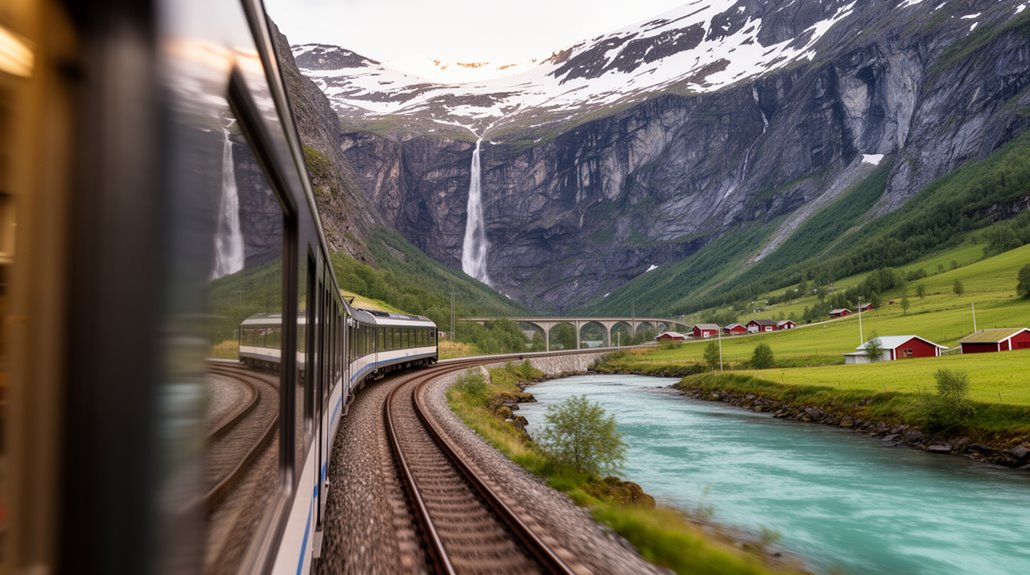
Steel ribbons through Norway. Steel through unforgiving rock. Steel that carved a route between Dombås and Åndalsnes, 114 kilometers of ambition and iron will—this is the Rauma Line.
Yes, it’s a branch line. But what a branch.
From Dombås junction station, where connections run north and south like veins across the map, the railway follows the Rauma River into Romsdalen Valley. You’ll watch scenery unfold: waterfall viewpoints tumbling white against granite, the vertical terror of Trollveggen wall rising beside your window, landscapes that make your breath catch.
Where granite meets cascade and ancient rock walls rise to steal your breath—this is Norway raw and unfiltered.
The train hugs curves through terrain that seems to reject civilization itself; switchbacks carved into mountainsides tell stories of engineers who refused to accept “impossible,” and every meter of track represents a victory over stone and slope and the sheer vertical hostility of western Norway. The line includes two horseshoe curves that wind through the mountain landscape, engineering solutions that allowed steel to conquer impossible grades. Like Austria’s Semmering Line, the Rauma represents a triumph of railway engineering over seemingly impossible alpine terrain.
Then comes Kylling Bridge.
The engineering highlight crosses a chasm with graceful defiance—stone arches spanning what shouldn’t be spanned. Beyond it: more valley, more river, more of Norway’s raw beauty pressed against the glass until Åndalsnes appears at the terminus.
Can you imagine building this in 1924? You’d understand why it took vision, dynamite, and stubbornness. The Rauma Line Norway doesn’t merely connect two points on a map. It threads the impossible: a passenger route through mountains that dwarf human scale, following water through walls, delivering travelers to the heart of Romsdalen where fjords meet alps. Lonely Planet declared this journey the world’s most scenic train route in 2023.
Branch line? Sure. But some branches bear the finest fruit.
Which Waterfalls Pass Trackside? Slettafossen, Vermafossen, and Mongefossen Cascade Past
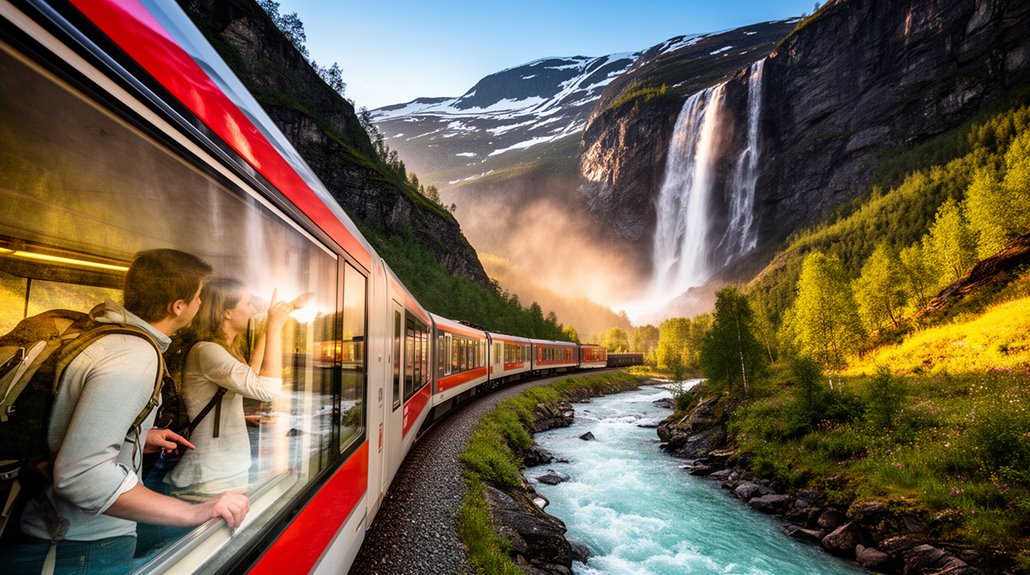
Steel rails carve through Romsdalen. They carry you past more than granite walls. More than river curves.
Along this route between Dombås and Åndalsnes, waterfall after waterfall thunders trackside—each one a curtain of white against black stone, each one close enough to feel its mist through observation windows, each one framing the raw power of Norwegian mountain country.
Then silence.
Near Verma, Slettafossen appears: a 40-meter cascade of emerald-green water tumbling down the gorge wall. Vermafossen drops next—381 meters of sheer vertical fury plunging into the valley below.
Beside the gorge, Mongefossen roars so close you could reach out and touch the spray.
Have you ever watched a landscape transform itself through train glass?
These proximity points multiply your photography opportunities; the waterfalls pass so near that bridge crossings become natural frames for your lens.
During scenic rides through this river gorge, the rhythm changes—short tunnels, sudden views, cascades appearing without warning. You’ll find observation windows positioned perfectly: engineers knew what they were doing. The Rauma Line follows the water down, tracks and river parallel, both carving the same ancient path through stone.
Waterfall, tunnel, waterfall. Waterfall, bridge, waterfall. Waterfall, then mountain wall.
Not every journey offers such concentrated drama. The Romsdalen gorge compresses nature’s grandest features into a single corridor—granite sentinels standing watch while meltwater performs its endless dance earthward. Steel beneath you hums a steady note; water beside you crashes in wild percussion. While Norway’s Bergensbanen showcases dramatic fjords and mountain scenery, the Rauma Line delivers its own distinct brand of natural spectacle. At Slettafossen, the river forces itself through a narrow canyon passage that amplifies its power into something you can feel in your chest. The river’s name itself comes from Old Norse “raumr”, meaning thundering waterfall—a title earned through centuries of relentless descent.
Cross Kylling Bridge on Its 1923 Stone Viaduct Arching 59m Above the Rushing River
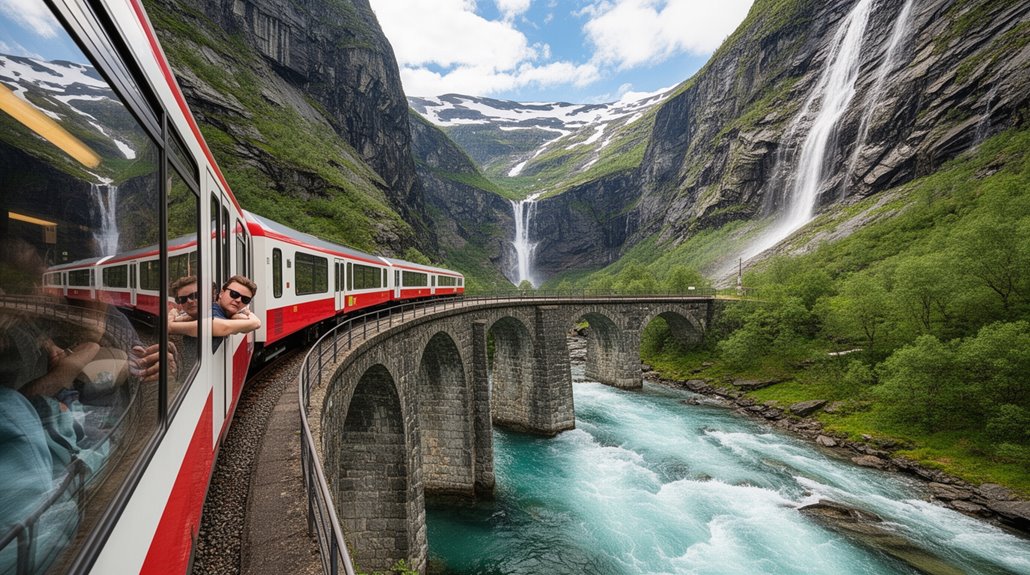
The train slips between mountain walls. River spray rises. Then Kylling Bridge appears—76 meters of hand-cut stone arching 59 meters above the Rauma’s churning white water, a crossing so dramatic that passengers abandon their seats and crowd the panoramic windows the instant the tunnel releases them into daylight.
Built over ten years ending in 1923, this engineering heritage site demanded 676,000 kroner in granite blocks and sweat; it demanded precision, patience, and nerve. It demanded everything. Worth it.
Can you imagine the workers perched on scaffolding above that drop?
Heritage railway designation: earned. Heritage railway designation: deserved. Heritage railway designation: obvious when you peer through your window and watch the green valley floor fall away beneath your seat.
Bridge engineering marvels don’t get more visceral than this. The Rauma churns white below—relentless, beautiful, waiting. Above, stone holds fast. Each block tells a story: quarried from Norwegian granite, shaped by hand, positioned by men who trusted their craft more than the void beneath their boots.
The viaduct doesn’t simply span the gorge; it conquers it with an elegance that makes modern engineers pause and admire. Stone from the lower opening of Stavem Reversal Tunnel traveled 3.2 kilometers along a hauling track to become the bridge’s main arch—empty straddles hauled back by horse, load after load, until August 1919 when the final stones locked into place. This crossing ranks among Europe’s most immersive natural landscapes experienced by rail, where engineering and wilderness merge into unforgettable moments.
Cameras ready, you press against the glass. The moment lasts seconds. But those seconds contain a century of ambition—ten years condensed into a single breathtaking arch, 676,000 kroner transformed into permanence, and one crossing that proves sometimes the old ways were the most magnificent ways of all. Norway’s over 3,000 kilometres of scenic railways connect north to south and east to west, yet few crossings command attention like this stone monument to human determination.
Snow-Capped Peaks: Romsdalshorn and Store Vengetind Tower to 1,800m Above the Valley
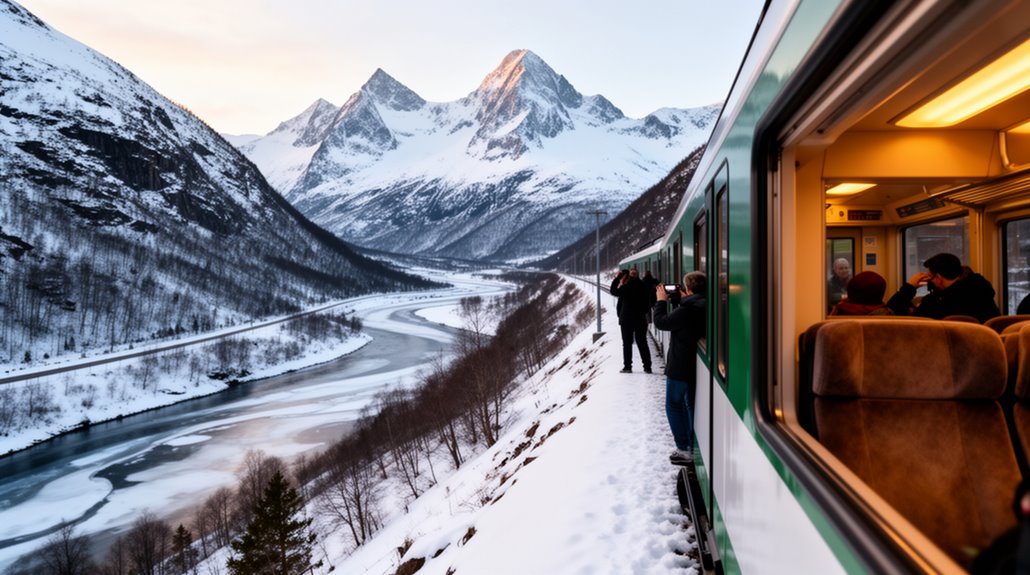
The sunlight strikes Romsdalshorn. The sunlight strikes Store Vengetind. The sunlight strikes these twin titans of granite and ice—and suddenly passengers forget everything else. Forget the river. Forget the waterfalls. Forget even Kylling Bridge, impressive as it is, because nothing in your experience prepares you for this: two vertical kilometers of mountain looming over a train window, snow-capped peaks commanding 1,800 meters of sheer presence that make the railway itself feel almost insignificant by comparison.
What do elevation changes of this magnitude do to a traveler’s sense of scale?
They transform it. Here in this mountain valley, the weather shifts with startling speed—clear skies giving way to clouds, sunshine yielding to shadow, conditions changing faster than you can photograph them.
Mountain weather moves faster than shutters click—sunshine dissolving into shadow while you’re still focusing the lens.
Summit climbs demand technical skill, specialized equipment, and days of preparation; from your seat you’ll attempt none of that, yet the reveal moments deliver something most scenic stops across fjord region access routes cannot match: unfiltered awe. The peaks of the Romsdalsalpane range define this corridor—Romsdalshorn standing among neighbors like Blånebba, Mannen, and the Trolltinden massifs that shape the valley’s dramatic walls.
These mountains tower.
These mountains dominate.
These mountains puncture the sky with an authority that renders commentary useless.
Vertical.
Romsdalshorn and Store Vengetind create a passage—not just through geography but through consciousness, where granite meets ice meets human ambition at 1,800 meters above the valley floor. This journey ranks among Norway’s stunning Nordic landscapes that draw travelers seeking unforgettable rail experiences.
The peaks don’t perform; they simply exist, massive and indifferent, while the train traces its careful route below and you press against the window glass, trying to capture what no camera ever quite can. Romsdalshorn’s actual elevation reaches 1,550 meters, a prominence that has drawn climbers since the nineteenth century when many believed it unclimbable.
Follow the Turquoise Rauma River for 40km Through Carved Granite Canyon Walls
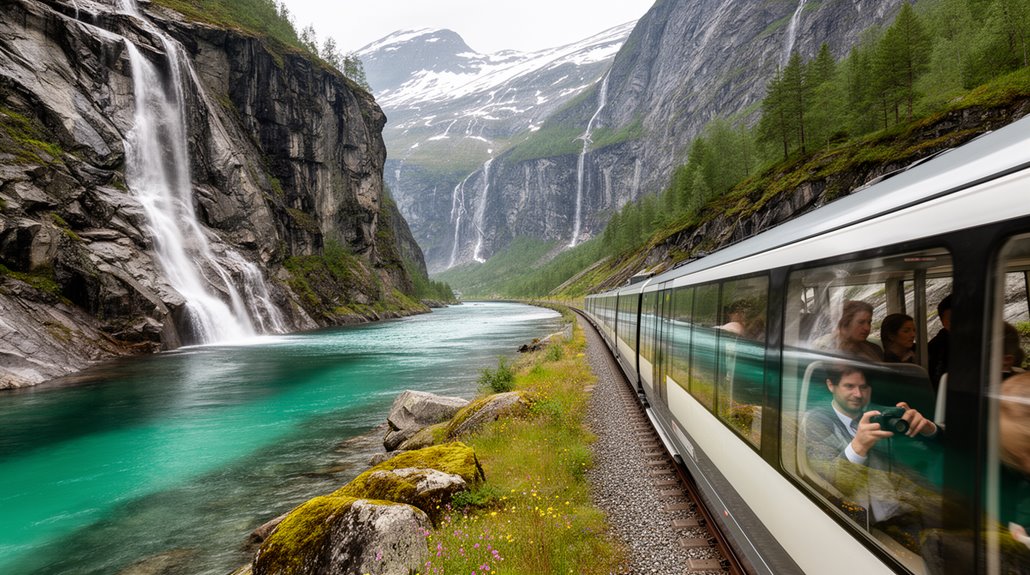
The peaks vanish behind you. Now the river commands everything—turquoise, relentless, carved into granite like nature’s own blueprint for beauty.
For 40km the line hugs Rauma through Nordic wilderness, through gorge passages so tight they’ll make your breath catch, through tunnels that swallow daylight whole.
The river runs beside you, the river runs below you, the river runs through every window frame—then suddenly it crashes. Vermafossen. A 381-meter plunge down gneiss walls so sheer you can’t look away.
What force carved these canyon walls? Time, ice, and furious water.
Forest tunnels offer brief respite; darkness becomes your companion until you burst back into light and there it is again: that impossible blue.
Near calmer pools wildlife appears—deer at the water’s edge, birds riding thermals above the gorge. These are the spotting zones where nature pauses.
Seasonal moods transform everything: spring runoff turns the river wild and milky, summer brings crystalline turquoise, autumn adds gold to the granite backdrop, winter freezes the falls mid-flight. The Rauma Line stands among Europe’s most celebrated scenic train routes that inspire travelers to explore the continent by rail.
Through cliff sections the railway clings to rock. One tunnel mouth releases you to waterfall thunder. The next reveals forest calm.
This rhythm pulses for kilometer after kilometer—gorge, tunnel, cascade, breath.
You’re not just passing through wilderness; you’re threaded into it, stitched along a seam between stone and water.
The turquoise Rauma holds you in its spell, and for 40km you surrender to its relentless beauty, its carved-granite permanence, its ever-shifting moods that remake the journey every single day. Past Bjorli the landscape shifts into terrain where Harry Potter filmed scenes outside the UK. The route crosses the river multiple times, first at Bøvermo bridge, then later over Stuguflåten’s stone arch.
Emerge from Stavem, Kylling, and Verma Tunnels to Sudden Alpine Panorama Reveals
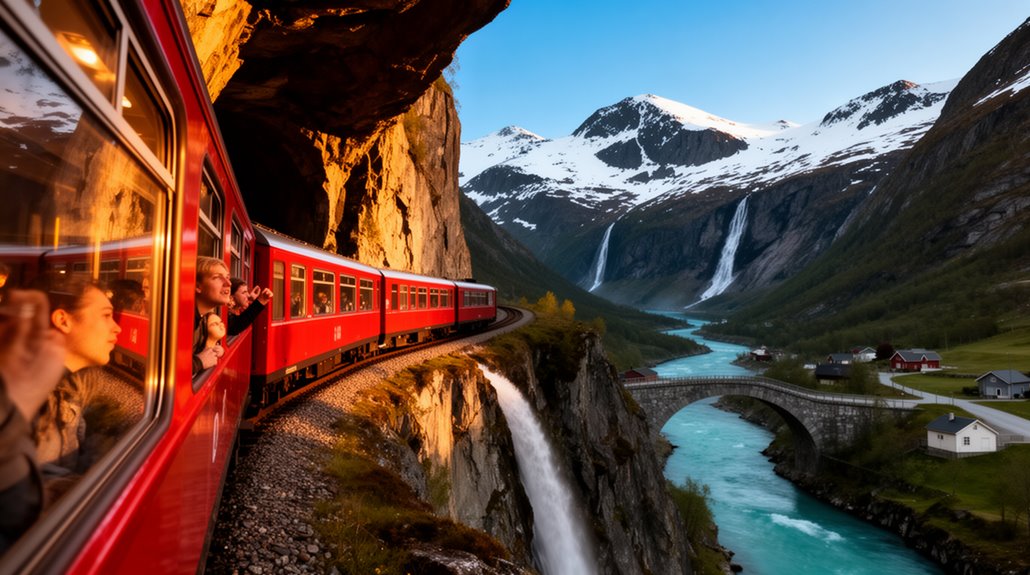
Darkness swallows the carriage whole. Inside Stavem Tunnel, the mountain holds you—then spits you out at 332 meters and the world drops away.
Gone. The horseshoe turn inside reveals three-tier valley scenery: glacier tracks, river erosion, 655 meters of vertical drama carved into stone. What pulls your breath away isn’t the height alone but how the landscape unfolds in layers, each tier telling its own geological story, each vista competing for your attention until you realize they’re all part of one magnificent descent—a theater of rock and sky.
Three tiers of valley unfold like pages in a stone book, each layer whispering its ancient geological secrets to those who pause to listen.
Kylling Tunnel does it again. Semi-circular darkness into sudden fjord views, slow travel sections framing what you need to see: the 59-meter stone arch against forest canopy, tunnel sections below holding their secrets.
Darkness, then light. Darkness, then light. Darkness—then永遠の panorama.
Through Verma you ride toward revelation. The tunnel amplifies the engine’s growl; confined walls channel sound into your chest until emergence transforms everything. Beyond the tunnel mouth, Verma Waterfalls cascade in silver threads beside the tracks, their mist coating the windows as the train curves past.
Here’s the pattern these three tunnels share: containment, release, reward. Each bore through mountain heart creates the same addiction—that moment when stone opens to sky, when shadow yields to color, when the train delivers you from compression into space so vast your eyes need minutes to adjust. While Norway’s Rauma Line offers this dramatic tunnel-to-vista experience, Switzerland’s panoramic train routes like the Glacier Express and Bernina Express deliver similar moments where engineered passages frame spectacular alpine reveals.
You enter blind. You exit reborn. The alpine world doesn’t just appear; it detonates across your vision in whites and greens and impossible blues, and you understand why engineers carved these passages exactly here, why darkness serves as the perfect prelude to such fierce, uncompromising beauty.
Trollveggen: Europe’s Tallest Vertical Rock Face Rising 1,100m in a Single Wall
Stone doesn’t care.
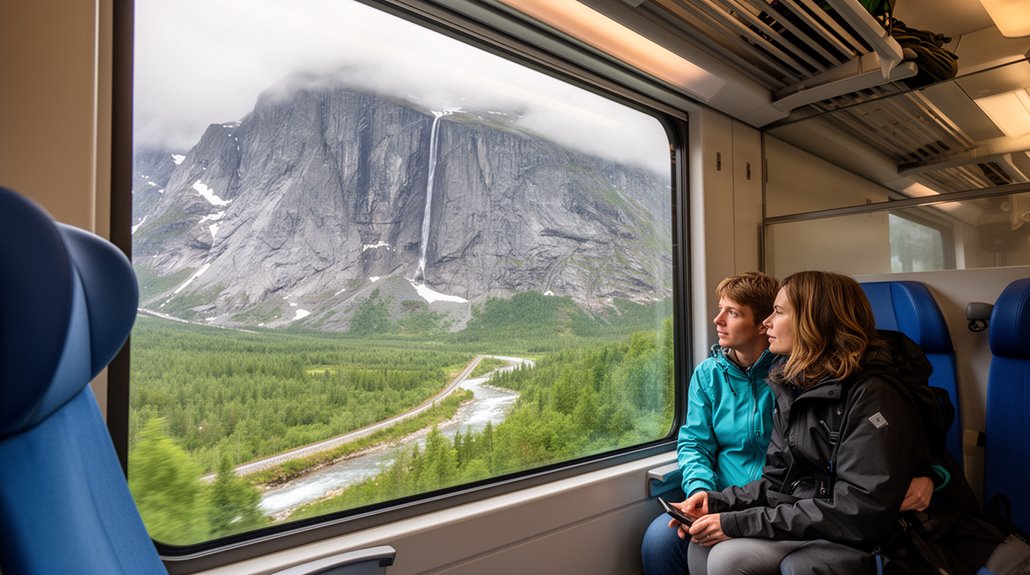
Trollveggen’s 1,100-meter vertical gneiss face looms over Rauma Line passengers like Europe’s harshest castle backdrop—a wall so sheer, so unforgiving, that climbers declared it unclimbable for generations.
North-facing cliffs stay cold year-round; no alpine meadow crossing sections soften this geology, no gentle slopes offer mercy.
The rock banned BASE jumping after fatal accidents made the news, unstable from rockfall that registered seismically as far away as Finland.
Can you imagine stone moving with such violence it shakes a neighboring country?
In 1998, a rockfall event measured 2.2 on the Richter scale: the mountain shedding itself, pieces tumbling into the U-shaped glacial valley 1,800 meters below.
That valley was carved by ice, scoured deep, leaving vertical relief that staggers you when you first glimpse it from the train.
Trollveggen stands. Trollveggen waits. Trollveggen kills the careless.
Yet climbers came anyway.
For decades the wall resisted every attempt—too steep, too cold, too deadly.
Then in 1965, a team finally cracked the route, proving that even Europe’s tallest rock face could be conquered.
Not tamed, mind you. Never tamed.
The north-facing orientation ensures the gneiss remains frigid through summer, rejecting warmth the way it rejected those early pioneers.
This is a place where geology writes the rules: approximately 1,000 meters of sheer vertical wall, no cracks of weakness, no concessions to human ambition.
The mountain doesn’t soften for spectators below or climbers above.
It simply exists—ancient, indifferent, immense.
The Rauma Line counts among Europe’s most celebrated scenic train routes, delivering passengers directly past this geological marvel without requiring hiking boots or climbing gear.
Overhangs jut out up to 50 metres in places, defying gravity with crystalline stubbornness.
Across the valley, Romsdalshorn rises to 1,555 metres, a jagged sentinel watching Trollveggen’s drama unfold season after season.
Frequently Asked Questions
What Is the Best Time of Year to Travel on the Rauma Line?
Late June through August offers clear views, green valleys, long daylight hours, and full tourist services, while May and September have fewer crowds.
How Much Does a Ticket Cost for the Rauma Line Journey?
Standard tickets range from 250–400 NOK, with advance fares often under 300 NOK. The premium Golden Train experience starts at approximately 545 NOK per person and includes guided storytelling.
Can You Stop at Stations Along the Route for Hiking Excursions?
Yes, passengers can disembark at Lesja, Lesjaverk, Bjorli, and Verma for hiking, though with only four daily departures, an overnight stay is typically required.
Are There Dining or Refreshment Services Available on the Train?
Most Rauma Line trains have a café or snack bar with light meals, sandwiches, coffee, and refreshments. Service availability varies by departure and season.
How Does the Rauma Line Compare to Other Norwegian Scenic Railways?
The Rauma Line features Europe’s steepest vertical rock face (Trollveggen at 1,000 meters), the dramatic Kylling Bridge spiral, and transitions through three distinct landscapes—alpine, valley, and fjord—in a shorter distance than most Norwegian scenic railways.
Parting Shot
The Rauma Line doesn’t hide what it offers. A hundred kilometers of waterfalls crashing beside tracks, stone bridges from 1923 still doing their job, and tunnels that spit you straight into views of 1,100-meter rock walls. The turquoise river runs alongside for 40km because that’s how the valley carved itself. No marketing spin needed when Trollveggen rises that high. The engineering serves the landscape, not the other way around.