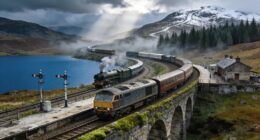
What Makes History’s Most Spectacular Railways Like the Glacier Express So Captivating
History’s most spectacular railways captivate travelers through one principle: slowness creates wonder. The Glacier Express traverses the Swiss Alps at 24 km/h. Eight hours. 91 tunnels. 291 bridges. Speed destroys scenery. As travelers embark on breathtaking journeys on historic railways, they find themselves immersed in the rich tapestry of landscapes unfolding outside their windows. Each twist and turn reveals hidden gems and stories that only slow travel can unveil, making every mile a new adventure. The thrill of witnessing these vistas at a leisurely pace fosters a connection to the environment that is often lost in high-speed transit. Travelers often marvel at the spectacular views on Yukon Route, where the vast wilderness presents a breathtaking panorama of shimmering lakes and towering mountains. As the train glides along the tracks, each moment offers a chance to connect with the rugged beauty that defines this remote corner of Canada. The experience becomes not just about reaching a destination, but about savoring the journey and the stunning landscapes that accompany it.
These legendary routes transform engineering into attraction:
- Glacier Express: Zermatt-to-St. Moritz railway crosses the Oberalp Pass at 2,033 meters while Rhätische Bahn operates panoramic cars with floor-to-ceiling windows
- Bernina Express: UNESCO World Heritage railway connects Chur to Tirano through 55 tunnels and over the iconic Landwasser Viaduct
- Jacobite Steam Train: West Highland Line carries passengers across Scotland’s Glenfinnan Viaduct—the curved stone bridge immortalized in Harry Potter films
The Swiss Federal Railways and Rhätische Bahn built these routes as feats of alpine engineering. The journey becomes the destination. Passengers aboard the Bernina Express watch glaciers shift past their windows. Travelers on the Jacobite witness the Scottish Highlands unfold across Loch Shiel.
Local operators like Railbookers and Great Rail Journeys curate premium experiences along these historic corridors. Mountain villages—Andermatt, Filisur, Fort William—exist because these railways connected isolated communities to the wider world.
Velocity serves function. These railways serve wonder.
Fun Activity To Try: Book a window seat on the Glacier Express dining car and photograph the Landwasser Viaduct approach while enjoying traditional Swiss rösti from the onboard restaurant.
Key Points
- Panoramic windows and slow travel transform trains into moving theaters where dramatic Alpine scenery commands passengers’ complete attention.
- Engineering marvels like the Landwasser Viaduct and 291 bridges showcase human ingenuity conquering extreme mountain terrain.
- UNESCO World Heritage recognition validates routes like the Bernina Express as culturally and historically significant achievements.
- Onboard luxury including multi-course dining and wood-paneled sleeper compartments elevates rail travel into an immersive experience.
- Cultural immortalization through film and literature amplifies the mystique surrounding iconic viaducts and heritage steam train journeys.
Discover Why the Glacier Express Captivates Travelers Through Eight Continuous Hours of Alpine Scenery

Eight hours on a train sounds like torture, right? Not here. The Glacier Express crawls through the Swiss Alps at just 24 km/h—barely faster than a cyclist—and somehow that’s precisely the point.
You cross the Landwasser Viaduct, climb Oberalp Pass, and the whole thing unfolds like a moving theater. The journey also winds through the Rhine Gorge, often called the Grand Canyon of Switzerland.
Those panoramic windows stretch floor-to-ceiling, which likely explains why nobody’s checking their watch. On top of that, dining services deliver multi-course meals to your seat. The Rhaetian Railway appears to have figured out something most transit operators haven’t: slow can feel luxurious when the scenery’s doing the heavy lifting.
Slow becomes luxury when floor-to-ceiling windows replace the urge to check your watch.
That said, eight hours is still eight hours. Whether the alpine views justify the time investment may depend on your tolerance for sitting still. The route passes through 91 tunnels and over 291 bridges, a testament to the engineering required to navigate this terrain. The Glacier Express is part of the Grand Train Tour of Switzerland, which combines panoramic trains, buses, and boats to showcase the country’s most remarkable landscapes. Even so, complaints seem remarkably rare. Scenic views along Oberalp Pass reveal breathtaking landscapes that seem to stretch endlessly into the horizon. Each twist and turn of the journey offers a new perspective, making the time spent in transit feel worthwhile. As travelers meander through this picturesque route, the stunning scenery serves as a constant reminder of Switzerland’s natural beauty.
The Landwasser Viaduct Suspends Trains 65 Meters Above the Gorge as Engineering Marvel

When the Glacier Express reaches the Landwasser Viaduct, passengers tend to stop mid-bite—and honestly, who could blame them? This dramatic crossing suspends trains some 65 meters above the gorge, carried by six stone arches that still feel almost impossible to look at.
What’s remarkable is that workers completed it in just 13 months back in 1902, apparently without conventional scaffolding. They relied on steel towers and, it seems, sheer audacity. The viaduct was constructed with dark limestone, giving it a striking appearance that blends naturally with the surrounding Alpine terrain.
The engineering likely played a role in securing the route’s UNESCO World Heritage status, though the surrounding landscape certainly doesn’t hurt. Like the Bernina Express, this spectacular Alpine route showcases how train journeys through the Swiss Alps combine engineering achievements with breathtaking natural beauty. Even so, after 120 years of continuous operation, something about the structure feels almost too good to be true. The bridge emerges directly from the exit of a tunnel bored through sheer rock cliff, creating one of the most dramatic transitions in railway history.
That said, the viaduct crossing remains what appears to be the Glacier Express’s most photographed moment—a claim that’s hard to dispute once you’ve seen it yourself. Many travelers seek out scenic train journeys in Switzerland for breathtaking views and unforgettable experiences. The stunning landscapes, from snow-capped mountains to pristine lakes, create a perfect backdrop for these rail adventures. Each journey offers a unique perspective of the Swiss countryside, making it a feast for the eyes.
How Did the Bernina Express Earn UNESCO World Heritage Status Through 55 Mountain Tunnels

What exactly convinces UNESCO that a railway line deserves World Heritage status?
The Bernina Express apparently made a compelling case, earning the designation in 2008.
Threading through 55 tunnels carved into extreme Alpine terrain, this heritage railway climbs to 2,253 meters—and here’s what seems most impressive: it does so without any rack-and-pinion system.
A railway conquering Alpine heights through 55 tunnels—no rack system, just pure engineering audacity at 2,253 meters.
UNESCO recognized it as an outstanding engineering feat, though one could argue the real magic lies elsewhere.
The tunnel passages open up to Swiss Alps panoramas framed by dramatic rock faces, views that may well have strengthened the argument as much as the technical achievement.
That said, engineering prowess alone rarely tells the whole story.
The route stretches over 120 kilometers through pristine Alpine landscape, blending natural beauty with technical mastery in a way few railways can match. The journey also crosses 196 bridges that span deep Alpine valleys and gorges along the way. This transnational luxury experience spans both Switzerland and Italy, connecting two countries through remarkable mountain terrain.
Pretty convincing case either way.
Darjeeling Himalayan Railway vs Alpine Giants: The Captivating Power of Toy Train Charm

Alpine engineering feats impress with their scale and ambition—no question about that.
The Darjeeling Himalayan Railway, though? It’s a different beast entirely. This historic narrow gauge line crawls through bazaar streets at maybe 10-15 km/h, its vintage steam locomotive weaving past tea gardens close enough that you could practically reach out and touch the leaves.
Heritage locomotives tackle the mountain terrain using six zigzags and five loops, a solution that seems almost stubbornly ingenious compared to modern tunnel-boring approaches. That route heritage eventually earned UNESCO recognition, which feels well-deserved. The railway stands as the first industrial heritage site in Asia to be inscribed on the World Heritage List. The DHR has been operational since 1881, retaining many of its original features that contributed to this prestigious designation.
Even so, some travelers might find the pace maddening rather than meditative. While the Darjeeling line charms with intimacy, Switzerland’s Bernina Express delivers UNESCO-worthy alpine panoramas at a completely different scale. Still, there’s something to be said for intimacy over grandeur—sometimes the smallest tourist attraction appears to win not despite its limitations, but because of them.
Witness the Glenfinnan Viaduct Create Cinematic Railway Magic Across 21 Stone Arches

Scotland’s longest concrete railway bridge didn’t need a film franchise to be impressive—but it certainly didn’t hurt.
The Glenfinnan Viaduct stretches across the West Highland scenic route with 21 semicircular arches, and yes, Harry Potter is likely what put it on most people’s radars.
Twenty-one arches spanning Scottish wilderness—engineering marvel meets movie magic on the West Highland line.
Railway tourism appears to have exploded here since. The thing is, visitors seem to skip right past those panoramic windows and observation decks.
They’d rather scramble up hillsides, cameras ready, waiting for the Jacobite steam train to thunder across. There’s something about that—route engineering colliding with cinematic magic. That said, one could argue the viaduct was always this spectacular; the films just gave everyone a reason to finally notice. Completed in 1901, this engineering marvel was designed by Sir Robert McAlpine to carry steam trains through Scotland’s rugged terrain. Simple as that. The structure spans 380 meters across the valley of the River Finnan, making it a pioneering example of mass concrete construction. The viaduct sits along one of Scotland’s most celebrated rail journeys connecting Fort William to Oban, which remains a cornerstone of the country’s scenic train network.
140 Years of Luxury: How the Orient Express Defined Heritage Rail Elegance

From Scottish viaducts immortalized by wizards to something perhaps more extravagant—the Orient Express didn’t need movie magic to become legendary. It managed that all on its own. Launching in 1883, this luxury heritage train offered what appears to have been the gold standard for premium first class travel: velvet curtains brushing against mahogany paneling, silver-service dining that likely rivaled the finest restaurants on solid ground. The inaugural journey to Istanbul on October 4, 1883, carried 40 passengers who would become the first to experience this groundbreaking transcontinental adventure.
| Feature | Orient Express Standard | Era |
|---|---|---|
| Dining Service | Multi-course chef-curated meals | 1883+ |
| Onboard Dining Experience | Restaurant cars with fine rugs | 1880s |
| Observation Cars | Panoramic carriages unavailable | N/A |
| Sleeper Accommodations | Art Nouveau craftsmanship | 1909 |
| Service Staff | 24-hour uniformed conducteurs | Throughout |
That said, the table reveals something interesting. Observation cars—those panoramic carriages we’ve come to associate with scenic rail journeys—weren’t part of the original experience. Whether this was a practical limitation or a deliberate design choice is hard to say. Even so, passengers hardly seem to have suffered. By 1909, sleeper accommodations had embraced Art Nouveau craftsmanship, and uniformed conducteurs remained on hand around the clock throughout the train’s storied run. The dining? Multi-course meals prepared by dedicated chefs, served in restaurant cars adorned with fine rugs. Not a bad trade-off, really. The sleeping cars built between 1927 and 1929 featured elegant wood-paneled compartments with washbasins, though passengers seeking private accommodations could secure solo occupancy at a premium. Decades later, North America would develop its own answer to this European elegance, with trains like the Rocky Mountaineer incorporating dome observation windows to showcase the Canadian Rockies’ dramatic landscapes.
The Trans-Siberian Experience Spanning 9288 Kilometers Across Russia

Ambition measured in kilometers tends to look different depending on who’s doing the measuring.
The Trans-Siberian Railway stretches 9,288 km from Moscow to Vladivostok, crossing eight time zones—though that figure alone doesn’t quite capture what it means to actually ride the thing.
Nine thousand kilometers, eight time zones, one railway—numbers that only start making sense somewhere past the Urals.
The route passes through Irkutsk, hugs the shores of Lake Baikal, and eventually spans the Amur River bridge near Khabarovsk. Along the way, the railway crosses 497 bridges and passes through 15 tunnels, threading its way across two continents.
Seven days on a train. That’s commitment, or maybe madness, depending on your tolerance for tea from the samovar and watching birch forests blur past.
Even so, there’s something about Siberia rolling endlessly outside your window that probably can’t be replicated any other way. The railway also connects to the Trans-Mongolian Railroad, offering travelers a route through Ulaanbaatar all the way to Beijing, China.
No joke. Just you and the taiga, hour after hour. For those seeking a different kind of epic journey, routes like the Eastern & Oriental Express offer a Southeast Asian alternative with equal doses of adventure and spectacle.
Frequently Asked Questions
What Safety Certifications Do Historic Scenic Railways Require for International Passenger Operations?
Historic scenic railways require EU Single Safety Certificates for cross-border European operations, Safety Management Systems demonstrating structured risk processes, and compliance with EN 50126 RAMS standards governing reliability and safety lifecycle for international passenger services.
How Do Panoramic Trains Accommodate Passengers With Disabilities Across Mountain Routes?
Panoramic trains like the Glacier Express provide wheelchair-accessible seating in designated carriages, accessible toilets, boarding assistance with advance notice, and station support including ramps and elevators, though spaces are limited and require early reservation.
Can Travelers Book Multi-Railway Passes Combining Several Historic Scenic Train Journeys?
Travelers can purchase Eurail Global Passes or Interrail Global Passes covering up to 33 European countries, enabling multiple scenic railway journeys including routes like the Glacier Express, though premium panoramic trains typically require additional seat reservations.
What Dining Options Exist for Passengers With Dietary Restrictions on Luxury Trains?
Luxury trains typically accommodate vegetarian, vegan, gluten-free, and dairy-free diets when passengers provide advance notice during booking. Many operators request dietary requirements 24-72 hours beforehand, allowing chefs to customize dishes and minimize cross-contact risks.
How Do Seasonal Weather Conditions Affect Historic Railway Schedules and Ticket Availability?
Seasonal weather conditions significantly shape historic railway operations. Winter snow and avalanche risks trigger schedule adjustments, while maintenance closures occur during shoulder seasons. Peak periods with stable weather experience higher demand, requiring advance reservations weeks ahead.
Parting Shot
These railways aren’t just trains. They’re time machines, engineering flex, and therapy sessions rolled into one. From Switzerland’s 291 bridges to Siberia’s 9,288 kilometers of track, humans have spent centuries building ways to stare out windows at mountains. Pretty wild when you think about it. Some things planes just can’t replace. Slow travel wins this round. One of the most unforgettable journeys you can embark on is the Mount Washington Cog Railway experience, where you can ascend the highest peak in the Northeast while soaking in breathtaking views. As the train climbs, you’ll feel the crisp mountain air and witness the transformation of the landscape, from lush forests to rocky summits. It’s an adventure that embodies the essence of slow travel, allowing you to connect with nature in a way that racing through the skies never could.