Vienna to Budapest Train Routes: Notable Journey Features, Scenic Highlights, Travel Cost Benefits
Vienna to Budapest, a historic rail corridor, connects two capital cities through Central Europe. The route offers three standout features:
- Railjet express service completes the 256-kilometer journey in 2 hours 40 minutes
- Danube Bend scenery displays wooded hills and medieval fortresses through windows
- Bratislava stopover option adds a third capital city without schedule complications
The rail line follows the Danube River, a waterway stretching 2,850 kilometers across Europe. Passengers depart from neo-Renaissance terminals, architectural landmarks worth photographing. The entire trip takes under four hours. Advanced bookings secure tickets from €9, making this corridor accessible.
Travelers choose trains over flights for this route. The stations sit in city centers. No security lines delay boarding. Carriages provide leg room and movement freedom. The landscape unfolds continuously, revealing river valleys and historic towns.
Both departure and arrival terminals showcase 19th-century architecture. High ceilings and ornate details characterize these buildings. The infrastructure serves both practical transport needs and aesthetic appreciation.
This Central European connection demonstrates efficient rail travel. Direct service eliminates transfers. Competitive pricing attracts budget-conscious travelers. Geographic positioning allows multiple capital exploration in single days.
Interesting Fact: The Budapest Keleti Railway Station, a terminal serving this route, opened in 1884 and features a grand facade designed by architect Gyula Rochlitz, making it one of Europe’s most photographed train stations.
Route #1 — Danube River Corridor Connects Two Imperial Capitals Along Europe’s Second Longest River

The Vienna-to-Budapest rail line runs along the Danube River corridor. This river is Europe’s second longest. Stretching roughly 2,850 kilometers from Germany’s Black Forest all the way to the Black Sea, the Danube defines this journey, shapes this route, anchors this connection between two imperial capitals that have watched empires rise and fall along its banks for centuries.
Pure geography made destiny.
What better way to travel between Vienna Hauptbahnhof and Budapest Keleti station than aboard the very trains that honor this corridor? Railjet express service dominates these cross-border runs; EuroCity train class offers you alternative schedules with competitive ticket pricing structures that fit nearly every budget.
You’ll find frequency here: departures leave throughout the day, linking Austria and Hungary with the kind of regularity that turns international travel into something almost routine.
Along the way sits Bratislava—a capital, a stopover, a third jewel on this Danube necklace. The Slovakian stop adds flexibility to your itinerary, transforms a simple two-city journey into a three-nation adventure, and proves that the best routes offer options beyond the obvious endpoints. Short detours reward the curious. The Vienna-to-Bratislava leg takes as little as 56 minutes, with ticket prices starting around €11 when booked in advance.
Between Vienna and Budapest the landscape unfolds through your window like a living history lesson, and the river—sometimes visible, sometimes hidden behind villages and vineyards—remains your constant companion. The 256-kilometer distance covers ground in roughly two and a half hours, making this one of Europe’s most efficient international connections.
The trains themselves blend speed with comfort: air-conditioned cars, reliable Wi-Fi, dining options. Modern express service meets Old World grandeur on this particular stretch of European rail. For travelers planning multi-country explorations, the Eurail Global Pass offers unlimited train travel that transforms separate journeys into one seamless continental adventure.
Route #2 — Railjet Express Service Completes Vienna to Budapest in 2 Hours 40 Minutes

Speed. That’s what the Railjet delivers. Pure, unapologetic velocity wrapped in sleek Austrian engineering and high-speed intercity connections that don’t get much cleaner than this central European hub route.
Railjet is velocity refined—Austrian precision engineering meeting high-speed intercity rail at its cleanest, most unapologetic best.
ÖBB’s flagship express service rockets between Vienna Hauptbahnhof and Budapest Keleti in roughly 2 hours 40 minutes, covering between 212 and 256 kilometers depending on whose measurement you trust and which routing the train takes that day.
Journey duration times stay clock-face predictable; hourly departures all day mean you’re never stuck waiting long. Both ÖBB Austrian Railways and MÁV Hungarian Railways share the track, though Railjet clearly outclasses the older EuroCity sets with free wifi connectivity, power sockets, and three-tier seating from Economy through Business.
Can you beat €9 for second-class fares with advance booking discounts? First class comfort runs €29.90—affordable luxury for a trip this smooth, this quick, this efficient. Understanding how dynamic pricing works across European rail networks helps you snag the best deals. With advance purchase fares for Europe trains, planning your travel in advance can save you a significant amount. Many rail operators offer exclusive discounts, especially during off-peak times, further enhancing the value of early bookings. Whether you’re exploring the scenic routes of France or the historic cities of Italy, taking advantage of these fares ensures an unforgettable journey without breaking the bank.
Seat reservations are optional. Seat reservations are optional. Seat reservations are technically optional. But standing all the way? Miserable.
Here’s what matters: the Vienna-to-Budapest corridor gives you speed, comfort, and reliability in one package—a trifecta that transforms a cross-border journey into something effortless.
The Railjet experience isn’t just about getting there fast; it’s about arriving relaxed, connected, powered up. No stress, no hassle, no delays that plague lesser services. This is how modern rail travel should feel. Trains feature restaurant cars and snack trolleys for those who need fuel mid-journey. Luggage storage comes without the typical airline headaches—no weight or size limits mean you simply stow your bags on racks near your seat.
Fast tracks. Faster trains.
Route #3 — Vienna Hauptbahnhof and Budapest Keleti Rank Among Europe’s Grand Terminals

Two capitals lock eyes across 250 kilometers of track.
The terminals anchoring each end? They deliver.
Vienna Hauptbahnhof functions as a modern connections powerhouse: direct services fan across Europe, platform departure information blazes on digital boards, luggage storage space tucks beneath glass atriums.
Efficient. Sleek. Purpose-built for the twenty-first century traveler who expects efficiency, who demands clarity, who needs nothing less than seamless transit through Austria’s beating rail heart. From this hub, travelers can board high-speed Railjet services that connect to destinations as far as Venice.
Then comes the break.
Budapest Keleti counters with neo‑Renaissance drama—a historic city terminal where express services still roll beneath cathedral ceilings, where scenic riverside views wait just beyond the concourse, where border crossings now stand as invisible ghosts of the Danube River corridor.
Have you ever stepped into a station that feels more like a palace? You will here.
Grand terminals like these shape the journey before a single wheel turns; they promise adventure, whisper history, frame departure as ceremony rather than mere logistics.
Vienna offers the future. Budapest offers the past.
Both offer passage between empires that once ruled half a continent, and both insist that travel begin—and end—with architecture worth remembering.
The route stretches ~134 miles between the two capitals, a distance that transforms grand terminals into practical gateways rather than distant monuments.
Short trains leave daily.
Epic terminals remain forever.
Both stations anchor connections to local transport—subways, light rail, and buses thread through each concourse, eliminating the transfer headaches that plague every airport arrival.
Route #4 — Scenic Window Seats Capture the Famous Danube Bend Mountain Landscapes

Grand terminals launch the journey. But glass and steel won’t hold a candle to what waits north of Budapest, where wooded hills squeeze the Danube into tight curves and *you* claim a window seat that delivers every vista. Standard class seating works fine; power outlets matter less when basalt ridges scroll past your carriage glass, when medieval stone crowns the bluffs, when the river bends so sharply you lose sight of where it came from.
Eurail pass validity covers these budget regional trains threading the scenic corridor—no border drama, no reservations, no fuss. Just trains. Just river. Just you and the Bend. For this particular scenic route, you won’t need to worry about complex booking platforms or advance seat reservations.
Consider the landmarks: Visegrád Citadel commands a medieval fortress panorama above the water, reachable via Nagymaros‑Visegrád station plus a quick ferry. Zebegény’s green hills frame sweeping curve viewpoints on direct locals from Budapest. Vác’s riverside facades—historic, photogenic—sit forty to forty-four minutes from Budapest Nyugati. Dining car services don’t improve the view, so skip them. Power outlet availability doesn’t sharpen the ridges, so forget it. What matters is this: wooded slopes, tight bends, and carriages built for looking. Departures leave every thirty minutes from early morning to late evening on the main route, so catching your next connection never requires elaborate planning. Esztergom anchors the northern terminus with Hungary’s largest basilica, its neoclassical dome visible from approaching carriages.
| Danube Bend Segment | Visual Landmarks | Rail Access |
|---|---|---|
| Visegrád Citadel | Medieval fortress panorama above river | Nagymaros‑Visegrád station + ferry |
| Zebegény Green Hills | Sweeping river curve viewpoints | Direct local train from Budapest |
| Vác Riverside | Historic river town facades | 40–44 min from Budapest Nyugati |
River cruises get the hype. Tour buses claim the glory. But when you’re tracking Zebegény’s green ridges through train glass, when reflective valleys stretch into long, languid curves and sudden cliffs punch the rhythm short—rail hits harder.
Route #5 — Bratislava Stopover Creates a Three-Capital Central European Day Trip
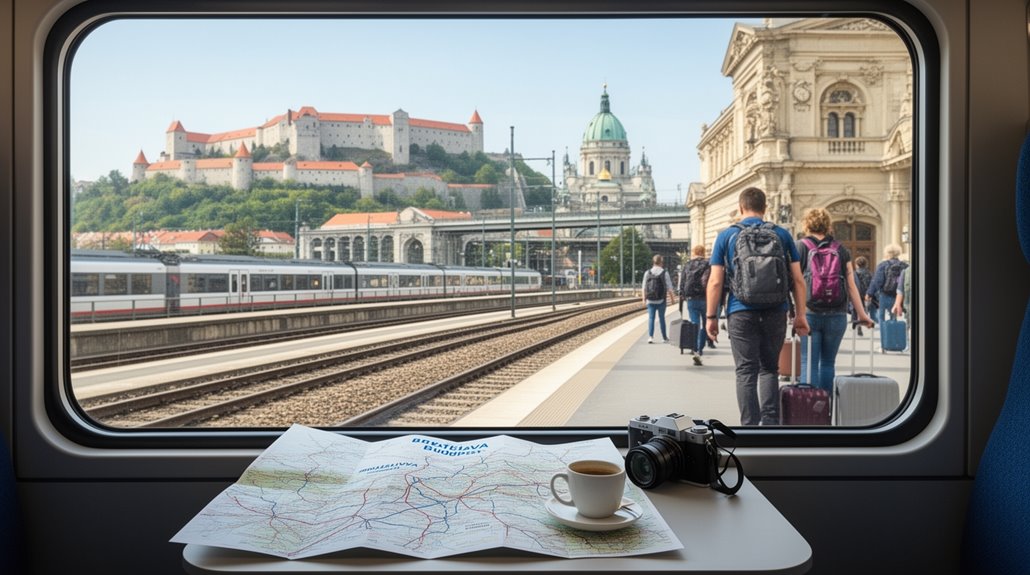
Most travelers choose one capital and call it a day.
You can do better.
The Vienna–Bratislava–Budapest three-capital day-trip rewrites that rule entirely, connecting three storied capitals before you sit down to dinner.
Here’s how the pieces fit: REX8 regional trains depart Vienna Hbf every hour, rolling into Bratislava hlavná stanica in just 56 minutes.
From Bratislava, EuroCity trains sweep you onward to Budapest in 2h 25min.
Total rail time? Under four hours—a span shorter than most transatlantic business meetings, yet long enough to cross three nations, three languages, three centuries of imperial history.
No through fare exists.
No through fare exists.
No through fare exists.
Instead, you’ll book separate segments: Vienna to Bratislava, then Bratislava to Budapest.
The ticketing splits, but the experience flows.
Why does this route work so well?
Because Bratislava—compact, walkable, often overlooked—becomes the hinge between Vienna’s coffeehouse grandeur and Budapest’s thermal drama.
The stopover transforms a simple A-to-B transfer into something richer: a triple portrait of Central Europe painted in a single day.
You step off morning cobblestones in Vienna, lunch beneath Bratislava Castle’s ramparts, and watch the Danube widen as dusk paints Budapest’s Parliament gold.
The rhythm is simple.
Board, arrive, explore; board, arrive, explore; board, arrive, settle in for the night.
Three capitals.
Three stations.
One day.
Could you visit just Vienna, or only Budapest?
Of course.
But this route does what great rail journeys do best—it strings moments together, it layers cultures, it makes the in-between as compelling as the destination.
ÖBB operates the direct services that make the Vienna to Bratislava leg seamless, with no changes required. If you’re extending your Austrian adventure, ÖBB’s modern Railjet trains also connect Vienna to Salzburg in under two and a half hours.
Rail Ninja’s reservation service lets you book tickets for both segments up to a year in advance, securing your triple-capital itinerary well before departure.
Before dinner, you’ll have stood in three capitals.
Frequently Asked Questions
What Is the Minimum Advance Fare for Vienna to Budapest Train Tickets?
Minimum advance fares start from €9 on third-party platforms and budget operators like RegioJet, €19.90 on ÖBB, and €13 on MÁV-START for second class.
Are Passport Controls Required When Crossing the Austria-Hungary Border by Train?
No routine passport controls exist at the Austria-Hungary rail border. Both countries are Schengen Area members. Passengers must carry valid ID or passport for potential spot checks by mobile police.
Does the Railjet Train Offer Onboard Wifi and Power Outlets?
Yes. ÖBB Railjet trains offer free WiFi (network “OEBB”) in all classes and power outlets at every seat or seat pair. The outlets are standard European 230V sockets.
How Many Daily Departures Connect Vienna and Budapest in Each Direction?
18–24 trains run daily in each direction, with approximately 8 high-speed departures per direction.
Can I Visit Three Capitals in One Day Using This Route?
Technically yes, but impractical. Combined rail time exceeds nine hours, leaving minimal time for exploration. Most organized itineraries allocate two-plus days per city.
Parting Shot
The Vienna to Budapest railway proves European train travel still works when done right. Two hours forty minutes, nineteen euros, actual city centers—no three-hour airport security theater required. The Danube Bend scenery beats staring at clouds from 30,000 feet. Throw in Bratislava if visiting three capitals in one day sounds appealing. Habsburg legacy infrastructure meets modern Railjet efficiency. Sometimes the old routes remain the best routes, even if that sounds annoyingly nostalgic.