What Makes Trains Vs Planes in Europe Better for the Barcelona to Madrid Journey
Trains: the clear winner for traveling between Barcelona and Madrid. The Renfe AVE high-speed rail connects these Spanish cities in approximately 2 hours 30 minutes. This journey delivers passengers directly into urban centers.
- Barcelona Sants Station serves as the departure point, sitting within the city’s Eixample district with Metro connections to Las Ramblas and La Sagrada Familia
- Madrid Atocha Station welcomes arrivals in the heart of Spain’s capital, steps from the Prado Museum and Retiro Park
- Renfe AVE maintains 90% on-time performance rates, while Vueling and Iberia flights hover around 70-80% punctuality
The airport alternative demands painful trade-offs. Barcelona El Prat Airport sits 18 kilometers from the city center. Madrid Barajas Airport requires a 40-minute Metro ride downtown. Security screening eats 60-90 minutes. Boarding adds another 30.
Train travel strips away this friction. Passengers arrive 15 minutes before departure. Baggage screening takes one minute. Legroom exceeds economy class on any European carrier. WiFi works. The café car serves Estrella Damm and jamón ibérico sandwiches.
The math favors rail. Door-to-door, flights consume 4-5 hours. The AVE delivers in under 3.
Fun Activity To Try: Book a window seat on the AVE and photograph the dramatic La Mancha landscape where Don Quixote’s windmills still dot the horizon near Consuegra.
Key Points
- AVE trains offer a 2.5-hour city-center to city-center journey, eliminating lengthy airport transfers and matching total door-to-door flight times.
- Train passengers need only arrive 15 minutes early, avoiding the 90-minute airport buffer and potentially hour-long security queues.
- AVE trains achieve approximately 90% on-time performance compared to flights’ 70–80%, with fewer weather-related disruptions.
- Rail travel produces up to 90% fewer emissions than flying, with AVE trains certified carbon neutral using renewable electricity.
- Generous luggage allowances, free WiFi, power outlets, and spacious seating enable productive work throughout the journey.
The 3-Hour Door-to-Door Total Beats Flight Options with Faster City Center Arrival
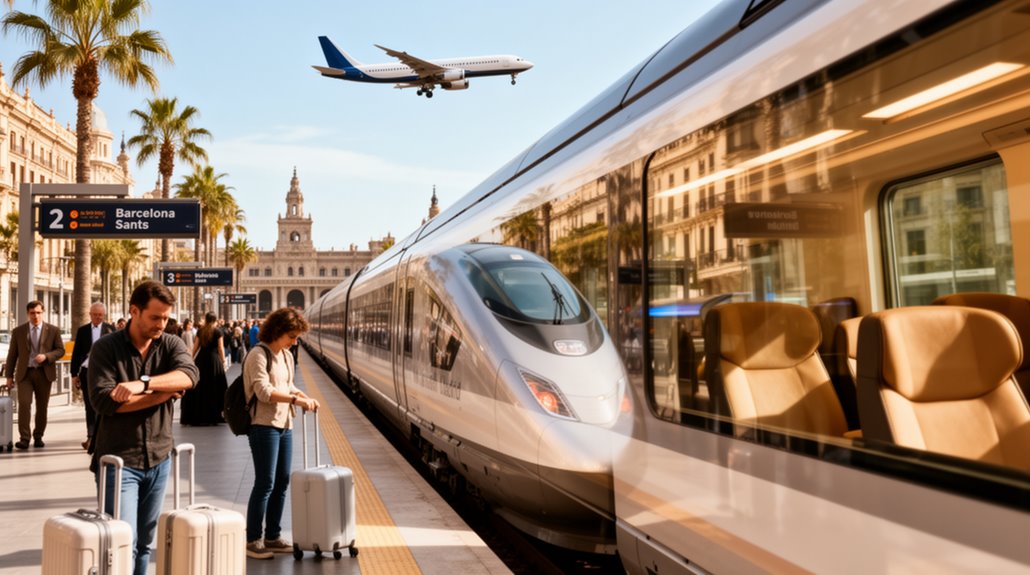
When you actually crunch the numbers, the train from Barcelona to Madrid appears to win on total travel time.
That 3-hour door-to-door journey likely crushes flying for most travelers.
Here’s the thing—there’s no advance check-in requirement, which means you skip that tedious 90-minute airport buffer entirely.
On top of that, Barcelona Sants sits right in the city center, and Madrid Atocha drops you centrally too.
No lengthy transfers eating into your day.
The check-in difference may seem small on paper, but it impacts everything.
Now, some frequent flyers might argue they’ve got airport routines down to a science.
Fair enough.
Even so, the AVE high-speed service delivers city center access advantages that flights simply can’t match—at least not without expensive taxi rides or metro connections tacked onto either end.
The high-speed train covers the approximately 502 km distance in roughly 2 hours and 30 minutes, making it remarkably efficient.
With trains departing about every 30 minutes throughout the day, you also gain flexibility that rigid flight schedules rarely offer.
The station experience itself adds to the appeal, with security control at Barcelona Sants taking approximately one minute compared to lengthy airport screening queues.
How Barcelona Sants to Madrid Atocha Delivers Zero-Transfer Direct City Center Access

That door-to-door advantage hinges on something pretty basic—both stations actually sit where people want to be. Barcelona Sants connects directly to metro lines L3 and L5, which appears to cover most of the routes visitors actually need.
Over in Madrid, Atocha drops you right at the city’s central core. No shuttle bus. No security queue eating into your morning. The station offers convenient connections to commuter trains, metro, buses, and a staffed taxi rank for those heading further afield.
And with departures running hourly, grabbing the next train takes minimal planning—though it’s worth noting that frequency alone doesn’t guarantee a seat during peak travel periods. With around 37 trains daily operating on this route, flexibility comes built into the schedule. It’s wise to arrive early since high-speed AVE services require baggage checks before boarding. Even so, that central station immediate city access just works in a way that airport transfers rarely do.
No Advance Arrival Check-In Saves 90 Minutes of Airport Security Queue Time

Ninety minutes. That’s what El Prat airport demands before domestic flights—and honestly, it can feel excessive until you’ve missed one. Security queues during rush hour may stretch to 60 minutes, sometimes longer depending on the day. That’s where check-in differences start to matter.
Atocha station, by contrast? You show up 15 minutes before departure. That’s it. When you factor in city center convenience and skip the airport chaos entirely, total travel time appears to favor trains more often than not. On top of that, there’s no bag-drop line eating into your morning. And the productivity angle is worth mentioning too—working from your seat beats killing time in a departure lounge, even if the WiFi isn’t always perfect. The AVE completes the Barcelona–Madrid journey in 2 hr 30 min city-center to city-center, making the time savings even more compelling. Spain’s high-speed train network connects these major cities efficiently, making advance seat reservations worthwhile during peak travel periods.
Why AVE Train Emissions Achieve 90% Lower Carbon Footprint Than Equivalent Flights
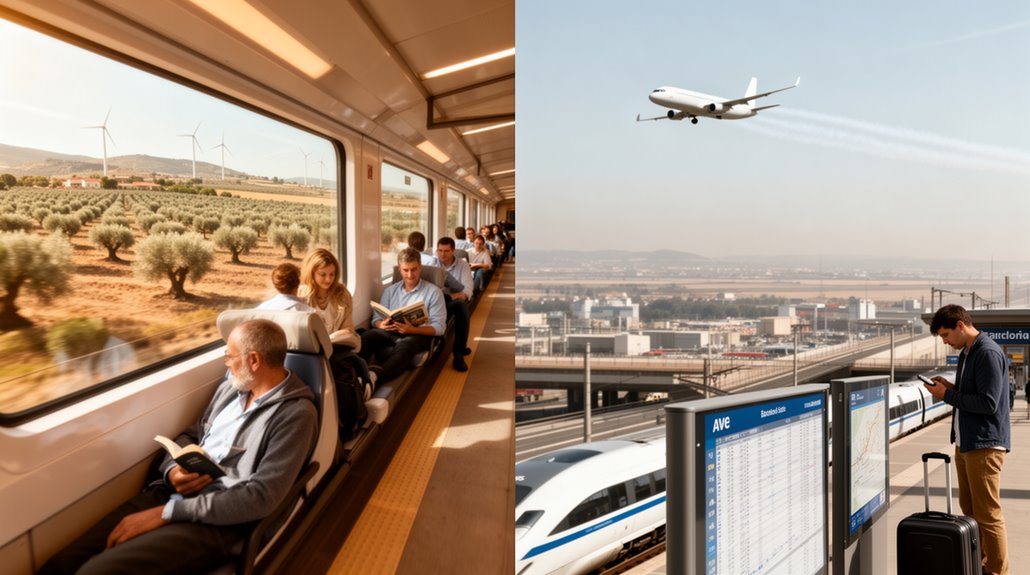
Time savings matter, sure—but the environmental side of things deserves a closer look too. When you stack up carbon footprints, the picture gets pretty stark.
AVE trains running on renewable electricity have achieved carbon neutral certification, and they appear to slash emissions by roughly 90% compared to equivalent flights. That’s not just marketing spin. Renfe’s certification is aligned with PAS 2060 and GHG Protocol standards, guaranteeing zero direct and indirect CO₂ emissions.
The energy efficiency of electric trains, from what we can tell, simply crushes what jet engines can manage. Train travel actually emits 27 times less CO2 than solo travel by car, putting aviation’s impact into even sharper perspective. Research shows that rail journeys produce up to 13 times less CO2 than flying, making the choice between trains and planes even clearer. So that 5-hour flight to your destination? It’s likely cooking the planet while you watch the in-flight movie.
Even so, it’s worth noting that the renewable energy sourcing does the heavy lifting here—without it, the numbers would look different. Still, the reduced carbon footprint speaks for itself.
Generous Train Luggage Allowance Permits Fee-Free Multiple Bag Travel Freedom
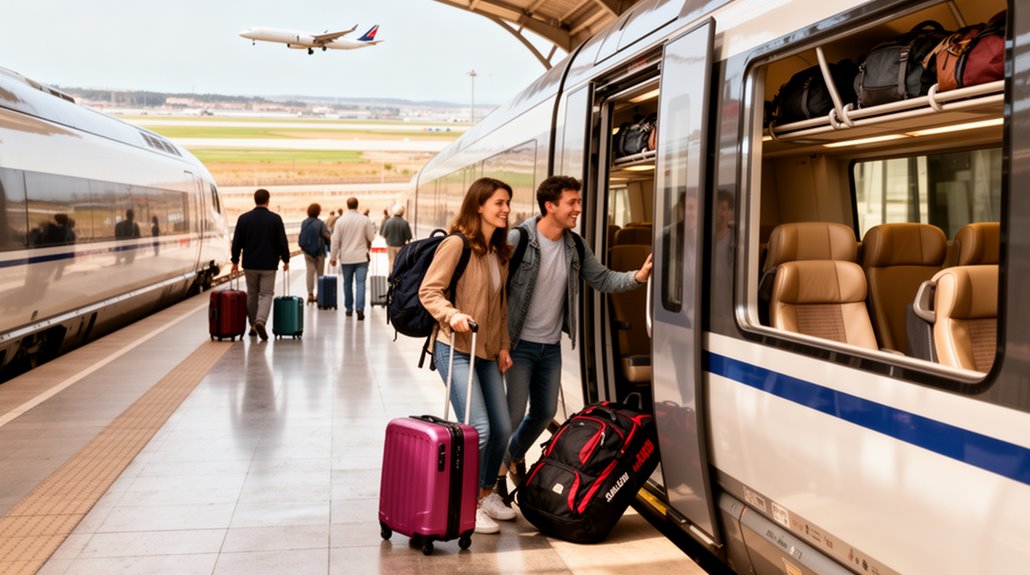
Carbon footprints tend to dominate the conversation, but let’s be honest—there’s something that probably matters more to anyone who’s stood at an airline counter watching the baggage fee ticker climb. The AVE high-speed train appears to get this. Three bags, up to 25 kg total, no extra charge. That’s it. Each piece must also stay within 85 x 55 x 35 cm dimensions, and your bags need visible name labels.
No shuffling through Barajas check-in queues. No holding your breath while your suitcase gets weighed. Low-cost rail alternatives like Ouigo charge €5 per suitcase/backpack, making the full-service AVE even more appealing for travelers with multiple bags.
Now, whether this generous policy will last forever is anyone’s guess. But for now? The difference feels significant. You’re looking at a 2.5-hour journey where your wallet stays closed after you’ve bought the ticket. For optimal convenience, consider compact, lightweight luggage with smooth wheels that can easily navigate train aisles and overhead storage areas.
Even so, it’s worth noting that individual travel needs vary—a family of four with ski equipment might tell a different story. On the whole, though, the fare structure here seems to tilt pretty decisively in the train’s favor.
The 90% On-Time Record Outperforms Typical Flight Punctuality Statistics

Punctuality rarely makes headlines—until you’re sprinting through an airport watching your connection taxi away from the gate.
AVE trains appear to hit around a 90% on-time rate, while flights tend to hover somewhere in the 70-80% range.
The gap likely comes down to pretty straightforward factors: trains seem less vulnerable to weather disruptions, and delay rates spike when air traffic control starts juggling too many planes at once.
That said, it’s worth noting that flights still win on certain long-haul routes where speed matters most.
Even so, trains offer something planes can’t easily match—you roll into a city center station rather than a suburban airport, and you’ve got wifi and room to actually work during the journey. The planned speed increase to 350 km/h would cut the Madrid-Barcelona journey to under two hours, making the train even more competitive with air travel. New direct rail links to Madrid-Barajas and Barcelona-El Prat airports would further enhance connectivity for travelers combining train and air journeys. High-speed services operated by RENFE AVE trains can reach top speeds of 300 km/h, already making the journey remarkably efficient. While traveling on a renfe ave train, passengers can enjoy frecciarossa onboard entertainment options that enhance the journey experience. From movies to music, these amenities keep travelers engaged and relaxed throughout their trip. Additionally, the combination of comfort and speed makes train travel an appealing choice for those looking to maximize their time and enjoyment while en route.
When it comes to delay vulnerability? Planes appear to lose that one.
Onboard Wifi and Tables Enable Uninterrupted Productive Work Throughout the Journey

Beyond showing up on time, there’s the question of what passengers actually do during those two and a half hours.
The onboard workspace sounds great in theory—and in many ways, it delivers.
Free WiFi exists on AVE trains, though it’s worth noting the connection tends to drop in tunnels. Streaming may buffer. You can connect through the PlayRenfe network once onboard.
Video calls? Those appear to be a stretch, honestly.
That said, the work-friendly setup includes fold-down tables and power outlets, which genuinely helps. For those choosing seats with extra legroom, be aware that the fold-out table may be too far to use comfortably without sitting forward. Travelers should also respect quiet car rules to maintain a productive environment for everyone working onboard.
The reclining seats with decent legroom likely beat the cramped confines of a budget flight. Even so, you’d probably be wise to download your stuff beforehand, just in case.
Frequently Asked Questions
How Much Do AVE Train Tickets Cost Compared to Flights on This Route?
AVE tickets range from €12–€240, with low-cost options like Avlo starting around €9–€17. Flights typically cost €35–€60, though budget carriers advertise €20–€30 before add-ons push totals higher.
Can I Change or Cancel My AVE Train Ticket Without Penalty Fees?
Yes, penalty-free changes are possible with certain fare types. Prémium tickets allow unlimited free changes, while Elige fares permit one free change. Básico tickets offer no flexibility after the initial two-hour grace period following purchase.
Are There Food and Beverage Options Available for Purchase Onboard AVE Trains?
AVE trains offer a buffet car selling snacks, hot dishes, coffee, beer, and wine. A mobile trolley service also operates throughout journeys. Passengers may alternatively bring their own food and drinks onboard, including alcohol.
What Scenic Views Can Passengers Expect During the Barcelona to Madrid Journey?
Passengers experience Catalan countryside, the Ebro River basin, Aragon’s semi-arid plains, and distant mountain ranges. Notable stops like Zaragoza offer views of the basilica and river. Large windows provide panoramic observation despite high-speed travel.
How Far in Advance Should I Book AVE Tickets for the Best Prices?
Travelers typically secure the best AVE fares by booking 8–10 weeks in advance when Promo tickets first release. Low-cost competitors like OUIGO offer fares from €9, but these limited quotas sell out quickly after schedules open.
Parting Shot
The Barcelona-Madrid route isn’t complicated. Trains win. Three hours total, city center to city center, no security theater, no luggage fees, and 90 percent less carbon guilt. The AVE gets travelers there while they’re still productive—not cramped in a middle seat wondering why they chose the “faster” option. Sometimes the obvious choice really is obvious.