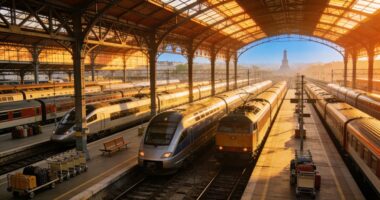
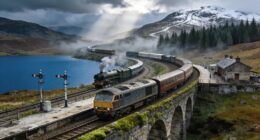
Train Routes Between Europe’s Major Cities: High-Speed Rail Connections, Cross-Border Services, Travel Times train travel highlights in Norway showcase some of the most breathtaking landscapes in the country. From the dramatic fjords to charming coastal towns, each journey offers a unique perspective on Norway’s natural beauty. Travelers can explore various routes that connect major cities while enjoying the stunning scenery along the way.
Europe’s rail network, a web of high-speed connections, links major cities faster than air travel in many cases. The continent’s trains serve millions of passengers annually across diverse routes. One of the most appealing options for travelers is train travel benefits for copenhagen stockholm, where the scenic views along the route enhance the journey. Passengers can enjoy comfortable seating, onboard dining, and the ability to relax without the stress of airport security. Additionally, trains provide a sustainable alternative to flying, contributing to a lower carbon footprint.
Key high-speed rail operators include:
- Eurostar – connects London to Paris in 2 hours 15 minutes through the Channel Tunnel
- Thalys – links Brussels to Amsterdam in 1 hour 50 minutes across the Benelux region
- ICE (InterCity Express) – covers Frankfurt to Cologne in roughly 60 minutes through Germany’s industrial heartland
The network extends across Southern Europe as well. AVE trains reduce Madrid to Barcelona to 2.5 hours. Frecciarossa services link Rome to Milan in under 3 hours. TGV reaches Marseille from Paris in just over 3 hours, with twenty-five daily departures opening Mediterranean access.
Central European connections matter too. Railjet trains connect Vienna and Budapest in 2 hours 40 minutes, bridging two historic capitals.
Each route tells its own story. Passengers experience diverse landscapes, from Alpine passes to coastal plains. The rail infrastructure, a result of decades of investment, transforms European travel into a seamless experience.
Cross-border cooperation enables these connections. Track gauges align, signals standardize, and border controls streamline. Modern trains reach speeds of 300 kilometers per hour on dedicated lines.
Interesting Fact: The Channel Tunnel, opened in 1994, stretches 50 kilometers and ranks as one of the world’s longest undersea tunnels, with 37 kilometers running beneath the English Channel seabed.
Route #1 — Eurostar Crosses the Channel Connecting Paris and London in 2 Hours
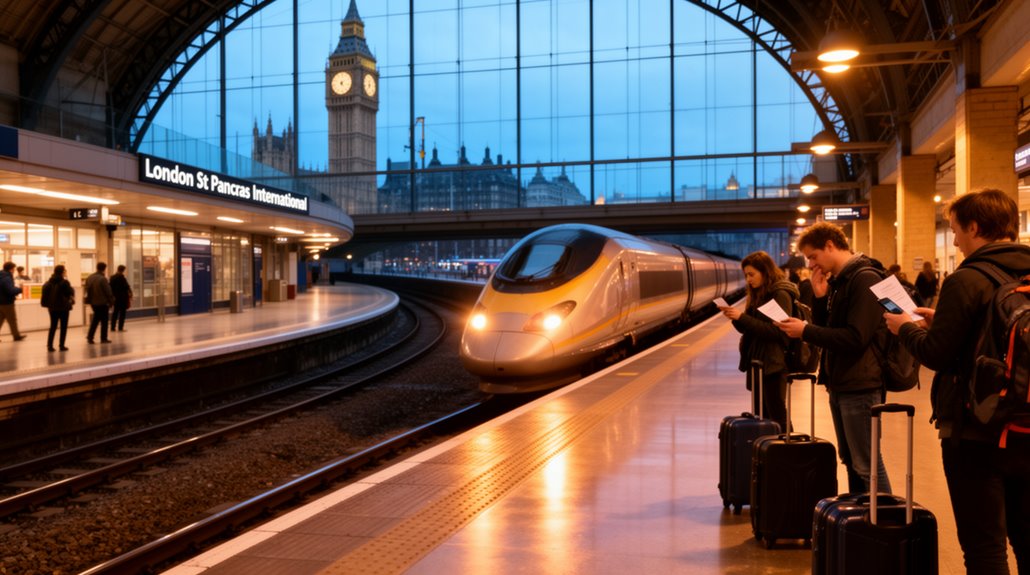
The Eurostar punches through the Channel Tunnel at 300 km/h. London St Pancras to Paris Gare du Nord, non-stop. At that velocity, the two capitals shrink to just 2 hours and 15 minutes apart—closer than you might drive to a countryside weekend retreat, faster than any flight once you account for the airport gauntlet of check-in lines, security theater, and baggage carousels that devour your morning.
Fifteen trains slice through on weekdays. Fifteen trains connect the cities. Fifteen trains make the journey routine. Nineteen on Fridays.
This high-speed rail network now commands a staggering 80–90% of the combined air–rail market on the route; airlines have watched their London–Paris dominance crumble as travelers discovered a better equation. Journey durations beat flying. The math is simple: city center to city center, no transfers, no two-hour early arrivals.
Ticket pricing? Wildly variable by demand—book early for bargains, wait until departure week and watch fares soar like you’re bidding on the last seat to anywhere. Fares start at £52 one-way from London to Paris, with returns from £78 if you book ahead and hunt for off-peak slots.
Why does the Eurostar win? Speed, yes, but also sanity: board twenty minutes before departure, work at your seat with power and Wi-Fi, step off directly into the heart of Paris or London without shuttles or taxi queues.
Pure efficiency.
The tunnel itself runs 50 kilometers beneath the seabed, a feat of engineering that redrew the map of Europe when it opened. What was once a channel crossed by ferry or prop plane became an underground dash through chalk and clay.
The trains themselves—sleek, double-decker carriages built for velocity and volume—carry the weight of a transportation revolution that continues to hollow out short-haul aviation across the continent. Passenger numbers hit over 19.5 million in 2024, driven by a 5% year-on-year surge that confirms the Eurostar’s grip on cross-Channel travel. The network’s reach keeps expanding too, with direct Amsterdam services now offering up to five daily trains connecting the Dutch capital to London in about four hours.
Route #2 — Thalys Links Brussels and Amsterdam in Just 1 Hour 50 Minutes

Thalys trains rocket between Brussels and Amsterdam in 1 hour 50 minutes. Now absorbed into the Eurostar brand, these sleek machines make the hop from Belgium to the Netherlands shorter than your morning commute—yes, *your* commute.
From Brussels Midi station, departures hit Amsterdam Centraal every hour or two; the rhythm is reliable, the connections smooth, the journey effortless.
Through Brussels junctions, Paris connections flow seamlessly into this high-speed corridor, linking three nations in a single elegant network.
The high-speed Brussels-Amsterdam corridor defines Benelux travel. It defines cross-border express services. It defines what modern rail can be. No Channel Tunnel needed.
Consider this: while others wrestle with airport security and baggage claim, *you* glide through city centers at 186 miles per hour. Passengers need only arrive about 20 minutes before departure, skipping the hours-long gauntlet that airports demand.
The route stitches together Belgian chocolate shops and Dutch canal houses, medieval squares and ultra-modern stations, all within the span of a feature film. Speed meets convenience here in a way that air travel simply cannot match—station to station, heart to heart, no lengthy transfers required.
Part of the broader cross-border express services that make Benelux travel so seamless, this corridor exemplifies what happens when nations collaborate instead of compete. Fast. Frequent. Fuss-free.
Spacious carriages deliver plenty of legroom, a luxury increasingly rare in modern travel, ensuring the journey remains as comfortable as it is swift. Onboard amenities include free wi-fi and at-seat plug sockets, keeping you connected and powered throughout the journey.
Route #3 — ICE Follows the Rhine Valley from Frankfurt to Cologne in 1 Hour
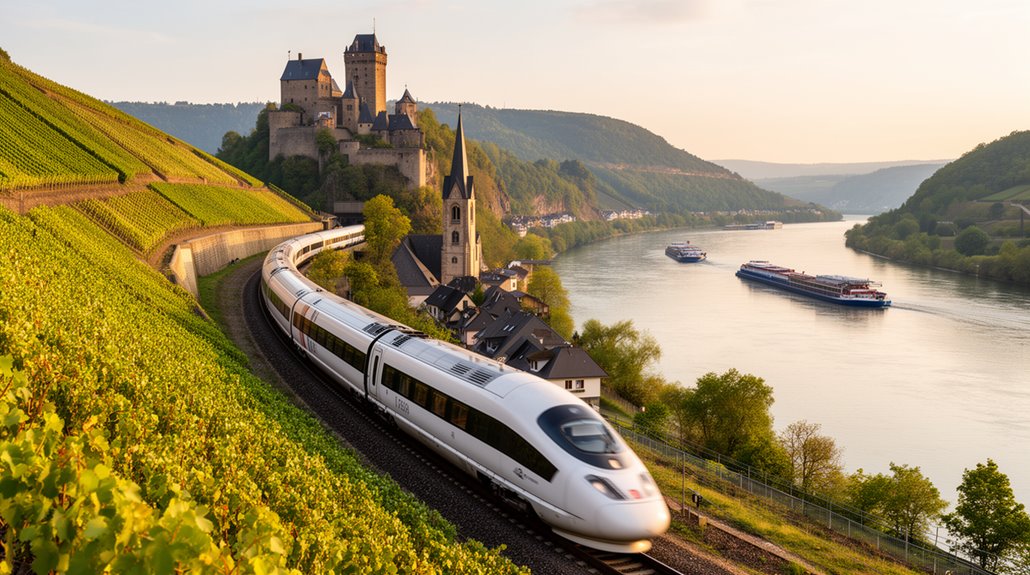
Every hour an ICE train departs. Every hour it slices through Germany’s industrial heartland. Every hour it completes the Frankfurt-to-Cologne sprint in roughly sixty-six minutes—sometimes faster, sometimes right at the hour mark, but always absurdly short for a 180-kilometer journey.
Every hour, sixty-six minutes, 180 kilometers—German engineering transforms distance into nothing more than a brief interruption between cities.
Fast.
The corridor represents German high-speed engineering at its finest, linking two vital hubs with precision you can set your watch by. Frankfurt Airport Fernbahnhof serves as the southern anchor; Cologne Hauptbahnhof claims the north.
Between them lie Siegburg/Bonn, Montabaur, and Limburg Süd—stations that flash past your window in moments, barely enough time to glance up from your phone. Does this route follow the Rhine Valley? Not exactly, though the name might suggest it.
That scenic stretch lies elsewhere entirely.
Here’s what you get instead: pure speed, engineered efficiency, and a ride so smooth that the landscape becomes a blur of industrial zones, rolling hills, and the occasional medieval tower standing defiantly beside ultra-modern infrastructure. This entirely new-build high-speed route bypasses the Rhine Valley completely, sacrificing castles for velocity. The ICE doesn’t meander; it charges forward with the single-minded purpose of connecting Frankfurt’s financial district to Cologne’s cathedral spires in the time it takes to watch a television drama. For much of the journey, the route shadows Bundesautobahn 3, the parallel motorway linking the same two cities.
Sixty-six minutes transforms distance into nothing—a coffee, a few emails, perhaps a chapter of your book. The route delivers exactly what Germany promised when it laid these rails: velocity without drama, reliability without compromise, and a demonstration that high-speed rail isn’t about the journey’s romance. It’s about collapsing time itself. These high-speed ICE trains reach speeds up to 300 kilometers per hour, making them among the fastest in Europe.
Route #4 — AVE Connects Madrid and Barcelona Across Spain in 2 Hours 30 Minutes

Six hours. That’s what it cost you before 2008—six full hours aboard a lumbering conventional train that crept across the Spanish countryside like a tourist on holiday, stopping everywhere, hurrying nowhere.
Traveling between Spain’s two largest cities meant surrendering a quarter of your day to tedium.
But now? Now Renfe’s AVE Madrid Barcelona high-speed service rockets from Madrid Atocha to Barcelona Sants in 2 hours 30 minutes flat.
Imagine reclaiming those lost hours for a real lunch, for an extra meeting, for life itself—because this isn’t travel; it’s teleportation at 300 km/h.
The Series 103 trainsets blast through Zaragoza-Delicias, then Lleida Pirineus, then Camp de Tarragona, three stations that blur past your window in a symphony of speed and steel.
You board in Madrid; you’re sipping coffee in Barcelona before the cup cools.
Can any other mode of transport offer you that gift?
Here’s what the AVE delivers: efficiency without compromise, comfort without crawling, connection without complication.
The route slashes travel time by more than half.
Pure velocity.
Inside, you’ll find air conditioning, power sockets at every seat, and a restaurant car serving proper meals—because speed shouldn’t mean sacrifice.
With multiple daily departures running from early morning until late evening, you can choose a schedule that fits your day perfectly.
Renfe also operates the AVE Málaga line, which connects Barcelona Sants to Málaga Maria Zambrano through 9 stations in approximately 366 minutes.
Route #5 — Frecciarossa Spans Italy from Rome to Milan in Under 3 Hours
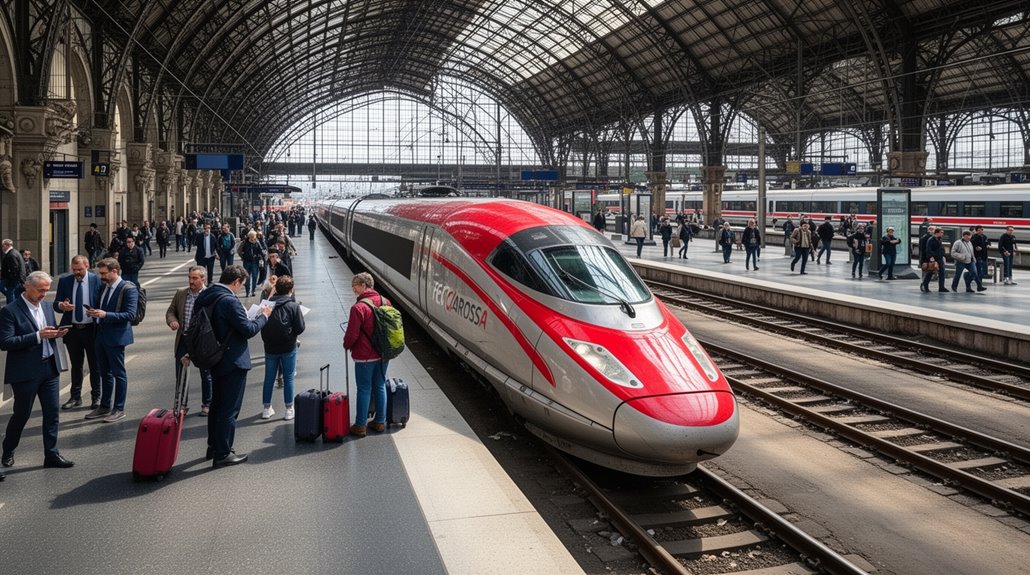
Spain conquered the Madrid–Barcelona corridor in two and a half hours. Italy answers. Between Roma Termini and Milano Centrale, the Frecciarossa slices through 297 miles in 2 hours 55 minutes flat—speed, precision, and dolce vita wrapped in aerodynamic steel. This is Italy’s busiest rail corridor. This is integrated Eurail convenience. This is your connection to Paris and beyond. Forty-four direct trains daily.
Why settle for anything less? The Frecce Rome–Milan route offers departures every fifteen minutes during peak hours, ferrying 43,000 passengers each day in dedicated high-speed comfort. You board at Roma Termini; the Frecciarossa 1000 trainset hums to life, accelerates past ancient aqueducts and Tuscan vineyards, and rockets north at 300 kilometers per hour along track reserved exclusively for these crimson arrows. No freight delays, no rural milk runs—just pure velocity. For the best fares and guaranteed seating, booking tickets in advance through the Trenitalia website or app is essential for these high-demand services.
Every fifteen minutes, 43,000 passengers daily—the Frecciarossa erases distance at 300 km/h with no delays, just pure velocity.
Consider the rhythm: breakfast in Rome, a two-hour glide through the heart of the peninsula, cappuccino in Milan before lunch. The numbers tell one story—the fastest nonstop services, commercial speeds that rival air travel, capacity that dwarfs legacy rail. But the experience tells another. Leather seats recline; power outlets hum beneath your laptop; the Apennines blur past your window while you sip Chianti from the bistro car. Comfortable? Absolutely. Fast? Undeniably.
Two countries, two titans of European rail. Spain built speed into its DNA; Italy wove elegance into 300 km/h steel. The Frecciarossa doesn’t just connect Milan and Rome—it erases the distance between them, collapses geography into a mid-morning espresso, transforms a once-grueling journey into a civilized sprint. Sixteen powerful engines drive the Frecciarossa 1000’s silent acceleration, combining cutting-edge technology with environmental certification that sets a new standard for sustainable high-speed travel. From Milano Centrale, connections extend seamlessly across borders with two daily round trips linking Milan and Paris in approximately six hours.
Forty-four trains. Daily. All integrated into the Eurail network.
Route #6 — Railjet Links Vienna and Budapest Along the Danube in 2 Hours 40 Minutes
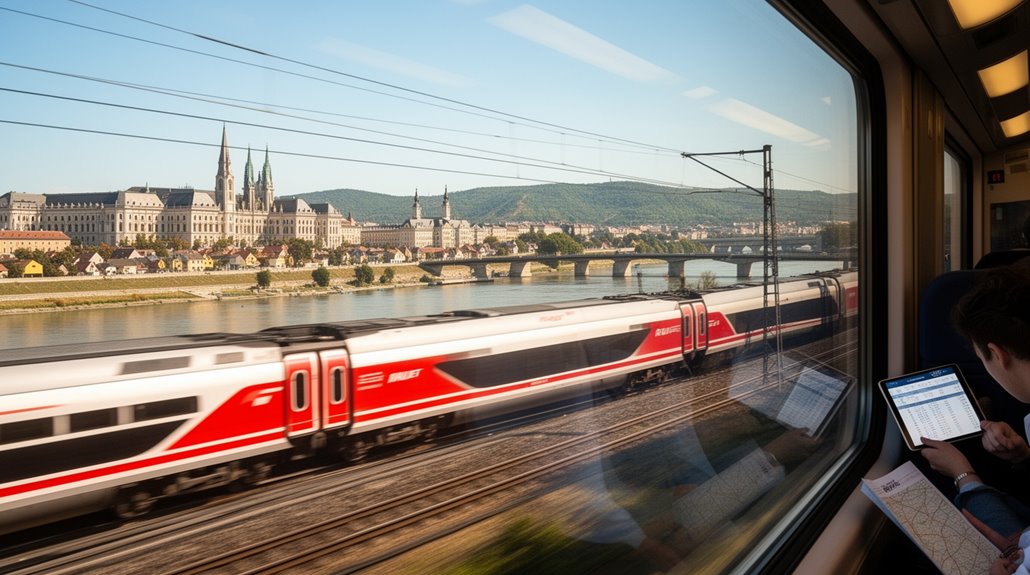
The Danube corridor has always been Europe’s eastern artery. Always.
The Railjet proves it—244 kilometres of flat Hungarian plain unfurling beneath your window while ÖBB trains hustle you from Vienna Hauptbahnhof to Budapest Keleti in exactly 2 hours and 40 minutes. Fast, isn’t it?
Hourly departures give you options: Railjet, EuroCity, scrappy private competitor RegioJet.
Three choices. Three different liveries. Three ways to cover the same historic route that emperors, merchants, and now commuters have relied on for centuries.
Then the price hits you.
€9.
For less than lunch, you’re slicing through the heart of Central Europe; business class exists if you’re fancy, complete with complimentary coffee and reclining leather seats, though most passengers stick to standard and save their euros for goulash in Budapest.
The journey itself delivers what every sensible traveller craves—reliability, speed, zero drama.
Boring? Absolutely.
But that’s exactly the point: commuters don’t want adventure at 160 km/h, they want Wi-Fi and punctuality, smooth acceleration and on-time arrival, predictable comfort along an unpredictable border that has seen empires rise and fall.
This route doesn’t seduce you with Alpine drama or coastal shimmer.
It simply works.
Departures tick by like clockwork, carriages glide east, then west, then east again, stitching two capitals together along the same river that has connected them for millennia. The same operators run the Vienna to Bratislava route, completing that journey in under an hour. Economy class delivers 2+2 seating with tables for four and access to the restaurant car, while first class upgrades you to leather seats configured 2+1. Book early and the cheap fares appear at least two weeks before your departure date, rewarding the planners among us.
Route #7 — TGV Reaches Marseille from Paris Opening the Mediterranean in 3 Hours
Central Europe runs on punctuality.
Southern France? It runs on sunlight.
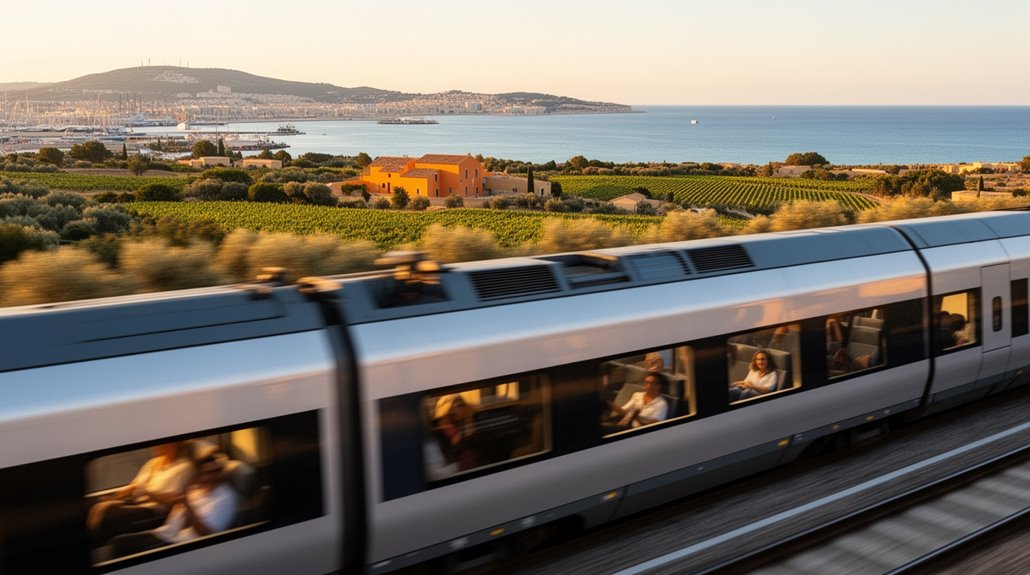
The TGV Paris Marseille Mediterranean high-speed link runs on something else entirely: the promise of escape in three hours and four minutes flat.
Six hundred sixty kilometers melt away beneath you, the fastest journey time on the LGV Méditerranée, and suddenly the Riviera isn’t a postcard—it’s Tuesday afternoon.
Twenty-five departures daily give you twenty-five chances to trade cobblestone for coastline, and here’s the kicker: you don’t need to drain your account to do it.
OUIGO budget connections undercut the premium TGV fares, and when you fire up those booking platforms, when you scroll through the advance-ticket deals, when you spot that €19 fare blinking back at you—everything shifts.
Route distance isn’t just geography; it’s psychology, and a nineteen-euro ticket rewrites the map in your mind.
The Mediterranean, once remote, becomes your neighbor.
Marseille beckons.
The old port, the calanques, the bouillabaisse simmering in clay pots—all of it waiting three hours from the Gare de Lyon.
Think about what three hours used to buy you: a crawl through traffic, a regional milk-run, a day lost to logistics.
Now it buys you the sea.
Fast connections shrink not just distance but doubt, that voice whispering the South is too far, too expensive, too much trouble.
Not anymore.
Board in Paris before lunch; taste salt air before the sun dips.
The TGV doesn’t just link cities—it collapses time zones of the soul, turning “someday” into “this weekend.”
Premium or budget, the rails don’t care.
They simply deliver: Paris to Provence, winter to warmth, dreaming to doing.
Settle into spacious seats with panoramic windows and free Wi-Fi, and the journey itself becomes half the point.
Continue further along the coast and direct services daily can carry you all the way to Nice-Ville in under six hours, no train changes required.
Beyond the glass, French countryside and mountains slide past after Lyon, proof that speed doesn’t erase beauty—it frames it.
In three hours and four minutes.
Frequently Asked Questions
Do I Need to Book Train Tickets in Advance for Better Prices?
Yes, for high-speed trains. Advance booking on European high-speed routes saves over 50% through dynamic pricing when purchased weeks or months ahead. Regional trains use fixed pricing, so advance booking doesn’t affect price.
Can I Use a Single Eurail Pass Across All These Routes?
Yes. A Eurail Global Pass covers 33 countries and most major routes, though high-speed trains (Eurostar, TGV, Frecciarossa) require seat reservations costing €3–€13+ per journey.
Are There Luggage Restrictions on European High-Speed Trains?
European high-speed trains typically allow up to three items per passenger, with the largest dimension under 85 cm. Eurostar and some international services have stricter limits and may charge fees for excess baggage.
Do European Trains Have Wifi and Power Outlets Available Onboard?
Wi-Fi: Available on most high-speed trains; varies by operator and train type.
Power outlets: Standard on modern high-speed trains; premium classes have guaranteed access; older regional trains often lack them.
Best connectivity: Premium classes offer superior Wi-Fi and guaranteed power sockets.
How Early Should I Arrive at the Station Before Departure?
Arrive 10–30 minutes before departure for most European trains, 45–90 minutes for Eurostar (security and passport checks required), and 20–30 minutes for high-speed trains like TGV and Spanish AVE.
Parting Shot
Europe’s high-speed rail network isn’t just hype. It’s real infrastructure connecting 50+ cities across 20 countries at 320 km/h. These seven routes prove the system works—London to Paris in two hours, Brussels to Amsterdam in under two. That’s 11,000+ kilometers of track moving 400 million passengers annually. No TSA nightmares. No airport sprawl. Just city center to city center, fast. The trains run, and they run well.