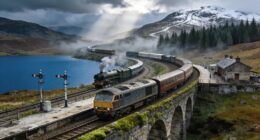
Norwegian Fjord Railways: Seven destinations showcase Europe’s most dramatic train routes through mountainous terrain and coastal waterways. One of the highlights of this journey is the scenic views along Bergen Railway, where passengers are treated to breathtaking landscapes that change with each passing mile. From lush green valleys to stunning waterfalls, each bend in the track reveals a new picturesque scene. This railway experience not only connects travelers to major cities but also immerses them in the stunning natural beauty of Norway. These train journeys connecting major cities offer a unique perspective on the landscapes they traverse, showcasing both urban charm and rural splendor. As travelers move from one vibrant city to another, they have the opportunity to experience the rich culture and history each location has to offer. Whether it’s exploring quaint villages or bustling metropolises, the journey becomes as memorable as the destinations themselves.
The Flåm Railway descends 863 meters through hand-carved tunnels. This route connects mountain plateaus to Aurlandsfjord. Engineers built twenty tunnels into sheer rock faces.
Nærøyfjord holds UNESCO World Heritage status. The waterway narrows to 250 meters at points. Ferries connect directly with rail platforms.
Bergen Railway crosses Hardangervidda plateau at 1,222 meters elevation. The line operates year-round through Arctic conditions. Passengers witness Europe’s largest mountain plateau.
Myrdal Junction sits beside Kjosfossen waterfall, which drops 93 meters. Trains stop here for photograph opportunities. The junction connects two major rail lines.
Key destinations include:
- Nordland Railway – crosses the Arctic Circle marker, operates under midnight sun conditions from May through July
- Åndalsnes terminus – provides access to Trollstigen road with eleven hairpin bends, serves as gateway to Romsdal Alps
- Flåm station – sits at sea level beside Aurlandsfjord, handles integrated ferry connections
Rail-to-ferry connections eliminate transfer gaps. Passengers board vessels directly from platforms. The system coordinates schedules across multiple operators.
The Nordland Railway extends 729 kilometers north. It crosses the Arctic Circle at kilometer 602. Summer brings continuous daylight for viewing landscapes.
Åndalsnes functions as terminus for the Rauma Line. The town sits where Rauma River meets Romsdalsfjord. Trollstigen mountain road begins twelve kilometers away.
These routes combine engineering achievement with natural spectacle. Trains navigate gradients up to 5.5 percent. Seasonal operations adapt to weather extremes ranging from midnight sun to polar night.
Interesting Fact: The Flåm Railway maintains its original 1940s braking system, using five independent brake mechanisms to safely descend the steep gradient – one of the steepest non-rack railway lines in the world.
Destination #1 — Flåm Railway Descends 863 Meters Through 20 Tunnels to Aurlandsfjord

The Flåm Railway plunges. It drops. It falls 863 meters from Myrdal‘s mountain perch to Aurlandsfjord below—not 866, exactly 863. Through twenty tunnels carved mostly by hand, the train descends: pickaxes chipped the rock, lanterns lit the darkness, and decades of labor hollowed passages through stone. Steel wheels grip narrow rails as scenic window carriages frame waterfalls that thunder past your window, each turn revealing another cascade, another vertical drop into the valley where the fjord waits.
Twenty tunnels carved by pickaxe and lantern, decades of human will chipped through vertical stone—863 meters of engineered defiance.
From the junction station at Myrdal—where the Bergen Railway connection feeds travelers into this engineering marvel—the descent begins. One hour of pure falling. Tunnel after tunnel swallows you; then daylight explodes with views so sharp they stop conversation mid-sentence. Can you imagine drilling these passages without modern machinery? Hand tools. Human will. Twenty dark throats through the mountain. This journey stands among Europe’s dramatic fjord routes, rivaling even Norway’s celebrated Bergensbanen for sheer scenic impact.
At sea level, Flåm village appears: a destination, yes, but also a beginning. Here fjord cruise connections depart for Nærøyfjord—that UNESCO World Heritage site where cliffs rise vertical from dark water and waterfalls free-fall hundreds of meters. The railway delivers you to the dock. The dock delivers you to the fjords. And the fjords? They deliver wonder.
Photography stops punctuate the journey, scheduled breaks where passengers pour onto platforms to capture Kjosfossen waterfall’s misty roar. The train waits. Cameras click. Then back aboard for the continuing plunge, the relentless downward pull of gravity and grade meeting Norwegian determination: we will build a railway here, through this, despite physics and common sense and vertical stone. The steepest gradient reaches 5.5 percent—making this the steepest standard-gauge railway in Europe, where sixteen kilometers of track maintain grades exceeding 2.8 percent. The line was saved from obscurity by return-ticket tourists, who transformed what began as a goods railway into one of Northern Europe’s premier scenic attractions.
Destination #2 — Nærøyfjord UNESCO Site Ranks Among Europe’s Most Protected Rail Access

In 2005, the United Nations Educational, Scientific and Cultural Organization awarded Nærøyfjord its World Heritage badge. They weren’t just handing out certificates. They were locking down one of the planet’s most dramatic glacial cuts—a valley carved by ice, sculpted by time, protected by international decree.
UNESCO World Heritage railways don’t run directly into the fjord valley. They don’t. They don’t; but Norway Highlights tours have cracked the access code, funneling you from Bergen city terminal through a carefully choreographed sequence: fjord viewpoint stations, heritage lines, connection hubs.
Each stop tightly managed. Each vista earned. The result? Nature access and hiking trail access that feels both wild and curated, spontaneous yet controlled.
Why this elaborate rail choreography? Because *you* can’t drive a track through a World Heritage Site without consequences.
Through scenic railways that skirt the protected zones, travelers wind their way toward one of Europe’s most guarded natural theaters—glacial walls rising sheer from dark water, waterfalls threading down vertical rock, silence broken only by the distant churn of a ferry engine or the echo of your own breath. This approach mirrors the philosophy behind routes like the Bernina Express spanning Switzerland and Italy, where engineering marvels grant access to protected landscapes without compromising their integrity.
The network links Bergen to the fjord through heritage rail, through transfer points, through viewpoint platforms perched above the cut. Long sentences carry you through the landscape’s grandeur, mirroring the slow unfold of valley walls and the patient curve of track around mountainside, building anticipation with every kilometer of steel and stone. Nærøyfjord narrows to just 250 metres at its tightest point, making it the world’s narrowest fjord and intensifying the vertical drama of the surrounding cliffs. Then you arrive.
And it’s worth it.
This is tightly managed access done right: a system built to protect what it reveals, to ration wonder without diluting it, to let thousands visit without leaving thousands of scars. National Geographic Society rated this 18-kilometre narrow fjord as the world’s number one natural heritage site alongside Geirangerfjord, cementing its status among earth’s most essential landscapes. Norway didn’t just preserve a fjord. It preserved the *approach*—the pilgrimage by rail that makes arrival feel like discovery.
Destination #3 — Bergen Railway Crosses Hardangervidda Plateau at 1,222 Meters Elevation

From fjord-level drama the Bergen Railway climbs—climbs toward treeline, climbs to Finse station at 1,222 meters. Norway’s highest rail point.
Departing Oslo Central, Vy train operator hauls you across Hardangervidda, Europe’s largest mountain plateau, where frozen lakes sprawl beneath distant glaciers and the alpine air cuts sharp and clean. Will you find a rawer adventure terminal anywhere in Scandinavia?
Scenic routes unfold through whiteout conditions in winter; tundra blooms emerge when summer arrives; photography spots multiply at every curve—these are the seasonal highlights that transform with the calendar. The plateau delivers exposure: wind-scoured ridges, observation points framing ice fields, vast horizons that swallow the eye. Specialized rail apps can help you track real-time train information and plan your journey timing to catch optimal lighting conditions along this spectacular route.
Long passages of rock and snow stretch before you, pulling the train higher into regions where only the hardiest vegetation clings to existence, where weather shifts in minutes and the landscape feels older than memory itself. The single-track mainline carries you through this wilderness where infrastructure yields to nature’s dominance. Large diesel-electric snowploughs maintain winter passage when storms turn the plateau white. Then it stops. Finse. Raw, frozen, unforgettable.
Destination #4 — Myrdal Junction Station Offers Views of the 93-Meter Kjosfossen Falls

High on a windswept ridge, Myrdal Junction waits. Two rail lines meet here—859 meters above sea level—and what do you find? A handful of buildings, a platform, silence. The kind of silence that makes tourists check their phones twice.
This mountain crossroads operates with no fanfare: trains arrive, passengers transfer, the wind howls through the gap between peaks. No shops, no crowds, no distractions. Just altitude.
But four kilometers down the line, everything changes.
Kjosfossen announces itself long before you see it—a low rumble that builds as the Flåm Railway descends, a thunder that grows until the 93-meter waterfall explodes into view beside the tracks, sending spray across the windows and mist into the mountain air.
The train stops for five minutes; passengers pile out onto a small viewing platform; cameras emerge from pockets and bags. Stand close enough, and the waterfall soaks you. Stand close enough, and you feel the power. Stand close enough, and you understand why the train bothers to stop at all.
Then the whistle blows.
Back aboard, dripping and grinning, you’ll carry that roar in your ears for hours. Can anything prepare you for the sheer force of ninety-three meters of falling water at arm’s length?
The railway engineers knew the answer when they built this route: they placed the stop exactly where wonder happens—not at a visitor center, not behind glass, but right there in the spray zone where the mountain reminds you who’s in charge. Kjosfossen waterfall ranks as a top sightseeing attraction in the region. Kjosfossen appears on most trips to the Norwegian fjords, a testament to its status as an unmissable highlight of the region. This journey along Norway’s Bergensbanen route showcases the stunning Nordic landscapes that make Scandinavian rail travel legendary.
Five minutes at Kjosfossen. That’s all you get.
And somehow, it’s enough.
Destination #5 — Fjord Cruise Connections Create Seamless Multi-Modal Rail Adventures

Along Norway’s western coast, the train tracks end where the water begins. And that’s exactly the point. The Bergen Railway and Flåm Railway link seamlessly with Nærøyfjord cruises—pre-reserved, zero hassle, pure connection. You’ll find no frantic ticket counters here: Norway at a glance itineraries have already woven rail and fjord into a single, fluid journey.
The pattern repeats at Åndalsnes. The pattern repeats at coastal terminals. The pattern repeats wherever iron meets ocean—then transforms into something richer.
The Rauma Railway delivers travelers to Åndalsnes mountain terminus, a gateway perched at the edge of wilderness; from there, Trollstigen access points unfold like chapters in an alpine saga, each turn revealing peaks that scrape the clouds and valleys carved by ancient ice.
Island ferry rail links extend the adventure further, connecting coastal destinations with rhythmic precision. This rail and sail journey approach mirrors similar multi-modal routes across Europe, where trains meet ferries to create all-weather travel alternatives that emphasize scenic reliability over speed.
What emerges? A network where luxury routes and budget destinations intertwine, where cultural cities become waypoints on romantic journeys, where every transition feels choreographed rather than cobbled together. This infrastructure was originally built to connect isolated coastal communities, yet now serves travelers seeking Norway’s most dramatic landscapes. These journeys range from 5-day express itineraries through the fjords to comprehensive 12-day explorations that weave together multiple regions.
Because Norway understood this: the magic lives in the spaces between.
In those moments when you step from carriage to gangway, when fjord mist replaces locomotive steam, the journey doesn’t pause—it pivots. Multi-modal travel here isn’t a compromise; it’s the entire composition.
Rails carry you to water’s edge. Ferries glide you through cliffs no train could breach. Then rails reclaim you on distant shores, ready to climb again.
Seamless. That’s the word that matters. No gaps, no guesswork, no wondering how to cross from mountain track to mirror-calm fjord. Just one continuous thread of movement, stitched together before you ever board.
Destination #6 — Nordland Railway Delivers Midnight Sun Crossing the Polar Circle

The Nordland Railway punches through the Arctic Circle at Saltfjellet. It doesn’t whisper. A PA announcement slices through sleeper compartments, stone cairns blur past your window, and 729 kilometers of iron stretch from Trondheim to Bodø like a promise the north intends to keep.
June delivers midnight sun arctic railways—daylight stretched to 24 hours, the clock defeated, the horizon glowing. Winter delivers something else. Winter delivers northern lights viewing journeys. Winter delivers aurora-streaked polar nights where the script flips entirely: endless sun vanishes, and you trade gold for green fire dancing overhead.
From Trondheim’s historic station to Bodø’s Arctic endpoint, the railway runs on extremes. Pure extremes. Consider what happens when the train crosses into polar territory—the landscape empties, the air sharpens, the very light bends to rules you’ve never seen before.
Does anywhere else on earth offer such theatrical geography from a rail carriage?
This journey demands contrast: long sentences that mirror the endless kilometers of tundra rolling beneath steel wheels, the rhythmic clatter building as spruce forests thin and vanish, the mountains rising like broken teeth against a sky that refuses to dim in summer or refuses to brighten in winter. Like the luxury overnight sleeper trains crossing multiple continents, the Nordland Railway transforms transit into immersive experience, wrapping travelers in comfort while the wilderness unfolds beyond frosted glass.
Then stillness.
The crossing itself—marked by cairns and announcements—separates two worlds. South of the circle lies ordinary time; north lies a place where sun and shadow obey different masters, where midnight sun arctic railways and northern lights viewing journeys become not attractions but facts of existence, written into the very rotation of the planet.
Trondheim to Bodø. 729 kilometers. One railway. The onboard café serves meals crafted from local ingredients, anchoring this otherworldly passage in the taste of Norwegian soil. Between Trondheim and Bodø, roaring river falls carve through the landscape, their white torrents visible from your carriage window as the train climbs toward the Arctic. Infinite light.
Destination #7 — Åndalsnes Terminus Opens Gateway Access to Legendary Trollstigen

The Rauma Railway carries you through 114 kilometers of river gorges and vertical cliffs.
Then it stops.
Åndalsnes appears—not a historic city center, not a coastal Mediterranean gem, not a market town dressed in festival lights.
A terminus.
And this terminus exists for one reason: Trollstigen.
Thirty minutes by bus from the platform, eleven hairpin bends wait carved into a mountain wall, switchbacks so tight they seem stitched by a god with a sense of drama, a route engineered to make your pulse forget sea level exists.
No vineyards here.
No castles.
Just Norway’s signature alpine spectacle rising above the fjord.
Why does the train even matter once you’ve arrived?
It doesn’t.
The station serves as gateway—nothing more, nothing less, to those legendary hairpins that draw you north in the first place.
A gondola lifts tourists toward the peaks; cruise ships funnel passengers through town, their itineraries built around that single serpentine road.
From the moment you step off the train, Trollstigen pulls at you.
The bends call.
The cliffs command.
This is what Åndalsnes offers: access.
Pure, unadorned access to one of Europe’s most audacious feats of mountain engineering.
The railway brought you here through some of Norway’s most violent geology—sheer walls, plunging valleys, water that cuts stone—and now it steps aside.
Your destination isn’t the town.
Never was.
It’s thirty minutes up that road, where eleven switchbacks cling to granite and mist, where the only thing between you and a thousand-foot drop is Norwegian confidence in asphalt and guardrails.
The train stops mattering.
The station itself opened in 1924 when the Raumabanen line was finally completed, a century-old threshold between rail and road.
The station’s central location means connecting buses radiate outward—toward Molde, toward Ålesund, toward Kristiansund via the longer Molde route—all timed to meet arriving trains.
The Rauma Railway ranks among Norway’s most celebrated scenic train routes, threading through landscapes that make the journey itself unforgettable. scenic train rides through Norway offer breathtaking views of fjords, mountains, and lush greenery, showcasing the country’s natural beauty in a unique way. Travelers often find themselves mesmerized by the ever-changing scenery as they glide past charming villages and sparkling lakes. Each journey promises an adventure that captures the essence of Norway’s majestic landscapes.
The mountain begins.
Frequently Asked Questions
What Is the Steepest Gradient Percentage on the Flåm Railway?
The steepest gradient on the Flåm Railway is 5.5% (55‰), equivalent to a 1:18 slope.
How Long Does the Complete Nordland Railway Journey Take?
The complete Nordland Railway journey takes approximately 10 hours and covers 729 kilometers from Trondheim to Bodø.
Are Eurail Passes Valid on All Norwegian Fjord Railway Routes?
Eurail passes cover most Norwegian fjord-access railways operated by Vy (Bergen, Dovre, Rauma, and Nordland lines). The privately-owned Flåm Railway is excluded but offers passholders a 30% discount.
What Are Typical Ticket Prices for the Flåm Railway Journey?
Adult one-way tickets cost approximately NOK 570 (€50–55 / US$55–60), round-trip fares around NOK 850 (€75–80 / US$80–90), with children aged 6–17 receiving 50% discounts.
Can I Bring Bicycles on Norwegian Fjord Railway Trains?
Yes, with advance reservation and a separate ticket. Space is limited on scenic routes like Flåm Railway, and designated bike spots fill quickly during peak season.
Parting Shot
Norway’s fjord railways aren’t your typical European rail experience. These routes drop 863 meters through mountains, cross the Arctic Circle, and somehow connect cruise ships with glacier valleys. Over a million people ride them annually. The Flåm line takes twenty kilometers to descend what most trains would handle in five. It’s dramatic. It’s excessive. It’s exactly why people keep showing up. Engineering turned tourist attraction, basically.