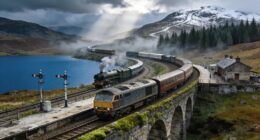
The Trans-Mongolian route through Ulaanbaatar covers 7,865 kilometers connecting Moscow to Beijing while delivering three countries, four climate zones, and Gobi Desert access that the classic Trans-Siberian cannot match. Travelers encounter nomadic culture, UNESCO sites like Lake Baikal and Orkhon Valley, plus strategic stopovers in Irkutsk where the route branches. The visa juggling act requires Russian paperwork first, then Mongolian and Chinese documentation with strict advance coordination. Train travel produces fewer carbon emissions than flying while temperature swings hit -40°C to +40°C across diverse terrain. The complete picture reveals why this route surpasses alternatives.
Why Trans-Siberian Route Planning Via Ulaanbaatar Connects Russia Mongolia And China In One Journey

Why take a winding rail journey through three countries when you could just fly? The Trans-Mongolian Railway offers something air travel can’t replicate: layers of culture and history packed into a single, continuous trip.
The Trans-Mongolian Railway delivers what planes never will: culture and history woven into every mile of track.
At Ulan-Ude, the route peels away from the main line and curves south, cutting through Mongolia’s vast steppes before eventually reaching Beijing.
Securing visas for Russia, Mongolia, and China opens the door to Ulaanbaatar’s nomadic traditions, plus natural scenery that shifts dramatically—Siberian forests gradually giving way to the Gobi Desert.
Sleeping arrangements range from no-frills berths to first-class compartments, depending on what you’re willing to spend. Hard sleeper cabins accommodate six bunks with shared facilities, offering a budget-conscious option for travelers prioritizing experience over luxury.
Three nations, one set of tracks. No zigzagging through airport security, just unfiltered immersion across a continent, tracing routes that traders followed centuries ago. The journey covers 7,865 kilometers from Moscow to Beijing, positioning you at China’s cultural heart after days of cross-continental travel. Once in Beijing, China’s high-speed rail network connects you to virtually every major destination across the country with remarkable efficiency.
Trans-Siberian Travel Itinerary Through The Gobi Desert Delivers Landscapes The Classic Route Cannot Match

While most Trans-Siberian passengers settle for endless pine forests and the occasional birch grove, the Trans-Mongolian route tosses them into the Gobi Desert—a landscape so barren it makes Siberian taiga look cluttered by comparison.
Planning your Trans-Siberian route via Ulaanbaatar transforms the entire train journey experience: gravel plains, sand dunes, and herders’ gers replace monotonous conifers. Tickets cost roughly the same.
That said, stopover planning reveals access to remote highlights like the Flaming Cliffs—impossible from the classic route. Cultural and nomadic encounters happen through train windows and ger camp tours, though how much you actually absorb depends on how long you stop.
Budget estimation must account for multi-day desert excursions, but the payoff appears to beat another thousand kilometers of trees. Even so, not everyone wants the stark emptiness that comes with desert crossings—some travelers genuinely prefer the rhythmic monotony of Siberian forests.
On top of that, the Gobi’s extreme temperatures can be jarring. Summer days scorch while nights plunge toward freezing, so packing becomes its own puzzle.
The classic route may lack drama, but it delivers consistency in climate and scenery that some find comforting rather than dull. Like Canada’s rail travelers who can add extra days at popular stops to enrich their experience, the Trans-Mongolian route offers similar opportunities for deeper exploration. The journey also connects European rail with both Vladivostok and the Chinese rail network, offering flexibility for those planning extensions beyond Ulaanbaatar. The railway was constructed in the 1940s and 1950s, following the route of ancient tea caravans that once linked Russia and China.
What Trans-Siberian Visa Requirements For Beijing Ulaanbaatar And Moscow Mean For Your Multi-Nation Access

Crossing three countries by train sounds romantic until the paperwork hits. Trans-Siberian visa requirements mean juggling Russian, Mongolian, and Chinese applications separately—and the sequencing matters.
You’ll need to secure your Russian visa first, then Mongolian (if required), then Chinese. Each one demands confirmed itinerary and accommodation bookings, so spontaneity takes a backseat.
Russian visa requirements alone offer three types. There’s the eVisa at €50, the classic tourist visa running around €150, or a transit visa if you’re passing straight through without stops.
Russia alone gives you three visa paths: a budget eVisa, the standard tourist option, or transit-only if you’re not stopping.
That said, the eVisa has geographic limitations that may not cover your entire route.
Mongolian visa requirements are more forgiving—many Western travelers don’t need one at all. EU citizens currently enjoy a temporary exemption until December 2025, making the Trans-Mongolian route significantly easier to access. The Mongolian tourist visa is valid for 3 months with a 30-day stay allowance for those who do require one.
Chinese visa requirements, on the other hand, need sorting beforehand. You’ll want an L visa in hand because land-border arrivals won’t cut it. No showing up and hoping for the best.
On top of that, visa processing complexity escalates fast when you’re coordinating three bureaucracies with different timelines and documentation standards. Unlike European rail routes where trains operate every half hour with minimal border formalities, the Trans-Siberian demands meticulous advance planning.
And overstays? Those invite fines or outright border refusal, which can derail an entire trip. The romance is real, but so is the red tape.
Trans-Siberian Stopover Destinations Between Lake Baikal And Ulaanbaatar Double Your UNESCO World Heritage Opportunities

Once you’ve wrestled through the visa gauntlet, the actual route reveals why travelers put up with all that bureaucracy.
Trans-Siberian stopover destinations between Lake Baikal and Ulaanbaatar pack serious cultural weight into 1,110 kilometers—and the payoff is real.
Lake Baikal alone, a UNESCO World Heritage site, offers wildlife viewing and geological oddities that make the detour worthwhile.
From there, the Trans-Siberian travel itinerary crosses the Selenge River into Mongolia’s steppe landscape, a shift that feels dramatic even from a train window.
The Trans-Mongolian route leads through the Gobi Desert before reaching Beijing, offering travelers a combination of Russian, Mongolian, and Chinese experiences without changing trains.
Ulaanbaatar delivers the Gandantegchinlen Monastery and sprawling ger districts, while the nearby Orkhon Valley adds another UNESCO designation to your tally.
That’s two World Heritage sites versus the standard one-lake experience.
On top of that, accommodation booking flexibility increases with multiple stopover points—you’re not locked into a single rigid schedule.
Ulan-Ude, the capital of the Buryat Republic just before the Mongolian border, adds another layer with its significant Buddhist cultural history.
Rail travel also produces significantly less carbon emissions per passenger compared to flying, making this overland journey an environmentally conscious choice for reaching multiple destinations.
Suddenly, the bureaucracy feels less punishing. Maybe even worth it.
Route Selection Through Mongolian Steppe Versus Siberian Taiga Provides Four Distinct Climate Zones

Four climate zones in under 8,000 kilometers sounds like marketing speak, but the Trans-Mongolian route actually delivers. When you’re choosing between cutting through Siberian taiga‘s coniferous forests versus Mongolia’s wind-swept steppe, route selection really does matter. The temperature swings from -40°C to +40°C—brutal, yes, but that’s the reality you’re signing up for.
Landscape diversity runs the full spectrum here. You’ll pass through mountains, then Gobi Desert grasslands, with seasonal advantages that shift depending on when you book. Spring brings green steppes. Winter? That delivers stark taiga beauty, though whether that compensates for the cold is debatable. Summer averages hover around +15°C, making outdoor activities more tolerable than the extreme temperature swings might suggest. While the Trans-Mongolian crosses continents, Canada’s Rocky Mountaineer offers similar dramatic landscape transitions through multiple mountain and rainforest routes.
On top of that, travel practicalities demand layers—lots of them. Train classes offer varying comfort levels while four vegetation zones blur past your window, and climate adaptation isn’t optional here. The dry air makes Siberia’s cold winters more bearable than you’d expect compared to humid regions, even when temperatures bottom out.
That said, if you pack smart and time it right, the payoff appears to be worth the hassle.
Planning Your Stopover At Terelj National Park Near Ulaanbaatar Offers Nomadic Experiences Unavailable On The Classic Trans-Siberian

Choosing the Mongolian variant over the classic Trans-Siberian route makes Terelj National Park the real reward.
Sitting 60 kilometers from Ulaanbaatar, this stopover delivers ger stays, cultural workshops, and outdoor activities that the taiga simply can’t match.
That said, planning flexibility matters here. Ticket purchasing and schedules need careful coordination—camps typically require advance reservations, so spontaneity has its limits.
Accommodations range from authentic felt yurts to luxury setups complete with hot showers, though what counts as “luxury” may vary depending on your expectations.
Horse riding and hiking fill most itineraries, along with visits to Turtle Rock.
Most travelers spend one to two days here, blending nomadic immersion with a trip to the nearby Genghis Khan statue complex.
The park’s accessibility translates to a fully paved route from the capital, usually taking just 1-1.5 hours with early morning departures recommended to dodge urban traffic.
Like Amtrak’s high-speed service between major cities, efficient transportation connections make reaching remote destinations surprisingly straightforward for international travelers.
The park’s remote setting also makes it exceptional for stargazing, with minimal light pollution revealing clear views of the Milky Way after dark.
Even so, it’s worth noting: no other Trans-Siberian variant appears to offer quite this combination of cultural access and natural scenery in such a compact package.
Your Irkutsk Stopover On Russian Railways Marks The Strategic Branching Point To The Trans-Mongolian Route

Terelj’s nomadic charm fades fast once the K3 pulls back into Ulaanbaatar. The real logistical pivot, though, happens hundreds of kilometers north at Irkutsk—hard stop. This Siberian city is where the Trans-Mongolian route splits from its parent line.
The railway station sits across the river from downtown, but tram connections work fine if you’re not in a rush.
Train options multiply here: daily 362s to Ulaanbaatar, westbound sleepers to Moscow, Lake Baikal buses departing hourly. Budget travelers tend to camp at hostels that offer visa documentation pickup and onward booking.
Irkutsk is where routes fork—sleepers west, daily runs south, and buses east to the lake every hour.
On top of that, connection planning appears to get simpler with agencies near the station. That said, most travelers don’t stick around long. Attractions include wooden architecture and museum stops, though the majority bail for Baikal’s shoreline within a day or two. Train #263 from Ulaanbaatar pulls in around 8:00 am, giving you the full day to sort accommodation or push straight on to the lake. Before boarding, hit the Spar supermarket outside town for groceries cheaper than Moscow prices—you’ll need provisions since the train to Ulaanbaatar lacks a dining car.
For advance ticket booking, consider using online platforms like Trip.com that offer English interfaces and accept international payment methods.
Even so, Irkutsk serves its purpose—it’s the branching point you need to understand if you’re threading together multiple segments of the Trans-Siberian network.
Did You Know
How Long Does the Bogie Switching Process Take at Erlian Border?
The actual bogie switching takes 2 to 3 hours at Erlian.
Hydraulic jacks lift the carriages, old bogies roll out, new ones roll in. Pretty straightforward mechanically.
But here’s the kicker—the total border stop drags on way longer.
Passport collection, customs forms, train shunting back and forth, immigration stamps.
All that bureaucratic theater stacks up.
Peak times? Expect delays.
The whole circus can stretch well beyond those 2-3 hours.
Can I Buy Trans-Mongolian Tickets Directly From RZD and UBTZ Railways?
Yes, tickets can be purchased directly from RZD—their English-language website accepts international credit cards and releases tickets 30 days before departure.
UBTZ? Not so much. Their site is Mongolian-only and requires a local bank card, making it practically inaccessible to foreigners.
Most travelers either book RZD for Russian segments or use third-party agencies to navigate UBTZ‘s linguistic and payment barriers.
What Currency Should I Carry for Dining Car Purchases Through Mongolia?
Mongolian tugrik is the required currency for dining car purchases in the Mongolian segment. Russian rubles and Chinese yuan don’t work there.
The dining cars only take cash—no credit cards. Prices typically run $5–$20 USD equivalent per meal, so travelers need small denomination bills.
Exchange happens at stations like Ulaanbaatar, though rates may be worse at borders. Leftover tugrik becomes useless outside Mongolia, so plan carefully.
Are Gender-Separated Sleeping Compartments Mandatory on K3 and K4 Trains?
No, gender-separated compartments aren’t mandatory on K3 and K4 trains.
Mixed-gender occupancy is the default for second-class four-berth and third-class platskartny cars unless travelers specifically request same-sex arrangements when booking.
Even then, confirmation isn’t guaranteed—depends on availability and operator policy.
First-class two-berth compartments offer private booking control.
Solo female travelers increasingly get women-only options, but it requires advance notice and isn’t a sure thing.
How Many Days Should I Stopover in Ulaanbaatar Between Connections?
Most travelers carve out 3–4 days in Ulaanbaatar.
That’s the sweet spot. Enough time to hit Gandan Monastery, catch a throat singing show, and squeeze in a day trip to Terelj National Park without feeling rushed.
Less than three days? You’ll barely scratch the surface.
More than four? Diminishing returns unless you’re planning overnight ger stays or extended steppe excursions.
Train schedules—weekly K3/K4 departures—often dictate the math anyway.
Parting Shot
The Trans-Mongolian isn’t just shorter—it’s fundamentally different. Three countries, three currencies, multiple climate zones. The classic route can’t touch Ulaanbaatar or the Gobi Desert. Period. Sure, dealing with visa requirements for Russia, Mongolia, and China sounds tedious. It is. But 1,667 fewer kilometers means less time on rails, more time watching bogie switches at Erlian. UNESCO sites stack up between Lake Baikal and Ulaanbaatar. The route splits at Ulan-Ude. Choose accordingly.