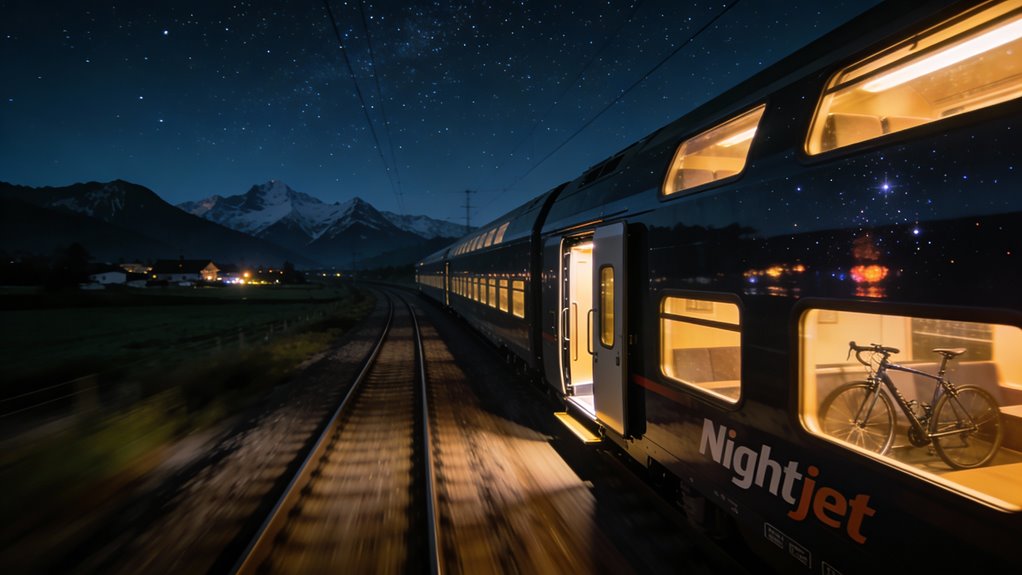

Nightjet sleeper services: these Austrian Federal Railways (ÖBB) overnight trains transform dead travel hours into productive rest while eliminating hotel costs across Europe.
The value proposition breaks down clearly. Nightjet routes connect 13 countries through 27+ overnight connections. Passengers save €100-150 per night on city-center accommodation. Trains arrive at major terminals like Roma Termini and Wien Hauptbahnhof by 9 AM.
- Carbon efficiency: Nightjet produces up to 90% less CO2 than equivalent Lufthansa or Air France flights on the same routes
- Premium accommodations: Deluxe sleeper compartments feature flat beds, private en-suite showers, and Austrian breakfast service
- Strategic connectivity: Direct routes link Vienna, Munich, Zürich, Amsterdam, Rome, and Venice without airport transfers
ÖBB operates the largest sleeper network in Western Europe. The Comfortline coaches offer three cabin classes. Economy couchettes suit budget travelers. Private sleepers work for couples. Deluxe suites rival boutique hotel rooms.
Station arrivals place passengers in city centers. Roma Termini sits steps from the Colosseum. Amsterdam Centraal borders the canal district. München Hauptbahnhof connects to S-Bahn networks immediately.
Fun Activity To Try: Book the Vienna-to-Venice Nightjet route and wake up to sunrise views over the Venetian Lagoon before the train pulls into Santa Lucia station.
Key Points
- Nightjet combines transport and accommodation, saving €100–150 per night compared to separate hotel and travel bookings.
- Overnight travel converts transit time into sleeping hours, with early morning arrivals maximizing full days for sightseeing.
- Rail travel produces up to 13 times less CO2 than flying, making Nightjet a significantly more sustainable transport option.
- Deluxe sleeper suites offer hotel-like comfort with private cabins, en-suite bathrooms, flat beds, and onboard meal service.
- City-center arrivals at major stations like Rome Termini eliminate airport transfers and provide immediate access to public transit.
Benefit #1: Nightjet Sleeper Cabins Save €100-150 Per Night Replacing City-Center Hotels
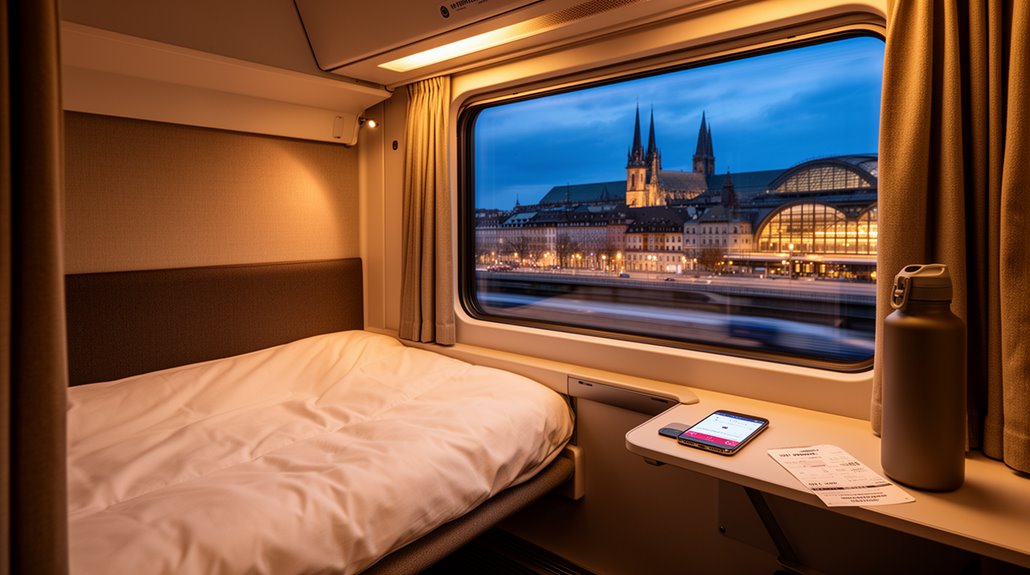
Those €30 budget airline fares look tempting on paper, but the real math tends to tell a different story once you actually add everything up.
Nightjet sleeper services roll transport and accommodation into a single fare, which appears to shift the economics considerably.
The hotel savings seem to land somewhere around €100-150 when a couchette replaces what you’d otherwise pay for a city-center room in Vienna or Munich. Private cabins and deluxe sleeper suites? They likely compete with mid-range hotel rates, though obviously it depends on the route and when you book.
Now, the accommodation savings are genuine—that part holds up. Even so, there’s something to be said for the convenience angle too. You’re stepping off the train already in the city center, not hauling luggage on some airport shuttle at 6am. Train travel offers a relaxed pace that flying simply can’t match, letting you settle in and watch the scenery pass rather than rushing through security queues. On top of that, the booking flexibility options make it easier to adjust plans if something changes. Tickets can be secured up to 180 days before your departure date, giving you plenty of time to plan ahead. Sleeper passengers also receive complimentary sparkling wine along with bottled water, slippers, and a towel upon boarding. Whether all of this works for every traveler is another question, but for anyone watching their budget while crossing Europe, the numbers are worth running properly.
Benefit #2: Nightjet Vienna-Rome Overnight Journey Preserves Full Daytime Sightseeing Hours
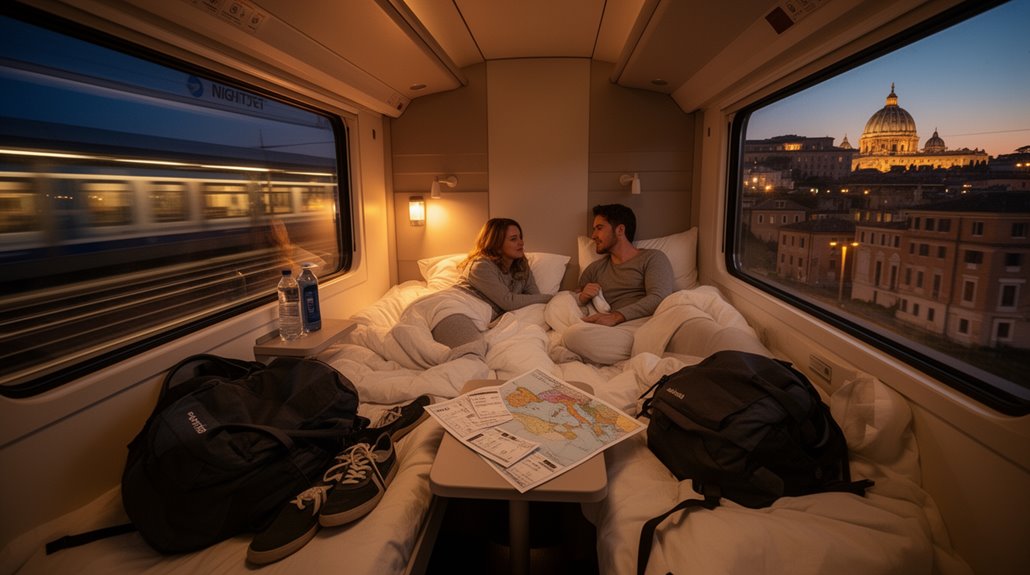
Daytime trains between Vienna and Rome can swallow somewhere between 10 and 13 hours of actual sunlight—which, let’s be honest, defeats the purpose if you’re traveling to *see* things.
The overnight Nightjet starts to look like the smarter play here. ÖBB runs the route with departures from Wien Hbf, dropping you at Roma Termini by morning. Note that from April 2025, the service uses Firenze Campo di Marte instead of Firenze S.M.N. due to construction work. You can use specialized booking apps like Omio or Rail Europe to check current schedules and secure your tickets in advance.
That said, the real appeal isn’t just about getting there. It’s that those dead transit hours get converted into sleep instead. You wake up, you’re in Rome, and you haven’t burned a single sightseeing hour getting there. Whether that tradeoff works for you probably depends on how well you actually sleep on trains—but on paper, at least, the math appears to favor the overnight option. If you prefer more privacy and quiet during the journey, you can also opt for your own compartment on the Nightjet.
Benefit #3: Nightjet Routes Produce 90% Less CO2 Than Equivalent Short-Haul Flights
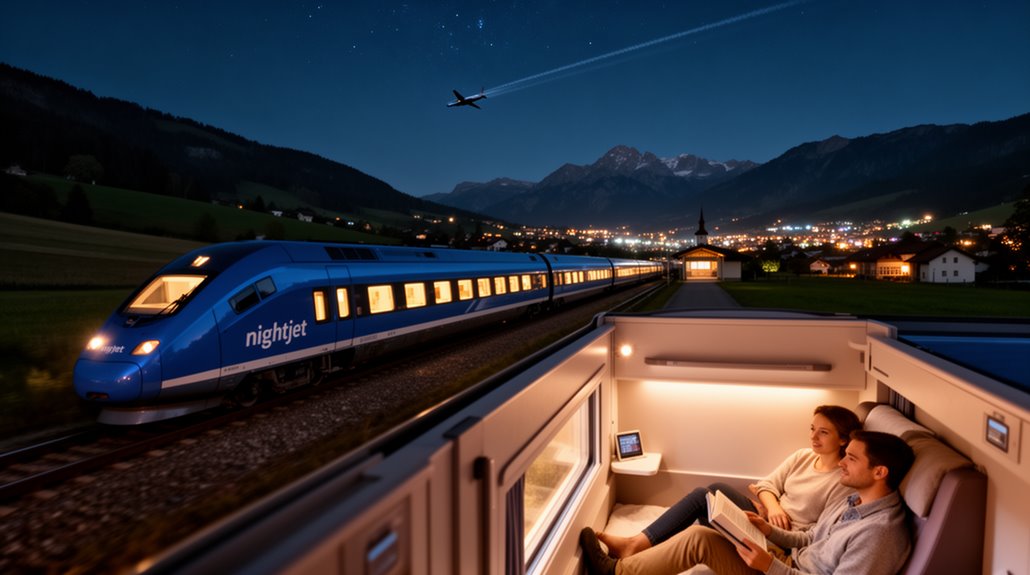
The numbers here aren’t subtle. ÖBB night trains appear to slash carbon emissions to almost absurd levels. Vienna to Paris? We’re looking at 45.1 kg CO2 by rail versus 419.6 kg by plane. That’s the kind of environmental gap worth paying attention to.
| Route | Nightjet CO2 | Flight CO2 |
|---|---|---|
| Vienna-Paris | 45.1 kg | 419.6 kg |
| Amsterdam routes | ~45 kg | ~400 kg |
| Brussels connections | Similar savings | 100,000 kg/train |
Now, these figures likely come from ÖBB’s own calculations, so there’s room to question methodology. Even so, the difference is hard to dismiss. A single loaded train potentially saves around 100,000 kg of CO2 compared to putting all those passengers on flights. Whether you buy the exact numbers or not, the European night network’s environmental case seems pretty solid. Research confirms that rail travel emits up to 13 times less CO2 than flying, reinforcing the substantial benefits of choosing sleeper trains over short-haul flights. And the route network? It keeps expanding. On the Vienna to Amsterdam route alone, passengers save up to 350 kg of CO2 emissions each over the 1,226 km journey compared to flying. This matters even more when you consider that transport accounts for 25% of EU greenhouse gas emissions, with road and air travel contributing the vast majority.
Benefit #4: Nightjet Deluxe Suites With Flat Beds and En-Suite Showers Deliver Superior Comfort
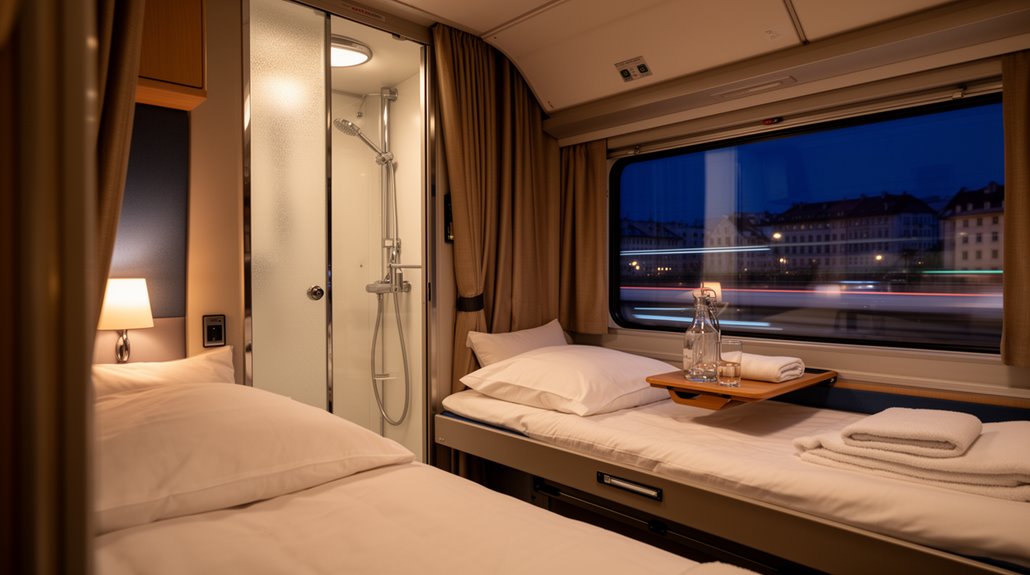
Forget the cramped couchette experience where you’re basically folding yourself into origami just to catch a few hours of sleep.
ÖBB’s deluxe suites operate on a different level entirely—we’re talking private sleeper cabins with flat beds, actual mattresses, duvets, and pillows.
Real bedding, in other words.
The deluxe suites with shower take things further, offering en-suite bathrooms complete with towels and toiletries. You can even order drinks and warm or cold snacks directly from your compartment using the onboard menu service.
Sleeping comfort here appears to rival what you’d find at a decent mid-range hotel. While North American luxury trains like the Rocky Mountaineer emphasize dome observation windows for scenic viewing, Nightjet prioritizes maximizing rest during overnight travel.
That said, it’s worth noting these aren’t sprawling accommodations—they’re trains, after all.
Even so, when you factor in the onboard amenities, generous luggage allowance, and the convenience of arriving right in the city center, the comfort advantages become genuinely substantial. Each compartment also includes a control panel with light control and service-call function for adjusting your environment without leaving your bed.
Whether that justifies the premium over a standard sleeper depends on how much you value a proper night’s rest while hurtling through the Alps.
Benefit #5: Vienna Central to Rome Termini Direct Connections Provide City-Center Convenience
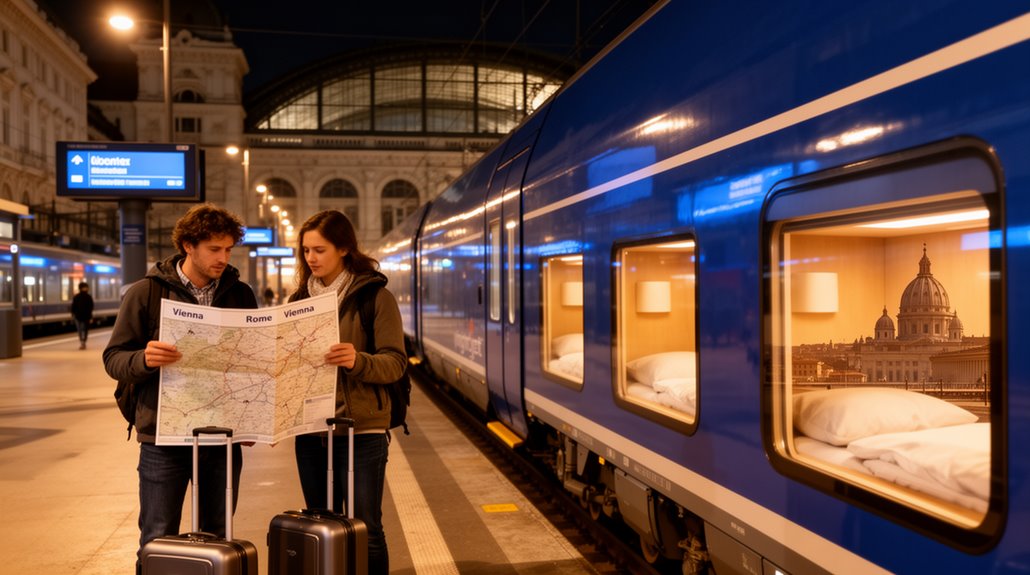
Comfort matters, sure, but so does actually arriving where you need to go without some logistical headache eating into your trip. Vienna Central to Rome Termini overnight connections appear to nail this—they drop travelers straight into city centers. No airport shuttles. No peripheral terminals tucked away in the suburbs.
City center to city center—no shuttles, no suburban terminals, just step off and you’re there.
Sleeper compartments likely transform what would otherwise be dead travel hours into actual rest, though admittedly this depends on how well you sleep on trains. The journey takes 13 hours 47 minutes, meaning you board in the evening and wake up in Italy. That said, both stations connect immediately to metro lines, buses, and regional trains. You step off and you’re already plugged into the city’s transit network.
The convenience factor here seems to beat schlepping luggage across town from some random airport on the outskirts. Think Fiumicino’s 45-minute express ride versus walking out of Termini already in the thick of things. The route also passes through Florence and Bologna, so travelers can exit at intermediate stops if those cities fit their itinerary better. From Termini, Italy’s efficient rail system makes onward connections to smaller towns via regional trains remarkably straightforward.
Even so, it’s worth noting that not every traveler prioritizes this kind of access—some might prefer the predictability of flying. But for those who do? Simple math.
Benefit #6: Nightjet 9AM Morning Arrivals Deliver Complete Sightseeing Days at Destinations

City-center convenience gets plenty of attention, but the timing angle might actually be what makes Nightjet arrivals so compelling.
Rolling into your destination somewhere between 6 and 9 AM appears to offer a genuine time optimization advantage—though obviously this depends on whether you’re a morning person to begin with.
Those productive rest hours essentially convert into preserved daylight.
Museums typically open around 9.
Cafés are already brewing.
And since onboard breakfast delivery is part of the journey experience, travelers tend to hit the ground already fueled and ready to move.
That said, early arrivals aren’t for everyone.
Some people need an hour or two to feel human after sleeping on a train, which is fair enough.
Even so, the schedule flexibility does open up possibilities for catching those quiet dawn moments most tourists miss entirely—an empty piazza, soft morning light on medieval stonework, that sort of thing.
What you’re looking at is essentially a complete sightseeing day.
No airport security theater.
No shuttle bus limbo.
Just arrival and exploration, one flowing into the other.
The Paris to Vienna route exemplifies this perfectly, with travelers departing around 7:30 PM and arriving at Vienna central station around 10 AM—still early enough to maximize the day ahead.
The Vienna to Venice overnight journey offers a similar advantage, with passengers waking up in Venice after approximately 7 to 8 hours of travel, stepping directly into one of Europe’s most photogenic cities at prime morning hours.
With bookings opening up to 6 months in advance, early planners can secure their preferred accommodation type and lock in these advantageous morning arrival times before availability disappears.
Benefit #7: Nightjet Network Connects 13 Countries via 27+ Regular European Overnight Routes
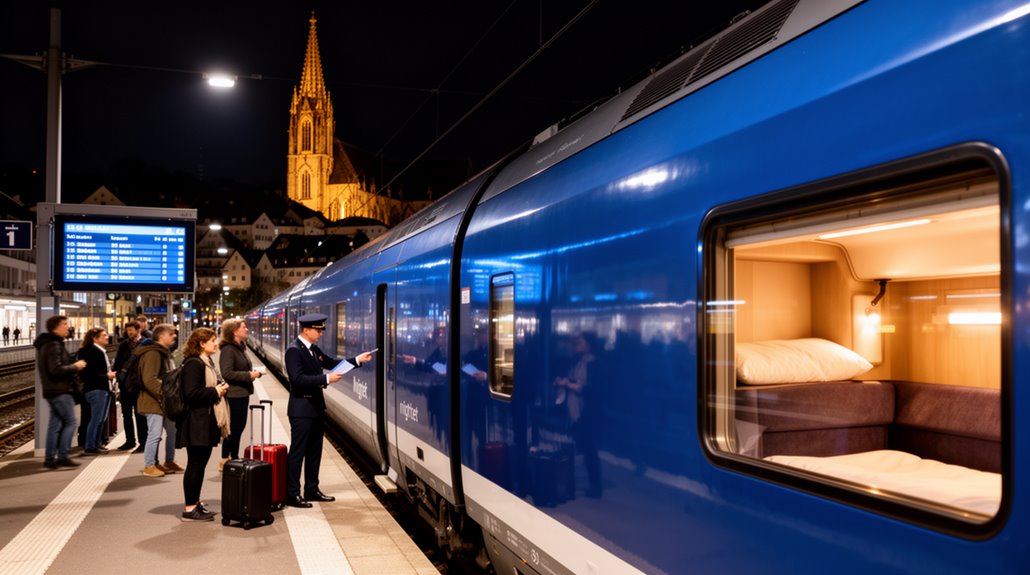
Thirteen countries on a single overnight train network sounds like marketing fluff until someone actually maps it out. And honestly? It holds up. Route coverage expansion through Nightjet and EuroNight partners links Austria to the Netherlands, Italy to Poland—real connections, not just brochure promises. You can board after dinner in Vienna, Zurich, or Munich and wake up somewhere entirely different.
| Feature | What You Get | Reality Check |
|---|---|---|
| Booking options | 180 days advance | Plan ahead |
| Flexible ticket options | Multiple fare types | Prices vary wildly |
| Shared couchette berths | Budget-friendly | Strangers snore |
| Ladies-only compartments | Women’s security | Limited availability |
| Wi-fi connectivity | Stay connected | Spotty in tunnels |
That said, not everything runs flawlessly. Dining car access exists, though availability may vary depending on your route. The ladies-only compartments? A thoughtful touch for solo travelers, even if spaces appear to fill quickly. Wi-fi seems reliable enough—until the train dips through alpine tunnels and your connection vanishes. For longer journeys, some routes also offer ferry connections that extend your travel options beyond the tracks.
Still. Twenty-seven-plus regular routes. Thirteen countries. The network actually delivers on something that sounds, at first glance, like it shouldn’t work at all. The expansion gained serious momentum after Deutsche Bahn withdrew City Night Line services in December 2015, opening the door for ÖBB to step in and build what exists today. For those wanting to visualize this sprawling network, the Back-on-Track night train map provides an excellent overview, though it only includes trains with sleeping or couchette cars rather than every overnight service.
Frequently Asked Questions
Can I Bring My Bicycle on Nightjet Sleeper Trains Across Europe?
Bicycles are permitted on select Nightjet routes, including Vienna–Amsterdam and Munich–Rome connections. Each train typically offers six spaces requiring separate bike tickets and mandatory reservations. Travelers should book early as spaces sell out quickly.
Are Women-Only Compartments Available on Nightjet Overnight Services?
Women-only compartments are available on ÖBB Nightjet overnight trains in both couchette and sleeping car coaches. These “Ladies only compartment” options can be booked online through oebb.at or via ÖBB Customer Service at +43 5 1717.
How Far in Advance Can I Book Nightjet Sleeper Tickets?
Nightjet sleeper tickets can generally be booked up to 180 days (approximately 6 months) before departure. However, periods around the annual mid-December timetable change may have shorter booking windows due to scheduling constraints.
Is Breakfast Included With Nightjet Cabin Bookings?
Breakfast is included with Nightjet sleeper cabin and couchette bookings. Sleeper passengers receive an à la carte breakfast with welcome drink and snacks, while couchette travelers get a lighter Viennese breakfast. Seated accommodation excludes breakfast.
Can I Travel With Pets on Nightjet Sleeper Services?
Dogs are permitted on Nightjet sleeper and couchette services when passengers book the entire compartment, with a €29 fee payable onboard. Small animals in secure containers are also allowed. Guide dogs travel free.
Parting Shot
Night trains aren’t exactly groundbreaking. They’re just smart. Nightjet’s sleeper services knock out two problems at once—getting somewhere and finding a bed. The math works. The environmental impact is minimal. And waking up in a new city beats stumbling through airport security at 5 AM. Europe figured this out decades ago. Now the rest of us are catching on.