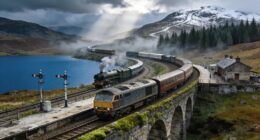
The Rocky Mountaineer showcases remarkable rail voyages through seven standout features: World Travel Award-winning luxury status for four consecutive years, glass-domed coaches offering 360-degree wilderness panoramas across four UNESCO World Heritage sites, multi-day packages combining premium hotels with daylight-only scenic travel, chef-prepared meals using regionally sourced ingredients, prime wildlife viewing of grizzly bears and elk from observation platforms, and photography opportunities at geological landmarks like Hell’s Gate. The train’s reduced carbon footprint—13 times less CO2 than flying—sweetens the deal. Those curious about maximizing this experience will find the details below illuminate what separates ordinary train rides from transformative journeys.
Way #1 Rocky Mountaineer’s Luxury Scenic Train Journeys Set Award-Winning Global Standards

Excellence in luxury rail travel isn’t just about fancy coaches and good food—it’s really about consistently delivering experiences that earn global recognition year after year.
Rocky Mountaineer’s luxury scenic train journeys snagged World’s Leading Luxury Train four years straight, from 2020 through 2023. That’s not luck. Since 1990, over 2.3 million guests have experienced these award-winning routes, which suggests the formula is working.
The guest experience blends spacious glass-domed coaches with culinary experiences featuring locally sourced ingredients. World-renowned luxury trains get compared constantly, and while Rocky Mountaineer appears to dominate North American scenic rail travel, competition in the global luxury train market remains fierce.
That said, the value of premium amenities shows up clearly in repeat clientele and industry validation. On top of that, results speak louder than marketing brochures—awards are one thing, but millions of passengers coming back is another. The service operates as a daylight-only luxury train from mid-April to mid-October, allowing guests to fully appreciate the stunning mountain scenery without missing any views to darkness. The World Travel Awards themselves are often called the Oscars of the travel industry, recognizing excellence across various categories in global travel and tourism. Travel + Leisure readers also voted Rocky Mountaineer as Favorite Train in their 2023 World’s Best Awards, adding another prestigious accolade to the collection.
Way #2 Experience Panoramic Mountain Railway Views on Scenic Routes Through UNESCO Heritage Sites

Awards mean nothing if the views don’t deliver.
Rocky Mountaineer nails it with glass-domed coaches offering panoramic mountain railway experiences through Banff, Jasper, Yoho, and Kootenay—all UNESCO World Heritage passages.
Glass-domed panoramic coaches carve through four UNESCO World Heritage sites where mountain peaks and geology outperform any marketing claim.
There are no luxury sleeper trains here; it’s daylight-only travel, which actually makes sense when you think about it.
Scenic rail itineraries hug Fraser River canyons.
Glacier viewing observation decks reveal Mount Robson’s 3,954-meter peak.
Wildlife spotting train tours catch grizzlies near turquoise lakes—though sightings are never guaranteed.
Forget heritage steam locomotive excursions.
This is modern engineering threading through Spiral Tunnels and Kicking Horse Pass, and it’s likely to impress even seasoned travelers.
Onboard narration covers geological history while windows stay spotless, but really, the landscapes do the talking.
The route passes Pyramid Falls, a 300-foot cascade with its distinctive shape visible only from the rails.
The train also navigates Hells Gate in the Fraser Canyon, where the river narrows dramatically through a steep-walled gorge.
Rocky Mountaineer operates multiple routes from Vancouver extending to destinations like Jasper and beyond, each showcasing different aspects of the mountain and rainforest terrain.
That said, you’re paying premium prices for what amounts to a moving observation deck—worth it if scenery is your priority, less so if you need constant entertainment.
Even so, when a glacier fills your entire field of vision or a bear ambles into view, the value proposition becomes clearer.
Way #3 What Makes Multi Day Rail Adventures With Travel Packages Worth the Investment?

Why spend hours piecing together a Rockies trip when Rocky Mountaineer’s multi-day rail adventures appear to bundle everything into one booking?
These travel packages merge rail journeys, hotel stays, transfers, and curated excursions—no juggling reservations or lugging baggage between stops.
Here’s something worth noting: forget first class sleeper compartments. The trains run daylight-only, which actually maximizes those panoramic vistas, while your nights go to premium hotels.
Gourmet dining car services and observation car experiences come standard. Hosts narrate wildlife viewing opportunities as you roll through Jasper, Banff, and Yoho—think elk at dawn or bears foraging near the tracks.
Circle tours hit multiple national parks in one sweep, which is efficient if you’re short on time.
Bundled pricing likely beats booking independently, though it’s worth comparing if you’re a meticulous planner. On top of that, expert trip designers handle the logistics so you don’t have to. Oversized glass-dome windows deliver unobstructed panoramic views that enhance every moment of the sightseeing experience.
Keep in mind that Canadian routes operate separately from US itineraries, so you’ll need to plan accordingly if you’re hoping to combine both regions.
Unlike VIA Rail’s transcontinental overnight trips with sleeper accommodations, Rocky Mountaineer focuses exclusively on premium daytime sightseeing experiences.
Simple, seamless, done.
Way #4 Gourmet Dining Car Services Feature Onboard Dining With Regionally Sourced Chef Cuisine

Those all-in-one packages handle the logistics, sure—but what actually shows up on your plate matters just as much as what shows up outside the window.
Rocky Mountaineer’s gourmet dining experience centers on regionally sourced ingredients: Alberta beef, British Columbia berries, Fraser Valley chicken. Chef-led culinary teams prepare multi-course meals in real time, which appears to elevate the experience beyond typical rail dining.
Menu variety runs the gamut from Dungeness crab ravioli to chickpea nourish bowls, with seasonal produce shaping what’s available at any given time. This sophisticated dining approach mirrors the elevated culinary experiences found on luxury trains like the Belmond Hiram Bingham, which similarly emphasizes exceptional onboard gastronomy as part of the premium rail travel experience.
GoldLeaf passengers get dedicated restaurant cars with linen-topped tables and panoramic views—essentially full-scale culinary theater at altitude. SilverLeaf passengers receive the same chef-prepared courses with seat-side service, delivered directly to their single-level coaches.
That said, luxury accommodations here extend well beyond comfortable seats. The dietary accommodation protocol allows for bespoke dishes created by onboard chefs, covering everything from vegan requirements to gluten-free adaptations with advance notice.
The onboard dining setup may not rival a Michelin-starred restaurant on solid ground, but it’s likely as close as you’ll get while moving through the Rockies.
Way #5 Discover Wildlife Viewing Including Bears, Eagles, and Mountain Elk on Train Tours

Every year, thousands of travelers board Rocky Mountaineer trains expecting mountain scenery—and instead find themselves scrambling for cameras when a grizzly bear ambles into view.
Those glass dome coaches? They turn into wildlife observation posts as the train crawls through prime habitats. Grizzly bears, black bears, elk herds, bighorn sheep, bald eagles—all visible from climate-controlled comfort.
The crew delivers real-time spotting reports, slowing down at known animal corridors. Early morning departures appear to coincide with peak feeding times, which likely explains why sightings happen so often. Photography opportunities are unmatched, especially during fall’s elk rut when the animals are more active and visible. The route’s average 30mph speed allows passengers to fully absorb wildlife encounters without the blur of high-speed travel. Passengers should maintain a respectful and safe distance when viewing wildlife during station stops or photo opportunities.
That said, it’s Canadian Rockies tourism at its most unscripted. Bears don’t care about your schedule. They just show up—or they don’t. Even so, the setup gives you better odds than hiking with a telephoto lens strapped to your back. Unlike other train operators that restrict pets to certain cars, Rocky Mountaineer’s focus remains entirely on passenger comfort and wildlife viewing experiences.
Way #6 Glass Dome Coaches on Rocky Mountaineer Provide 360-Degree Wilderness Panoramas

Rocky Mountaineer’s glass dome coaches don’t just offer views—they appear to suspend passengers in 3,080 square feet of steel-and-glass architecture that’s designed to blur the line between traveler and wilderness.
Sixteen Ultra Domes stretch 85 feet long. Each one’s topped with 6-by-6-foot glass panes delivering 360-degree wilderness panoramas across scenic routes through Fraser Canyon and Jasper.
The window technology is impressive, blocking around 70% of UV rays while maintaining what seems to be crystal clarity for photography.
That said, the real experience unfolds 18 feet high, where pre-assigned recliners face uninterrupted mountain peaks.
No curtains, no compromises—just Rocky Mountaineer engineering that makes forests and canyons feel almost touchable.
Even so, it’s worth noting this level of immersion may not suit everyone.
Some passengers might find the constant exposure overwhelming, especially on longer journeys.
But for those seeking raw wilderness connection, the Ultra Dome design delivers on that promise. Choosing rail travel over flying or driving also significantly reduces your carbon footprint, with trains emitting up to 13 times less CO2 than planes for comparable journeys.
The coaches feature spacious legroom and reclining seats engineered specifically for passenger comfort during extended viewing sessions.
The concept traces back to Thomas G. Rader, an American railway entrepreneur who pioneered dome car tourism in Alaska before the technology expanded to Canadian routes.
Way #7 Capture Fraser Canyon Vistas Using Observation Platforms for Photography Opportunities

When glass-dome views aren’t enough, outdoor observation platforms deliver what photography purists actually want—unfiltered air, zero reflections, and direct access to canyon walls that tower 1,000 feet above the Fraser River.
These wilderness landscapes don’t mess around. Hell’s Gate alone compresses 750 million litres per minute through a 33-metre gap, creating compositions that phones honestly can’t fake.
Photography-focused railway trips position shooters between cars, where hosts announce approaching natural landmarks before they arrive. You’ll catch Pyramid Falls‘ 300-foot staircase tiers. Mount Robson’s 3,954-metre peak dominates the river canyons below, weather permitting.
Seasonal landscape viewing routes span 1,300 kilometres—sunset perspectives included. The large, exclusive outdoor viewing platform means you’re not fighting for elbow room with 50 other passengers when that perfect shot materializes. On top of that, there’s no glass interference to navigate around or edit out later.
The route transitions through desert-like landscapes that contrast sharply with the Fraser Valley’s greenery, offering diverse photographic opportunities throughout the day-long journey to Kamloops. While many countries have abandoned railway lines like those once serving Costa Rica’s banana plantations, the Rocky Mountaineer continues to showcase active rail travel at its finest.
Just geology doing what it does best.
Frequently Asked Questions
What Is the Best Time of Year to Ride Rocky Mountaineer?
Summer (June–August) offers the most reliable weather, longest daylight, and lush scenery, though crowds and prices peak. Shoulder seasons (April–May, September–October) provide better value, fewer tourists, and dramatic seasonal landscapes with snow-capped peaks or autumn colors.
How Far in Advance Should I Book My Rocky Mountaineer Trip?
Travelers should book Rocky Mountaineer trips 12-18 months ahead for summer departures, especially GoldLeaf service. Final payment is due 60 days before departure. Shoulder season offers more flexibility but still requires 6+ months’ advance booking.
Which Service Level Should I Choose: Goldleaf or Silverleaf?
Choose GoldLeaf for dome views, gourmet dining room, outdoor platform, and enhanced service at CAD $2,800-$4,200. Select SilverLeaf for excellent panoramic windows, at-seat meals, and significant savings at CAD $1,500-$2,400—both deliver exceptional Rocky Mountain experiences.
What Should I Pack for a Rocky Mountaineer Journey?
Pack layered clothing, comfortable shoes, sunglasses, sunscreen, camera, binoculars, and medications in a carry-on. Include waterproof jacket, hat, reusable water bottle, portable charger, passport, and travel insurance documents for varying mountain weather and daylight-only travel.
Are There Wheelchair Accessible Options Available on Rocky Mountaineer Trains?
Yes, Rocky Mountaineer offers wheelchair-accessible options with hydraulic lifts for boarding, ADA-compliant washrooms, and onboard aisle wheelchairs. SilverLeaf Service provides better single-level accessibility. Guests must complete a Mobility Requirements Form when booking.
Parting Shot
The Rocky Mountaineer sticks to a straightforward formula—and it’s a formula that works. You travel only during daylight hours through some of the most dramatic terrain western Canada has to offer. Glass-dome coaches put you right inside the landscape. The regional cuisine? Actually tastes good, which shouldn’t be remarkable but somehow is.
It’s theatrical rail travel. Nothing subtle about any of it. Four routes, two service tiers, zero overnight segments. The train treats scenery like a stage performance, which may sound a bit much until you’re actually watching bears from a moving observation deck. Then it makes sense. That said, the approach won’t appeal to everyone—some travelers prefer a quieter, less orchestrated experience. But if you want the Rockies served up with intention and polish, this delivers. Simple as that.