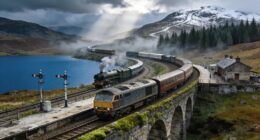
Historic train journeys like the Darjeeling Himalayan Railway combine engineering insanity with Victorian-era authenticity. These UNESCO-protected lines climb thousands of meters through mountain terrain using original 19th-century narrow-gauge tracks, zigzags, and rack-and-pinion systems that shouldn’t work but somehow do. Passengers experience preserved colonial architecture, vintage steam locomotives, and period-uniformed staff while traversing routes featuring 800 bridges and 100 tunnels. The blend of death-defying elevation changes, historical preservation, and scenic mountain landscapes creates experiences that modern railways simply can’t replicate—and understanding what makes each route unique reveals why preservation efforts matter beyond simple nostalgia.
Experience Heritage Steam Locomotive Expeditions at Railway Stations Featuring Original Victorian-Era Platforms

Heritage steam train services run on a handful of historic lines worldwide, and they’re not just nostalgia trips—they appear to be legitimate preservation efforts keeping Victorian-era engineering alive.
These heritage steam locomotive expeditions feature authenticated steam locomotives rolling into railway heritage sites with original Victorian-era platforms intact. Brick, stone, cast iron—the whole deal.
Vintage carriages match the era. Staff sometimes wear period uniforms. And the railway architecture? Those ornate ironwork canopies, decorative tiling—it all remains protected under heritage status. The immersion is real.
On top of that, railway preservation supports entire tourism economies now, turning passenger experiences into what are essentially living museums where 19th-century engineering still functions. Some stations like St Kilda Station, built in 1857, represent Victoria’s oldest intact suburban station structures that anchor these preservation efforts.
That said, it’s worth noting these operations walk a fine line between authentic preservation and commercial tourism—though for many lines, the revenue may be what keeps the preservation viable in the first place. These stations originally served as democratic spaces where people from all social backgrounds could gather, a function they continue to fulfill through modern heritage tourism. Similar to South Africa’s renowned Rovos Rail, these heritage trains emphasize the journey itself as an elegant travel experience that combines historical nostalgia with scenic beauty.
UNESCO Protected Railway Heritage Displays Dramatic Elevation Changes Through Mountain Landscapes

When it comes to railways that actually climb mountains, UNESCO singled out three lines in India for permanent protection—and the engineering alone probably justifies it.
The Darjeeling Himalayan Railway claws its way from 100 meters all the way up to 2,200 meters using zigzags and loops. Nilgiri’s rack-and-pinion system tackles gradients as steep as 1:12.5. Kalka–Shimla needed 100 tunnels and 800 bridges just to exist.
These UNESCO protected railway heritage sites showcase dramatic elevation changes that Victorian engineers somehow conquered with what were, by today’s standards, primitive tools.
The mountain landscapes remain brutal, beautiful, and utterly unchanged—which makes watching vintage narrow gauge railway cars still traversing them feel borderline miraculous.
That said, it’s worth remembering these lines also represented colonial infrastructure priorities, though their technical achievement is undeniable. Beyond their engineering prowess, these railways have become integral to regional identity and heritage, inspiring local festivals and attracting visitors from around the world to celebrate their historical significance. India maintains this legacy through museums, heritage parks, and galleries dedicated to preserving railway history across the country.
While other countries like Canada offer transcontinental overnight trips with sleeper accommodations through diverse landscapes, these Indian mountain railways remain unique for their vertical ambition.
Even so, the fact they’re still running today speaks to how well they were built in the first place.
Which Scenic Viewpoints Offer the Most Spectacular 360-Degree Panoramic Mountain Vistas from Historic Funicular Railways?

Victorian-era engineers built funicular railways with one goal: get tourists to the summit without killing them. The view? That was just a bonus.
These days, though, those same historic climbs are all about the panorama.
What was once built for safety has become a ticket to elevated sightlines and tourist-ready spectacle.
Take Harder Kulm—its observation decks serve up sweeping views of Lake Thun and the Jungfrau peaks in under 10 minutes. It’s hard to beat that efficiency.
Over in Basque Country, Monte Igeldo’s 1912 wooden carriages (the oldest still running in the region) chug passengers up to what is, charmingly, a summit fairground. The ascent starts near El Peine del Viento, surrounded by natural beauty that enhances the journey.
Meanwhile, Heidelberg’s mountain railway pulls in about a million visitors a year, ferrying them between a preserved station experience and the Königstuhl summit. The Harder Kulm funicular offers glimpses of both deep blue Lake Thun and turquoise Lake Brienz during the ascent to 1322 metres.
Then there’s Fløibanen, whose 1918 scenic route lifts riders 320 meters above Bergen.
In Canada, The Canadian covers over 2,762 miles between Toronto and Vancouver, showcasing some of the world’s most diverse railway landscapes from prairie expanses to towering mountain ranges.
That said, not every vintage railway was positioned with vistas in mind—some face thick forest or urban sprawl.
Even so, restoration projects today seem laser-focused on one thing: making sure nothing blocks the view.
Vintage Narrow Gauge Railway Heritage Preservation Maintains Authentic 19th Century Track Systems

Keeping a 2-foot-wide railway from the 1880s running in 2024 turns out to be ridiculously expensive—and borderline obsessive.
Preservation efforts for heritage locomotives and vintage railcars demand custom-built parts nobody manufactures anymore, which helps explain why annual maintenance hits $150,000–$200,000 per historic railway. On top of that, original narrow gauge tracks used wildly inconsistent widths, making standardization nearly impossible.
Railway engineers need both 19th-century construction knowledge and modern safety expertise—good luck finding that combo.
That said, these living museums pull 90,000 tourists annually, which appears to prove their cultural and educational importance. Tourism development thrives on authenticity, after all. Narrow gauge railroads often attract a disproportionate amount of preservation attention compared to their standard gauge counterparts.
Even so, you have to wonder whether the financial strain is sustainable long-term for smaller operations. The introduction of e-ticketing software and multilingual websites helps modernize operations without sacrificing historical authenticity. Like the Bernina Express through the Swiss Alps, these heritage railways offer travelers a unique blend of spectacular natural views and cultural experiences that modern transportation simply cannot replicate. But here’s the thing: the crowds keep coming. Turns out, obsessive preservation may actually pay off.
Colonial Mountain Railway Routes Showcase British Imperial Engineering Heritage Through Preserved Colonial Architecture

The trains themselves tell only half the story—what really catches your eye are the buildings. British colonial architecture lines these mountain railway routes like monuments to imperial ambition, though how you read that ambition probably depends on where you’re standing. Imagine embarking on a historic train journey through Scotland, where each curve of the track reveals breathtaking landscapes and charming villages steeped in history. The contrast between the serene countryside and the rugged highlands enhances the sense of exploration, inviting travelers to step back in time. As the train glides past ancient castles and lochs, it’s easy to dream about the stories held within those storied walls.
Colonial railway stations stand as architectural power statements—their interpretation shifting based on whose history you’re inheriting.
Railway stations at Darjeeling, Kurseong, and Ghum show off Gothic arches and pitched tin roofs imported straight from Victorian England. These aren’t replicas—they’re the actual structures, preserved down to original signage.
They’re UNESCO World Heritage Sites now, but they started as power moves. That said, the engineering achievements remain operational: viaducts, tunnels, zigzag sections that still work exactly as designed.
Steam engines continue pulling passengers past colonial bungalows and hotels, some weathered, some remarkably intact. At Ghum, railway museums display restored heritage locomotives on tours documenting what was, essentially, calculated territorial control through infrastructure. While these heritage routes focus on scenic mountain terrain, India’s modern railway network includes epic long-distance journeys like the Vivek Express covering over 4,000 kilometers.
The Kalka-Shimla line demonstrates similar ambitions, constructed from 1898 to 1903 specifically to link the summer capital with the broader colonial railway network. The Matheran Light Railway follows this pattern, built primarily for visitors escaping Mumbai’s heat when it opened in 1907.
Whether you see that as impressive or uncomfortable—or both—depends on how you weigh preservation against history’s less savory motivations.
Ride Fully Restored Heritage Steam Locomotives Operating on Original Historic Routes

Climbing aboard a fully restored heritage steam locomotive isn’t like stepping into a museum replica. It’s the actual thing—brass fittings and all—huffing coal smoke just like it did 150 years ago.
These operational preservation projects run on original historic routes. Same tracks, same tunnels, same mountain gradients. Conservation efforts keep rare and historic rolling stock alive through authentic operation, not static displays.
Heritage railway journeys traverse what are often spectacular scenic viewpoints across continents: Darjeeling’s tea gardens, Scotland’s Glenfinnan Viaduct, Swiss Alpine passes. You can literally ride the same machines that colonial engineers rode, though that history comes with its own complexities.
No glass cases. Just steam, steel, and history moving.
That said, maintaining these locomotives in working order is enormously resource-intensive. On top of that, not every “heritage” route follows its exact historical alignment—some sections may have been rerouted for safety or practical reasons over the decades. North America offers its own collection of luxury heritage experiences, with trains featuring dome observation windows that provide unparalleled views of mountain landscapes and wilderness.
Even so, the core experience remains: you’re still sitting in genuine 19th-century rolling stock, feeling the same lurching rhythm and watching coal-fired steam billow past the windows. It’s preservation through use, which some argue is the only way these machines survive at all. England’s Middleton Railway demonstrates this philosophy perfectly, operating tourist services on weekends and public holidays since its original construction in 1758 as the oldest continuously operating railway. The slower, leisurely pace of steam train travel allows riders to fully absorb the landscapes unfolding outside their windows, a sharp contrast to the rushed blur of modern high-speed rail.
How Tourism Infrastructure Enables Preserved Railway Station Experiences While Supporting Authentic Historical Journey Access

Station platforms that were once caked in coal dust now sport interpretive panels and visitor centers with climate control—a shift that appears both necessary and, to some preservationists, slightly unsettling.
Tourism infrastructure transforms preserved stations into revenue machines: museums, cafes, gift shops hawking nostalgia. It’s not subtle, but then again, station preservation doesn’t come cheap.
Adaptive reuse pays the bills while maintaining architectural authenticity, or at least that’s the balancing act curators attempt.
Historic routes gain Wi-Fi and accessibility ramps without sacrificing Victorian charm. Well, mostly without sacrificing it.
Rail tourism tends to explode when visitor experience improvement meets authentic travel documentation—people want the romantic past, just with working toilets and cell service. Digital ticketing replaces handwritten ledgers, but those vintage signs stay put, a calculated nod to what travelers expect.
On top of that, the economic impact ripples through local communities. Employment spikes, businesses thrive near these revitalized stations. St Pancras International capitalizes on its Victorian Gothic architecture by housing Europe’s longest champagne bar, proving heritage preservation and upscale tourism amenities aren’t mutually exclusive.
Heritage railways discovered something vital along the way: preservation requires modernization, just selectively applied. Porto’s Sao Bento Railway Station demonstrates this principle with over 20,000 tiles depicting Portuguese history across its main lobby, turning functional architecture into an immersive museum experience. The trick is knowing where to draw that line between authentic decay and profitable comfort.
Sometimes they get it right. Routes like the Glacier Express through Switzerland’s Alpine terrain showcase how preserved railways can offer both historical authenticity and world-class scenic experiences. Sometimes a gift shop selling fridge magnets next to a century-old waiting room feels like they may have drawn it in the wrong place. As travelers seek new adventures, scenic luxury rail experiences worldwide can transform the journey into a lavish exploration of breathtaking landscapes. Through plush seating and gourmet dining, these train journeys provide a unique opportunity to savor the beauty of destinations while enjoying unparalleled comfort. It’s not just about the destination; it’s about the journey itself, where every moment onboard is designed to be a memorable part of the adventure.
Frequently Asked Questions
What Are Typical Ticket Prices for Heritage Train Journeys Worldwide?
Heritage train ticket prices worldwide typically range from $500 for day trips to $40,000+ for premium transcontinental journeys. Most luxury heritage railways charge $2,000–$10,000 per person, with all-inclusive fares covering accommodation, meals, and excursions.
How Often Do Steam Locomotives Require Maintenance During Operational Seasons?
Steam locomotives require daily pre-departure inspections before each operational day, with periodic maintenance at 31 and 92 service day intervals. Heritage railways typically need one hour of maintenance for every two hours of operation throughout the season.
Can Passengers Bring Luggage on Narrow Gauge Heritage Railway Carriages?
Passengers may bring luggage on narrow gauge heritage railway carriages, but space constraints limit quantity and dimensions. Most operators permit one small and one medium-sized bag, stored under seats or overhead racks, ensuring aisles and exits remain unobstructed for safety.
What Safety Protocols Govern Heritage Steam Train Operations in Mountains?
Mountain heritage steam railways require annual boiler certification, approved coupling hardware, minimum train separation distances, mandatory signal adherence, crew-based crossing protection, emergency equipment onboard, and immediate operation halts after suspected impacts until thorough safety inspections confirm track and locomotive integrity.
Are Dining Services Available During Extended Historic Railway Journeys?
Many extended historic railway journeys worldwide feature full dining services with multiple-course meals, regional cuisine, and formal table service. However, shorter heritage routes like the Darjeeling Himalayan Railway typically offer limited onboard refreshments rather than complete dining facilities.
Parting Shot
Historic train journeys like the Darjeeling Himalayan Railway aren’t just transportation—they’re living museums chugging through impossible terrain. These UNESCO-protected lines preserve Victorian engineering that, remarkably, still works a century later. The narrow-gauge tracks, original steam locomotives, and colonial-era stations create something modern rail can’t quite replicate: an authentic connection to the past. The QinghaiTibet Railway engineering marvels exemplify human ingenuity, showcasing how modern technology can triumph over the challenges of harsh environments. This railway not only connects remote regions but also offers breathtaking views that highlight the stunning landscape of the Tibetan plateau. Travelers are continually drawn to this route, eager to experience a journey that marries both engineering excellence and natural beauty. the shinkansen’s impact on global travel has transformed how people perceive high-speed rail systems and their connectivity. As more countries look to replicate Japan’s success, the shinkansen sets an example of efficiency and punctuality that many aspire to achieve. This shift not only enhances passenger experience but also fuels economic growth by linking urban centers and reducing travel times significantly.
At 10-15 km/h, passengers actually see everything. Speed, it turns out, kills experience. That said, this isn’t just romantic nostalgia—there’s something genuinely different about travel this slow. The landscape unfolds rather than blurs past. You notice details. Even so, some might argue these railways survive more as tourist attractions than practical transit, which perhaps diminishes their “living” status somewhat.
Still, these railways prove slow travel beats efficiency when the journey itself matters more than the destination. The crawl up mountainsides, the rhythmic clatter of vintage wheels on narrow rails, the smell of coal smoke—these sensory elements may not get you anywhere fast, but they offer something increasingly rare in our world of bullet trains and budget flights.