
Bergen Railway Journey: Mountain Plateau Crossings, Glacier Access Points, Waterfall Viewing Platforms
The Bergen Railway, a mountain rail route, crosses Norway’s Hardangervidda Plateau at 1,222 meters elevation. This plateau, Europe’s largest mountain expanse, displays wild reindeer herds through passenger windows.
Key destinations include:
Finse Station – A roadless settlement provides direct access to Hardangerjøkulen ice cap, a 73-square-kilometer glacier formation.
Myrdal Junction – This transfer point connects passengers to the Flåm Railway, a steep descent covering 20 kilometers toward fjord level.
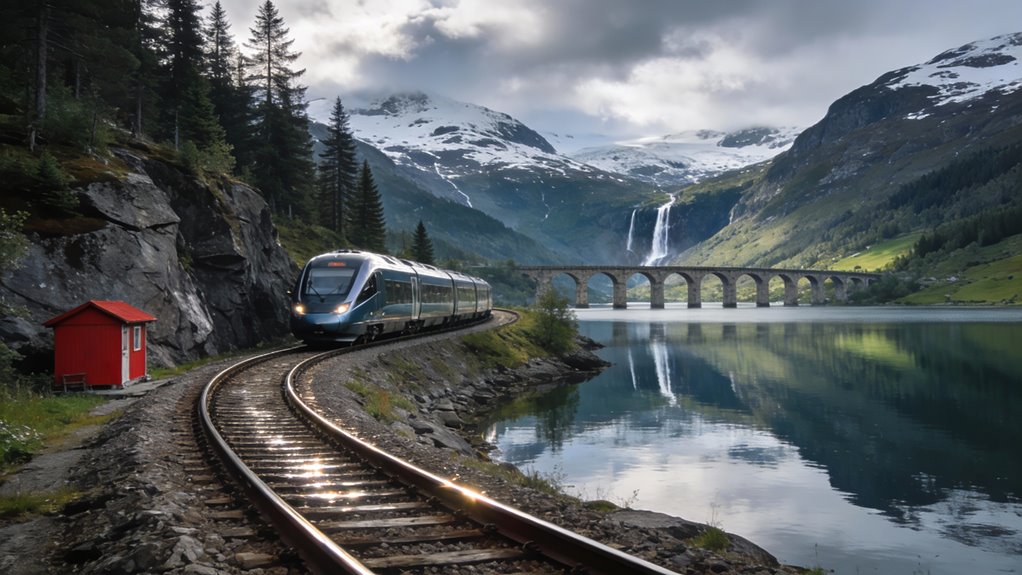
Kjosfossen Waterfall – A 225-meter cascade sends mist across viewing platforms where seasonal performances occur.
The railway, an engineering achievement, burrows through 182 tunnels. These passages cut through 73 kilometers of bedrock. Snow sheds protect exposed sections from avalanches and harsh weather.
Finse sits at the highest point along the route. No roads reach this station. Visitors arrive only by train or foot. The settlement serves as a base for glacier hiking and cross-country skiing expeditions.
The Flåm Railway descends from Myrdal with a gradient of 5.5 percent. Twenty tunnels spiral through mountain walls. The journey reveals waterfalls, valleys, and farmsteads clinging to steep slopes.
Passengers witness dramatic landscape shifts. Bergen’s coastal climate gives way to alpine conditions. Arctic tundra stretches across the plateau. Then forests and fjords appear as the train descends westward.
The route operates year-round. Winter transforms the landscape into snow fields. Summer brings midnight sun and green valleys. Each season offers distinct vistas through the carriage windows.
Interesting Fact: The Bergen Railway required 16 years of construction and opened in 1909, making it one of the world’s highest standard-gauge railways that operates through winter without closure.
Highlight #1 — Hardangervidda National Park Reveals Europe’s Largest Mountain Plateau

At 1,200 meters, the window frames freeze. Hardangervidda National Park spreads beneath you—3,422 square kilometers of Europe’s largest mountain plateau. The Bergen Railway’s scenic window carriages carry you across this wilderness, climbing between Oslo Central Station and Bergen station through landscapes that defy easy description.
Arctic-alpine tundra. Rolling endlessly at Finse station, the highest point on the line, where the air thins and the horizon stretches into white nothingness; the plateau reveals itself in waves of stone and ice, 8,500 square kilometers of mountain territory that existed long before railways dreamed of crossing it. Then Myrdal station appears.
From Myrdal you descend—the Flåm railway connection drops away from the plateau’s edge. National park access routes cut through terrain older than memory: plateau, plateau, plateau. Trout lakes and rivers scatter across the protected wilderness, their waters teeming with fish that have adapted to the harsh mountain conditions. But these paths lead somewhere new.
Have you ever watched Europe transform outside a train window? High altitude crossings expose the continent’s hidden spine, where mountains flatten into tundra and winter never fully releases its grip. The Bergen Railway threads this needle, connecting two coasts through a landscape that swallows human ambition whole. Somewhere below, Europe’s largest wild reindeer population moves across the plateau, their migrations shaping the ecosystem as they have for millennia. Like the UNESCO-listed Bernina Express crossing the Alps, this journey combines remarkable natural vistas with engineering achievement.
Station after station marks your passage—Oslo Central, Finse, Myrdal, Bergen—each one a punctuation mark in a journey across stone and sky. The plateau doesn’t care about your schedule; it was here first, spreading its vast emptiness beneath every carriage that dares the crossing, indifferent to the scratches of steel on its ancient back.
Highlight #2 — Myrdal Station Connects to the World-Famous Flåm Railway Fjord Descent

Myrdal Station waits at 866 meters. Not a destination. Just a junction where the Bergen Railway meets the Flåm Railway‘s plunge toward Aurlandsfjord—a mountain handoff engineered for one purpose: descent.
Myrdal at 866 meters: not a destination but a handoff point where Bergen Railway meets Flåm’s engineered plunge toward the fjord.
The platform transfer takes seconds, maybe ten meters, perhaps twenty, and then you’re committed to gravity’s pull through tunnels that slam alpine against coastal in a geography lesson written in steel and stone.
This is the Norway in brief route, the one that connects, connects, connects—then drops you into the fjord world below.
Why do ninety-eight percent of passengers simply switch trains and vanish? Because Myrdal exists for motion, not arrival.
Here’s what happens: the Bergen line delivers you to this wind-scraped junction; the Flåm Railway collects you for the famous fjord descent; the mountains give way to water.
Three movements, one station.
You step from train to train across a platform shorter than a city block, and suddenly the scenery shifts from horizontal to vertical.
Tunnel engineering carved these passages through rock that refused easier routes—twenty tunnels in twenty kilometers, each one a controlled fall through elevation zones that would take hours to hike.
The scenic route runs straight through this junction, yet Myrdal itself offers nothing scenic.
No cafés, no lookouts, no reason to linger.
The station serves transfer, pure and simple: a comma in your journey, not a period.
No roads penetrate this elevation—rails alone deliver and retrieve passengers from this mountain crossing point.
Miss your connection and the mainline train will wait—the Bergen Railway holds for late Flåm arrivals, guaranteeing your descent continues without strand or scramble.
Board the Flåm train and discover what this mountain platform promises—that descent toward Aurlandsfjord, that collision of alpine and fjord, that gravity-driven theater where rails become the script and you become the audience hurtling downward through Norway’s vertical drama. Planning tools like the Eurail Planner app can help you coordinate these precisely timed mountain railway connections before you arrive.
Highlight #3 — Finse Station Delivers Glacier Views of the Hardangerjøkulen Ice Cap

At 1,222 meters, the Bergen Railway crests.
Finse Station emerges—a wind-blasted outpost where roadless wilderness collides with Europe’s highest mainline platform.
Do you see it?
Hardangerjøkulen’s ice cap commands the horizon, seventy-three square kilometers of ancient glacier draped across the skyline like a frozen banner.
Photography spots frame the view; observation decks amplify it; the station itself becomes your portal to pure Arctic stillness.
This is remote wilderness station access.
This is Norway’s high plateau crossing.
This is where civilization whispers and ice roars.
Summer hiking trails depart daily at 11:00 AM, guided treks threading toward the glacier’s blue-veined tongue, while you stand ready with boots laced and camera charged.
The midnight sun journey timing transforms June evenings into endless golden hours, shadow and light dancing across crevasses that have carved themselves deep since the last ice age.
Station stops offer more than platform breaks: they deliver glacier observation points that professional photographers covet, historic wooden station visits that echo with a century of mountain crossings, and scenic mountain plateau vistas that stretch your sense of scale until distance loses meaning.
Here the wind never rests.
Finse huddles under Hardangerjøkulen’s gaze, a cluster of red-roofed buildings defiant against the elements, trackside and timeless. The Bergensbanen route showcases these dramatic fjords and mountains that have made it one of Europe’s most celebrated rail journeys.
The platform hosts Finse 1222 hotel, offering immediate accommodation for those who wish to extend their glacier encounter beyond a brief station stop.
Experienced guides lead rope teams across the glacier itself, sharing knowledge about ice formations and geology while you traverse fifteen kilometers of high mountain terrain that maps cannot fully capture.
The railway brought you here, but the ice cap holds you—its presence magnetic, its silence profound.
When your train finally pulls away, you’ll carry that stillness with you: the memory of standing where roads cannot reach, where Europe climbs highest, where glacier and railway meet in cold, perfect harmony.
Highlight #4 — Flåm Railway Connection Features the Spectacular Kjosfossen Waterfall

Twenty kilometers of branch line peel away from the Bergen Railway at Myrdal. Down, down, down—863 meters toward sea level—plunges the Flåm Railway. At Kjosfossen waterfall, the tourist train pauses: a few minutes to watch 225 meters of water thunder into the gorge, to stand on a platform drenched in mist, to glimpse the Huldra dancer twirling in summer spray. Winter? The cascade freezes solid.
You step off the train, and immediately spray soaks your camera lens. The roar fills your ears; the platform trembles beneath 900,000 visitors each year who make this pilgrimage along the twenty-kilometer track. During summer months the Huldra appears—Nordic folklore come alive against sheets of falling water—while winter transforms the torrent into a sculpture of ice, silent and vast. The Huldra performers are students from Norwegian ballet school, bringing professional grace to the folklore tradition.
Photography here demands one thing: waterproof gear.
Norway Highlights itineraries weave this rail segment into broader fjord cruise connections, linking mountain and water in a single day’s journey. From Myrdal you descend through twenty tunnels carved into stone, past waterfalls that erupt from sheer cliffs, toward Flåm at sea level where ferries wait. The stop at Kjosfossen lasts mere minutes, yet those minutes etch themselves into memory—the force of nature compressed into a single viewing platform, the seasonal transformation from summer’s roar to winter’s frozen silence, the spray that reminds you why your gear needs protection. The waterfall qualifies as a sightseeing destination in its own right, drawing travelers specifically for its dramatic display along the railway route. This journey ranks among the world’s most immersive natural landscapes that travelers can experience from the comfort of a train carriage.
| Element | Detail |
|---|---|
| Total drop | 225 m (738 ft) |
| Annual visitors | 900,000 |
| Flåm–Myrdal distance | 20 km |
| Stop duration | Few minutes |
| Seasonal conditions | Summer roar / Winter ice |
Can any railway match this drama?
Highlight #5 — 182 Tunnels and Snow Sheds Define the High Altitude Mountain Crossings

Above Kjosfossen, the drama fades. What replaces it? Something far less photogenic but infinitely more stubborn: 182 tunnels carved through Norwegian bedrock.
These passages—182 of them, hewn from stone—shield the line from winter snow conditions that would otherwise lock the route down for months. You watch the light vanish as Vy train operator crews plunge into darkness, navigating 73 kilometers underground, fully 15% of the journey duration spent beneath the mountains. Your window seat goes black; your photography car position means nothing but reflection.
The tunnels come, the tunnels stay, the tunnels swallow everything. Then light.
Why tunnel so relentlessly through high altitude crossings? Because Norwegian winter gives no quarter.
Snow sheds join the tunnels in this defensive architecture, shielding vulnerable stretches where the mountain permits no passage beneath. Through these engineered corridors, the Bergen Line defies conditions that would halt lesser routes. This route stands among Norway’s most stunning Nordic landscapes, drawing travelers seeking authentic Scandinavian railway experiences.
Seventy-three kilometers of bedrock: a fortress against avalanche, against drift, against the white paralysis that grips unprotected track. The train bores through, emerges, bores again—a rhythm of dark and bright, tunnel and sky, confinement and release. The line crosses Hardangervidda Plateau, Europe’s largest mountain plateau, where tundra and frozen lakes stretch beyond the tunneled path.
Not picturesque, no. Necessary.
These 182 passages represent more than holes in stone; they embody the calculation required to operate year-round in terrain that actively resists human ambition. Each tunnel was blasted, each snow shed positioned with winter’s fury in mind. The longest among them stretches 2,300 meters through solid mountain, a sustained darkness that reduces the world outside to memory.
The result? A line that runs when others stop, that connects coast to capital through months when the high country belongs to storm and silence. Photography suffers. Passenger experience dims for those 73 underground kilometers. But the train moves—predictably, reliably, stubbornly—through the very conditions designed to stop it.
Frequently Asked Questions
What Is the Total Journey Time Between Oslo and Bergen?
The Bergen Railway journey between Oslo and Bergen takes 6.5 to 7 hours, with the fastest direct services completing the 371-kilometer route in 6 hours 34 minutes.
How Many Daily Departures Are Available for the Bergen Railway Route?
Four to five daily departures operate in each direction, with four in winter and five during most of the year.
Does the Eurail Pass Cover Travel on the Bergen Railway?
Yes, the Eurail Pass covers the Bergen Railway. A seat reservation fee of approximately €7 (second class) or €12 (first class) is required.
Are There Café Car Services Available During the Journey?
Yes, Vy Café operates on most daytime departures, serving hot meals, snacks, beverages, and light refreshments. Only card payments are accepted onboard.
What Ticket Classes Are Offered on Bergen Railway Trains?
Bergen Railway trains offer Standard Class (2nd class), Komfort Class (1st class), Family Coach, and sleeper cabins on overnight services.
Parting Shot
The Bergen Railway packs serious punch for a train route—Europe’s highest northern crossing, 182 tunnels, glacier views, and connections to the legendary Flåm descent. Six hours of dramatic landscapes, Arctic tundra, and engineering triumph. It’s infrastructure and tourism rolled into one historic package. Since 1909, this thing’s been hauling passengers across Norway’s wildest terrain. Four seasons, one route, zero compromises. That’s Northern European rail travel at its most authentic. The Norwegian fjord railways scenic routes present an unparalleled experience, showcasing the stunning beauty of Norway’s coastlines and mountains. Travelers can immerse themselves in breathtaking views that transform with the changing seasons, making each journey uniquely captivating. With every bend in the tracks, the landscape reveals hidden gems and picturesque villages, inviting exploration and adventure.