Photographing Iconic Train Routes: Mirrorless Camera Systems, Wide-Angle Lenses, and Autofocus Tracking Modes
Mirrorless camera systems lock autofocus onto carriages rounding alpine viaducts at 80 km/h. Five-axis stabilization cancels platform vibration that wrecks handheld shots. Shutter Priority at 1/30s transforms locomotives into streaking ribbons of motion. Crank to 1/1500s to freeze alpine trains mid-climb.
Railway photography demands precision equipment:
- Wide-angle lenses capture 114° of UNESCO panoramas with edge-to-edge sharpness
- Continuous autofocus modes hold focus through tunnel exits and curves
- Image stabilization systems compensate for platform movement during exposure
The 14–24mm focal range resolves rivets on moving trains and distant glaciers simultaneously. AF-C mode with 3D-tracking proves critical when three seconds is the entire window to compose a viaduct shot.
Train routes through mountain passes challenge photographers. The Bernina Express traverses Swiss Alps on spiral viaducts built in 1910. Professional photographers position themselves where tracks curve through valleys. Light changes fast in alpine terrain. Morning fog lifts from gorges. Afternoon sun illuminates carriage windows.
Fast shutter speeds freeze wheel motion and passenger faces. Slow speeds blur scenery into painterly streaks. Panning technique follows trains along platforms. A tripod steadies compositions during long exposures at dawn.
Interesting Fact: The Landwasser Viaduct in Switzerland, a UNESCO World Heritage site, features six limestone arches spanning 65 meters and attracts thousands of railway photographers annually who time their shots to the exact moment trains emerge from the mountain tunnel onto the bridge.
Tip #1 — Scenic Railway Photography with Nikon Z-Series Captures UNESCO Alpine Panoramas
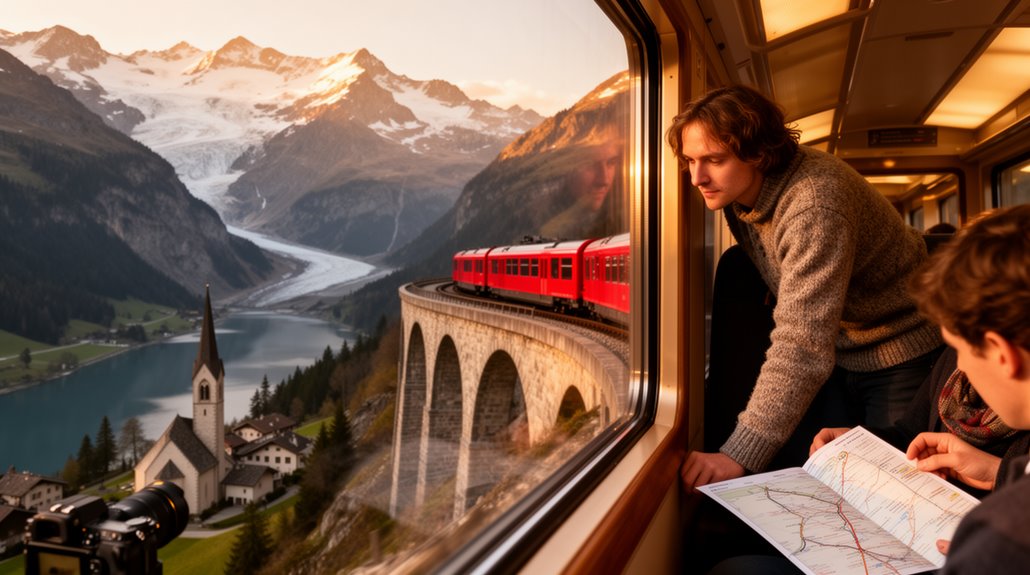
Alpine trains demand precision. They demand speed. They demand a camera that won’t choke when the Bernina Express rounds a spiral viaduct at thirty miles per hour—glaciers gleaming, peaks towering, light fleeting. What delivers?
Nikon’s Z-series mirrorless cameras.
Against UNESCO-protected summits, where scenic railway photography meets unforgiving geography, this system tracks motion with surgical accuracy: the autofocus locks onto carriages carving through Alpine switchbacks, holds them through curves, never wavers.
In-body image stabilization steadies your handheld panoramic vistas even as you brace against mountain wind; no tripod, no waiting, no missed moments.
You capture the Glacier Express slicing through snowfields in crystalline detail, because Nikkor lens sharpness matches—exactly—what these routes require.
Consider the challenges. A train hurtles past at speed, backlit by glacier glare, framed by rock faces that plunge a thousand meters, and you have three seconds to nail the shot.
Three seconds.
The Z-series autofocus system doesn’t guess; it tracks with precision that scenic railway photography actually demands, not what marketing brochures promise.
Round a viaduct, chase a locomotive, frame a UNESCO vista—your equipment either keeps pace or it doesn’t.
Nikon’s mirrorless platform does.
The stabilization absorbs your breathing, your heartbeat, the vibration of trains thundering over iron bridges.
Sharp glass renders every rivet on carriages, every crevasse on glaciers, every detail that separates documentary from snapshot.
Will your current gear handle it?
Handheld panoramas along the Bernina line test everything: autofocus speed, stabilization performance, lens resolution. The Grand Train Tour of Switzerland combines these panoramic routes with boats and buses, offering photographers endless compositional opportunities across cultural landmarks and lakes.
The Z-series answers each test.
No excuses, no compromises.
Just Alpine trains captured against protected peaks—exactly as they deserve. Set your shutter to approximately 1/1500s to freeze the Express mid-climb, preserving every detail as it crosses the viaduct. The 3:2 aspect-ratio screen matches your photo composition perfectly, making framing easier as you compose against these sweeping mountain vistas.
Tip #2 — Panoramic Window Captures Use Nikon Vibration Reduction to Eliminate 80km/h Shake
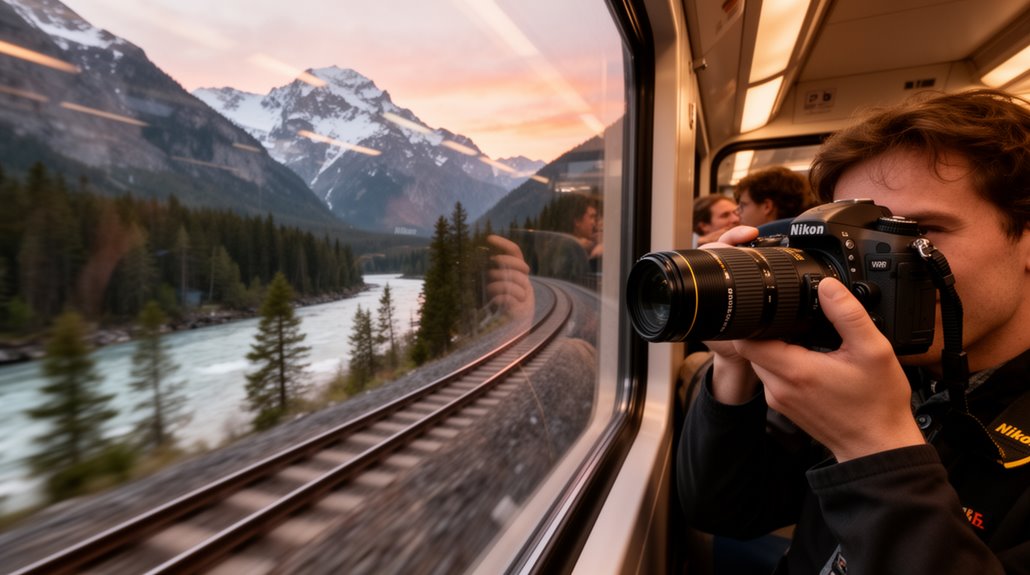
At 80 kilometers per hour, physics turns hostile.
The Glacier Express rattles beneath you, metal wheels grinding against rails, and you’re trying to frame the Landwasser Viaduct through those sweeping panoramic windows—but every click captures blur instead of beauty.
Every click captures blur instead of beauty—vibration wants to ruin your shot at 80 kilometers per hour.
Vibration wants to ruin your shot.
Enter Nikon’s vibration reduction.
This system detects train shake at speed, compensates for the constant motion, allows you to shoot slower shutter speeds without surrendering sharpness.
Five stops of stabilization: that’s the difference between mush and masterpiece.
Five stops transform shaky hands into steady tripods.
Five stops mean the viaduct stays crisp while the train hurtles forward.
And burst mode? Essential backup.
Here’s what the technology actually does—it reads the vibration signature, calculates the countermovement, stabilizes the image before the sensor ever sees it.
Window reflections still haunt your composition, but motion blur bows out.
Can you afford to shoot without it when the landscape streams past at this velocity?
Camera settings matter.
They always matter.
The physics are simple: moving trains create unstable platforms, unstable platforms demand compensation, compensation requires smart glass and gyroscopic sensors working in concert to cancel the shake you feel in your feet.
Through those panoramic windows, Switzerland blurs into impressionism unless your gear fights back. The nearby Bernina Express route offers equally breathtaking UNESCO World Heritage scenery worth capturing with these same stabilization techniques.
You need this stabilization.
Trust it when the wheels sing their metallic song and the viaduct appears in your viewfinder—because at 80 kilometers per hour, steadiness isn’t a luxury.
Two angular velocity sensors inside your lens measure every vertical pitch and horizontal yaw the train inflicts on your frame.
Wait for the viewfinder display to stabilize before pressing the shutter, even with VR active.
It’s survival.
Tip #3 — Motion Blur at 1/30s Nikon Shutter Priority Creates Dramatic Train Speed Effects
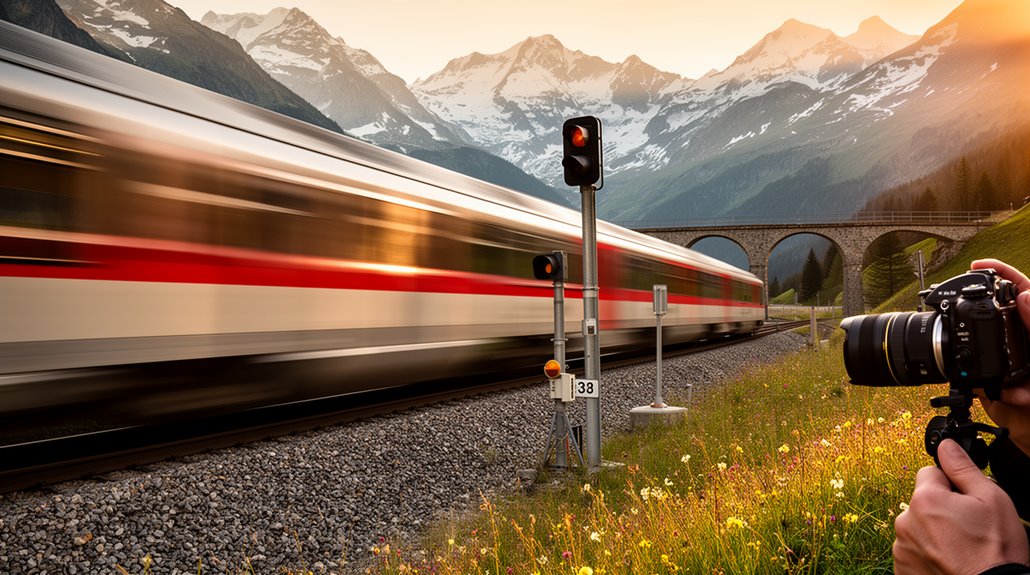
Stabilization stops the shake.
But what if shake is the soul of the shot?
Sometimes blur is beauty.
Enter Nikon’s S mode: it locks your shutter at 1/30s, holding that precise speed while the full-frame sensor and image processor dance through shifting light, auto-adjusting the aperture so you never miss the moment.
Raw capture preserves every motion trail—those streaks of color and form that transform a passing train into pure kinetic energy.
Now focal length enters the equation; wider glass smooths your composition, lets you frame the chaos with intention, grants you control even as the world rushes past.
Exposure metering shifts.
ISO performance stays low.
The camera thinks so you can feel.
Speed becomes art.
Speed becomes narrative.
Speed becomes the reason you shoot.
Not accident.
You want drama?
Let the train blur into bands of steel and light while the platform stays sharp—a study in contrasts, in motion versus stillness.
The technical details matter here: that 1/30s shutter is slow enough to render velocity as visible streaks yet fast enough to keep handheld shots crisp where you need them.
Shutter Priority mode handles the math; your eye handles the poetry.
Consider this—what separates a snapshot from a photograph?
Often it’s the choice to embrace imperfection, to let motion write its own signature across the frame.
Metering adapts.
The processor compensates.
ISO holds steady in low light, refusing to spike into noise even when you’re shooting at dusk, in tunnels, under the amber glow of station lamps.
Every element works in concert: sensor, shutter, aperture, light.
The result?
Images that pulse with energy, that make you feel the rush of departure, the weight of momentum.
Panning with the train keeps the locomotive sharp while blurring the background into ribbons of color—an effect that amplifies the sensation of speed.
Smooth camera motion synchronized with the train’s path requires practice but delivers that coveted effect where subject stays crisp against streaked surroundings.
This technique transforms routes like the Bernina Express into dynamic visual stories where Alpine landscapes streak past the frame in ribbons of white and green.
Motion isn’t your enemy.
It’s your medium.
Tip #4 — Camera Settings for Nikon Autofocus System Enable Sharp Landscape Tracking
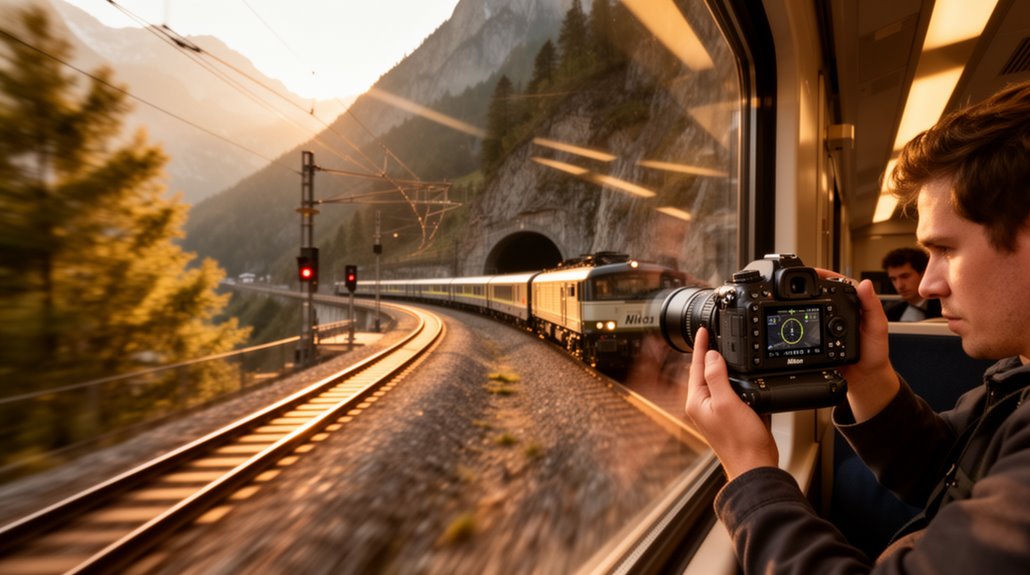
Speed demands precision. AF-C mode tracks trains through alpine express photography and tunnel emergence shots—each frame sharp, each moment locked. For railway bridge perspectives, select 3D-tracking; it uses color data for erratic motion, following your subject even when it darts behind steel girders or vanishes momentarily in shadow. During landscape railway framing, set a3 to 3 for blocked shot response: the camera won’t hunt, won’t panic, won’t lose your speeding locomotive when a tree trunk slices through your composition.
Perfect focus.
Golden hour vantage points need steady subject motion settings. Why let soft focus ruin that glowing hillside shot? Tracking trains means tracking light, tracking color, tracking movement—and you need every tool the Nikon autofocus system offers. Through tunnels, across bridges, along mountain curves, your camera must anticipate. It must respond. It must deliver. Assign group-area AF to a focus function button to toggle between AF-area modes when composition demands change rapidly. Rotate the focus-selector lock to I to enable focus-point selection with the multi selector, ensuring you can quickly adjust your composition as the train approaches.
| AF Setting | Application |
|---|---|
| AF-C + 3D-tracking | Dynamic range scenes |
| Blocked shot: 3 | Tunnel emergence shots |
| Subject motion: Steady | Travel photography |
| Auto-area AF | Aperture priority framing |
Consider auto-area AF for aperture priority framing when you can’t predict where that express will appear in your viewfinder. The camera chooses; the camera decides. You shoot. These settings transform erratic railway motion into portfolio-worthy images, ensuring that every tunnel emergence and every alpine curve stays razor-sharp in your frame. Routes like the Rocky Mountaineer feature glass-domed cars and outdoor observation platforms that create unique shooting opportunities from both inside and outside the train.
Tip #5 — Composition Techniques with NIKKOR Wide-Angle 14-24mm Frame Expansive Vistas
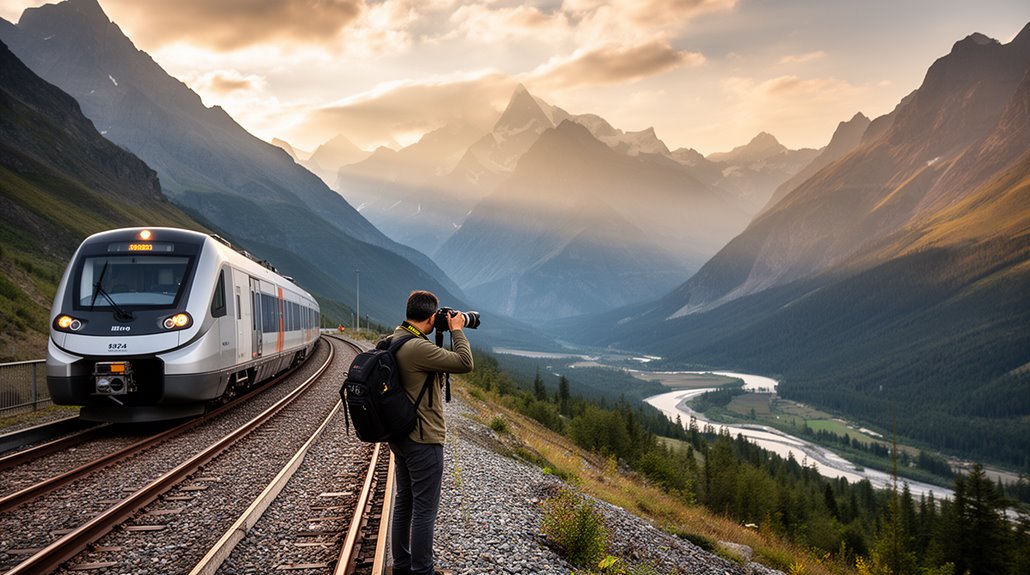
Mountains race past. Locomotives thunder forward. And you need glass that devours the horizon.
The NIKKOR 14-24mm delivers a 114° wide-angle field of view—carriage interiors, distant peaks, entire railway panoramas captured in a single frame. Its optical performance rises from fourteen elements and aspherical lenses that render every sunrise positioning with brutal, unforgiving clarity; sharpness lives here, edge to edge, no compromises. A constant aperture of f/2.8 conquers those dim pre-dawn departures when mist clings to the tracks and lamplight barely cuts through the gloom—you’ll freeze motion while others fumble with sluggish glass.
Handling for field use means carrying 1000g of serious engineering: weather-sealed, built to survive platform jolts and alpine cold. Rugged.
But composition enhancements? That’s where magic happens. That’s where your vision crystallizes. That’s where this lens transforms good into unforgettable—because the 0.28m minimum focus distance pulls foreground tracks into vivid, tactile presence. Imagine this: frost on steel rails three inches from your front element, snow-draped summits floating in the background, all held in the same crystalline plane. The wide angle expands space; the close focus compresses drama. Together they create depth that makes viewers lean in, wondering how you bent reality. This technique proves especially powerful when capturing routes like Switzerland’s Bernina Express, where UNESCO World Heritage status reflects the stunning alpine vistas begging to fill your frame.
Can any other zoom claim such range?
Sunrise positioning demands speed. Low-light departures require that constant f/2.8. Railway scenery spanning platforms to peaks needs those 114 degrees. And every technical challenge—flare control, distortion correction, chromatic aberration—vanishes behind those aspherical elements working in concert: coatings, curvatures, optical wizardry invisible to everyone but essential to everything. The rounded diaphragm blades deliver creamy bokeh when isolating details against blurred backgrounds, transforming distant station lights into smooth orbs of color. The Nano Crystal Coat virtually eliminates internal reflections when diagonal morning light streams through train windows, ensuring ghost-free images even in the harshest backlighting conditions.
Swallow horizons whole. Render them sharp. Make them sing.
Frequently Asked Questions
Which Nikon Camera Body Offers the Best Battery Life for Full-Day Train Journeys?
Which Nikon camera offers the best battery life for full-day train journeys?
The Nikon D3X leads all Nikon models in battery endurance.
What’s the best mirrorless option for extended shooting?
The Z9 with its 3300mAh battery provides extended capability without frequent recharging.
How Does Weather Sealing Protect Nikon Equipment During Outdoor Platform Photography Sessions?
Weather sealing uses rubber gaskets at lens mounts, internal seals, and protective covers at body joints, buttons, and ports to prevent water and dust from entering Nikon cameras and lenses during outdoor shoots in rain, mist, and harsh conditions.
Can Z-Mount Lenses Be Used With Older F-Mount Nikon DSLR Camera Bodies?
No. Z-mount lenses are incompatible with F-mount DSLR bodies due to different mount specifications and shorter flange distance. Nikon does not manufacture an adapter for this reverse configuration.
What Memory Card Capacity Is Recommended for 8K Video Recording on Train Routes?
325GB to 1TB CFexpress Type B cards are recommended. Larger capacities of 650GB-2TB prevent frequent card changes during continuous filming.
Does Nikon’s Silent Electronic Shutter Work Effectively Inside Moving Train Compartments?
Q: Does Nikon’s silent electronic shutter work inside moving trains?
A: Yes, for stationary interior subjects, but creates rolling shutter distortion for exterior scenery through windows.
Q: What causes the distortion when photographing through train windows?
A: The combination of train motion and sequential sensor scanning.
Q: Can you photograph interior subjects clearly on a moving train with electronic shutter?
A: Yes, stationary interior subjects photograph without issues.
Q: What is the main limitation of electronic shutter on trains?
A: Rolling shutter distortion when capturing exterior moving scenery.
Parting Shot
Nikon’s Z-series handles train photography without fuss. The vibration reduction works. The autofocus tracks landscapes through dirty windows at 80km/h. Wide-angle lenses capture everything. Honestly, the hardest part isn’t the gear—it’s finding a clean window on a crowded train. The cameras deliver sharp images in tunnels, through rain, and at dawn. Set it to shutter priority, shoot at 1/30s for motion blur, and you’re done. Simple stuff, really.