European Train Travel: How to Ride the Most Scenic Railways Across the Continent
European railways: a network that traverses glaciers, vineyards, and alpine passes. The continent offers travelers a seat-side view of dramatic landscapes. Switzerland’s mountain routes climb ancient viaducts. Norway’s coastal lines plunge past thundering waterfalls. The journey rewards those who plan well. train travel advantages for copenhagen to stockholm include the unique opportunity to experience both urban culture and stunning Swedish countryside. Passengers can enjoy comfortable amenities while viewing picturesque lakes and lush forests along the route. This mode of travel not only reduces carbon footprint but also allows for seamless connections to other destinations in Scandinavia.
- Bernina Express route: a UNESCO World Heritage passage connecting Switzerland to Italy through 55 tunnels and 196 bridges
- Flåm Railway: a Norwegian engineering marvel descending 866 meters through fjord country in under one hour
- Glacier Express: an eight-hour crossing through 91 tunnels linking mountain resort towns
Timing determines the experience. Summer months bring long daylight hours and green valleys. Winter transforms routes into snow-covered corridors. Spring offers wildflower meadows. Autumn delivers golden forests.
Window seats require strategy. Early boarding secures prime viewing positions. Seat reservations cost extra but guarantee placement. The right-hand side offers better views on eastbound journeys.
Local rail operators provide scenic routes at lower costs than premium services. Regional passes offer flexibility for spontaneous travel. Station cafés serve fresh bread and local cheese—provisions for the journey ahead.
Interesting Fact: The Semmering Railway in Austria, completed in 1854, became the world’s first mountain railway built for locomotives and remains fully operational today as a UNESCO World Heritage Site.
12 Iconic Scenic Train Routes Across Europe

Twelve train routes wind through Europe, and each one rewrites what scenic rail travel can mean.
Consider the Bernina Express: glaciers tower above you, ancient and cold, while far below, palm trees sway in Mediterranean warmth—ice and tropics sharing the same impossible view.
The Flåm Railway in Norway? It plunges down a 55% gradient, one of the steepest standard-gauge tracks on Earth, carving through valleys so deep you’ll forget to breathe.
Along the Rhine, castles rise from rocky cliffs.
They look painted.
They look staged.
They look absolutely fake—yet every stone is real, weathered by centuries of river mist and human ambition.
Scotland offers something different; here, lochs vanish into fog as your train curves through highlands that seem to exist outside of time.
Mist swallows the water.
Mountains emerge, then disappear.
You press your face to the glass like a child.
Why do these journeys matter?
Because Europe has spent generations perfecting the art of the scenic route, threading steel through landscapes that humble cathedrals and dwarf monuments.
These aren’t simply trips from station to station—they’re immersions: glacier light, vineyard shadow, castle silhouette, highland grey.
The rhythm of wheels on track becomes meditation; the passing view becomes revelation.
Twelve iconic rail journeys cross this continent, and each one earns its legend.
Some rush you through drama—tunnels giving way to sudden precipices, waterfalls thundering past your window.
Others let beauty unfold slowly, reflectively, like a letter read by candlelight.
The Bernina shows you extremes.
The Flåm shows you gravity.
The Rhine shows you history stacked on history.
Scotland shows you solitude.
The Glacier Express, often called the slowest express train in the world, crosses nearly 300 bridges as it connects Zermatt and St. Moritz.
Beautiful?
That word barely reaches.
These are the most stunning train rides you’ll ever take—routes that transform passengers into witnesses, windows into frames, and ordinary travel into something that lingers for years.
The Venice Simplon-Orient-Express offers luxury dining, elegant sleeping accommodations, and a live pianist as you journey through rolling hills and French Riviera scenery.
For the ultimate Swiss experience, the Grand Train Tour combines panoramic trains, buses, and boats to showcase lakes and UNESCO World Heritage locations.
Unforgettable.
See Europe’s Best Views From a Train Window
Knowing which routes exist is one thing. Actually seeing the landscapes unfold before you—that’s something else entirely. Strategy matters here; it matters more than you might expect.
European scenic railways reward the thoughtful traveler. They reward the planner. They reward those who ask one simple question before boarding: which side?
Consider what happens when you choose well. The Belgrade-Bar Railway carries you through Montenegro as evening approaches, and if you’ve claimed a seat on the right, the Dinaric Alps catch fire with sunset gold. The Bernina Express demands a different approach—strategic repositioning—because the Landwasser Viaduct reveals itself unexpectedly, curving through Swiss wilderness like a stone dream suspended in air. Meanwhile, the Golden Pass eliminates the guessing game altogether with its panoramic cars, those curved windows opening wider angles onto a world most passengers never truly see. Worth the planning. The Bernina Express route has earned UNESCO World Heritage status, cementing its place among the world’s most celebrated rail journeys.
| Route | Best Side | Why It Matters |
|---|---|---|
| Belgrade-Bar Railway | Right | Sunset over Dinaric Alps |
| Bernina Express | Strategic | Landwasser Viaduct views |
| Golden Pass | Panoramic cars | Curved windows, wider angles |
What separates a nice trip from an unforgettable one? Often, it comes down to something as simple as a window seat on an alpine rail journey: the right window, the right moment, the right light spilling across peaks you’ll remember for decades. The Flåm Railway proves this perfectly, descending 2,830 feet from Myrdal through tunnels and past thundering waterfalls in just 12.6 miles. For the Bernina Express, the panoramic car usually requires reservation, so book ahead to secure those sweeping mountain views.
So grab your ticket. Study the route. Arrive early enough to claim your position.
The best scenic train views Europe offers don’t happen by accident—they happen to passengers who understand that magic requires a little preparation. Just a little. But enough.
Which Scenic Railway Tops the Europe List?
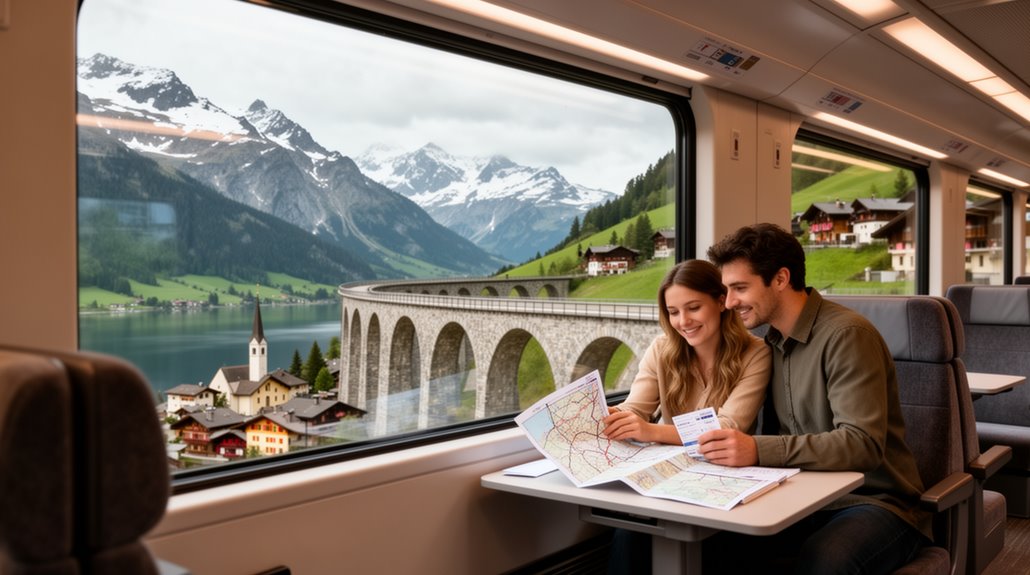
One railway keeps appearing at the top of every list.
The Bernina Express.
Again and again, the Bernina Express.
Always, without fail, the Bernina Express.
Then silence from the competition.
Why does this single route dominate every scenic railway ranking Europe produces?
Lonely Planet includes it among the 10 best train journeys on the continent; travel specialists call it “perhaps the most scenic train journey of them all”—a bold claim, yet one that sticks.
Consider what you’re up against when measuring beautiful train routes across Europe: the legendary Glacier Express winding through Alpine valleys, the dramatic Flåm Railway plunging toward Norwegian fjords, dozens of other must-ride contenders threading through mountain passes and coastal cliffs.
Still, when experts compile their top rated train journeys, when bucket list train travel guides go to print, when travelers share their unforgettable moments, this Swiss-Italian masterpiece rises above them all.
The numbers confirm it.
The reviews echo it.
The rankings prove it.
Undeniable.
Picture yourself aboard as the train climbs through snow-dusted peaks, crosses the famous Landwasser Viaduct, and descends into palm-lined Italian villages—all in a single journey.
You witness glaciers, alpine meadows, spiral tunnels carved through ancient stone.
From frozen heights to Mediterranean warmth in hours.
What other railway offers such dramatic transformation?
Must-ride railways ranked by seasoned travelers and industry authorities alike place the Bernina Express at the summit.
Not second.
Not tied.
First.
Europe produces countless scenic journeys. The narrow-gauge route navigates 55 tunnels and 196 bridges as it travels from St. Moritz to Tirano. The journey’s crown jewel arrives at Ospizio Bernina, where passengers gaze upon the turquoise Lago Bianco from an elevation of 2,253 meters. This breathtaking Alpine route has earned recognition as a UNESCO World Heritage designation, cementing its status among the world’s most significant railway achievements.
One wins.
Top 5 European Scenic Railways for Your Bucket List
Europe sprawls before you, a continent threaded with steel and story. Where do you even begin? The routes are many. The views are endless. The choice is yours.
Start in Scotland, where the West Highland Line winds through misty glens that seem lifted from ancient legend; here, the famous viaduct—yes, the one from Harry Potter—arches across the landscape like a stone ribbon frozen in time, and fog clings to the hills as if the land itself is breathing. Stunning. The journey from Glasgow to Fort William and onward to Mallaig connects seamlessly with ferries to the Isle of Skye, making it easy to extend your adventure beyond the rails.
Or consider the Bernina Express. This Swiss marvel climbs through UNESCO-recognized Alpine drama, carrying passengers past glaciers, across spiraling viaducts, and into a world where rock meets ice meets sky. The scenery doesn’t just impress—it overwhelms.
Then there’s Italy. Sun-warmed, salt-kissed Italy. The Cinque Terre Express hugs the coastline for under £5, threading through tunnels that burst open onto views of turquoise water and pastel villages stacked against cliffs. Quick, affordable, unforgettable.
Three countries. Three journeys. Three reasons to book a ticket tomorrow.
But why do these routes belong on your bucket list? Because Europe by train offers what no highway can: the slow reveal, the gradual crescendo of landscape unfolding outside your window. You watch. You breathe. You remember why travel matters.
Pack light. Dream big. Let the rails carry you toward something extraordinary—a highland shrouded in mist, an Alpine pass carved by centuries, a Mediterranean coastline gilded by afternoon light. For the ultimate slow journey, the Glacier Express travels between Zermatt and St. Moritz, crossing 291 bridges along the way.
These are not just train rides. They are passages through living postcards, each one a story waiting to wrap itself around your memory. So grab a window seat, settle in, and let Europe’s scenic railways remind you what wonder feels like. For an overnight adventure, the Thello train from Paris to Venice offers cozy couchettes and premium cabins as you glide past the Swiss Alps and Italian Dolomites.
Your bucket list? Consider it complete.
Dream Train Rides Through Europe’s Mountains

Coastal routes draw crowds. Highland passes steal headlines. But Europe’s mountain railways? They offer something else entirely—raw altitude, ancient peaks, and the kind of views that make you forget your phone exists.
Europe’s mountain railways deliver what coastlines cannot—raw altitude, ancient peaks, and silence worth traveling for.
Consider the Brenner Railway. It climbs, and climbs, and climbs; at 1,371 meters, it threads through three nations, crossing from Germany through Austria and finally descending into Italy.
Engineers carved this passage through the mountains in the 1860s, when the very idea of conquering such terrain seemed impossible, when steam and iron were still proving themselves against rock and ice, when Europe dared to dream vertically. They succeeded.
Have you ever watched a landscape transform through a train window? One moment: German forests.
The next: Austrian valleys draped in shadow. Then, suddenly, Italian light pouring golden across the peaks.
Hidden gems wait beyond the famous routes. Germany’s Brocken Railway, tucked away from the tourist brochures, reaches 1,125 meters—a quieter ascent, perhaps, but no less magnificent. The journey from Drei Annen Hohne takes approximately 50 minutes, winding through the Upper Harz Mountains past panoramic views that extend into the foothills. Slovakia’s low-Tatras mountain line from Banská Bystrica to Margecany offers another overlooked alpine adventure, threading through dramatic Eastern European peaks.
These are not mere transportation lines: they are time machines, engineering marvels, moving galleries of granite and sky.
What makes mountain railways different from their coastal cousins? Altitude changes everything.
The air thins. Colors sharpen. Villages shrink to specks below while clouds drift at eye level, close enough to touch through an open window.
You sit in a carriage built over a century ago, rattling upward on tracks that cling to cliffsides, and something shifts. The phone stays pocketed. The email waits.
Above the treeline, surrounded by peaks older than memory, the modern world releases its grip. Norway’s Flåm Railway stands among the steepest train lines in the world, delivering unbeatable fjord and mountain views that epitomize this alpine escape.
Raw altitude. Ancient stone. Silence broken only by the rhythm of iron wheels.
This is what Europe’s mountains offer by rail.
Bernina Express to Flåm Railway: Route Comparison
Two railways dominate every “best scenic train” list in Europe.
They tower above the rest.
They captivate travelers year after year.
And then—the pattern breaks.
Because honestly? The competition isn’t even close.
Consider the Bernina Express, that legendary must-do journey connecting Switzerland to Italy by train.
It earns a commanding 8.8/10 in the scenic route comparison that Europe travelers obsess over, and for good reason.
This is a railway that stretches 144 kilometers across the Alps; it consumes more than four hours of your journey; it carries you over 196 bridges—each one a postcard waiting to happen.
The journey is elevated further by panoramic carriages featuring large windows and glass roofs that ensure no glacier or alpine lake escapes your view.
This iconic route through the Swiss-Italian Alps has become one of the most celebrated train journeys worldwide.
Now shift your gaze north.
The Flåm Railway operates on an entirely different scale: just 20 kilometers, under one hour, a concentrated burst of Norwegian drama.
What it lacks in length, it compensates for in sheer audacity.
No northern Europe train route descends more steeply than this vertiginous plunge through fjord country.
You want contrast? Here it is—the Bernina unfolds like a symphony, movement after movement building across glaciers and spiral viaducts, while the Flåm detonates like a thunderclap, brief and unforgettable.
One rewards patience with Alpine grandeur that keeps revealing itself around every curve.
The other grabs you by the collar and doesn’t let go until you’ve dropped nearly 3,000 feet through tunnels carved into mountainsides.
Both belong on your list.
Both deliver what they promise.
But which rhythm calls to you: the long, meditative crossing where Switzerland slowly becomes Italy, or the swift, heart-pounding descent that packs a lifetime of scenery into fifty-seven minutes?
These are the routes that define European rail travel.
Magnificent, yes.
Comparable? Barely.
According to a Which? ranking evaluating scenery, comfort, on-board facilities, and value for money, the Bernina Express received top marks for scenery and facilities.
Choose one, choose both—just don’t miss them.
Northern vs Southern Europe Scenic Railways
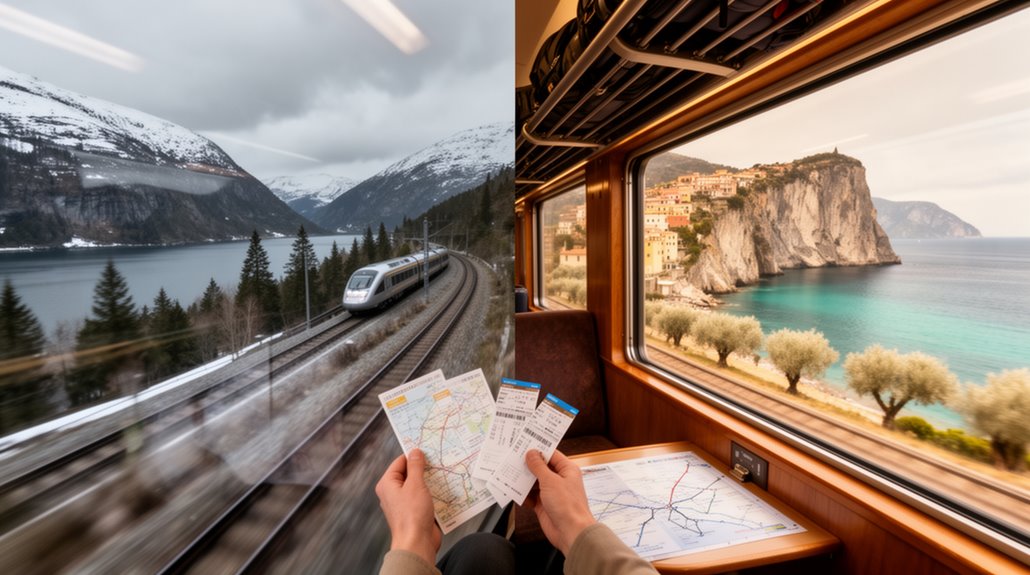
The Bernina and Flåm comparison tells one story. But north against south? That’s another tale entirely.
Northern Europe’s scenic railways carve through landscapes that feel prehistoric: fjords plunging into black water, Arctic Circle crossings where the world turns white, midnight sun stretching golden across endless sky.
You could ride for hours and never see the same shade of blue twice.
The rhythm up there runs slow, contemplative, ancient.
Then comes the south.
Mediterranean coastlines flash past your window in bursts of terracotta and azure; alpine passes climb through villages clinging to impossible slopes; vineyards roll like green waves toward horizons you want to chase.
Speed. Color. Warmth.
The southern rails move with urgency, with passion, with a tempo that quickens your pulse and makes you lean closer to the glass.
So which calls to you—the brooding north or the sun-drunk south?
Consider this when planning your Europe train trip itinerary: you don’t have to choose just one.
The continent offers both in a single journey, both in a single week, both waiting on parallel tracks for whoever dares to embrace contrast.
Northern routes demand patience and reward it with silence.
Southern routes demand attention and reward it with spectacle.
Every route—every single kilometer of track—demands something.
Here’s the truth about Europe train travel planning.
It’s not about finding the best landscape.
It’s about picking your poison: fjord or coastline, midnight sun or Mediterranean noon, reflection or exhilaration.
Maybe all three.
Maybe you board in Oslo and step off in Nice, having collected every vista in between.
The rails don’t care which direction you choose.
Sweden’s Inlandsbanan stretches 1,288 kilometers from Kristinehamn to Gällivare, threading through wilderness that swallows sound whole.
Norway’s Nordland Railway runs 729 kilometers from Trondheim to Bodø, crossing 290 bridges and passing through 150 tunnels along frosty Arctic coasts.
Tools like the Eurail Planner app can help you map these epic cross-continental journeys with real-time information at your fingertips.
They simply wait.
Plan Your Europe Scenic Rail Trip in 4 Steps
Europe’s scenic railways don’t plan themselves.
They wait.
They wind through alpine passes and vineyard valleys, patient as stone—but your seat on that panoramic car won’t wait forever.
The trains move slowly through ancient landscapes—your window of opportunity to book that view does not.
So where do you begin?
A solid scenic rail guide breaks the journey into four manageable steps, and the first demands your attention before anything else: pick your routes by season.
Vineyards pop in fall, their leaves burning gold against ancient hillsides.
Mountains shine year-round, draped in snow or wildflowers depending on when you arrive.
The Brenner Pass from Innsbruck to Verona transforms completely, with snow-dusted peaks in winter giving way to blooming valleys come spring.
The scenery changes; the magic doesn’t.
Next comes booking.
Book early.
Book smart.
Book those seat reservations before everyone else claims the panoramic windows—because they will.
You can easily book tickets online or through dedicated rail apps to secure the best seats weeks in advance.
Trust this.
Pacing matters too.
You could cram three countries into forty-eight hours; you could race from platform to platform, watching stations blur past in a frenzy of departure boards and espresso.
Or you could breathe.
Pace your connections realistically, allowing time to wander a medieval square, to miss one train and catch the next without panic.
The rails aren’t going anywhere.
And if this is your first time riding European trains, here’s what nobody tells you: the window seat changes everything.
Position yourself on the right side for that famous gorge; switch left before the coastal stretch.
Bring a lens cloth.
Study train window photography tips before departure—because the light through those panoramic panes can make or break your shots.
The Bernina Express from Chur to Tirano offers some of the most spectacular alpine scenery on the continent.
Four steps.
That’s all.
Season, reservations, pacing, preparation.
The mountains are waiting.
The vineyards are ripening.
Your itinerary sits empty, ready for routes you haven’t yet imagined.
Plan it.
Frequently Asked Questions
Do I Need a Visa to Travel by Train Between European Countries?
Do I Need a Visa to Travel by Train Between European Countries?
No visa is required for train travel within the Schengen Area for eligible country passport holders. A valid passport allows stays up to 90 days.
Can I Bring My Bicycle on European Scenic Trains?
Can I Bring My Bicycle on European Scenic Trains?
Yes, many European scenic trains allow bicycles. Reservations often required. Fees may apply. Peak hour restrictions common. Folding bikes have fewer limitations.
Are European Scenic Trains Accessible for Wheelchair Users?
Are European Scenic Trains Accessible for Wheelchair Users?
Yes, many European scenic trains offer designated wheelchair spaces, accessible toilets, and boarding assistance. Advance reservations are required for routes like the Glacier Express, West Highland Line, and Eurostar.
What Happens if I Miss My Booked Scenic Train Departure?
If you miss your booked scenic train departure, contact staff immediately. Railway delay-caused misses allow boarding the next available train. Other circumstances require rebooking fees or new ticket purchases.
Do Scenic Trains in Europe Offer Wi-Fi and Power Outlets?
Do Scenic Trains in Europe Offer Wi-Fi and Power Outlets?
Most European scenic trains lack Wi-Fi, especially Swiss routes. Power outlet availability varies by train. Mobile data provides the most reliable connectivity option.
Parting Shot
Europe’s scenic railways aren’t just transportation. They’re moving postcards. The Bernina Express, the Flåm Railway, the Glacier Express—each one stitches together landscapes like a quilt of mountains, waterfalls, and vineyards. Sure, planes get travelers there faster. But faster isn’t always better. Sometimes the journey actually is the destination. Grab a window seat. Wipe that lens. Watch the continent unfold, one curve at a time.