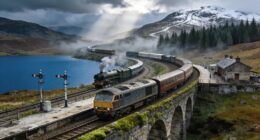
Why Sustainable Train Travel Europe Relies on Swiss Federal Railways Innovation
Swiss Federal Railways: Europe’s leader in sustainable rail transportation. SBB operates 90% of its fleet using hydroelectric power. The company owns or co-owns 13 hydroelectric plants across Switzerland. This vertical integration creates energy independence that Deutsche Bahn, SNCF, and Trenitalia study closely.
SBB pioneered regenerative braking technology five decades ago. Train motors convert kinetic energy into electricity. The captured power flows back into the Swiss national grid. Austrian Federal Railways and NS Dutch Railways adopted similar systems after observing SBB’s success.
- Kraftwerk Amsteg: This Alpiq-operated facility supplies clean energy directly to SBB’s traction current network
- Etzelwerk Power Station: Located near Lake Sihl, this plant generates renewable electricity for Zurich commuter lines
- Ritom Power Station: Ticino’s mountain facility powers cross-Alpine Gotthard Base Tunnel operations
The European Union references SBB benchmarks in its Sustainable and Smart Mobility Strategy. Rail Europe promotes Swiss connections as carbon-conscious alternatives to short-haul flights. Eurail Pass holders choose SBB routes for environmental credibility.
Local energy cooperatives in Valais and Graubünden partner with SBB on micro-hydro projects. These collaborations distribute economic benefits to Alpine communities. Switzerland Tourism highlights the green rail network in destination marketing campaigns.
Fun Activity To Try: Book a scenic SBB Glacier Express journey from Zermatt to St. Moritz and track your trip’s carbon footprint using the official SBB Mobile app’s environmental calculator.
Key Points
- SBB owns hydroelectric plants providing 90% of traction energy, achieving energy independence rare among European national rail systems.
- Swiss regenerative braking technology has fed energy back into rail networks for 50 years, with trains generating up to 6,000 kW.
- SBB’s technical expertise shapes UIC international standards for environmental certification, pantograph systems, and sustainable railway routes across Europe.
- Switzerland’s nearly 100% electrification rate and compatible voltage systems with Germany enable seamless cross-border electric train operations.
- SBB leads the transition from GSM-R to FRMCS telecommunications, enabling future automated train operations across European networks.
Swiss Federal Railways Powers Europe’s Renewable Railways With 90% Hydroelectric Energy

Swiss Federal Railways basically runs on water—which sounds dramatic until you realise it’s been doing this for decades.
Roughly 90% of its traction energy comes from hydroelectric power, which honestly makes their whole renewable setup seem almost unremarkable at this point.
The electrification story is where things get interesting, though.
The railway owns eight hydro plants outright and holds stakes in five more, giving them a level of energy independence that most national rail systems can only dream about.
SBB doesn’t just run trains—it owns the power plants that fuel them.
This infrastructure supports Switzerland’s second-largest railway electricity network, spanning 70 substations and 1,800 km of transmission systems.
On top of that, regenerative braking has been feeding energy back into the system for something like 50 years now.
The efficiency numbers are striking—around 6 kWh per person per 100 km.
That’s sipping energy, really.
The company has also ensured that electricity for its stations, offices, and production buildings is already 100% CO2-neutral.
This clean energy powers everything from urban commuter routes to scenic panoramic trains like the Bernina Express and Glacier Express that wind through the Alps.
Whether this model could translate to other countries with less favourable geography is another question entirely, but as a proof of concept? It’s hard to argue with half a century of results.
How European Rail Networks Achieve Zero Emissions Through Swiss Electrification

Switzerland sits at nearly 100% electrification—a number that honestly sounds made up but isn’t. The rest of Europe? Playing catch-up with varying degrees of success.
| Country | Electrification Rate | Voltage Standards |
|---|---|---|
| Switzerland | ~100% | 15 kV 16.7 Hz AC |
| Luxembourg | 96.7% | 25 kV 50 Hz AC |
| Sweden | 70%+ | 15 kV 16.7 Hz AC |
| EU Average | 56.9% | Mixed systems |
| France | Varies | 25 kV AC/1.5 kV DC |
What makes this work in practice is cross-border cooperation. Swiss Federal Railways shares catenary systems with Germany, which means electric locomotives can slip across the border without switching to diesel. That said, the “mixed systems” row in that table hints at a thornier reality—voltage incompatibilities likely slow broader adoption across the continent. Even so, power grid integration across the European rail network appears to deliver CO2 reductions at genuine scale. The environmental case is compelling: rail travel produces up to 13 times less CO2 emissions than flying, making these electrification investments critical for meeting climate targets. Whether other nations can replicate the Swiss model remains an open question, though Luxembourg’s near-complete electrification suggests it may be more achievable than the EU average would have you believe. Luxembourg also leads rail investment per capita among European countries, which helps explain how smaller nations can achieve such impressive electrification rates. Meanwhile, Poland has reached over 63% electrification as of 2023, demonstrating that even larger rail networks can make significant progress toward sustainable train travel.
Alpine Transit Routes: Electric Mountain Railways Setting World Environmental Standards

Electrifying flatland networks is one thing—scaling mountains is something else entirely. Swiss Federal Railways and the alpine transit routes they connect to run electric mountain railways powered almost entirely by hydropower, which appears to make them among the cleanest rail systems operating today. The foundation for this network was laid when Switzerland’s 1898 popular vote approved the socialisation of major rail companies, setting the stage for unified electric infrastructure development.
Take the Jungfrau Railway: it climbs to 3,454 meters, Europe’s highest station, and produces roughly 20 times less CO₂ than cars making the same journey. That’s a striking figure, though it’s worth noting the comparison likely depends on vehicle occupancy and specific route conditions. The Pilatus Bahn adds another dimension to this achievement, operating as Europe’s steepest railway while maintaining the same commitment to electric traction.
At 3,454 meters, the Jungfrau Railway proves low-carbon transit can conquer even Europe’s most extreme terrain.
Even so, these green alpine railways aren’t just postcard material. They seem to be making a genuine case that low carbon transport can work—even at altitudes most engineers would call absurd. Nearby, the Bernina Express demonstrates this same engineering philosophy while traversing the Swiss-Italian Alps through equally dramatic terrain.
On top of that, they’re doing it with renewable energy railways that draw from the Alps’ abundant hydropower. It’s not a perfect model for everywhere, sure. But as proof of concept? Hard to argue with a train station sitting at the top of Europe.
Swiss Regenerative Braking Returns 30% Power to Grid for Maximum Energy Efficiency

When trains brake on most railways, that energy just disappears as heat. Switzerland does things differently. SBB’s clean locomotives capture kinetic energy and feed it back into the rail infrastructure—though the exact efficiency likely varies depending on conditions. Still, we’re looking at serious renewable energy recovery here.
| Locomotive Class | Annual Energy Savings | Environmental Efficiency |
|---|---|---|
| Re 460 | 8 GWh | 119-unit fleet optimization |
| Re 6/6 | 100 MWh per unit | 2% consumption recovery |
| ICN Tilting | 2.7 GWh | Carbon reduction leader |
These trains essentially become mini power stations. A descending train can literally power one climbing uphill. During braking, trains can generate output up to 6,000 kW, demonstrating the substantial power recovery potential of this technology. That said, the 2% recovery figure for the Re 6/6 units may seem modest compared to the fleet-wide numbers—it’s worth noting these are older locomotives, so the technology appears to perform better in newer rolling stock. Even so, the principle holds: energy that would otherwise be wasted gets a second life. That’s intermodal transport thinking at its finest, though some might argue true grid-level impact depends on how Switzerland’s rail network manages peak demand across routes. The Re 6/6 improvements required developing a programmable control device to modify how the regenerative brake operates, which was tested on locomotive Re 6/6 11617 during regular service. This innovation contributes to why high-speed trains across Europe have become a model for efficient continental travel.
What Paris Climate Agreement Targets Mean for Carbon Neutral Rail Investment

The Paris Agreement set an ambitious target—keeping global warming well below 2°C, ideally capping it at 1.5°C—and that put the entire transport sector on notice. Suddenly, everyone had homework.
Rail, to be fair, was already in a decent position. Its carbon footprint looked comparatively modest, with the mode accounting for less than 2% of EU emissions while maintaining over 8% market share. The Union Internationale des Chemins de Fer (UIC) responded by pledging carbon neutrality by 2050, which appears to signal where the industry sees itself heading. That said, pledges are one thing; delivery is another. The commitment has gained significant traction, with more than 60 UIC members signing on to represent most global rail activity.
Climate targets now demand green transportation investments, zero-emission connections, stricter emission standards. Energy consumption isn’t just a line item anymore—it’s become central to the conversation. Expanded high-speed rail services like direct Eurostar connections between major European cities demonstrate how infrastructure investment can make train travel a competitive and eco-friendly alternative to air travel. And science-based targets? Those seem less optional by the day, though how consistently they’ll be enforced across different regions remains an open question.
UIC Standards Spread Swiss Rail Innovation Across European Borders

Switzerland built one of the most punctual, efficient rail networks on the planet—that much is hard to argue with.
And now their expertise appears to be shaping climate-friendly rail across Europe through UIC standards.
SBB experts lead key sectors, including noise and vibration guidance, which is no small feat given how contentious those technical committees can get.
These eco railway innovations get codified into international rules.
Pretty smart, honestly.
Though one might wonder whether smaller national rail operators can actually implement them at the same pace as wealthier systems.
On top of that, the standards support environmental railway certification, pantograph systems, and sustainable routes.
The result? Swiss passenger mobility solutions spreading to public transit systems everywhere—from commuter lines in the Netherlands to regional networks stretching through Austria.
Even so, adoption likely varies quite a bit depending on local infrastructure and political will.
Travelers planning to experience these improved European rail networks can use specialized apps and booking platforms to navigate routes that benefit from Swiss-influenced standards.
SBB is also pioneering the transition from GSM‑R to FRMCS, a future-proof telecommunications standard that will enable innovations like Automatic Train Operation and support railway digitalization across the continent.
By June 2023, GSM‑R had been implemented across approximately 130,000 km of track, demonstrating the massive scale of infrastructure that FRMCS will eventually need to replace.
Why European Union Policy Elevates Rail Over Short-Haul Aviation

While Switzerland keeps perfecting its rail system, the European Union has been placing a pretty bold bet on trains over planes. Climate policy now explicitly favors rail for trips under 800 km—and the reasoning seems straightforward enough. Rail appears to be roughly 12 times more energy-efficient than air travel, though the exact figure likely varies depending on how you measure it. The EU has committed to reducing greenhouse gases by 55% by 2030 compared to 1990 levels, making this modal shift a critical piece of the climate puzzle.
| Policy Element | Rail Advantage |
|---|---|
| Green Deal 2050 | Climate neutrality priority |
| TEN-T Network | High-speed corridor funding |
| Aviation Taxes | Kerosene still exempt |
| ETS Allowances | 85% free for airlines |
Sustainable scenic railways and eco-certified train routes benefit from billions in EU funding. To date, the EU has supported 804 rail infrastructure projects with €34.4 billion via the Connecting Europe Facility. On top of that, airlines basically get a free pass on fuel taxes—kerosene remains untaxed while you pay through the nose to fill your car. Fair? Not really. That said, defenders of aviation point out that planes serve routes where rail simply isn’t viable, and some argue the industry needs time to develop cleaner alternatives. Even so, when 85% of emissions allowances come free to airlines, the policy tilt seems hard to ignore. Beyond the environmental benefits, train travel offers passengers comfort and scenic views along with amenities like free Wi-Fi, dining services, and unique features such as quiet cars and dome cars that make the journey itself an enjoyable experience.
Frequently Asked Questions
How Does Sbb’s Clock-Face Scheduling System Improve Sustainable Travel Connections?
SBB’s clock-face scheduling synchronizes arrivals and departures at hub stations every 30 minutes, reducing transfer times to approximately five minutes. This predictable coordination across rail, bus, and boat services maximizes network efficiency while minimizing energy waste.
Can Passengers Bring Bicycles on Swiss Trains to Reduce Car Dependency?
SBB permits assembled bicycles on most trains with a bike ticket, while folded bikes travel free as luggage. Dedicated bike spaces and accommodating policies support car-free mobility across Switzerland’s dense rail network.
What Makes the Gotthard Base Tunnel Crucial for European Freight Sustainability?
The Gotthard Base Tunnel proves vital for European freight sustainability by enabling modal shift from road to rail, increasing Alpine freight capacity from 20 to 50 million tonnes annually while reducing energy consumption through its flat profile.
How Does Sbb’s Integrated Ticketing Encourage Multi-Modal Sustainable Journeys?
SBB’s integrated ticketing system allows passengers to purchase single tickets covering trains, buses, trams, and boats across Switzerland. This seamless approach eliminates transfer barriers, reducing reliance on private vehicles and encouraging sustainable multi-modal public transport journeys.
Does Sbb’s 92.5% Punctuality Rate Reduce Emissions From Missed Connections?
Yes, SBB’s 92.5% punctuality rate reduces emissions by minimizing missed connections. High reliability decreases additional train movements, extended idling, and delay cascades while maintaining passenger trust in rail over more carbon-intensive transport modes.
Parting Shot
Switzerland figured this out in 1960. Let that sink in. While other countries debate carbon targets, SBB runs 1.32 million passengers daily on 90% hydroelectric power. The Gotthard Base Tunnel exists. Regenerative braking pumps energy back into the grid. It’s not transformative anymore—it’s just smart infrastructure that works. Europe’s sustainable rail future already has a blueprint. Someone already built it.