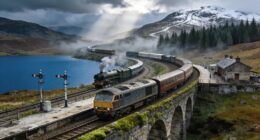
How Luxury Train Experiences Europe Perfected Michelin-Starred Dining Cars
European luxury trains: mastered fine dining through compact kitchen engineering and precision timing. The Venice Simplon-Orient-Express operates full-service galleys within 15 square meters. These kitchens produce multi-course menus at 200 kilometers per hour.
Jean Imbert earned Michelin recognition for his Orient Express collaboration. The French chef sources ingredients at scheduled station stops. Langoustines board at Lyon. They reach plates within hours.
- Belmond operates the Venice Simplon-Orient-Express with restored 1920s dining cars featuring hand-crafted marquetry panels
- La Dolce Vita Orient Express launches Accor’s Italian route with Massimo Bottura consulting on regional menus
- Golden Eagle Luxury Trains employs rotating guest chefs from London establishments including The Ritz
Silver service teams train at hospitality academies in Switzerland. They navigate narrow aisles in synchronized formation. Sommeliers curate cellars exceeding 200 labels from Burgundy estates and Tuscan vineyards.
The Royal Scotsman sources Highland venison from Balmoral-region suppliers. Local smokeries provide salmon for breakfast service. Platform markets at Florence Santa Maria Novella supply seasonal produce.
Kitchen brigades prep during overnight segments. Cold storage units maintain precise temperatures. The logistics demand military coordination between purchasing agents and station vendors across seven countries.
Fun Activity To Try: Book a demonstration experience aboard the Belmond British Pullman’s stationary dining event at London Victoria, where chefs reveal galley techniques during a four-course tasting menu.
Key Points
- Celebrity-chef partnerships bring instant credibility, with chefs like Jean Imbert earning Michelin stars within weeks of launching train dining concepts.
- Compact galley kitchens under 15 square meters use reinforced frames and vibration-tolerant equipment to deliver fine dining at 200 kilometers per hour.
- Station-stop procurement logistics ensure same-day freshness, with chefs loading ingredients like langoustines hours before service at scheduled platforms.
- Sommelier-led wine programs featuring 200-plus labels offer tableside education and regional pairings from rolling cellars stocked with global selections.
- Silver-service choreography requires synchronized teams delivering courses within minutes while adapting to the visible, theatre-like dining car environment.
Celebrity Chef Partnerships Achieve Signature Tasting Menu Authority Through Expert Cultivation

Slapping a celebrity chef’s name on a train menu isn’t just about the food—it’s brand warfare, plain and simple.
Celebrity chef consultation partnerships with Michelin-starred names like Jean Imbert appear to transfer instant credibility, though whether that translates to genuinely better dining likely depends on execution. Imbert earned his Michelin star at Hôtel Plaza Athénée just nine weeks after launch, demonstrating the rapid recognition his culinary approach can achieve.
Celebrity chef names buy instant credibility—but a Michelin star on paper doesn’t guarantee one on your plate.
These collaborations tend to feature multi-course tasting menu experiences built around seasonal ingredient sourcing and regional cuisine interpretation. Golden Eagle Luxury Trains recently announced Joseph Rawlins as guest chef for their Istanbul to Paris journey, where he will create an exclusive 8-course gala dinner inspired by local ingredients gathered along the route. North American operators like Rocky Mountaineer have similarly embraced gourmet dining as a cornerstone of their luxury rail experience through the Canadian Rockies.
Menu curation becomes storytelling, or at least that’s the idea. Even so, there’s something to be said for how culinary partnerships can transform dining cars into what feel like moving fine-dining institutions. Whether every passenger actually cares about the distinction between a Jean Imbert-curated duck confit and a standard menu option? That’s another question. Pretty clever approach, actually.
How Compact Galley Kitchen Engineering Enables Multi-Course Fine Dining at Full Speed

Celebrity chef names grab the headlines, sure. But the real engineering miracle? It’s happening in galley kitchens barely bigger than a walk-in closet.
These compact spaces somehow manage to pack commercial-grade ovens and refrigerators into under 15 square meters—a feat that still seems slightly improbable when you actually stand in one. The kitchen carriage engineering itself appears to rely on reinforced frames designed to fight constant vibration, though the tolerances involved must be remarkable. Companies like Winkler Design have been refining mobile kitchen technology since 1960, becoming European market leaders in creating these tailor-made solutions for international long-distance rail traffic.
On top of that, the layout has to accommodate tasting menu presentation formats and seasonal menu rotations, which adds another layer of complexity. The single-corridor design with equipment positioned on either side creates an ergonomically efficient workflow that minimizes unnecessary movement during service. And the service choreography? Flawless, or at least it looks that way from the dining car.
The Venice Simplon-Orient-Express route from London to Venice exemplifies how these engineering marvels deliver multi-course fine dining while passengers take in some of Europe’s most spectacular scenery.
All of this at 200 kilometers per hour.
Seven-Course Progressive Menus Deliver Culinary Journey Storytelling Across Every Dish

Crafting a seven-course dinner that actually tells a story—while hurtling through the Italian countryside—sounds like culinary madness. And yet. Michelin-starred chefs like Heinz Beck somehow manage to pull it off.
The tasting menus appear to map regional sourcing directly to geography: coastal seafood arrives first, mountain game later. Each course, in theory, references specific terroir.
Wine pairings tend to follow the same logic, though one could argue whether passengers truly absorb these connections mid-journey. On the Presidential Train in Portugal, Douro wines are carefully paired with five-course lunches prepared by acclaimed Michelin-star chefs during the nine-hour gourmet excursion. Portugal’s rail network offers scenic travel experiences that make such culinary journeys possible, with routes winding through wine country and coastal landscapes.
Even so, the culinary journey programming and dinner service choreography seem designed to transform regional ingredients into something like edible chapters—a narrative you eat your way through, one plate at a time. The British Pullman takes a similar approach, with menus celebrating culinary highlights of the towns and cities passed along the route.
Why Sommelier-Led Wine Selection Assembles 200-Plus Label Collections for Pairing Excellence

Matching wine to food on a speeding train is already tricky enough, so it’s almost amusing that luxury rail sommeliers landed on 200-plus labels as their baseline.
These rolling wine cellars—because that’s essentially what they are—span everything from storied Old World estates to scrappy New World boutiques.
The sommelier service here appears to go well beyond simply pouring; there’s genuine tableside education happening, the kind where you might actually learn something between courses.
Wine programs often tie selections to local producers along the route, which makes sense when you think about it. Rovos Rail, for instance, offers more than three dozen wines spanning sparkling, rosé, white, red, and dessert categories sourced from South African vineyards.
Even so, the standards are demanding.
Fine dining onboard means wine pairing protocols that have likely been stress-tested through tasting panels before a single cork gets pulled. The leisurely travel pace of around 60 km/h on trains like Rovos Rail actually enhances the dining experience, allowing guests to savor both scenery and sommelier selections without rushed service.
The Glacier Express takes this seriously with sommelier-selected wines complementing its first-class multi-course meals served beneath panoramic alpine windows.
It’s serious business, though whether every passenger truly appreciates the effort is another question entirely.
Station-Stop Ingredient Procurement Guarantees Same-Day Peak Freshness Along the Route

Wine cellars on wheels are impressive, sure, but even the best bottle can’t save a mediocre plate. That’s where station-stop procurement comes in—and it’s genuinely clever when you think about it. Belmond and Orient Express operations coordinate supplier drops at scheduled platforms, a logistical dance that appears to work remarkably well.
Chefs grab seafood, truffles, and vegetables just hours before service. Fresh langoustines loaded at Lyon, say, or white asparagus picked up somewhere along the Italian stretch. This tradition of station-based resupply dates back decades—by the 1950s, restaurant cars relied on ice blocks replaced at major stations to keep fresh ingredients properly cooled throughout the journey. New routes now extend this procurement network to key cities like Budapest, Vienna, and Prague, opening access to Central European culinary traditions.
This approach likely maintains ingredient quality worthy of Michelin Guide standards, though of course much depends on the specific route and season. That said, chef partnerships with regional producers do seem to guarantee that “dining excellence” isn’t just marketing fluff. The Venice Simplon-Orient-Express journey from London to Venice exemplifies this historic luxury revival with its commitment to culinary excellence. Whether every single meal hits those heights? Hard to say. But the system itself suggests a genuine commitment to freshness that most land-based restaurants would struggle to match.
Silver Service Protocol Orchestrates Synchronized Table Presentations for Every Course

Most restaurants get to hide their service hiccups behind kitchen walls. A dining car? Not so much. Everything’s on display.
Silver service presentation standards appear to demand that trained sommelier teams move in lockstep, delivering courses within minutes of each other. On trains like the Venice Simplon-Orient-Express and other Belmond luxury trains, these choreographed dining experiences operate alongside rigorous cleaning protocols that maintain the pristine presentation guests expect.
That said, it’s not just about timing. Crystal stemware needs resetting between courses. White-glove staff pick up on non-verbal cues, adjusting on the fly. Even so, one could argue this level of choreography leaves little room for genuine spontaneity—the kind of warmth some diners actually prefer. Eurostar Premier takes a different approach, with meals served fresh by a warm and welcoming onboard team directly to passenger seats.
Precision in every pour, every glance—but does flawless choreography come at the cost of genuine human connection?
These service standards likely transform what might otherwise be a simple meal into something closer to a synchronized performance. Similar attention to detail defines the Maharajas’ Express in India, where opulent vintage-style experiences extend from accommodations to cuisine. No pressure.
Crystal Stemware and Fine Linen Create the Visual Theatre of Michelin-Level Dining

Service choreography sets the stage—but honestly, the props carry just as much weight.
Crystal stemware catches the flicker of carriage lamplight, throwing those choreographed reflections across mahogany walls in a way that feels almost intentional.
Maybe it is.
Fine linen tablecloths lay down that crisp white backdrop, and Michelin-level wine curation likely demands nothing less.
Then there’s the sommelier, pairing wines with each course while those linen presentation standards do the quieter work of keeping everything stable on moving tracks.
It’s easy to overlook.
On top of that, champagne service in branded flutes—some might call it excessive.
That said, it’s not extra.
That’s the point entirely.
The dining cars themselves—L’Oriental, La Côte d’Azur, and Étoile Du Nord—feature Lalique glass panels and lacquered inlaid woodwork that elevate every meal into visual spectacle.
Similar attention to detail appears in heritage railcars like the 1952 Super Dome Pullmans, where brass accents and etched glass finishings complement the mahogany paneling to create that same sense of timeless elegance.
California’s Napa Valley Wine Train takes a comparable approach, pairing multi-course gourmet meals with vineyard views in elegantly refurbished railcars that echo the golden age of train travel.
Frequently Asked Questions
How Do Trains Maintain Wine Storage Temperature Regulations During Long Journeys?
Trains maintain wine storage temperatures through dedicated refrigerated cabinets holding 10–15°C, dual-zone coolers separating reds and whites, continuous electronic monitoring, thick insulation, climate-controlled cars, and strict operational protocols including temperature logging and minimal door opening.
What Staff-To-Guest Ratio Ensures Michelin-Level Service in Dining Cars?
Michelin-level dining cars typically require a staff-to-guest ratio between 1:3 and 1:4 at minimum, with premium services approaching 1:2 during multi-course dinner services to guarantee attentive silver service and synchronized course delivery.
How Many Guests Can Typically Be Seated per Dining Car Service?
Luxury European dining cars typically seat 18–42 guests per service, depending on train configuration. Smaller ultra-luxury operations accommodate approximately 18–24 covers, while larger services utilize two cars seating 40+ guests each.
What Culinary Qualifications Must Dining Car Chefs Possess for Michelin Standards?
Dining car chefs pursuing Michelin standards typically require advanced culinary arts diplomas, classical French technique training, HACCP food safety certification, and documented apprenticeships in fine-dining establishments, alongside progressive brigade experience from commis through head chef positions.
How Does Rail Motion Affect Plating Time per Course?
Rail motion significantly extends plating time, with lateral vibrations above 0.2–0.3 g adding 30–60 seconds per plate for precision garnishing. Chefs typically reserve complex plating for low-speed segments under 80–100 km/h, when stability permits finer detail work.
Parting Shot
European luxury trains turned tiny kitchens into rolling Michelin temples. That’s not nothing. Thirty-six guests, seven courses, one-to-four staff ratios, all while barreling through the Alps. The engineering alone took decades. The sommelier programs stock over 200 wines. Fresh ingredients get grabbed at station stops. Silver service happens in sync, every single course. Stationary restaurants simply cannot compete with this particular brand of moving madness.