European Train Travel Passes: How to Pick the Right Rail Pass for Your Trip
Rail passes: choosing the right one requires understanding your travel style, destinations, and budget. European rail networks span 33 countries. Pass types vary by coverage area and validity period. Travelers must match pass features to itinerary demands.
- Continuous passes: these tickets grant unlimited travel within consecutive days, suiting travelers who move daily between cities
- Flexible passes: these options allow scattered travel days within a wider window, benefiting those who linger in destinations
- Single-country passes: these selections cover one nation’s rail network, saving money for focused regional exploration
Pass selection depends on journey frequency. Heavy travelers benefit from continuous coverage. Casual explorers save with flexible options. Reservation requirements add hidden costs. High-speed routes like those connecting Paris to Barcelona demand seat bookings. Night trains require supplements. Mountain railways often fall outside pass coverage.
Budget calculations must factor in these extras. A pass costing 300 euros may require 150 euros in reservations. Point-to-point tickets sometimes beat pass value. The break-even point sits around three to four long journeys per week. Regional trains in Germany, Austria, and Switzerland rarely need reservations. Southern European high-speed lines almost always do. Considering the swiss travel pass benefits for scenic routes, travelers can enjoy breathtaking views while minimizing additional costs. This makes it an attractive option for those looking to explore stunning landscapes without the hassle of separate tickets. Additionally, the flexibility of the pass allows for spontaneous detours along some of the most picturesque train lines in Europe.
Travel duration shapes the decision. Two-week trips across multiple countries favor broad coverage. Week-long stays in one region suit targeted passes. Youth discounts apply to travelers under 28. Senior rates begin at 60. Children often travel free with adults.
Interesting Fact: The Trans-European Express network, launched in 1957, pioneered international rail cooperation and laid the groundwork for modern cross-border pass systems that now connect over 40,000 destinations.
Eurail vs Interrail: Which Rail Pass Saves More?

Eurail or Interrail? The question echoes through travel forums, bounces around Reddit threads, and fills countless blog posts with fierce debate. Here’s the truth: it comes down to where you live. Nothing more.
Non-European residents purchase Eurail. Europeans purchase Interrail. That’s the rule—simple, clean, absolute.
Now, before you dive deep into spreadsheets and price calculators, consider this: any honest comparison between these two passes reveals something surprising.
The pricing? Identical. The coverage? Identical. The benefits you’ll enjoy as you glide from Paris to Prague, from Amsterdam to Athens, watching countryside blur past your window while strangers become friends in dining cars—all identical. So the great debate is, well, pointless.
What actually determines your cost has nothing to do with which pass bears your name.
Duration matters; a five-day pass costs less than a month-long adventure. Age matters too—youth discounts slice prices significantly, while seniors enjoy their own savings. The pass type itself? Irrelevant to your wallet.
Is an Interrail pass worth the investment? That depends entirely on your journey.
A whirlwind tour hitting twelve cities in three weeks will reward you handsomely. A slow meander through just two countries might not. You need to calculate; you need to compare point-to-point tickets against unlimited travel freedom. Sometimes individual tickets win. Sometimes the pass delivers extraordinary value. The math varies wildly from trip to trip.
Before booking anything, ask yourself one question: how do you want to experience Europe?
As a series of transactions, purchasing each segment separately? Or as one seamless adventure, where spontaneity costs nothing extra and detours become discoveries? Both passes also unlock access to high-speed trains, night trains, and scenic routes across the continent.
The passes are twins. Your residency chooses which one you get. If you hold dual citizenship, your country of residence determines which pass you should order, not your passport collection. One key limitation to remember: Interrail is not valid for free travel within your country of residence, though it does allow one outbound day to leave and one inbound day to return.
Everything else—the planning, the routes, the memories waiting on distant platforms—that part is entirely up to you.
Skip Ticket Lines With a European Rail Pass
Skip Ticket Lines With a European Rail Pass
You know those dreaded ticket counter lines. You’ve seen them snaking through station halls. You’ve imagined yourself trapped in them, watching your train depart without you.
But here’s the thing—you don’t have to stand there at all.
With a European rail pass, travelers skip those queues pretty often, actually. Direct boarding on covered trains becomes your new reality; no shuffling forward, no watching the clock, no frantic mental calculations about whether you’ll make it. The pass replaces what would otherwise be a handful of separate regional tickets, each requiring its own purchase, its own line, its own small theft of your precious travel time. For multi-country journeys especially, this convenience transforms chaos into something remarkably simple—one pass covers it all. Freedom.
Consider what flexible rail travel across Europe really means. No advance bookings required. No rigid schedules chaining you to predetermined departures. Spontaneity returns to your itinerary, and with it, the joy of wandering. Countries like Germany and France have even introduced cooperative programs offering 60,000 free tickets for travelers under 27 to encourage young adults to explore by rail. Germany’s 2022 summer program demonstrated massive public appetite for affordable rail travel, with 52 million 9-euro tickets sold over just three months.
The benefits stack up quickly: direct boarding on covered trains, simplified multi-country trips, pass activation replacing endless regional tickets, and the liberation of booking-free flexibility. Each advantage compounds the next. Tools like the Eurail Planner app help travelers map out routes and check train schedules in real time, making the most of their pass.
Why would any traveler choose the alternative—standing in queue after queue, clutching multiple tickets for multiple countries, anxious about connections?
Rail pass convenience in Europe isn’t a minor perk; it’s a fundamental shift in how you experience train travel. Station to station, border to border, the pass works while you relax. That’s the beginner’s truth about European train travel, stripped down and honest.
Those ticket counter lines will always exist. Travelers will always fill them. But you—armed with a rail pass—walk straight past, boarding directly, breathing easily. The trains wait. Your adventure doesn’t.
Is Your Eurail Pass Actually Worth the Price?
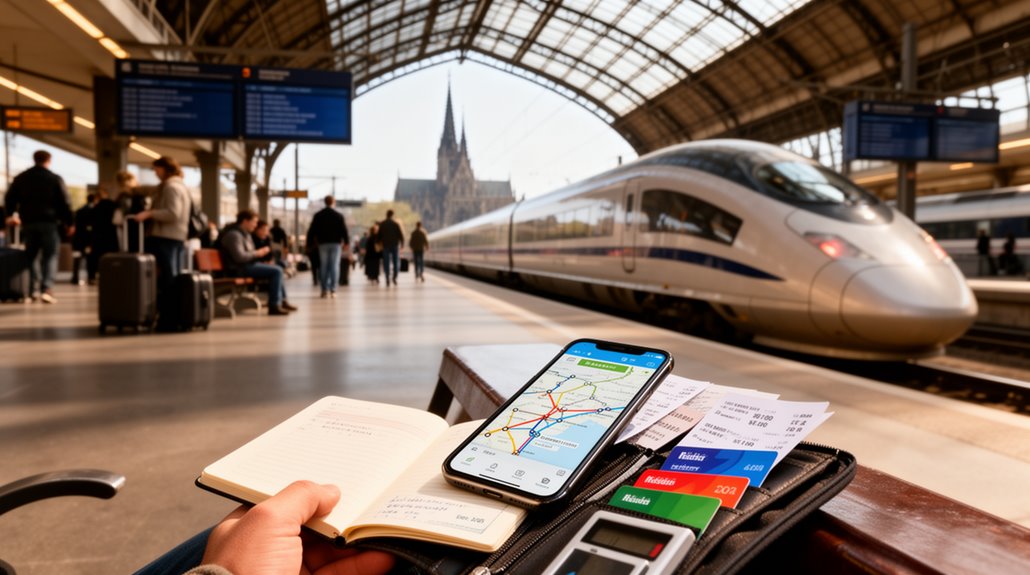
Walking past those ticket lines feels pretty great.
The breeze of efficiency.
The smugness of preparation.
But here’s the question that haunts every traveler clutching that laminated pass: is your Eurail pass actually worth it in 2026?
Depends.
A train pass savings calculator strips away the romance and reveals cold, hard math; fifteen-day passes demand €34.53 in daily value before you break even.
That number sits there, unblinking, challenging you to justify every journey.
And the costs don’t stop at the pass itself—high-speed trains pile on reservation fees ranging from €10 to €35 per ride.
Fees that accumulate quietly.
Fees that surprise you.
Fees that can devour your budget if you’re not careful.
The rail pass reservation fees guide matters.
Now consider the payoff.
International rail pass comparison data shows travelers achieving 55% savings on complex, multi-country itineraries—the kind of ambitious routes that weave through alpine passes and coastal corridors, connecting capitals and hidden villages in a single sweeping adventure.
For train trip planning across Europe, this changes everything.
Short hops? Not so much.
Quick journeys between nearby cities rarely justify the math.
You pay the premium; you watch the savings evaporate.
Better to book point-to-point tickets, to stay nimble, to let each leg stand on its own financial merit.
So when does the pass sing?
When your itinerary sprawls across borders: Paris to Munich, Munich to Vienna, Vienna to Venice—each connection stacking value until the numbers finally tip in your favor.
Routes like Paris to Barcelona showcase the pass’s potential, with high-speed trains reaching 300 km/h covering the distance in just over six hours.
The pass rewards ambition, punishes timidity, and demands you commit to movement.
Travelers 27 or under can slash up to 25% off adult pass prices with the youth discount, making ambitious itineraries even more accessible. Seniors over 60 also benefit from a 10% discount off adult prices, extending the value equation to older travelers exploring the continent.
Run the calculator before you buy.
Study the reservation requirements for your chosen routes.
Match your travel style to the pass that fits.
Worth it? For the right traveler on the right trip, absolutely.
For everyone else—maybe not.
5 Rail Pass Mistakes That Cost You Hundreds
Why do travelers keep throwing money at rail passes they’ll never fully use?
The mistake happens fast. You spot a deal. You buy too big. And suddenly, hundreds of dollars vanish into a ticket you’ll barely touch.
Consider the numbers—a global multi-country Europe pass hits $820 AUD, while Italy alone costs just $489 AUD. That difference could fund three dinners in Rome, a gondola ride in Venice, or a week of espressos at sidewalk cafés.
Yet travelers overbuy countries every single day; they imagine grand itineraries spanning half a continent, they picture themselves gliding through borders like seasoned nomads, they dream of spontaneous detours through alpine villages they’ve seen only in photographs. Then reality strikes. Most never leave their original destination.
Activation timing catches people off guard too. Ignore the pass activation timing guide, and you trigger fines ranging from €50 to €100—money burned before your journey even begins.
The rules exist. They’re printed clearly. Still, rushed travelers miss them. Border definitions for passes can differ from national borders, meaning Salzburg counts as Germany’s border when traveling from Munich on a German railpass.
Here’s what nobody mentions upfront: seat reservations carry their own weight. These fees can reach €118, buried in the fine print like secrets nobody wants you to find.
You budget for the pass itself, confident you’ve covered everything, only to discover hidden charges waiting at the platform. Rail pass fees across Europe stack up—quiet, persistent, relentless. One common blunder involves buying 15 continuous days instead of 15 flexible days, a misunderstanding that can cost over $400 to correct through cancellation and repurchase.
So before you click “purchase,” pause. Study the routes you’ll actually travel. Count the days you’ll genuinely spend on trains. Match your pass to your real plans, not your fantasy ones. Understanding different seating options like coach, business, or first class can also help you allocate your budget more wisely before committing to a pass tier.
A three-country dream sounds romantic until your wallet disagrees. The wrong pass doesn’t just cost extra; it transforms savings into waste, excitement into regret, planning into frustration.
Travel smarter. The rails will still be there—and so will your money.
Freedom on Rails: Travel Europe Without a Plan

Where exactly did anyone get the idea that European train travel requires military-level planning? Somewhere along the way, someone decided spontaneity and rail passes couldn’t coexist. They were wrong.
A spontaneous Europe train trip works—surprisingly, beautifully, effortlessly.
In Germany, the trains run like clockwork.
In Austria, alpine routes unfold without a single reservation slip.
In Switzerland, you simply show up. The country boasts one of the world’s most efficient rail networks, with frequent service and clear station signage that makes navigation effortless.
Show up at the platform. Show up with your pass. Show up ready to go.
No paperwork. No stress.
Consider this: the great rail networks of Central Europe were built for movement, for freedom, for travelers who refuse to be boxed into rigid itineraries that drain the joy from wandering.
These reservation-free routes welcome you aboard with nothing more than a valid pass and a destination in mind; they ask no questions, demand no advance bookings, expect no apologies for last-minute changes.
The Eurail global vs select pass debate? It matters far less than you might think when affordable options exist on routes that don’t chain you to a schedule. The Eurail Global Pass alone covers 28 participating countries, giving you vast freedom without needing multiple tickets.
For first-time travelers weighing their choices—global coverage versus regional focus, flexibility versus cost—Central Europe offers the perfect proving ground.
A European rail pass for beginners works best here precisely because the system forgives improvisation.
Miss one train; catch the next.
Change your mind in Munich; wake up in Vienna.
Freedom lives on these rails.
It breathes in the spaces between departures, in the spontaneous decisions to stay another hour or leave right now.
You don’t need a color-coded spreadsheet. You don’t need confirmation emails stacked like evidence.
You need a pass, a platform, and permission to wander.
Military-level planning? Leave that for someone else’s vacation. Save that energy for destinations like France or Spain, where most long-distance trains require reservations and spontaneity meets its match.
Yours begins the moment you stop scheduling and start moving.
How Reservation Fees Change Your Rail Pass Math
Before you settle into that “just show up and go” fantasy, consider the catch. Reservation fees exist. They lurk. They multiply.
Picture yourself in Rome, rail pass in hand, ready to glide onto a sleek Frecciargento bound for Venice—only to discover that €13 must change hands before you claim your seat; in France, the elegant TGV demands even more, extracting up to $35 for second class alone; and should you dream of slipping beneath the Channel on the Eurostar, prepare to part with €22 to €40, the price shifting like tides depending on your route. That adds up fast. The London to Paris journey takes only about two hours and fifteen minutes, yet those mandatory reservation fees still apply on top of your pass.
Night trains carry their own weight. A simple couchette? €34 as a supplement. Not optional. Not negotiable. Just another line item carving into your carefully planned budget.
So here’s the question you must ask yourself: does the math still work? Italian fast trains charge you. French TGVs charge you. Eurostars charge you. Then the night trains pile on.
Calculate before you celebrate. That promise of savings—the dream of stretching euros across borders, of watching countryside blur past your window without bleeding your wallet dry—it demands scrutiny. Add every reservation fee to your pass cost; compare that total against point-to-point tickets; factor in the routes you actually plan to ride. Only then will the numbers tell their truth.
The rail pass might still win. It might not. What matters is knowing, truly knowing, before you commit. Some travelers discover genuine value, covering enough ground to justify every supplemental euro. Others find themselves paying premium prices for flexibility they never use. Even routes that seem optional can surprise you—the Berlin–Prague line, for instance, requires reservations from June 16–Aug 31, transforming a spontaneous detour into a mandatory booking. Those who book point-to-point tickets far in advance often find cheaper fares than pass holders pay after adding reservation supplements.
Do the math first. Your budget depends on it—and so does the joy of that journey. Because nothing sours a European adventure quite like discovering, somewhere between Paris and Milan, that you’ve been nickel-and-dimed into overspending. Beautiful scenery. Bitter math.
Global Pass vs One-Country: Which Fits Your Trip?

How does anyone choose between a Global Pass and a One-Country Pass without losing their mind?
The question haunts every traveler. It lingers. It nags. It demands an answer.
Here’s the truth: cross-border train pass options matter more than you might think, and understanding the difference between these two choices will shape your entire European adventure. When planning your journey, consider the copenhagen to stockholm train comparison as it can lead to significant savings and a more comfortable experience. Not only do these trains offer stunning views of the Scandinavian landscape, but travelers also appreciate the modern amenities that enhance their ride. Ultimately, the choice you make will impact your travel rhythm and enjoyment throughout this beautiful region.
A one-country rail pass limits your travel to a single nation—no hopping borders, no spontaneous detours into neighboring lands without purchasing extra tickets. The One-Country Pass is rarely worth it due to its high cost and the difficulty of recouping its value through travel.
The Global Pass? It unlocks thirty-three countries with a single document; it transforms rigid itineraries into fluid possibilities; it turns the entire continent into your playground. One choice. Massive implications.
Consider what you actually want from your journey. Deep exploration calls for depth. Surface wandering demands breadth.
For a Europe train itinerary spanning multiple nations—France to Switzerland, Germany to Austria, Italy to Slovenia—the Global Pass wins without question. You’ll cross borders like they don’t exist; you’ll chase sunset trains into new countries; you’ll wake up wondering which language the conductor will speak today. The Global Pass even includes one outbound and one return journey from your home country. With it, you could experience the Bernina Express UNESCO route connecting Switzerland and Italy through breathtaking Alpine scenery.
But perhaps borders don’t tempt you at all.
Single-country explorations require a different tool.
The One-Country Pass serves travelers who want to know a nation intimately: its small towns, its coastal routes, its mountain passages.
Why pay for access to thirty-three countries when you crave only one? The focused traveler saves money and gains purpose.
So ask yourself this—are you a wanderer or a settler? Do you dream of checking off capitals, or do you yearn to understand the rhythm of Tuscan villages, the pulse of Bavarian beer halls, the silence of Norwegian fjords?
That’s it. Global for breadth. One-Country for depth. Your trip, your tempo.
Choose Your European Rail Pass in 4 Steps
Four steps. That’s all. Four steps separate a confused traveler from the perfect European rail pass.
First, check your residency status. Europeans qualify for Interrail; everyone else reaches for Eurail.
Simple enough—but now the choices multiply, branching outward like rail lines across a continent, and you must decide how far your journey will take you, whether you’ll chase the horizon through multiple countries or plant yourself deep within one nation’s borders.
Do you want the Global Pass, unlocking scenic routes that span from Portugal to Finland? Or does the One Country Pass call to you instead, offering focused exploration of a single destination? The scope is yours to define. Your pass opens doors to 33 countries across the European rail network. Spain alone offers an extensive network connecting cultural hubs like Barcelona, Madrid, and Seville via high-speed AVE trains that make single-country passes particularly rewarding.
Then comes timing.
Continuous passes let the days flow unbroken, one into the next; Flexi options scatter your travel days across weeks, perfect for those beautiful journeys where lingering matters as much as moving.
Consider your rhythm. Consider your pace. Consider what kind of traveler you actually are.
Now—the discounts. Youth rates exist for the young and restless; senior rates honor those with decades of wanderlust behind them; group rates reward the ones who refuse to travel alone. Grab what fits. Global Pass pricing starts from $208 for youth travelers aged 12–27, making European exploration accessible even on tighter budgets.
And here’s what many miss: overnight trains run on both Eurail and Interrail passes, turning sleep into distance, turning darkness into progress. You board in one city. You wake in another. The night itself becomes your vehicle.
Four steps stood between you and clarity. Residency, scope, flexibility, savings. That’s the architecture of your European rail adventure, laid bare and waiting.
Done.
Frequently Asked Questions
Can I Use My Rail Pass on Private Railway Companies in Europe?
Rail passes cover some private operators like Leo Express, RegioJet, and Westbahn. Italo in Italy and Ouigo in France and Spain are not covered.
Do Children Under 12 Need Their Own Rail Pass?
Children under 4 travel free without a pass. Children aged 4-11 get free Child Passes when traveling with an adult pass holder, limited to two children per adult.
Are Overnight Sleeper Trains Included in Standard Rail Pass Coverage?
Yes, overnight sleeper trains are included in Eurail and Interrail pass coverage, but sleeping accommodation reservations cost €13-€100 extra.
Can I Get a Refund if My Rail Pass Goes Unused?
Unused rail passes may be eligible for refunds. Non-activated Mobile Passes qualify until their last activation date. Paper Passes require official certification confirming they remained unused throughout validity.
How Far in Advance Should I Purchase My European Rail Pass?
Rail passes can be purchased up to 11 months in advance and must be activated within 11 calendar months of purchase.
Parting Shot
Rail passes aren’t magic money savers. They’re tools. Here’s the thing—Eurail claims travelers visit an average of four countries per trip with their Global Pass. That’s a lot of border crossings. For some, the math works out brilliantly. For others, it’s an expensive souvenir. The smart move? Crunch the numbers before buying. Compare point-to-point prices. Factor in those sneaky reservation fees. Then decide.