Why Winter Train Travel in Europe Tips Emphasize Alpine Route Delays
Alpine route delays: winter conditions create measurable disruptions that demand serious planning.
Swiss Federal Railways (SBB) reports punctuality drops from 93% to 83% during heavy snowfall. Delays increase approximately 40% compared to summer operations. The Brenner Pass between Austria and Italy faces closures lasting up to 48 hours when avalanche risk peaks.
- Frozen switches: Railway infrastructure fails when temperatures plunge below freezing. ÖBB crews work around the clock clearing ice from Austrian mountain junctions.
- Avalanche protocols: Trenitalia and SBB halt services when danger ratings exceed Level 3. The Gotthard Base Tunnel provides alternative routing but adds travel time.
- Connection buffers: Rail Europe recommends 60-minute layovers minimum. Eurail pass holders should book flexible tickets through their app.
Deutsche Bahn operates winter monitoring centers in Munich. SNCF coordinates cross-border delays with Swiss partners at Basel SBB station. Local operators like Rhätische Bahn on the Bernina Express route maintain dedicated snow-clearing equipment.
The Glacier Express between Zermatt and St. Moritz experiences the highest delay frequency. Passengers traveling through Innsbruck Hauptbahnhof should monitor ÖBB’s real-time updates.
Travel insurance from Allianz or World Nomads covers accommodation costs when trains cancel overnight. The SBB Mobile app sends push notifications for service changes.
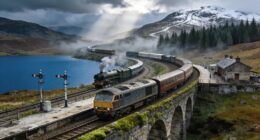
Fun Activity To Try: Book a window seat on the Bernina Express during a light snowfall—watching the train navigate snow-covered viaducts while sipping hot chocolate from the panoramic car creates an unforgettable Alpine experience.
Key Points
- Alpine routes experience approximately 40% higher delays during winter months, significantly impacting travel reliability and schedules.
- Frozen switches, avalanche risks, and heavy snowstorms frequently cause rapid closures lasting up to 48 hours on key routes.
- Replacement bus services can add 90+ minutes to journeys, substantially extending travel times on affected Alpine corridors.
- Cross-border travel compounds delays due to procedural mismatches between operators and cascading effects across multiple timetables.
- Winter service reductions affect popular scenic routes like Glacier Express, requiring advance planning and seat reservations for pass holders.
Swiss Federal Railways Data Reveals 40% Higher Winter Delay Frequency on Alpine Routes

When Swiss Federal Railways crunches its numbers, the story gets interesting. SBB data shows alpine route delays appear to spike roughly 40% higher during winter months—though the exact figure likely fluctuates year to year.
Long-distance punctuality? It tanks. We’re talking 92-93% in mild weather dropping to somewhere between 83-88% when snowfall disruptions hit.
Track heating systems and ice prevention measures help, sure. But they’re not magic. Frozen switches remain a persistent problem when snow accumulates between the switch and stock rail, overwhelming even heated systems during extreme weather events.
Even so, there’s only so much infrastructure can do against a proper alpine winter. De-icing operations can’t always keep pace with what the mountains throw at them, and that bottleneck seems to drive reduced service frequencies across mountain corridors. A CH Media analysis found that eight of the ten most frequently delayed trains in Switzerland during 2022 originated in German cities, highlighting how cross-border capacity issues compound weather-related disruptions. These delays can significantly impact travelers planning scenic routes like the Bernina Express and Glacier Express, which traverse some of the most weather-vulnerable alpine terrain.
Whether the root cause is purely weather or partly operational capacity is worth asking.
Why Alpine Route Connections Require 60-Minute Buffers During Winter Months

Train schedules might look perfectly orderly on paper, but Alpine winters have a way of humbling even the most meticulous plans.
Those 60-minute connection buffers? They’re not overcautious—they’re more like a survival strategy, honestly.
That hour-long buffer between trains isn’t paranoia—it’s hard-won Alpine wisdom.
Avalanche risk is the big one. When conditions deteriorate, preventative closures can happen remarkably fast, sometimes with little warning. Routes like the Glacier Express, which passes through 91 tunnels and over 291 bridges across the Swiss Alps, are particularly vulnerable to weather-related disruptions. The Bernina Express, threading through the Swiss Alps into Italian territory, faces similar challenges as one of the top mountain scenic routes exposed to harsh winter conditions. Its UNESCO World Heritage status reflects both the engineering marvel and the demanding terrain these trains must navigate.
And once a pass closes, well, the ripple effects tend to cascade across multiple operators in ways that are hard to predict. Weather alerts, even seemingly minor ones, may shift everything.
Real-time tracking helps to some extent—though it’s worth noting that technology only goes so far when nature decides to throw a wrench in things.
Even so, when schedules start falling apart, contingency bus services and alternative transport options are likely to become your closest allies. Not glamorous, sure, but they work.
Brenner Pass Closures: Up to 48-Hour Service Suspensions During Heavy Snowstorms
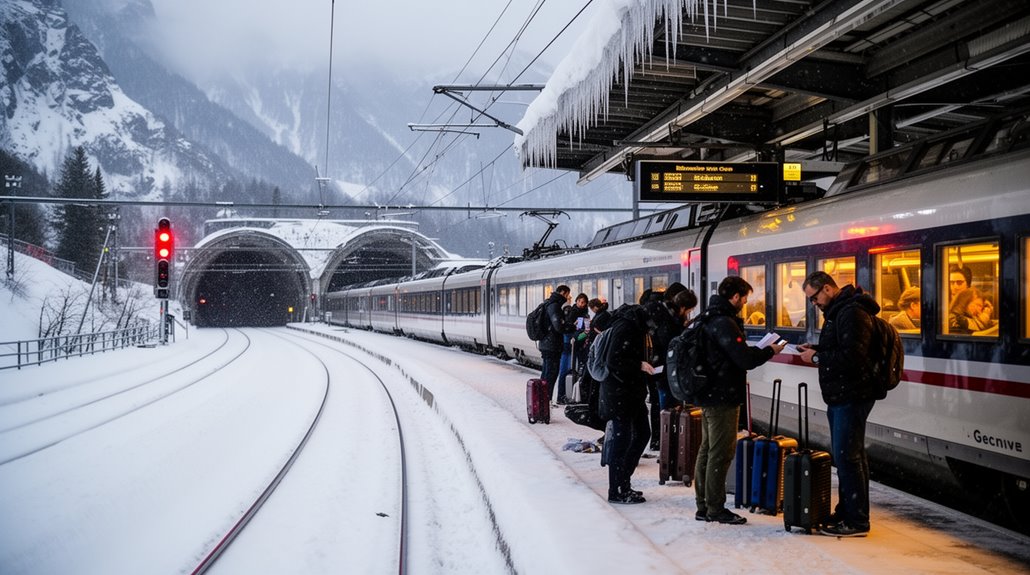
The Brenner Pass sounds like one of those ironclad Alpine corridors that nothing could stop—until a proper snowstorm rolls in. Heavy snow, fallen trees, and avalanche risks can trigger closures lasting up to 48 hours, though the exact duration likely depends on conditions at the time.
EuroCity and Railjet routes tend to bear the brunt of these cancellations. Winter timetables do account for some level of chaos, but even so, delay notification systems end up working overtime when things go sideways. When cross-border services are disrupted, substitute bus services between Innsbruck and the Brenner Pass can add up to 90 minutes to journey times. Travelers heading from Vienna to Venice on the high-speed Railjet should build extra buffer time into their itineraries during winter months.
Snow delay preparation matters here—probably more than most travelers realize. And storm contingency planning? It’s not optional. That said, whether current systems go far enough to minimize disruption is another question entirely. Interestingly, the road crossing at Brenner Pass is almost never closed for snow due to its major autoroute status, making rail disruptions particularly frustrating for travelers who see highway traffic moving while trains remain suspended.
Download ÖBB Real-Time Apps for Essential Alpine Disruption Alerts

Grabbing the ÖBB Scotty app before you tackle those Alpine routes isn’t just a good idea—it’s pretty much essential at this point. The real-time updates from Austrian ÖBB appear to cover just about everything you’d need: delay notifications, route closures, weather disruptions spanning the Brenner, Arlberg, and Tauern corridors. Makes dealing with the unexpected way more manageable. ÖBB is one of six major carriers currently supported with real-time timetable data in the Rail Planner App.
| Feature | Function |
|---|---|
| Train Radar | Live position tracking |
| Push Alarms | Connection buffer strategies |
| Timeboard | Station departure monitoring |
| Disruption Feed | Storm and blockage alerts |
That said, no app is perfect. The push alarms seem most useful when you’re cutting it close on connections—though they may not always account for those last-minute platform changes Austrian stations are fond of. It’s also worth noting that reminders in the app use planned timetable data rather than real-time information, so don’t rely solely on them when delays are in play. For backup options during major disruptions, apps like Omio offer live updates and mobile tickets across multiple transport modes, giving you flexibility to pivot to buses or alternative routes when rail service is compromised.
EU Passenger Rights Guarantee 25% Refunds When Alpine Delays Exceed 60 Minutes

Once those Alpine delays start pushing past 60 minutes, EU Regulation 2021/782 actually has some teeth to it. You’re looking at a guaranteed 25% refund for delays between 60 and 119 minutes—not bad. Push past the two-hour mark, though, and that jumps to 50%.
Alpine delays over 60 minutes mean real money back—25% for hour-long waits, 50% when you hit the two-hour mark.
Now, here’s where it gets a bit murkier. Delay compensation schemes do cover winter conditions, which sounds reassuring. Cross-border journeys add another layer of complexity since operators like SNCF and DB maintain incompatible passenger-rights procedures that don’t sync up when you’re traveling internationally. Understanding the various booking platforms for your journey can help you keep better records of your original tickets when filing claims.
That said, your weather disruption planning matters more than you might think. A heavy snowstorm rolling through the Brenner Pass? That could potentially trigger extraordinary circumstances exclusions, which is worth keeping in mind. The regs appear to give carriers some wiggle room there. Keep in mind that from June 2023, force majeure events like extreme weather can exempt railways from paying compensation entirely, provided they prove they took all reasonable efforts to mitigate the disruption.
Even so, compensation claims remain in play for most situations, and—this part’s non-negotiable—carriers are required to provide assistance regardless of the cause. On top of that, alternative route options stay on the table if your original connection falls through.
How Contingency Bus Services Replace Suspended Alpine Trains During Closures

When Alpine rail lines shut down—avalanche risk, landslides, those seemingly endless tunnel repairs—bus services step in to bridge the gap. Swiss Federal Railways and other operators piece together fixed rail-bus-rail chains at hub stations, which works well enough in theory.
Route alternatives do exist, though here’s the catch: journey times tend to balloon considerably. A Paris-Milan trip, for instance, stretches from around seven hours to nearly ten. Not ideal. During the Interlaken Ost–Grindelwald/Lauterbrunnen closure, travelers between Grindelwald and Lauterbrunnen must change at the Tanklager stop rather than the traditional railway junction. Routes like the Bernina Express that traverse the Swiss-Italian Alps are particularly vulnerable to these seasonal disruptions.
That said, passenger information systems and solid delay preparation appear to make a real difference in how smoothly these transitions go. Snowfall accumulation triggers the avalanche barriers, obviously, but what passengers actually notice is how connection times get messy—sometimes frustratingly so. Even so, the system generally holds together, even if it demands more patience than most travelers would prefer. On routes like the Glacier Express between Chur and Zermatt, replacement buses may remain in service until mid-August at earliest depending on storm damage repairs.
Glacier Express Reduces Winter Service Frequencies During Peak Snow Months

Between early December and early May, the Glacier Express shifts into its stripped-down winter timetable—and “stripped-down” isn’t an exaggeration. You’re looking at just two trains daily in each direction, which may catch some travelers off guard. Snow-affected sections appear to demand these leaner schedules, though one could argue the reduced frequency also reflects lower tourist volumes during these months.
Excellence Class suspension hits certain dates too. That said, local train alternatives do continue running if you’re flexible. Even so, advance planning becomes pretty much non-negotiable during this period. The recommended travel period of January to March falls squarely within this reduced service window, making early booking essential. Travelers holding Interrail or Eurail passes still need to secure a seat reservation required separately before boarding. For those seeking alternatives during service disruptions, the Bernina Express through the Swiss Alps offers another spectacular UNESCO World Heritage route worth considering.
| Season | Daily Trains |
|---|---|
| Summer | Four |
| Winter | Two |
| Suspension | Zero |
| Local Service | Continues |
Frequently Asked Questions
Are Hotel Vouchers Provided When Alpine Train Delays Cause Overnight Strandings?
Hotel vouchers are not guaranteed under EU rail passenger rights for overnight strandings. Operators may provide them discretionally, but Alpine delays from extreme weather often qualify as extraordinary circumstances, further reducing compensation obligations beyond basic assistance.
Which Alpine Routes Offer Weather-Independent Tunnel Alternatives During Winter Storms?
The Gotthard Base Tunnel, Lötschberg Base Tunnel, and Simplon Tunnel provide weather-independent alternatives during winter storms. These deep, low-level tunnels bypass exposed mountain sections, maintaining reliable north-south Swiss-Italian rail connectivity when surface routes face disruptions.
Do Train Operators Accept Competitors’ Tickets During Cross-Border Alpine Disruptions?
No general EU rule requires operators to accept competitors’ tickets during cross-border Alpine disruptions. Ad-hoc agreements may temporarily permit ticket acceptance during major events, but coverage remains patchy and depends on individual operator decisions.
What Altitude Threshold Triggers Special De-Icing Procedures on Alpine Rail Lines?
No single altitude threshold exists; de-icing procedures are triggered by temperature, snowfall, and icing risk rather than elevation alone. However, special winter measures typically intensify above 800–1,200 meters where persistent sub-zero conditions prevail.
How Do Ski Resort Closures Create Chain Reaction Delays on Connecting Train Services?
Ski resort closures trigger chain reaction delays when cancelled shuttle services disrupt hub connections, displaced passengers overcrowd alternative routes, and rerouted traffic congests remaining Alpine bottlenecks, causing cascading lateness across regional and international train networks.
Parting Shot
Winter train travel through the Alps isn’t for the impatient. That 40% delay increase is real. Snow happens. Passes close. It’s not personal.
Smart travelers download those ÖBB apps, pad their connections by an hour, and know their EU refund rights. The Glacier Express might run less often, but it still runs.
Alpine delays are annoying. They’re also completely survivable with basic preparation.