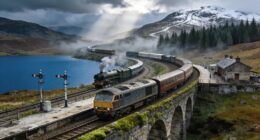
What Around-The-World Rail Escapades Like Tren a Las Nubes Achieve at High Altitude
High-altitude trains: engineering marvels that conquer extreme elevations through innovative design and bold construction.
Tren a Las Nubes operates in Salta Province, Argentina. This train climbs to 4,220 meters. The route uses zigzag switchbacks. No rack-and-pinion systems exist here. The locomotive relies on pure adhesion. La Polvorilla Viaduct spans 224 meters across a deep gorge.
- Qinghai-Tibet Railway reaches 5,072 meters at Tanggula Pass. China Railway supplies pressurized carriages. Passengers receive supplemental oxygen. The track crosses Tibetan permafrost terrain.
- Bernina Express climbs to 2,253 meters in the Swiss Alps. Rhaetian Railway operates this UNESCO World Heritage route. The train ascends through Graubünden Canton without cogwheel assistance.
- Ferrocarril Central Andino in Peru hits 4,781 meters. This Lima-to-Huancayo line features 69 tunnels. The railway crosses 58 bridges through the Andes Mountains.
Each route demands specialized engineering. Oxygen-thin air affects both passengers and engines. Extreme cold tests metal and machinery. Sharp curves require precise track geometry. Steep grades challenge braking systems.
Local operators maintain these lines year-round. Mountain communities depend on rail connections. Tourism agencies in Salta, Lhasa, and St. Moritz promote these journeys worldwide.
Fun Activity To Try: Book a sunrise departure on Tren a Las Nubes from Salta and photograph the moment your train breaks through cloud cover above the Argentine puna.
Key Points
- Tren a las Nubes reaches 4,220 meters elevation using innovative switchback engineering without requiring rack-and-pinion systems.
- The Qinghai–Tibet Railway achieves the world’s highest rail elevation at 5,072 meters while crossing 550 km of permafrost.
- High-altitude trains like Qinghai–Tibet provide pressurized carriages and specialized oxygen supply systems to prevent passenger altitude sickness.
- The Bernina Express climbs to 2,253 meters as an adhesion railway, earning UNESCO World Heritage status for its engineering excellence.
- La Polvorilla Viaduct uniquely curves while ascending at 4,220 meters, using 1,590 tons of steel spanning 224 meters.
Discover How Tren a las Nubes Conquers the Andes at 4220 Meter Elevation

The Tren a las Nubes doesn’t just climb mountains—it wrestles them. That’s not hyperbole, really. Starting from Salta province in Argentina, passengers wind their way through San Antonio de los Cobres before hitting that brutal 4220 meter elevation.
The switchback railway design appears to be pure engineering stubbornness at work. No rack systems. Just determination, 29 bridges, and the famous La Polvorilla Viaduct stretching across the void. The full route spans 434 km from Salta all the way to La Puna. Built between 1930 and 1932, the viaduct stands 64 meters high and stretches 224 meters long.
Now, some might argue there are flashier mountain railways out there. The Bernina Express offers its own dramatic alpine scenery while threading through the Swiss-Italian Alps. Even so, high altitude routes like this one demand serious altitude acclimatization from anyone brave enough to board.
And this train? It delivers both the climb and the challenge. Whether that’s a selling point or a warning probably depends on how well your lungs handle thin air.
La Polvorilla Viaduct Suspends Passengers 224 Meters Above the Ravine

La Polvorilla Viaduct doesn’t mess around. At 4,220 meters elevation, this engineering marvel likely ranks among the most dramatic railway crossings you’ll ever encounter—Tren a las Nubes earns its reputation as an extreme high-altitude rail experience for good reason.
Now, the steel structure stretches 224 meters long (not high, worth noting), and it stands about 63 meters above the ravine floor. Built between 1930 and 1932 using 1,590 tons of steel. The viaduct holds a unique distinction worldwide as the only one built in a curve while simultaneously rising with slightly inclined rails.
No tedious mountain switchbacks to contend with here. That said, what you do get is a train traversing one of the most dramatic landscapes imaginable. The complete 217 km route connecting Salta to La Polvorilla features 29 bridges, 21 tunnels and 13 viaducts. While Norway’s Bergensbanen showcases dramatic fjords and Switzerland’s alpine routes deliver UNESCO-certified scenery, Tren a las Nubes offers its own brand of high-altitude spectacle. Whether it actually deserves “legendary” status probably depends on who you ask, but for bucket-list railway journeys? This one appears to check every box. Pure viaduct engineering flex, honestly.
What Makes the Qinghai-Tibet Railway the World’s Highest at 5072 Meters

What actually earns a railway the title of world’s highest? The Qinghai-Tibet Railway reaches 5,072 meters at Tanggula Pass—and yes, that number is real.
The engineering here is remarkable, perhaps most notably the 550 km stretch crossing permafrost, which appears to be the longest such crossing anywhere on Earth. Thin air becomes a genuine concern at these altitudes, though pressurized carriages seem to handle it well enough. To combat altitude sickness, each compartment is equipped with two specialized oxygen supply systems for passengers.
The station at Tanggula sits at 5,068 meters, which is itself staggering to consider. Passengers riding through this desert plateau landscape may catch what’s sometimes called the cloud train phenomenon—watching it unfold through panoramic windows in the observation cars as the mountain terrain rolls past. The railway connects Golmud in northwest Qinghai Province to Lhasa, Tibet’s capital, spanning some of the most remote terrain on the planet. This route forms part of China’s extensive rail network, which includes the world’s longest high-speed rail system and offers travelers a combination of comfort, safety, and cost-effectiveness.
Rocky Mountaineer vs Alpine Rails: Dramatic Mountain Pass Engineering Compared

Climbing to 5,072 meters is one thing. Engineering a railway through brutal mountain terrain? That’s an entirely different beast. The Rocky Mountaineer crawls through Canadian passes at 2.2% grades, which sounds impressive enough—until you consider what’s happening in the Alps. Those heritage railway lines appear to laugh at such modest inclines, tackling gradients of up to 48% with their rack-and-pinion systems. It’s worth noting, though, that comparing these two approaches may be somewhat unfair; they’re solving different problems in vastly different landscapes.
| Feature | Rocky Mountaineer | Alpine Rails |
|---|---|---|
| Max Gradient | 2.5% | Up to 48% |
| Scenic Observation | Premium observation deck experience | Glacier Express, Bernina Express panoramic cars |
| Style | Transcontinental luxury train adventure | Steep scenic journey climbs |
That said, raw numbers don’t tell the whole story. The Rocky Mountaineer likely prioritizes passenger comfort over engineering showmanship—a gentle 2.5% grade means you can sip your coffee without wearing it. The train even slows down at scenic areas to give passengers enhanced viewing and photography opportunities. The Swiss, on the other hand, seem to have decided that going nearly straight up a mountain is a perfectly reasonable thing to do with a train full of tourists. The Rocky Mountaineer’s Silverleaf class features large wrap-around windows that maximize the viewing experience during these leisurely scenic stretches. Operating as a daylight-only service, the Rocky Mountaineer ensures passengers don’t miss a single vista through those massive glass-domed cars.
Cross 291 Bridges in Eight Hours Aboard the Glacier Express

Where the Tren a las Nubes wins bragging rights with its dizzying 4,220-meter altitude, the Glacier Express seems to take a different approach entirely. This historic heritage train crosses 291 bridges over its eight-hour journey—that works out to roughly one bridge per kilometer, which is frankly absurd in the best way.
The pace? A leisurely 42 km/h. Some might call it slow. Others would probably argue it’s the whole point.
And honestly, there’s something to be said for a rail expedition that refuses to rush you past the scenery. The dramatic landscapes unfold gradually, almost meditatively. The route also passes through 91 tunnels, including the 15.4-kilometer Furka Base Tunnel that takes roughly 30 minutes to traverse. The journey carries added weight knowing this train has been making its inaugural run since June 1930, accumulating over 90 years of service through the Swiss Alps.
On top of that, passengers get dining services, reliable route connections, and travel logistics that appear to run without much fuss. The Glacier Express is part of Switzerland’s Grand Train Tour, a comprehensive route that weaves together panoramic trains, buses, and boats to showcase the country’s cultural landmarks and UNESCO sites. It’s a train adventure that rewards patience—though whether that appeals to you likely depends on how you feel about spending eight hours watching bridges go by.
UNESCO World Heritage Status: What the Bernina Express Achievement Means for Rail Excellence

The Bernina Express earning UNESCO World Heritage status in 2008 wasn’t just some ceremonial nod—a nice plaque to hang on the wall. The Rhaetian Railway genuinely appears to have earned the recognition.
What makes it remarkable, and this is worth pausing on, is that the Alpine adhesion railway climbs to 2,253 meters without relying on rack-and-pinion systems. That’s no small feat. The route encompasses 58 covered tunnels and 196 bridges and viaducts, demonstrating the sheer scale of engineering required to traverse this terrain.
Reaching 2,253 meters through pure adhesion—no rack-and-pinion assist—remains one of Alpine engineering’s quiet triumphs.
The Landwasser Viaduct, with its dramatic curve over the gorge, and the Brusio spiral viaduct likely represent mountain railway engineering at its finest—though reasonable people might debate which route deserves that title.
Even so, what seems to set this corridor apart is the landscape integration. The tracks don’t fight the terrain; they work with it. UNESCO recognized the entire 122-kilometer stretch as an outstanding technical and environmental ensemble, which suggests the committee saw something beyond just impressive infrastructure. They were acknowledging how the railway and the mountains exist together. The journey through this World Heritage Site takes approximately four hours, giving passengers ample time to absorb the remarkable scenery unfolding outside the panoramic windows. This breathtaking UNESCO World Heritage route continues to exemplify how spectacular natural views can be seamlessly combined with engineering excellence.
The Trans-Siberian Engineering Achievement Spanning Eight Time Zones

Spanning eight time zones and roughly 9,289 kilometers from Moscow to Vladivostok, the Trans-Siberian Railway doesn’t just cross a country—it stitches together two continents. That’s not hyperbole. Building through permafrost meant engineers had to rethink pretty much everything they knew about laying track. Then there was Lake Baikal, which early on required icebreaking ferries just to keep the route connected. Double tracking appears to have been completed by 1939, with full electrification following in 2002—though the logistics of maintaining such a system across such distances likely presented challenges we don’t fully appreciate today.
| Feature | Specification |
|---|---|
| Tunnels and bridges | Extensive Baikal region |
| Time zones crossed | Eight |
| Electrification complete | 2002 |
| Track configuration | Double track |
| Train capacity | ~6,000 metric tons |
Even so, calling it “long-distance logistics at its finest” may undersell the sheer audacity of the project. Trains hauling around 6,000 metric tons through tunnels carved into the mountains near Baikal, across bridges spanning Siberian rivers—this wasn’t just infrastructure. It was, and arguably still is, an exercise in stubborn human ambition. The original construction between 1891 and 1904 was driven primarily by political and strategic motivations rather than immediate economic necessity. The railway’s strategic limitations became painfully evident during the Russo-Japanese War, when its single-track design contributed to Russia’s defeat by hampering the efficient movement of troops and supplies. Modern passengers can experience this historic route’s more leisurely side, with onboard amenities like dining services that transform the journey into something closer to a moving hotel than mere transportation.
Frequently Asked Questions
How Do Passengers Physically Adapt to Rapid Altitude Changes During High-Altitude Rail Journeys?
Passengers physically adapt through hyperventilation, increased heart rate, and sympathetic nervous system activation. Their bodies boost cardiac output and cerebral blood flow while arterial oxygen saturation initially drops before compensatory mechanisms stabilize oxygenation at elevation.
What Medical Emergencies Most Commonly Occur on Trains Operating Above 4,000 Meters?
Acute mountain sickness predominates, manifesting as headache, nausea, and dizziness. Severe cases may progress to high-altitude pulmonary or cerebral edema. Cardiovascular events, including arrhythmias and ischemic episodes, affect susceptible passengers with pre-existing conditions.
Are Children and Elderly Passengers Safe Traveling on Extreme High-Altitude Railways?
Children and elderly passengers face heightened risks on extreme high-altitude railways due to reduced oxygen levels and potential acute mountain sickness. Pre-travel medical screening is strongly recommended, particularly for those with cardiovascular or pulmonary conditions.
How Does Thin Air Affect Locomotive Engine Performance at Extreme Elevations?
Thin air at extreme elevations reduces oxygen density by approximately 50%, causing naturally aspirated diesel engines to lose significant power through incomplete combustion. Modern locomotives compensate using high-pressure-ratio turbochargers that restore cylinder air mass effectively.
What Travel Insurance Considerations Apply Specifically to High-Altitude Rail Excursions?
Travelers should verify policies cover elevations above 4,000 meters, as standard plans often exclude high-altitude medical emergencies. Emergency evacuation coverage proves essential given remote locations, while altitude sickness treatment and repatriation benefits require specific confirmation.
Parting Shot
These railways aren’t just transportation. They’re engineering flexes that conquered mountains most people can’t even breathe properly on. From Argentina’s cloud-piercing viaducts to Tibet’s oxygen-depleted tracks, humans basically looked at impossible terrain and said, “We’ll take trains through that.” Pretty wild when you think about it. The views aren’t bad either.