7 Eastern Europe Train Travel Guide Essentials for the Balkan Railway Network
Eastern Europe train travel essentials: seven critical elements determine success across the Balkan railway network. Among these essentials, air travel benefits for Copenhagen journey can significantly enhance the overall travel experience. By understanding the interconnectedness of train and air travel, passengers can maximize their time and resources. Additionally, knowing the best routes and timings can lead to a more seamless adventure across multiple destinations.
The Sofia-Belgrade corridor: advertises 8 hours but delivers 9-10. Serbian Railways: requires bus transfer at Niš station. Bulgarian State Railways: displays Cyrillic-only signage at most platforms.
- Serbian Railways (Srbija Voz): accepts Visa and Mastercard but triggers fraud alerts with certain European banks
- Romanian CFR Călători: crosses Transylvanian mountain passes through Brașov and Sibiu corridors
- Balkan Flexipass: covers eight national networks including North Macedonia Railways and Croatian HŽPP
The Belgrade-Bar overnight sleeper: spans 476 km through Montenegro. This route: passes through 254 tunnels carved into Dinaric Alps limestone. Ticket purchase: requires in-person pickup at Belgrade Glavna station.
Local vendors near Sofia Central Station: sell translated timetables. The Niš bus terminal: connects Bulgarian and Serbian rail segments. Podgorica station staff: assist with sleeper cabin assignments.
Romanian routes: wind through Carpathian valleys. Croatian connections: link Zagreb to Adriatic coastal towns. Thessaloniki terminal: serves as the southern Balkan gateway.
Fun Activity To Try: Book the Belgrade-Bar night train and wake at dawn as the locomotive emerges from mountain tunnels above the Morača River canyon.
Key Points
- The Balkan Flexipass covers eight countries including Serbia, Bulgaria, Romania, and Montenegro, simplifying ticketing across multiple national rail networks.
- Border crossings involve onboard passport checks and potential biometric capture for non-EU nationals at external Schengen borders.
- Station signage throughout Bulgaria uses Cyrillic script, so travelers should familiarize themselves with the alphabet for navigation.
- The Belgrade–Bar overnight sleeper offers dramatic scenery through 254 tunnels, but tickets require station collection rather than online booking.
- Scenic Romanian CFR corridors traverse Transylvanian mountain passes and Danube cliffs, rivaling Europe’s most celebrated railway journeys.
Essential #1 — Cross-Border Route Planning via Sofia-Belgrade Corridor Takes 8 Hours

The Sofia-Belgrade corridor might look like a straightforward eight-hour journey on paper, but the 2024-2025 reality appears to be something else entirely.
Direct trains have been suspended.
What you’re left with is a train-bus-train combination routing through Niš junction—a patchwork approach that likely stretches your actual travel time to somewhere between nine and ten hours, possibly more.
The Niš junction shuffle: three vehicles, ten hours, and a prayer that your connections actually align.
And that’s before factoring in border crossings, which add their own layer of unpredictability.
Simple ticket reservations? Not really an option here.
You’ll need to piece together regional timetables yourself, and even then, the Belgrade-Niš leg alone seems to run around six hours.
On top of that, overnight sleeper connections—the kind that used to make these routes bearable—are gone.
The whole sofia-belgrade line remains fragmented, essentially.
It’s one of those corridors where the official information may suggest feasibility, but seasoned travelers know better than to trust the advertised times.
Serbian trains are historically subject to delays, with waits of several hours reported as not uncommon even when services are running normally.
This route once carried the Orient Express until 1977, making its current deteriorated state all the more striking for rail enthusiasts.
Arriving without your own vehicle at either endpoint means you’ll need to arrange local transport options to reach your final destination.
Essential #2 — Ticket Booking on Serbian Railways Website Works With International Cards
Wouldn’t it be refreshing if booking train tickets in Serbia just worked?
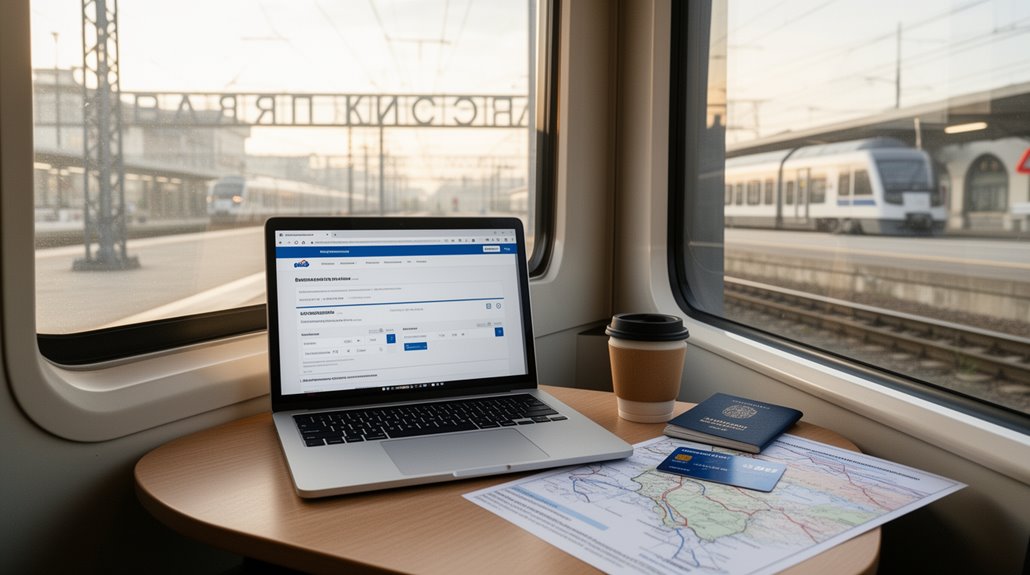
Serbian Railways—Srbija Voz, if you want the local name—runs the eKarta e-ticket platform, which appears to function reasonably well on paper.
International cards process through a local payment gateway, though you’ll need to create an account before you can actually purchase anything.
Here’s where it gets tricky.
Some banks seem to flag Serbia as high-risk territory, which may trigger fraud filters that block your transaction entirely.
Your card works fine across half of Europe, then suddenly gets rejected for a €12 train to Niš.
Frustrating, to say the least.
Self-service kiosks do exist as a backup option if the online route fails you. These kiosks are available at train stations and include an English language option, making navigation considerably easier than wrestling with the Serbian-only website. For the Belgrade–Bar night train, you’ll need to submit booking requests 30 days in advance by email or phone, then collect your reservation within 24 hours at major stations. Understanding fare structures and booking platforms before your trip can save considerable headaches when dealing with regional railway systems like Serbia’s.
Essential #3 — Border Crossing Procedures on Croatian Railways Include Onboard Passport Checks

Border crossings on Croatian trains? They’re unpredictable, honestly. No two seem to unfold quite the same way. Because Croatia shares external Schengen borders with Bosnia, Serbia, and Montenegro, onboard passport checks are standard fare on international routes. If you’re a non-EU national, expect the full EES biometric capture—fingerprints, facial scans, all of it.
| Border Type | Check Style |
|---|---|
| External Schengen | Full passport control |
| Internal Schengen | Temporary checks possible |
That said, even internal Schengen crossings may involve temporary checks depending on the security climate. Slovenia has reintroduced border controls with Croatia and Hungary due to increased terrorist threats, with measures in force until December 2025. Worth keeping in mind: these procedures can add real time to your journey. A crossing that looks quick on paper might stretch considerably longer in practice. Using real-time train apps can help you monitor delays and adjust your plans when border checks extend your travel time. The good news is that subsequent entries only require document presentation since biometric data is already stored from your first visit.
Essential #4 — Overnight Sleeper on Bar-Belgrade Line Offers 11-Hour Adriatic Scenic Journey
Once travelers clear those Croatian border formalities, the real adventure shifts south.
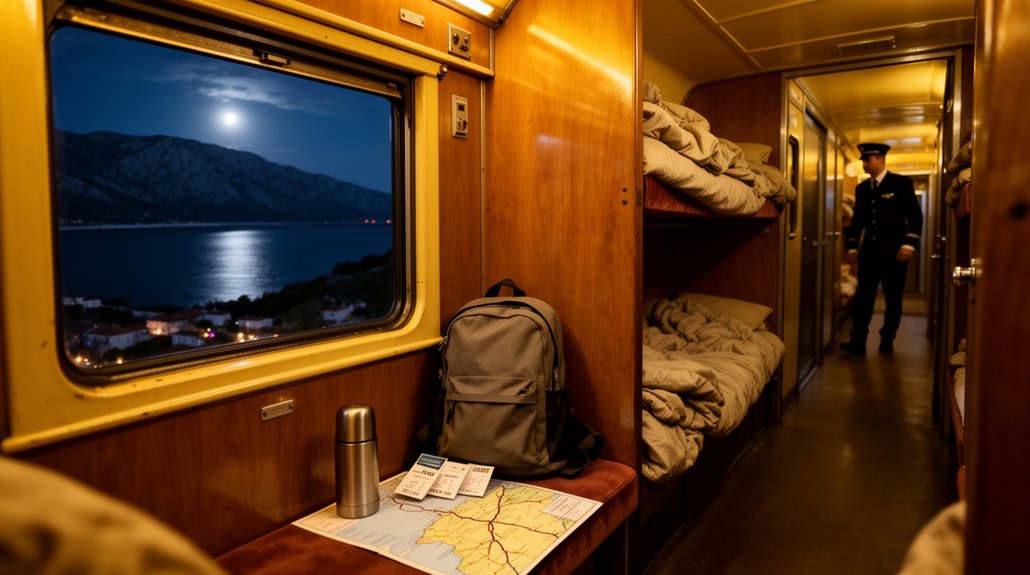
The Belgrade–Bar railway overnight sleeper covers 476 km in roughly 11 hours—and honestly, scenic railway routes don’t get much wilder than this one.
You’ll pass through 254 tunnels, roll across Mala Rijeka Viaduct, and skirt the edges of Lake Skadar, which alone is likely worth the ticket price. This journey rivals other remarkable engineering feats like Austria’s Semmering Line for its dramatic mountain crossings and technical achievements.
The sleeper cabins fit four, though comfort levels may vary depending on your fellow passengers. The overnight train departs Bar at 19:00 and arrives in Belgrade around 06:00 the next morning.
Serbian Railways (ŽS) handles booking, and the process appears to be straightforward enough. Keep in mind that tickets aren’t available online, so you’ll need to pick them up at the station.
One thing worth mentioning: bring your own snacks. Onboard food is hit or miss, and “miss” seems to be the more common outcome.
Essential #5 — Scenic Railway Corridors on Romanian CFR Cross Transylvanian Mountain Passes

The Bar-Belgrade line tends to grab most of the Balkan railway spotlight, but Romania’s CFR network quietly runs what may be some of the region’s most dramatic mountain crossings. Magistrala 300 cuts through Transylvanian passes via Brașov–Predeal–Sinaia, threading its way through landscapes that likely rival anything in the Balkans. A 12-day self-guided train tour can cover the main attractions along these routes, connecting highlights from Brașov through Sighișoara, Cluj-Napoca, and Sibiu in a triangular circuit.
Then there’s the Defileul Jiului route—gorges and tunnels punching through a national park, though it doesn’t always get the recognition it probably deserves. The Timiș Valley corridor keeps things interesting with repeated river crossings. Valea Sadului serves as a disembarkation point for park access, making it popular with rafting enthusiasts and wild-nature visitors. For longer journeys through these corridors, passengers can take advantage of dining car services to enjoy meals while watching the scenery unfold.
Even the historic Oravița–Anina line, which some railway enthusiasts might argue is underrated, delivers 14 tunnels along its route. And the Iron Gates corridor along the Đerdap? It hugs Danube cliffs in a way that appears almost impossibly close to the water. That said, these Romanian routes remain largely overshadowed by their more famous neighbours. They deserve attention—though whether they’ll ever get it is another question entirely.
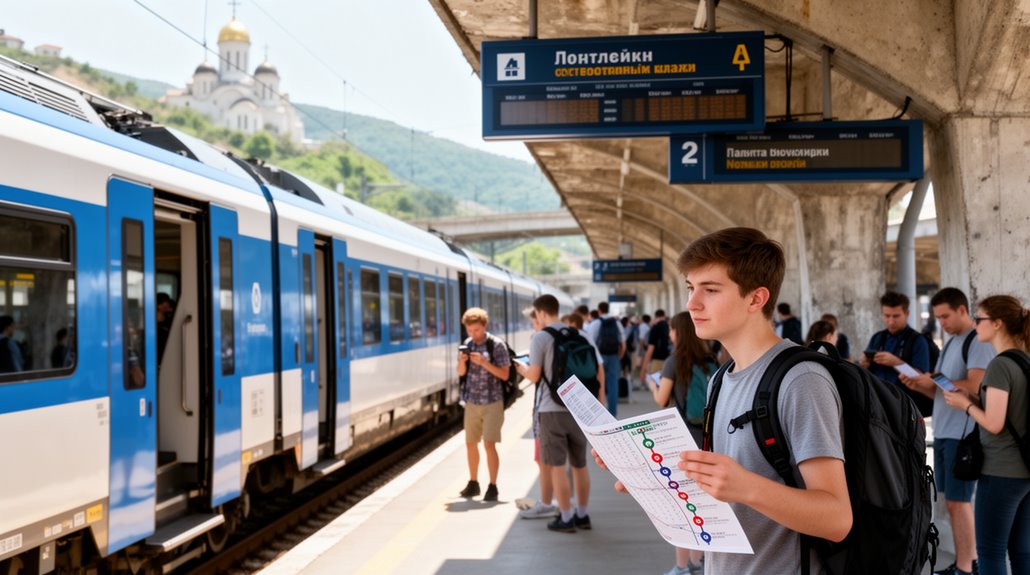
How hard can reading a train sign really be? At Bulgarian State Railways (BDZ), harder than you’d expect.
The Balkan railway network throws a genuine curveball—platform signage appears almost exclusively in Cyrillic. Departure boards, regional schedules, even the ticket windows? All Bulgarian script.
Cyrillic dominates Bulgarian stations—departure boards, schedules, ticket counters. If you can’t read it, you’re already lost.
That said, it’s worth noting that some larger stations may offer occasional Latin transliterations, though this seems inconsistent at best. The printed Patevoditel timetable publication is largely in Bulgarian, so don’t expect much relief when consulting official schedules either.
Station navigation tips essentially boil down to one uncomfortable truth: learn your Cyrillic basics or prepare to struggle. Those helpful station guides plastered around the terminal won’t do much good if you can’t decode them in the first place. At Sofia Central Station, platforms are divided into east and west ends, marked on departure boards with Cyrillic abbreviations like “изт.” and “зап.” that you’ll need to recognize to find your train. Planning to arrive early gives you extra time to locate your platform and decode unfamiliar signage before departure.
On top of that, the ticket booking platforms likely assume you’ve got at least passing familiarity with the alphabet.
Essential #7 — Regional Timetable Coverage With Balkan Flexipass Spans Seven Country Networks

Reading Cyrillic station signs is one challenge. But planning a route that weaves through seven countries? That’s a different beast altogether.
The Balkan Flexipass appears to offer a practical solution here, bundling Serbian Railways, Bulgarian State Railways, and Romanian CFR under a single ticket. Corridors like Sofia-Belgrade and routes down to Thessaloniki become accessible without the headache of purchasing separate fares at each border. That said, coverage from regional operators may vary depending on which country you’re passing through—worth checking before you commit.
| Coverage | Networks |
|---|---|
| Regional operators | Varies by country |
| Border formalities | Handled onboard |
On top of that, border formalities are generally handled onboard, which likely saves you from those awkward platform scrambles at frontier stations. Even so, it’s probably wise to carry documentation anyway. Balkan crossings can be unpredictable, and what works smoothly one day might hit a snag the next. Given how infrequent international connections can be, it’s strongly advised to determine routes in advance rather than figuring things out as you go. For older travelers, it’s also worth noting that modern trains throughout Europe increasingly feature accessible facilities and spacious seating designed to make journeys more comfortable.
The pass actually covers eight countries, not seven—Bulgaria, Greece, Macedonia, Montenegro, Romania, Serbia, Turkey, and Bosnia and Herzegovina are all included in the network.
Frequently Asked Questions
Are Power Outlets Available on Balkan Trains for Charging Electronic Devices?
Power outlets exist on some Balkan trains, particularly newer international and long-distance services, but older regional carriages often lack them entirely. Travelers should carry portable power banks as a reliable backup for charging electronic devices.
Can I Bring a Bicycle on Cross-Border Balkan Railway Services?
Bicycles are generally permitted on cross-border Balkan railway services, though policies vary by operator. Dedicated bike spaces remain rare, with storage typically in vestibules. Small fees may apply, and folding bikes offer the most reliable acceptance.
What Food and Dining Options Exist Onboard Long-Distance Balkan Trains?
Most long-distance Balkan trains lack regular onboard catering. Romania offers occasional bar cars with snacks, while Hungarian and Slovak international services provide full dining cars with hot meals, drinks, and at-seat service.
Do Balkan Trains Offer Wifi Connectivity During International Journeys?
Wifi availability on Balkan international trains remains inconsistent. Newer rolling stock on routes toward Central Europe may offer connectivity, though reliability suffers from mountainous terrain and rural coverage gaps. Many travelers rely on affordable local mobile data instead.
Are Wheelchair-Accessible Carriages Available on Major Balkan Railway Routes?
Wheelchair-accessible carriages are available on major routes in Slovenia, Croatia, Serbia, and Bulgaria, particularly on newer rolling stock. However, accessibility remains limited on international services and throughout Montenegro, North Macedonia, and Bosnia & Herzegovina.
Parting Shot
The Balkan Railway Network isn’t glamorous. It’s slow, occasionally confusing, and requires patience with Cyrillic signs and border checks. But that’s kind of the point. Seven countries, dramatic mountain passes, and fares that won’t destroy a budget. The infrastructure shows its age. The scenery doesn’t care. For travelers willing to trade speed for authenticity, these rails deliver something Western Europe’s polished high-speed trains simply cannot replicate.