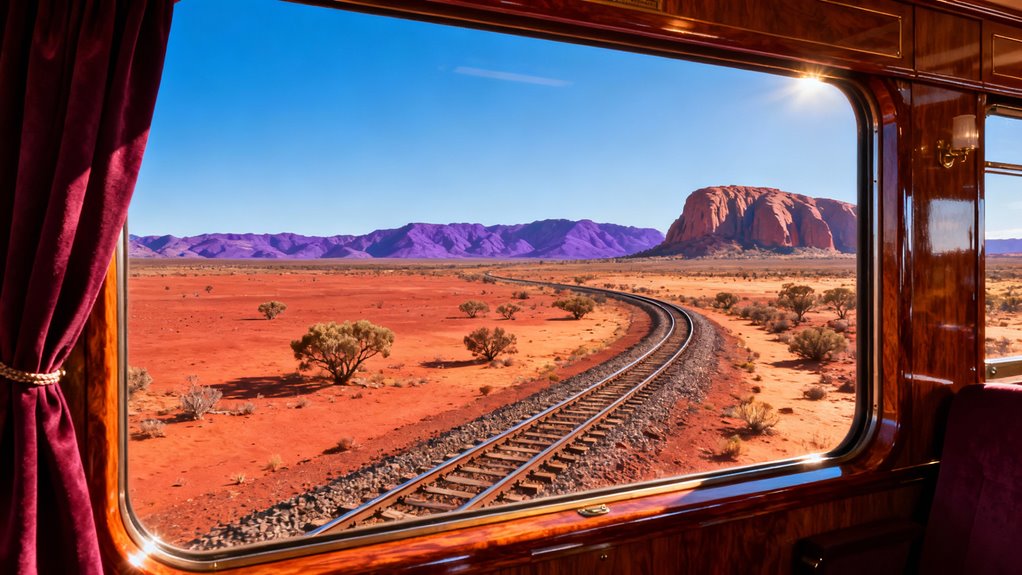

The Ghan’s 1,851-mile route from Adelaide to Darwin exposes how colonial surveyors mapped uncharted territory in 1929 using trigonometric methods, charting gibber plains and salt lakes while conveniently following Aboriginal songlines that had existed for 65,000 years. Steam locomotives battled 45°C heat with expansion gaps and concrete sleepers. Federation-era stations became outpost lifelines. Afghan laborers built ‘Ghantowns’ along tracks plagued by three incompatible gauges—intercolonial rivalry at its finest. The railway’s legacy reveals how infrastructure literally rewrote Australia’s human geography, overlaying ancient trade networks with steel.
The Ghan’s Transcontinental Route Reveals How 1929 Geographic Surveys Mapped Uncharted Territory

When surveyors set out to map the Australian interior in 1929, GPS and satellite imagery were obviously nowhere in sight. Instead, expedition route crews relied on trigonometric surveying and compass traverses—fancy math, really, and a whole lot of walking.
They charted gibber plains and salt lakes, along with indigenous cultural corridor routes that would eventually become transcontinental railway infrastructure. The inaugural journey occurred on August 4, 1929, marking the beginning of regular service to Alice Springs.
Water sources dictated everything. Steam engines needed hydration too, after all. The surveys led to pioneer settlements like Oodnadatta springing up, which enabled economic development despite the Red Centre’s brutal conditions. Afghan cameleers had previously transported goods across these same arid landscapes, carrying up to half a ton without water. Similar to Canada’s VIA Rail routes that traverse vast wilderness areas, these early Australian rail lines connected remote regions across incredible distances.
That said, track preservation became nearly impossible when floods hit. Turns out the 1929 mapping may have missed some vital details about outback exploration’s nastier surprises—though whether better technology would have captured seasonal flooding patterns is another question entirely.
Railway Infrastructure Through Outback Wilderness Documents Century-Long Settlement Patterns

Building a railway through one of Earth’s most hostile environments required more than steel and determination. It demanded an entire logistics network that would, somewhat accidentally, create permanent human habitation in places no one had seriously considered settling before.
The Old Ghan’s construction history spawned what became known as ‘Ghantowns’—settlements where Afghan laborers put down roots, creating outback infrastructure that later transformed into heritage tourism landmarks.
On top of that, weekly Tea and Sugar trains supplied isolated maintenance crews along these pioneering routes. Those supply runs established settlement patterns that appear to persist even today.
Regular supply trains to remote workers didn’t just deliver provisions—they mapped out where people would eventually choose to live.
That said, colonial railways didn’t just connect cities—they effectively manufactured communities from transport logistics alone. Construction crews achieved laying rates of 2.5 miles per day during peak periods, pushing the line rapidly across the continent. The workforce expanded dramatically, with over 3,400 workers employed by 1916 despite the challenges posed by World War I. It’s a striking example of how infrastructure can reshape human geography in unexpected ways.
This cultural heritage of accidental urbanization continues attracting visitors who trace these improbable origins, trying to understand how wilderness logistics became permanent towns. Similarly, Canada’s experience with transcontinental railways demonstrates how rail infrastructure consistently creates unexpected settlement patterns that endure far beyond the original construction period.
Colonial Era Track Networks: How They Connected Mining Towns Across Thousands of Desert Miles

Australia’s colonial governments didn’t build railways out of some grand vision for national unity—they built them because miners needed a way to get ore out of the middle of nowhere and into ships bound for global markets. Short. Practical. Profitable.
Colonial era rail exploration appears to have followed the money, tracking gold rushes and copper strikes rather than any careful master plan. What emerged was frontier settlement rail connection that transformed transportation history, though not always elegantly.
These track networks managed to cross thousands of desert miles, linking isolated mining settlements through wilderness corridors engineered for commodity export, not passenger comfort. If you were hoping for a smooth ride, you were in the wrong business.
The network integration was messy—three incompatible gauges because colonies couldn’t agree on standards, which seems almost predictable given the competitive nature of colonial administrations. The first major gauge junction problem occurred at Albury in 1881, where travelers and freight had to transfer between systems.
That said, the enduring legacy shaped transcontinental routes still used today. Even so, you have to wonder how different things might look if someone had convinced those colonial planners to coordinate from the start. The Commonwealth Railways established in 1912 represented one of the first attempts at coordinated national infrastructure planning following Federation.
Then again, maybe the urgency of the mining economy didn’t leave much room for such niceties. These early rail lines also suffered from multiple stops that significantly extended journey times, making long-distance travel particularly exhausting for passengers.
Federation-Era Station Architecture Preserves the Physical Heritage of Frontier Settlements

The stations themselves tell a better story than most history books. Federation-era station architecture stands as physical proof of Australia’s railway heritage—verandas wrapping around timber and stone structures, steeply pitched roofs fighting the Outback heat.
Federation-era stations serve as architectural storytellers, their timber verandas and pitched roofs documenting Australia’s railway heritage better than written records.
These weren’t just passenger services hubs. They were community centers, goods depots, symbols of frontier survival.
Regional variations emerged, too: Kalgoorlie used local stone, while Queensland preferred timber. Passengers on today’s heritage steam locomotive journeys witness this historic and cultural significance firsthand.
Even so, it’s the buildings themselves that really capture the imagination. Many endure through historic railway restoration projects, their ornate fretwork and high ceilings now framing scenic landscapes that once seemed impossible to reach. Like the UNESCO World Heritage routes found on iconic journeys worldwide, these Australian rail corridors showcase landscapes of extraordinary natural and cultural value. Kalgoorlie’s station, constructed in warm gold, pink, and cream Ashlar stone, exemplifies how builders drew materials from the surrounding landscape to create structures that would withstand decades of continuous operation. The unrendered red brick facades favored during the Federation period became distinctive markers of railway architecture across regional Australia, their warm tones harmonizing with the Outback’s natural palette.
Heritage Steam Locomotive Technology Enabled the First Successful Cross-Desert Transport

Grand buildings and ornate fretwork couldn’t have existed without the machines that made them necessary in the first place. Heritage steam locomotives conquered Australia’s harshest wilderness passages, hauling water that weighed half the train through waterless deserts—though calling it conquest might be generous.
The construction challenges were brutal. Mineral-laden water corroded boilers, sand attacked moving parts, extreme heat buckled tracks.
Even so, these vintage passenger train experiences linked isolated mining camps to ports, creating economic impacts that built entire towns. The cross continental railway adventure wasn’t romantic; it was survival engineering, pure and simple. Locomotive technology adapted or died. There wasn’t much middle ground. Historic journeys like The Ghan’s predecessors proved machines could beat the outback. The last steam service ran ore trains to Broken Hill until 1970, marking the final chapter of an era that had transformed the continent.
Barely.
On top of that, the romance we attach to these trains today may obscure just how desperate the enterprise really was—a constant battle against an environment that seemed designed to destroy metal and ambition alike. Steam trains facilitated access to markets for isolated communities that would have otherwise remained economically stranded in the vast interior. Like Costa Rica’s railway system, which once connected banana plantations before shifting to serve the Greater Metropolitan Area, Australia’s rail networks evolved from industrial necessity into essential urban connections.
What Pioneering Railway Construction Reveals About Overcoming Extreme Heat Engineering Challenges

Steel buckles at 45°C. The engineers who laid track across Australia’s interior knew it all too well.
Pioneering railway construction history is, in many ways, a masterclass in dealing with extreme heat effects on rail materials.
You see expansion gaps, fishplates, concrete sleepers engineered to resist warping. Afghan camels hauled supplies when horses simply quit. Supply logistics demanded dawn-to-noon shifts—afternoons could kill you.
On top of that, engineering adaptations for heat resilience included reflective paint on rolling stock and stone ballast that wouldn’t cook the track beneath it. Water treatment plants fought mineral-rich bore water that would otherwise destroy boilers.
Heat didn’t just slow the work—it threatened to melt the infrastructure itself, demanding constant innovation just to survive.
That said, today’s travel itineraries, steam expeditions to remote communities, and railway museums tend to gloss over one truth: building this was brutal.
The polished narratives may suggest adventure and progress, but they’re likely to downplay just how punishing the conditions really were. These same challenges of extreme weather and demanding terrain continue to shape rail travel experiences across vast landscapes, from America’s transcontinental routes to Australia’s outback railways.
Indigenous Cultural Corridors Along Historic Rail Routes Reveal Ancient Trade and Songline Networks
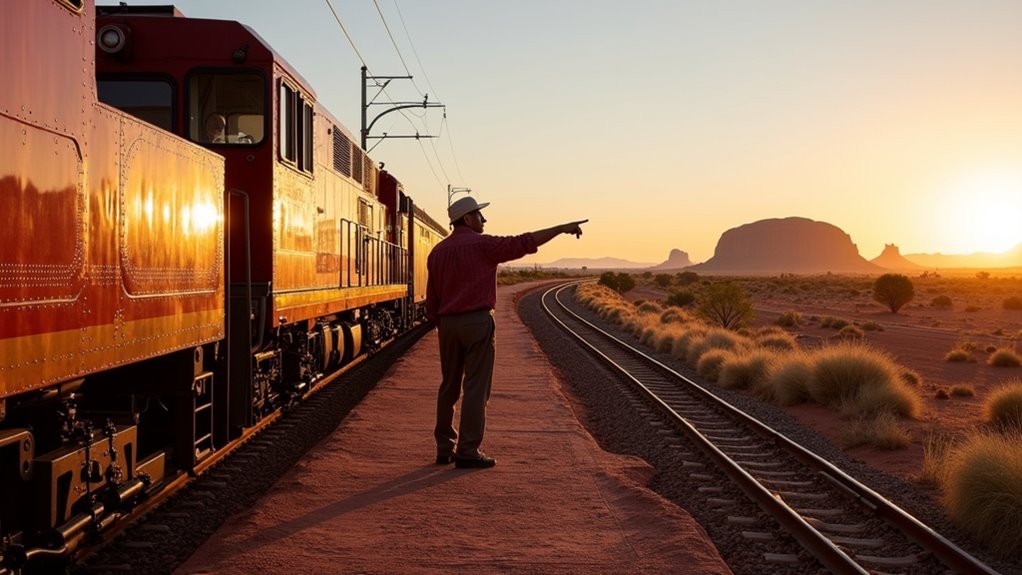
Long before surveyors plotted the Ghan’s route north, Aboriginal walking tracks had already stitched the continent together. These weren’t random paths—songlines encoded navigation, ceremony, and ancient trade across indigenous territories. Ochre moved along these corridors. So did tools and food, for millennia.
Then Europeans showed up. Here’s the thing surveyors noticed: those Aboriginal routes made sense. Rocks were cleared. Ridgelines mapped. Water sources marked. The Ghan’s vintage routes now parallel those cultural corridors, overlaying territorial mapping with steel rails.
Modern rail history rarely mentions this. That said, exploration narratives seem to miss the point entirely—the tracks were already there. Just in a different form. European explorers often relied on Aboriginal guides to navigate these established pathways during initial colonial expeditions.
The cultural significance? Undeniable. Railways simply followed what worked, what had worked for thousands of years before them. Like the scenic journey between Central European capitals, Australia’s transcontinental railways connect distant regions through landscapes shaped by indigenous knowledge. The Indian Pacific crosses the Nullarbor Plain along the longest straight railway track globally at 478 km, traversing ancient indigenous territories.
Frequently Asked Questions
What Luxury Service Classes Does the Ghan Currently Offer Passengers?
The Ghan currently offers four luxury service classes: Red Service (seated), Gold Service (twin/single cabins with shared facilities), Platinum Service (ensuite suites with exclusive lounge access), and Chairman’s Carriage (ultra-premium option with maximum privacy).
How Long Does the Complete Adelaide to Darwin Journey Take?
The complete Adelaide to Darwin journey takes approximately 54 hours, spanning three days and two nights. This covers 2,979 kilometers through Australia’s interior, with scheduled stops at Alice Springs and Katherine for off-train excursions.
What Off-Train Excursions Are Included in the Ghan Ticket Price?
The Ghan ticket includes guided off-train excursions at Alice Springs and Katherine, featuring experiences like Nitmiluk Gorge cruises, Aboriginal cultural demonstrations, Desert Park visits, and historic site tours, with advance booking required for specific activities.
Can Passengers Access Wi-Fi During the Entire Outback Journey?
No, passengers cannot access Wi-Fi during the entire outback journey. Wi-Fi is limited to specific communal areas like Platinum Club carriages and Outback Explorer Lounges, with frequent interruptions and blackouts throughout remote desert regions.
How Many Climate Zones Does the Ghan Cross During Its Route?
The Ghan crosses three distinct climate zones during its journey from Adelaide to Darwin: temperate Mediterranean conditions in the south, arid desert through the Red Centre, and tropical savannah climate in Australia’s northern Top End.
Parting Shot
The Ghan isn’t just a train—it’s a 2,979-kilometer history lesson on wheels. Afghan camel drivers. Modern luxury carriages. This route proves Australians eventually conquered their brutal interior through sheer stubborn engineering, though “conquered” might be too strong a word given how much the land still dictates the terms.
The rail line connected impossible distances and documented settlement patterns along the way. Somehow it made the Red Centre accessible without destroying it entirely—or at least without destroying all of it. Three days across three climate zones. That’s what it took to stitch a nation together, which says something about just how vast and unforgiving that interior really is.