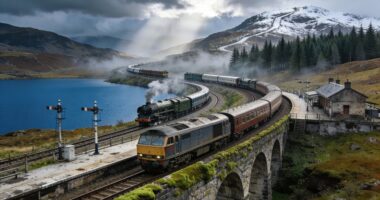
The West Highland Line crams alpine peaks, desolate moorland, and Atlantic coastline into 164 miles of scenery that rivals Switzerland minus the passport hassle. Travelers get Glen Coe’s dramatic valleys, the engineering feat of Horse Shoe Curve climbing to Rannoch Moor, and coastal drama hugging Loch Eil’s shores past white Morar sands. The route climbs to 410 meters then drops to sea level in under an hour—moorland to beaches in sixty minutes. Multiple world rankings as most scenic railway weren’t accidents. The journey continues beyond these headline moments.
Discover Alpine Mountain Railway Routes on the West Highland Line Through Glen Coe Valley Landscapes

When you think mountain railways, your mind probably jumps to Switzerland or Austria.
Scotland’s West Highland Line rivals Europe’s famous alpine routes—complete with dramatic mountain engineering and glacier-carved valleys, minus the international airfare.
But here’s the thing—Scotland’s West Highland Line delivers that same breathtaking alpine drama, just without the overseas flight. This heritage railway tackles seriously mountainous terrain using Alpine-inspired engineering tricks: the Horse Shoe Curve between Tyndrum and Bridge of Orchy actually doubles back on itself as it climbs toward Rannoch Moor‘s 1,347-foot summit.
What makes the scenic journeys special? Glen Coe Valley‘s glaciated ridges unfold alongside you, while Lochs Tulla and Laidon stretch out far below.
Railway tourism has taken off here, and it’s easy to see why. The panoramic observation routes work because the mountain scenery never stays still—light constantly shifts across the peaks, changing everything. The journey experiences appear to match what you’d find on European alpine mountain railway routes. This approach follows Alpine railway fashion, proving more scenic than building a traditional viaduct across the landscape. The line has been voted most scenic railway in the world multiple times, cementing its status among global rail enthusiasts. Exploring scenic train routes through Europe offers captivating views of rolling vineyards, charming villages, and dramatic coastlines. Travelers are often treated to breathtaking landscapes that change with each passing mile, creating an unforgettable experience. Whether traversing the rugged Swiss Alps or the serene countryside of Italy, these journeys showcase the continent’s diverse beauty and rich history.
That said, you’ll skip the Swiss price tag. Smart travelers pack durable luggage designed to handle the cobblestone platforms and station transfers that come with heritage railway adventures.
Highland Valley Railway Lines Connect Fort William to Mallaig Along Britain’s Most Scenic Coast

Beyond the mountain wilderness, the West Highland Line shifts character completely.
The Fort William to Mallaig stretch—40 miles of pure coastal drama—transforms these highland valley railway lines into something else entirely.
It’s hard to imagine coastal railways getting more dramatic than this. The route hugs Loch Eil‘s shores, then cuts through Arisaig with its views of the Small Isles before delivering passengers to Mallaig’s fishing port overlooking Skye’s Cuillin Hills.
Three daily ScotRail passenger services handle the journey. On top of that, the Jacobite Steam Train runs during summer months.
Heritage routes like this matter, especially when scenic viewpoints include the white sands of Morar and those rare mountain-meets-ocean transitions. The Glenfinnan viaduct, immortalized in the Harry Potter films, stands as one of the route’s most photographed landmarks. This section forms part of Scotland’s first national park, adding protected landscape status to its already impressive credentials.
From Mallaig, ferry connections provide seamless access to the Isle of Skye and other Hebridean islands for travelers continuing their Scottish adventure.
That said, journey planning demands a window seat—you won’t want to miss the views. Landscape photography thrives here, though the ever-changing light can be as challenging as it is rewarding.
What Makes Panoramic Observation Cars Essential for Capturing Snow-Capped Mountain Reflections?

When the light hits just right on Loch Shiel—snow-capped peaks doubling themselves in mirror-perfect water—the difference between a standard rail carriage and a panoramic observation car becomes brutally obvious.
Heritage lines figured this out decades ago.
Those oversized windows eliminate the glass reflections that tend to ruin photographic quality. Wraparound glazing captures mountain landscapes in single frames. No craning necks, no missing half the shot. The passenger experience transforms from “nice train ride” to something closer to bucket-list territory.
Opening windows let photographers shoot directly, which matters when you’re chasing that perfect angle. Scenic journeys demand unobstructed views, or at least that’s the thinking. Modest windows can create picture window effects, though they lack the full immersion of true panoramic design.
Standard carriages? They just can’t compete when reflections double the drama.
That said, they’re considerably cheaper to maintain—though heritage operators appear willing to absorb those costs for the enhanced experience. Modern routes like the Amsterdam Centraal to Berlin service demonstrate how even contemporary trains can offer compelling scenic experiences through Dutch and German countryside. The West Highland Line showcases exactly why this investment pays off, with views of Ben Nevis and waterfalls of Glen Falloch drawing passengers specifically for the scenery.
Journey Through Heritage Steam Railway Routes Operating the Famous Jacobite Steam Services

Those panoramic windows might capture reflections beautifully, but underneath all that glass they’re still hauling diesel carriages.
Heritage steam railway journeys tell a different story entirely—and it’s one worth paying attention to.
Take The Jacobite steam train. Resurrected in 1984 after diesel had pretty much wiped out steam by 1967, it runs actual vintage locomotives and 1960s Mark 1 coaches along the West Highland Line.
Railway enthusiasts get the authentic experience: that “clackity-clack” of jointed track, working steam engines grinding their way up Highland gradients. It’s the real deal.
On top of that, there are genuine cultural highlights.
Glenfinnan isn’t just scenery—it’s where the 1745 Jacobite Rising kicked off. These days it’s probably more famous for Harry Potter, but the history runs deeper than the films.
That said, operational safety nearly killed the whole operation.
Vintage carriages without modern locking mechanisms turned out to be a serious problem, at least until Mark 2 stock arrived to meet regulations. Even heritage experiences have to answer to contemporary safety standards.
The tourism impact? Massive, honestly.
Scenery plus nostalgia appears to be a formula that reliably equals money. Whether that’s entirely good for the railway or the region is another question, but the numbers don’t lie. The route covers 41 miles between Fort William and Mallaig, making it one of the most extensive regular steam services in Britain. West Coast Railways currently operates the service, focusing on safety compliance while working with rail regulators for continued permission. While Scotland offers these heritage experiences, Canada’s VIA Rail operates The Canadian across 2,762 miles, proving that spectacular train journeys aren’t limited to steam locomotives alone.
Mountain Scenery Transitions to Atlantic Coastal Views on West Highland Clifftop Passages

The train climbs to 410 meters across Rannoch Moor’s desolate plateau, then plunges toward sea level in less than an hour—mountain trains here don’t exactly take their time.
From alpine heights to ocean depths in sixty minutes—this railway doesn’t believe in scenic detours or leisurely descents.
Past Fort William, the railway clings to steep slopes above Loch Eil, and that’s where coastal clifftop journeys really begin. The Glenfinnan Viaduct becomes the star attraction for train photographers, its 21 arches sitting 100 feet up and framing water and hills in what seems like perfect composition.
The observation routes reveal something remarkable: landscape transitions that shift from windswept moorland to rough grasslands, then suddenly to white sand beaches. Like the Alpine Bernina Express with its UNESCO World Heritage route through the Swiss Alps, this Scottish journey demonstrates how trains can showcase nature’s most spectacular transitions.
Railway routes carve through Monessie Gorge before viaduct structures deliver passengers to Atlantic shores. That said, the transformation isn’t just gradual—it’s dramatic. Mountains become islands. Wilderness becomes ocean. The geography appears to reshape itself entirely within the span of a single journey. The final 42-mile stretch from Fort William to Mallaig showcases this coastal drama at its most intense, with the Atlantic visible for much of the route. This scenic landscape variety has established the line as one of the most beautiful railway journeys in the world. Travelers often embark on historic journeys on the west highland line, immersing themselves in breathtaking views that change at every turn. As the train traverses through lush green hills and rugged landscapes, passengers are treated to an ever-evolving panorama that captures the essence of Scotland’s beauty. Each mile unfolds a new story, making the ride not just a means of transportation, but a memorable experience in itself.
Rannoch Moor Wilderness Offers Remote Highland Photography From Moving Train Windows

Rannoch Moor stretches across fifty square miles of peat bog and heather—and honestly, not much else. It’s one of Britain’s largest uninhabited wildernesses, the kind of place that feels genuinely empty.
The railway line does something remarkable here: it essentially floats across unstable peat on bundles of Victorian-era brushwood. Maintenance crews still keep an eye on these floating sections, which seems like a minor engineering miracle when you think about it.
What makes this place special for photographers is its sheer inaccessibility. No roads reach this desolate expanse, so observation cars become the primary way to see it—functioning as glacier viewpoint train passages, if you will. Train windows frame endless lochans and distant peaks without a single piece of infrastructure cluttering the view. That said, you’re always shooting through glass, which has its limitations.
Corrour Station sits at the highest and most remote point on Britain’s mainline network. Some travel itineraries let you request stops there, though the experience shifts as forest wilderness train passages give way to pure, exposed moorland. The Hogwarts Express filming location actually passes through this very landscape, making it recognizable to Potter fans worldwide.
The upside? Safety standards permit slow speeds through here—perfect for actually capturing Scotland’s emptiest landscape without everything blurring past. Before reaching Mallaig, the route showcases Morar’s sandy shores, a striking contrast to the moorland’s austere beauty. Modern travelers can use apps like Trainline to book tickets for this remote journey with digital storage convenience.
In the end, your final destination matters less than this stretch of middle nowhere.
Best Times for Dawn Shots at Loch Lomond’s Lakeside Scenic Viewpoints

Rannoch Moor’s desolate beauty eventually gives way to something entirely different as the line drops south toward Glasgow.
Loch Lomond emerges through the trees—Scotland’s largest freshwater body—and suddenly photographers on these lakeside scenic railway routes face actual decisions about where to point their lenses. Dawn shots demand arrivals between 4:30 and 7:30 AM, though that window shifts depending on season.
Station platforms at Ardlui offer what appears to be the best vantage point: use the pier as foreground, catch golden hour roughly 30 minutes before sunrise.
Rolling stock tends to rumble past right as mist lifts, which is either perfect timing or cosmically frustrating.
That said, track infrastructure really limits your options for stopping. Gradient challenges and curve navigation mean you’re mostly shooting through windows. Like Canada’s transcontinental routes, these sleeper accommodations provide comfortable overnight positioning for early morning photography sessions. For those seeking different perspectives on Loch Lomond, Conic Hill provides iconic panoramic views during sunrise, reached by a steep walk of less than an hour from Balmaha car park.
Brutal but honest.
Frequently Asked Questions
Does the West Highland Line Operate During Winter Weather Conditions?
The West Highland Line operates year-round, including winter months, with ScotRail implementing de-icing protocols and improved heating. Extreme snowfall or severe weather may cause temporary disruptions, but scheduled services generally maintain continuity through Highland conditions.
Can Bicycles Be Carried on Scotrail Services Between Glasgow and Mallaig?
Yes, bicycles can be carried on ScotRail services between Glasgow and Mallaig with mandatory advance reservations. Class 156 trains accommodate six bikes, while Highland Adventure DMUs carry up to twenty cycles. No charges apply from April 2024.
Which Side of the Train Offers Better Views Traveling Westbound?
Traveling westbound from Glasgow to Fort William, the left side offers superior views of Loch Lomond and Rannoch Moor. After reversing at Fort William toward Mallaig, the left side again provides ideal vistas of Glenfinnan Viaduct.
How Many Daily Services Run Between Fort William and Mallaig?
Up to four ScotRail services operate daily year-round between Fort William and Mallaig. During tourist season (April–October), the Jacobite steam train adds one or two additional services, bringing peak summer totals to six daily departures.
Is Wifi Available on West Highland Line Train Services?
Wi-Fi is not universally available on West Highland Line services. ScotRail is trialing satellite-based connectivity on select Class 158 trains serving northern Highland routes, with potential future expansion to the West Highland Line pending trial success.
Parting Shot
The West Highland Line delivers exactly what it promises—raw Scottish drama on rails. From Loch Lomond to Mallaig’s coast, it’s 166 kilometers of legitimate scenery, not marketing hype. Those Victorian engineers? They nailed it with that Glenfinnan Viaduct, and somehow this thing still hauls 350,000 passengers yearly through terrain most trains wouldn’t dare touch.
Britain’s remotest station sits mid-route, which tells you something about the landscape you’re crossing. On top of that, UNESCO’s paying attention. Sometimes—just sometimes—the classics earn their reputation honestly.