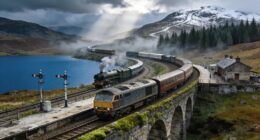
The Bernina Express nails Alpine beauty through sheer audacity—196 bridges and 55 tunnels carved across 122 kilometers of UNESCO terrain starting in 1898. It climbs to 2,253 meters at Bernina Pass, Europe’s highest railway crossing, while spiral viaducts like Brusio’s nine-arch masterpiece turn a brutal 1,000-meter descent into visual theater. Panoramic windows frame wildflower meadows and glaciers at a crawl-speed 35 km/h, because rushing through landscapes this dramatic would be criminal. The engineering alone—adhesion-only railroading on meter-gauge tracks—makes this four-hour journey worth understanding beyond the Instagram shots.
Experience Alpine Mountain Railway Journeys on the Bernina Express Across Four UNESCO Scenic Landscapes
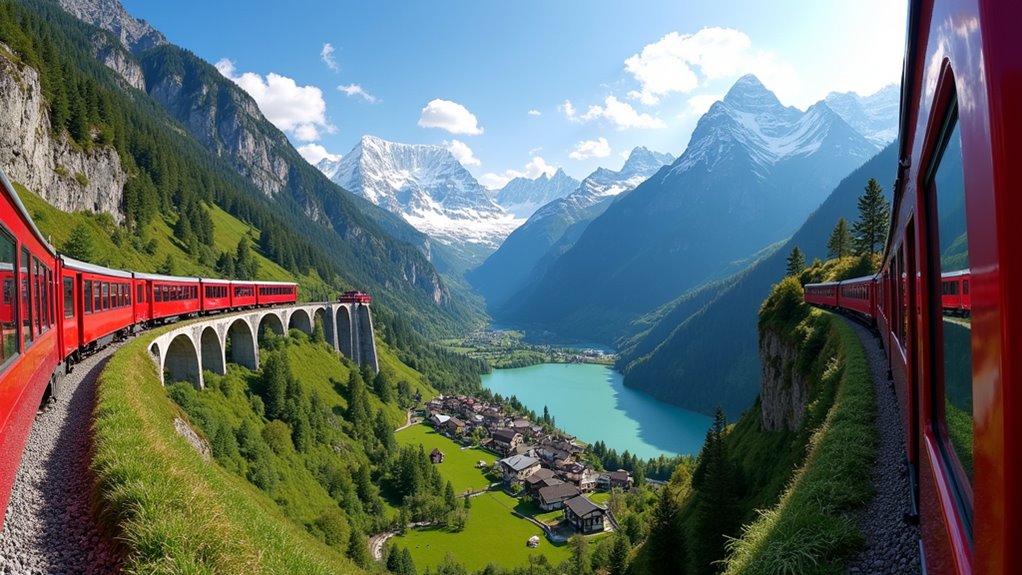
The Bernina Express cuts through the Swiss Alps, and calling it “just another train ride” would be missing the point entirely. This is a journey across four distinct UNESCO-recognized landscapes—the Albula Valley, Engadin, Bernina Pass, and Valtellina—that somehow manage to look nothing alike. Each has its own personality, its own character.
The route spans 122 kilometers of UNESCO heritage railway sections and takes roughly four hours. Those observation carriages? They feature panoramic windows that frame mountain landscapes like moving postcards, which appears to be perfect for scenic photography if that’s your thing. Though one could argue that sometimes the best views come from simply looking, not clicking.
The cultural and historical significance is real, no exaggeration: 196 bridges, 55 tunnels, engineering dating back to 1898. These panoramic train routes earned that UNESCO designation for good reason. The train operates on metre gauge track, a narrower width that allowed engineers to navigate the tight Alpine curves and challenging terrain. For those seeking flexibility, local Rhätische Bahn trains run regularly along the same route without requiring advance reservations.
On top of that, the sheer ambition of building a railway through these conditions in the late 1800s is likely to impress even the most jaded traveler. While North America offers spectacular rail journeys like the Rocky Mountaineer through Canadian mountains and the Empire Builder’s traverse of Glacier National Park, the Bernina Express provides its own unique Alpine perspective. That said, whether you’re there for the engineering marvel or just the views, the Bernina Express delivers.
Glacier Viewpoint Train Passages Reveal Pristine Alpine Grandeur at Panoramic Viewpoints

As the Bernina Express climbs toward 2,253 meters at Bernina Pass—Europe’s highest railway crossing, for the record—the windows become frames for something most people only see in screensavers.
Through panoramic windows designed specifically for this passenger experience, glacier viewpoint train passages deliver Morteratsch’s icy mass in full view. The route elevation shift is brutal: alpine snow zones give way to Italian palm trees in four hours.
From alpine glaciers to palm trees in four hours—the Bernina Express doesn’t just change elevation, it changes continents.
That said, viaduct crossings like Brusio’s circular spiral add engineering flex to natural drama, which seems almost intentional in its timing. The full journey from Chur to Tirano demands passage through 55 tunnels and 196 bridges, a statistical testament to the route’s ambition.
Valley descent transitions reveal Lake Bianco‘s glacier-fed waters first, then autumn foliage, then subtropical vegetation—a visual progression that heritage preservation maintains deliberately. The UNESCO heritage designation marks the route as a site of outstanding universal value, recognizing both its cultural significance and remarkable landscape.
These sightlines don’t just happen; they’re strategic. On top of that, the whole thing feels like beauty engineered with purpose, though whether that makes it more or less impressive is probably a matter of taste. The journey seamlessly integrates with Switzerland’s efficient rail network, connecting travelers to other scenic routes and major cities throughout the country.
It’s the kind of route that appears to compress entire climate zones into a single afternoon, leaving you wondering if the scenery is actually shifting that fast or if the train is just messing with your sense of geography.
How Viaduct Architecture Frames Dramatic Alpine Gorges on Panoramic Railway Crossings

The Bernina Express scenery does most of the talking, sure, but the viaducts—they’re really the ones holding up the conversation.
Take Landwasser: it stretches 142 m across a gorge, 65 m above the floor, with a 100 m radius curve that practically throws you into a tunnel carved straight into cliff rock. The engineering achievements here were done without scaffolding—just cranes and nerve, apparently. The structure itself required approximately 9,200 cubic meters of dolomitic limestone to complete.
Then there’s Brusio, which spirals a full 360 degrees through nine stone arches while climbing at a 7% gradient. The viaduct was constructed in 1908 to overcome the steep Alpine terrain while preserving the natural beauty of the landscape.
These structures work as visual gateways, framing everything around them. Ravines, crags, mountain backdrops—the viaducts seem designed to put all of it on display. While the Bernina Express showcases Alpine engineering, Canada’s Rocky Mountaineer demonstrates similar mastery in framing mountain landscapes across multiple routes through the Canadian Rockies.
Track curvature on heritage railway lines like this delivers panoramic viewpoints while maintaining passenger comfort, though one could argue the thrilling exposure is half the point. On top of that, fifty-two bridges shape this scenic railway passage, each one likely contributing to the choreography of views.
Even so, it’s worth noting that what makes these crossings memorable isn’t just the technical specs. It’s how they position you—suspended over a gorge, swung around a cliff face—so the landscape hits differently than it would from solid ground.
UNESCO Heritage Railway Sections: Century-Old Engineering That Defines Alpine Beauty

Since 2008, the Rhaetian Railway in the Albula/Bernina Landscapes has carried UNESCO World Heritage status—a designation that puts it in the same conversation as the Taj Mahal and the Great Wall.
The 122-kilometer route crosses 196 bridges and threads through 55 tunnels in alpine terrain that would challenge any modern engineer, let alone one working in the early 1900s.
Observation cars glide over panoramic viaduct crossings where bridge construction and tunnel technology somehow manage 7% gradient systems without any rack-and-pinion assistance.
That’s adhesion-only mountain railroading—wheels gripping rails through sheer friction—and it appears to work just as reliably now as it did a century ago.
The Landwasser and Brusio viaducts frame the cultural landscape in ways that feel almost improbable, elegant stone arches suspended over valleys that drop away beneath you.
The line opened on July 5, 1910, after four years of construction that pushed over 2,000 workers—most of them from northern Italy—through brutal Alpine conditions.
The railway crosses the Bernina Pass at 2,253 meters above sea level, making it the highest adhesion railway in Europe.
On top of that, the engineering holds up.
No major redesigns, no concessions to modern safety panic.
It’s the kind of infrastructure that may suggest we’ve lost something in how we build today—or at least raises the question of whether all our technological advances have made us better at solving problems like these. The Bernina Express shares Switzerland’s rail excellence alongside the equally celebrated Glacier Express, which offers its own distinctive route through the Swiss Alps.
Highland Valley Railways Traverse Alpine Terrain With Seasonal Wildflower Displays
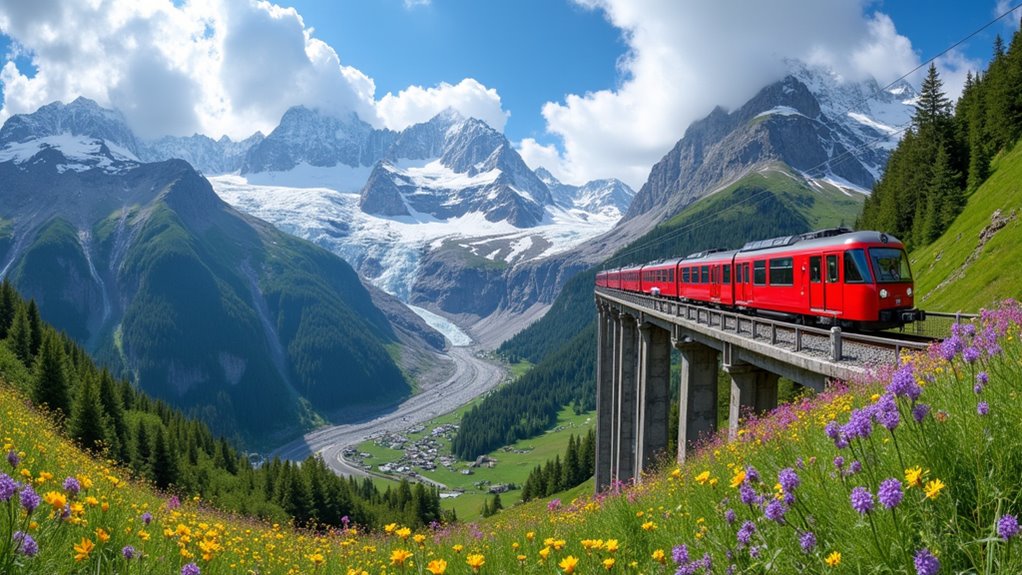
Beyond stone arches and century-old engineering feats, the Bernina Express rolls through valleys that seem to change costume every few months.
Highland valley railway traverses showcase seasonal wildflower displays—gentians, primroses, alpine roses—peaking May through July, when panoramic railway lines turn into what looks like botanical galleries. The scenic appeal isn’t accidental, though the scale of planning involved can be easy to miss.
Eco-sensitive construction appears to protect fragile meadows, while vegetation-friendly embankments encourage regrowth and wildlife overpasses maintain ecosystem continuity. This careful environmental planning reflects the route’s designation as part of a UNESCO World Heritage site, recognizing both its engineering significance and natural beauty.
On top of that, passenger amenities include retractable windows for unobstructed photography and commentary highlighting Alpine flora. The train crawls at 35 km/h. That pace is perfect for absorbing wildflower carpets flanking the tracks—assuming weather cooperates and blooms arrive on schedule. The route features 25 stations and stops, providing numerous opportunities to observe the changing landscape. Passengers can capture these moments throughout the approximately 8-hour journey, with multiple daily departures ensuring flexible viewing opportunities.
Nature’s timing meets engineering restraint, though it’s worth noting that climate shifts may gradually alter those peak viewing windows.
What Makes Suspension Bridge Railway Crossings Create Breathtaking Aerial Views?

Suspension bridge railway crossings punch holes in the sky—literally lifting tracks sixty-five meters above riverbeds and gorges, forcing passengers to confront sprawling alpine vistas whether they’re ready or not.
Take the Landwasser Viaduct: it’s a masterclass in engineering brutality. Slender frameworks, minimal obstructions, maximum panoramic elevation.
What makes these crossings so visually striking seems to be the uninterrupted sightlines—passengers get clear views over forests and valleys, with vertical drops that amplify the psychological sensation of floating.
On top of that, slow train speeds milk every second of the experience. Weather conditions play their part too. Fog, shifting clouds, alpine sunlight—each transforms the crossing into something distinct, a different scenic highlight every time.
That said, you could argue it’s not just about the engineering itself. It’s this strategic interaction with landscape that does the heavy lifting, turning steel and stone into aerial theater. The Bernina Railway’s UNESCO World Heritage recognition stems partly from these engineering marvels that blend function with theatrical topography.
The route’s infrastructure includes 196 bridges alongside 55 tunnels, creating a continuous sequence of elevated viewpoints that punctuate the journey from Chur to Tirano. Unlike Canada’s VIA Rail services that focus on transcontinental distances, these Alpine routes compress spectacular engineering into relatively short segments.
The kind that photographs itself, honestly.
Spiral Tunnel Railways Through Mountain Landscapes Offer 360-Degree Panoramic Exposure

Mountains don’t negotiate. When straight lines fail, engineers turn to spiral tunnel railways—360-degree helical routes that pack serious elevation gain into surprisingly tight horizontal footprints. It’s geometry solving stubbornness.
Take the Bernina Express. This route threads through 55 tunnels and crosses 196 bridges across Alpine terrain. The spiral viaduct at Brusio is a standout: functional necessity that happens to look spectacular.
Fifty-five tunnels, 196 bridges—the Bernina Express proves engineering constraints can accidentally become the spectacle itself.
Those panoramic windows aren’t just for show, either. Curved tracks mean passengers actually see their own train snaking through the landscape from constantly shifting angles. The whole experience becomes immersive in a way straight routes can’t match.
UNESCO thought enough of this scenic railway infrastructure to grant it World Heritage status in 2008. The Bernina Express spans both Switzerland and Italy, making it a truly transnational Alpine experience. That said, the real engineering triumph is simpler than the accolades suggest—curves weren’t some aesthetic flourish. They were mandatory.
The route tackles a nearly 1,000-meter drop between Alp Grüm and Poschiavo, requiring spiral loops to manage gradients that reach 7 percent. But somewhere along the way, that constraint became the main draw. The structure’s nine spans stretch 110 meters with a horizontal radius of curvature tight enough to circle back on itself. Function and spectacle collapsed into the same thing.
Frequently Asked Questions
What Is the Best Season to Photograph Glaciers From the Bernina Express?
Winter emerges as the ideal season for glacier photography from the Bernina Express, offering pristine snow contrasts, dramatic ice formations, clearer skies, and improved details through low sun angles that accentuate textures and create striking visual compositions.
How Much Does a Bernina Express Ticket Cost in Swiss Francs?
Bernina Express tickets range from CHF 33 to CHF 226 depending on route and class. Full Chur-Tirano journeys cost CHF 66 (second class) or CHF 113 (first class) single fare, plus mandatory reservation fees of CHF 32-38.
Can I Bring Luggage on the Bernina Express Train Journey?
Passengers can bring luggage on the Bernina Express without strict size or weight restrictions. Large suitcases fit on dedicated racks near carriage doors, while smaller bags store at seats, with travelers responsible for their own handling throughout.
Does the Bernina Express Offer Open-Air Observation Carriages Year-Round?
No, open-air observation carriages are not available year-round. The Bernina Express offers open-air “Cabrio” carriages only during summer months (typically July–September), subject to favorable weather conditions and specific train schedules.
What Dining Options Are Available Onboard the Bernina Express?
The Bernina Express offers trolley service with Swiss snacks, regional delicacies, and beverages served at seats throughout the four-hour journey. No restaurant car exists; passengers may bring their own food. Payment is card-only.
Parting Shot
The Bernina Express doesn’t just show alpine beauty—it arguably set the bar for what that should look like. You get four hours, 196 bridges, 55 tunnels, and this wild elevation change that takes you from glaciers down to palm trees. Around half a million people ride it every year, and it’s not hard to see why—there aren’t many railways that pack in this much engineering spectacle alongside landscape diversity. UNESCO seemed to think so too when they gave it World Heritage status in 2008.
That said, calling it the definitive alpine railway experience might be strong, though it’s tough to argue with the combination. The accessibility alone sets it apart. On top of that, the heritage angle gives it weight, and those jaw-dropping views speak for themselves. Whether or not any competition truly comes close probably depends on what you’re after, but this specific mix of features? Pretty hard to match.