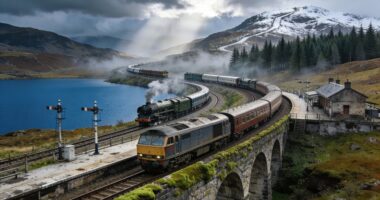
Glenfinnan Viaduct: The structure became cinema’s most recognizable railway crossing when filmmakers captured twenty-one curved stone arches rising 100 feet above a Scottish valley in 2001. The Victorian railway bridge transformed into a global pilgrimage site through its appearance in fantasy films.
The dramatic sweep across River Finnan delivers unforgettable backdrops. Studio backlots cannot match this location. Film scouts photograph the 800-foot radius curve. Untouched Highland landscapes minimize modern intrusion.
Three elements make this viaduct memorable in popular culture:
- The curved stone arches: Twenty-one spans create a sweeping arc above the valley
- The Highland setting: Remote Scottish landscapes provide authentic Victorian-era atmosphere
- The steam railway service: Period locomotives cross the bridge twice daily for tourists
The Jacobite steam train crosses twice daily. Tourists fund this service with ticket purchases. Fantasy film popularity preserves authentic 1901-era engineering. The structure might have deteriorated without blockbuster exposure.
Film location scouts sought authentic Victorian infrastructure. The viaduct provided that authenticity. Modern elements remain absent from sight lines. The railway continues operating as designed over a century ago.
Interesting Fact: The viaduct’s construction required over 400,000 tons of concrete made with crushed stone, creating the largest mass concrete railway bridge in Scotland when completed in 1901.
Discover How the Hogwarts Express Created Cinema’s Most Recognizable Railway Crossing Since 2001

November 16, 2001: the Hogwarts Express roared onto screens. Cinema railways would never be the same. Director Chris Columbus captured the Glenfinnan viaduct crossing—Scotland’s heritage rail infrastructure transformed into pop culture gold—and suddenly a steam train became a character you couldn’t forget.
The Harry Potter franchise spawned something. The franchise spawned pilgrimage routes. The franchise spawned an entire industry of screen tourism, proving that magic and marketing make perfect partners.
Today’s Jacobite steam train retraces those cinematic landscape shots, winding through the same Scottish Highlands that mesmerized audiences in *Harry Potter and the Philosopher’s Stone*. Heritage rail tourism now generates serious dollars because of what appeared on screen. Visitors can extend their journey beyond the viaduct by taking connections to ferries that open up Scotland’s islands for further exploration.
Can you imagine telling railway preservationists in 2000 that a children’s film would rescue their industry? Long sentences of track unfurl across misty valleys, carriages filled with tourists clutching cameras and wands, all chasing the exact angle Columbus framed two decades ago—the viaduct, the mountains, the impossible beauty of it all.
And you’re part of it now.
Every ticket sold. Every Instagram post. Every child pressing their face against the window, searching for Hogwarts among the peaks. This is how iconic train routes in popular culture work: they don’t just entertain; they transform real places into destinations, old infrastructure into attractions, forgotten railways into must-see experiences.
The crossing became cinema’s most recognizable railway moment since 2001. Columbus later moved to a producer role, but his visual legacy thundered on through every sequel that followed. The first film broke opening-day and opening-weekend sales records, becoming the highest-grossing film of 2001. Period.
Glenfinnan Viaduct’s 21 Dramatic Arches Deliver Unforgettable Highland Backdrops for Blockbuster Films

Recognize that viaduct? Twenty-one arches of pure cinema gold arch across the Highland sky. The Jacobite steam train crosses it twice daily—early morning, late afternoon—transforming this West Highland Line Scotland engineering marvel into the stuff of blockbuster film railroad scenes, the kind that make audiences gasp.
Railway photography enthusiasts swarm here. They swarm the Hogwarts Express route. They swarm with cameras ready, tripods extended, fingers hovering over shutters.
Pure Highland drama.
These scenic viaducts deliver what film location scouts dream about: one hundred feet of stone curving above River Finnan, sweeping through Glenfinnan valley with the kind of grandeur you can’t fake on a soundstage. While luxury experiences like the Venice Simplon-Orient-Express showcase Art Deco elegance, this Scottish route offers raw, untamed cinematic beauty.
One hundred feet of stone curving above River Finnan—the kind of grandeur you can’t fake on a soundstage.
Can you imagine a more photogenic rail heritage site? The arches create rhythm—arch after arch after arch, then sky. When steam billows from the locomotive, you’re watching engineering become art; when light hits the stonework at golden hour, you’re seeing why directors choose this spot again and again. The curve spans 800 feet of radius, adding cinematic sweep to every frame.
Twice daily, the crossing happens. The whistle echoes. The wheels clatter over rails laid more than a century ago, and suddenly you understand why this viaduct appears in film after film: it delivers unforgettable backdrops without trying. Built in the late 1890s as part of the Fort William to Mallaig extension, this structure has endured for over a century of continuous railway service.
No set designer could improve it. The curve, the height, the valley spreading below—these elements conspired to create railway perfection. Film gold doesn’t get more authentic than this West Highland Line treasure, where every crossing writes its own dramatic scene.
What Makes the West Highland Line Scotland’s 42 Miles Perfect for Cinematic Landscape Shots?

Forty-two miles. That’s all it takes. Forests bleed into mountains, mountains collapse into lochs, and lochs surrender to moors before the moors give way to coastlines—this heritage railway owns the scenic route map filmmakers crave. Remote wilderness traversal unfolds along every curve; landmark stations float above peat bogs like something out of a fever dream.
You won’t find roads here, won’t battle the usual filming permit drama, won’t waste weeks negotiating access: perfect terrain for travel documentary crews chasing documentary heritage rail features.
The landscape transforms. The landscape transforms. The landscape transforms—and then it breaks you.
Why do fictional movie train journeys live here? Because nowhere else delivers this relentless visual variety in such compressed distance. Through the window: ancient woodlands one moment, then windswept moorland, then sudden vistas of dark water hemmed by granite peaks. This isn’t scenery; it’s storytelling architecture.
The West Highland Line hands you drama in layers—atmospheric, geological, mythic—each mile a new frame begging for your camera. Consider the practicality too: minimal infrastructure means minimal modern intrusion, minimal distractions from the primal Scottish wilderness that filmmakers need when they’re selling audiences on authenticity. Red deer emerge from heather-clad slopes, adding wildlife movement to shots that might otherwise feel too static for modern audiences. The route cuts through Loch Lomond & The Trossachs National Park, framing protected landscapes that guarantee visual consistency across decades of filming. While other UNESCO-listed railway routes across Europe celebrate engineering achievements, Scotland’s line trades technical marvels for raw natural drama that no viaduct alone can replicate.
Forty-two miles of pure cinematic chaos. Film crews return season after season because the line delivers three essential elements: visual dynamism that holds attention, logistical simplicity that saves budgets, and that elusive quality every director hunts—a landscape that feels utterly untouched by the twenty-first century.
Heritage railways exist across Britain, but this one? This one was built for the screen.
The Jacobite Steam Train Preserves 1901-Era Victorian Engineering for Documentary Heritage Features

Preserving steam power isn’t about freezing time. It isn’t about nostalgia. It isn’t about quaint tourism—it’s about resurrecting the bones of an engineering philosophy that died in 1967, the year British Rail yanked the last steamers off the West Highland Line and closed a chapter of industrial history.
Resurrecting the bones of an engineering philosophy that died when the last steamers left the rails in 1967.
Gone, just like that.
West Coast Railways runs the Jacobite steam train today with a curator’s obsession: vintage carriages, Black 5 locomotives, and the Glenfinnan Viaduct route maintained authentically, down to the coal-fired breath and oil-slick precision of 1901-era Victorian engineering.
These aren’t replicas; they’re survivors, mechanical veterans kept alive through meticulous restoration work that demands you understand metallurgy, valve timing, and the lost art of reading steam pressure by sound alone. Do you know how rare that expertise has become?
The locomotives thunder across twenty-one arches of curved stone viaduct. They climb gradients that modern trains dismiss with electric ease.
They burn coal—actual coal—to move tonnage the way engineers once calculated it: with slide rules, experience, and faith in riveted steel.
The Hogwarts Express imagery? Pure accident. Locomotive history met tourism necessity, and suddenly a working heritage railway became a film location, a brand, a phenomenon that funds the very preservation work it accidentally romanticizes.
The irony sustains the operation: fantasy bankrolls authenticity.
Walk the platform when the Jacobite idles at Fort William, and you’ll smell hot oil and wet ash; you’ll hear the hiss of steam bleeding from relief valves, the clank of coupling rods, the shovel scrape from the firebox.
This is documentary heritage—functional, unglamorous, essential. Because when the last person who can rebuild a regulator valve dies, so does the knowledge.
And with it, a bridge to the engineering minds who built an empire on steam, precision, and the radical belief that iron could be taught to move mountains. The train set comprises coaches that are ex-British Railways Mark l and Mark ll models from the 1960s, open formations designed to maximize scenic viewing across landscapes that defined Highland rail ambition. The 82-mile round-trip between Fort William and Mallaig traces the original route that opened in 1901, when the Mallaig extension finally connected the West Highland Railway to the coast. This journey joins the ranks of celebrated heritage experiences like the Belmond Royal Scotsman, another legendary Scottish rail adventure that traverses the Highlands with vintage elegance.
From Orient Express to Screen: Television Series Draw Murder Mystery Inspiration from Legendary Locomotives

Murder rides the rails. Apparently, no locomotive carries more corpses per fictional mile than the Orient Express. Since the 1950s, Agatha Christie’s *Murder on the Orient Express* has spawned countless television series set on locomotives: syndicated dramas, prestige adaptations, specialty episodes.
The train keeps rolling through our screens.
The train keeps rolling through our imaginations.
The train keeps rolling—but why?
Railway nostalgia now drives streaming platform content, pulling you back to an era when travel meant glamour, when compartments held secrets, and when every passenger concealed something worth killing for. David Suchet’s 2010 adaptation reminded audiences that vintage settings still thrill; however, classic railway footage alone can’t compete with newer crossover phenomena.
Consider the Hogwarts Express. That scarlet engine proved family-friendly fantasy could eclipse even Christie’s elegant mayhem.
Yet the murder-train template endures—a confined space, a diverse cast, a ticking clock before the next station. Do you see the appeal? Locomotives transform every passenger into a suspect. They bottle tension. They accelerate dread with each clacking mile. The Orient Express remains the gold standard: opulent dining cars concealing dark motives, sleeper berths harboring darker truths, and corridors where alibis collapse like worn luggage. The original service commenced on 5 June 1883, connecting Paris and Vienna before extending to Istanbul, establishing the luxury route that writers would immortalize for generations. Today, the Venice Simplon-Orient-Express continues this tradition, carrying passengers from London to Venice in restored vintage carriages that echo the glamour screenwriters love to dramatize.
Television writers return to these rails again and again because trains impose natural dramatic unity—limited exits, forced proximity, the rhythmic urgency of wheels on track. You can almost hear the whistle. The 1974 film adaptation captured Christie’s quick character sketches with remarkable precision, setting a standard that later productions struggled to match. And streaming platforms keep commissioning them, knowing that audiences will always board a train bound for murder, especially when it promises the elegance of a bygone age and the satisfaction of a puzzle solved before the final destination.
Heritage Railway Photography Captures the Indian Pacific Australia’s 2,704-Mile Outback Wilderness Cinematography

Stretching across 4,352 kilometers of Australian wilderness, the Indian Pacific railway transforms photography into an epic visual marathon—one that demands commitment, endurance, and sixty-five hours of your life. While Scotland’s Glenfinnan Viaduct gets its fifteen seconds of Instagram fame, this transcontinental beast refuses quick fixes. Think you can capture outback brutality in a weekend?
Heritage railway photography meets reality here. The panoramic observation car becomes your cinema: Blue Mountains greenery collapsing into rust, rust surrendering to sand, sand finally dissolving into Nullarbor Plain nothingness. Cook ghost town appears, endures its moment, then vanishes behind you. No pretense.
This journey breaks photographers; it breaks tourists; it breaks anyone expecting Europe’s manicured rail romance—then it rebuilds them with something rawer. Unlike the Rocky Mountaineer’s glass-domed cars that frame Canadian peaks in luxury, the Indian Pacific demands you earn every frame across unforgiving terrain. From Sydney’s Pacific Ocean departure, the landscape strips itself bare across 478 kilometers of the world’s longest straight track. Endless horizon. Mining heritage flickers past at Broken Hill and Adelaide, where the train executes its out-and-back routing from Crystal Brook, a technical ballet invisible to most passengers yet essential to the journey’s architecture. Endless horizon. Mining heritage flickers past at Broken Hill and Kalgoorlie: silver, gold, the bones of ambition. Red Service passengers navigate the tilting two-by-two seats for three days without beds, their bodies becoming part of the landscape’s endurance test.
By the time you roll into Perth and glimpse the Indian Ocean, transcontinental completion feels earned, not given. The visual marathon rewards those who stay—who watch greenery die, who witness isolation calcify into beauty, who understand that some stories can’t be rushed.
Short trips deliver postcards. This delivers transformation.
| Journey Segment | Photographic Highlight |
|---|---|
| Sydney Departure | Pacific Ocean coastal scenery |
| Blue Mountains | Lush transition to arid interior |
| Nullarbor Plain | 478 km straight track isolation |
| Broken Hill/Kalgoorlie | Silver and gold mining heritage |
| Perth Arrival | Indian Ocean transcontinental completion |
Trans-Siberian Railway: 5,772 Miles of Scenery Attracting International Film Location Scouts

Seven days. Seven days locked on steel rails slicing through 9,288 kilometers of Russian wilderness, and you’ll cross eight time zones without once leaving your carriage.
The Trans-Siberian Railway demolishes geography from Moscow to Vladivostok; it hurls you across two continents, through forests that swallow horizons, over 497 bridges and viaducts that film location scouts photograph obsessively.
Consider Lake Baikal’s shoreline: 207 kilometers of crystalline water hugging the tracks. Yekaterinburg rises from the Urals. Krasnoyarsk sprawls along the Yenisei River. Then the taiga swallows everything—endless, ancient, indifferent. What other railway delivers this scale of visual drama?
168 hours of scenery. 168 hours of cinematography. 168 hours that international film crews now covet for their productions. A journey.
Through the window you’ll watch dawn break over Siberian steppes, watch twilight stain the birch forests purple, watch industrial cities flash past like fever dreams between vast stretches of nothing.
The rhythm changes—Moscow’s grandeur yields to wilderness, wilderness yields to settlements, settlements yield again to emptiness. This railway doesn’t just connect cities; it reveals Russia’s enormity, its contradictions, its raw geographic power that no studio backlot can replicate.
No other route offers such variety. The diversity staggers: European architecture morphs into Asian influences, Orthodox domes give way to Buddhist temples, permafrost meets volcanic ranges. Film location scouts obsess over these transitions, these juxtapositions of landscape and culture compressed into a single ribbon of track. Over 85,000 individuals constructed this visual corridor that now serves cinematographers hunting authentic backdrops. Electrification completed in 2002 transformed the railway’s technical capabilities while preserving its cinematic appeal. India’s Vivek Express spans 4,200 kilometers across eight states, yet even this legendary route covers less than half the Trans-Siberian’s staggering distance.
Five thousand seven hundred seventy-two miles of moving canvas.
Frequently Asked Questions
How Do Film Crews Obtain Permits for Railway Filming on Operational Lines?
Film crews submit applications to railroad operators with shoot details, timeline, and location. They secure executed agreements, provide production insurance, complete safety training, and obtain Right-of-Entry Permits assessed case-by-case.
What Camera Equipment Works Best for Capturing Trains in Mountainous Terrain?
What camera bodies work best?
Full-frame mirrorless bodies like Sony A7S III excel in variable mountain light conditions.
What lens is recommended?
24-105mm zoom lenses provide composition flexibility for train photography.
Are drones useful for train photography?
Yes, drones like DJI Mavic Air 2S capture sweeping aerial perspectives.
What feature protects against mountain weather?
Weather-sealed camera bodies withstand harsh mountainous conditions.
Are There Insurance Requirements Specific to Railway Location Shooting?
Are There Insurance Requirements Specific to Railway Location Shooting?
Yes. Productions need Railroad Protective Liability Insurance, formal permits, Certificates of Insurance meeting railroad minimums, and Additional Insured endorsements naming the railway operator.
Which Months Offer Optimal Lighting Conditions for Highland Railway Cinematography?
April through October provides optimal lighting for Highland railway cinematography. Spring months deliver soft morning light with fewer crowds. Autumn produces golden hillsides and warm pre-sunset conditions for afternoon train crossings.
Do Heritage Trains Modify Schedules to Accommodate Film Production Needs?
Yes. Heritage trains adjust timetables for film shoots, assign dedicated staff for production inquiries, and modify operations while maintaining safety standards. This practice generates extra income for operators. Notable example: Goathland station for *Harry Potter* filming.
Parting Shot
Railway infrastructure doesn’t usually become global icons. But throw in some wizards, Victorian steam locomotives, and jaw-dropping Highland scenery, and suddenly a 1901 concrete viaduct transforms into a pilgrimage site. The Glenfinnan Viaduct proved that fictional narratives permanently reshape how people view utilitarian structures. From Scotland’s West Highland Line to the Trans-Siberian Railway, cinema continues mining railway heritage for visual drama. Turns out, trains make incredible storytelling vehicles—literally.