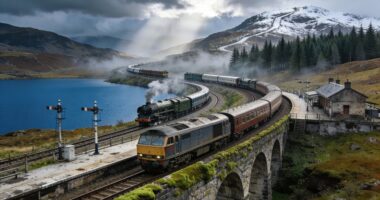
Most Scenic Train Routes in Europe: West Highland Line Photography Features, Fjord Reflection Opportunities, Mountain View Compositions
The West Highland Line, a railway passage through Scotland, captivates photographers with dramatic visual transitions. This route delivers tunnel-to-summit sequences that transform darkness into sudden mountain vistas. Photographers experience: scenic views along the west highland line provide opportunities to capture the breathtaking beauty of the Scottish Highlands. Each curve of the track reveals new landscapes, from lush valleys to rugged peaks, inviting travelers and enthusiast photographers alike. The journey becomes a visual feast, showcasing nature’s artistry at every turn.
- West Highland Line – thirteen tunnel exits reveal 3,000-foot peaks and mirror-still lochs
- Bergensbanen – Norway’s mountain railway offers Nordic fjord reflections
- Swiss panoramic routes – sealed observation domes provide controlled viewing environments
The West Highland route operates vintage droplight windows. These windows create unpredictable compositions. Photographers must work with quick reflexes.
Highland weather shifts rapidly. Mist transforms into crystal clarity within minutes. Framed shots rewrite themselves constantly. This weather pattern demands patience from photographers.
The tunnel-to-summit rhythm creates borrowed-time photography. Each tunnel exit offers fresh mountain and loch combinations. Light changes faster than most camera equipment reloads.
Norway’s Bergensbanen shares similar landscape characteristics. Both routes feature dramatic elevation changes. Both showcase water reflections against mountain backdrops.
Swiss routes counter with different advantages. Sealed panoramic domes protect equipment. Climate control stabilizes shooting conditions. The West Highland maintains its raw, unpredictable nature.
Interesting Fact: The West Highland Line passes through Rannoch Moor, one of Europe’s last remaining wilderness areas, where photographers can capture images of terrain unchanged for thousands of years while the train pauses at Britain’s most remote railway station.
West Highland Line: The Iconic 21-Arch Glenfinnan Viaduct Featured in Harry Potter Films

In the late 1890s the West Highland Line pushed north from Fort William to Mallaig. Engineers faced a problem. How could they cross the steep-sided valley at Glenfinnan without spending a fortune on traditional stone masonry? Robert “Concrete Bob” McAlpine—contractor, visionary, problem-solver—had an answer: mass concrete.
Picture this. Twenty-one arches spanning 380 meters. Soaring over Scottish Highlands scenery. All built with a material most engineers distrusted at the time, yet McAlpine believed in it, championed it, and proved it could work where stone would have bankrupted the railway.
The viaduct rises in graceful curves, each arch flowing into the next, carrying trains across a valley that once seemed impossible to bridge. A triumph of innovation.
Now you’ve probably seen it. The Hogwarts Express steaming across those arches in the Harry Potter films made Glenfinnan the most photographed viaduct crossing in Britain; tourists flock there year-round, cameras ready, hoping to capture that cinematic magic. But here’s what you should remember: before it was a movie star, before it became an Instagram backdrop, this structure represented pure audacity—a bet on untested technology, a gamble on concrete when the world trusted only stone.
McAlpine built arches. McAlpine built bridges. McAlpine built a legacy. And he did it by thinking differently. The Mallaig extension was completed in 1901, opening the rugged West Highlands to rail travel for the first time. Today, ScotRail operates this iconic route as part of Scotland’s most celebrated scenic rail journeys.
The viaduct still carries trains today. Still stands strong. Still proves that sometimes the boldest solution is the right one, even when conventional wisdom says otherwise. Standing 30 metres high, it remains the longest concrete railway bridge in Scotland.
Why Does Rannoch Moor Captivate? Dramatic Highland Wilderness at 400m Elevation

Northward from Bridge of Orchy, the West Highland Line climbs. The landscape opens. Something primordial emerges: Rannoch Moor, where nearly everything is water, bog, or both.
This is highland wilderness at 300 meters elevation—a vast plateau spanning 130 square kilometers, 82% waterlogged, utterly captivating.
Imagine mountain pass railway journeys transformed into lakeside reflection corridors, where lochans mirror sky and cloud in perfect stillness, where the train itself becomes a moving gallery threading through water and water and water, until suddenly the pattern breaks: peat and rock interrupt the wetland rhythm.
Threading through liquid mirrors until peat and rock shatter the rhythm—this is railway travel transformed into moving gallery.
Have you ever watched sunrise from an observation car here? You should.
Window seat selection matters desperately on this route; the right vantage point captures reflections that photographers dream about, those fleeting moments when light and liquid glass align.
But weather conditions shift fast—brutally fast—complicating both reflection management and mountain pass photography in ways that will test your patience.
During early morning runs, the moor offers its finest show: longer shadows stretch across bog pools, mist hovers at water level, and the plateau’s primordial character reveals itself in layers of gray, silver, and sudden gold.
Then clouds rush in. Gone.
The 82% waterlogged statistic tells you something essential about this terrain—it’s more liquid than solid, more sky-mirror than earth.
Lochans scatter across the plateau like shattered glass; each one reflects, each one shifts, each one disappears when cloud cover descends.
Fast doesn’t describe it adequately. Violently fast.
What makes Rannoch Moor captivate? Simple: you’re crossing a place that refused civilization, where railway engineers in the 1890s floated tracks on brushwood and heather because bedrock lay too deep to reach. This engineering feat rivals Austria’s Semmering Line, another historic railway triumph built through seemingly impossible terrain.
The train glides over impossible ground—130 square kilometers of beautiful, inhospitable, utterly unforgettable wilderness.
Mountains surround this blanket bog, rising over 3000 feet to the south-east and west, their peaks framing the wetland expanse below.
The moor’s mood transforms completely with the weather—what appears as heather-and-lochan glory one moment becomes grey and cloud-shrouded the next, a temperament that makes every crossing unpredictable.
Time Golden Hour Shots Between 6-8am on Summer Eastbound Services from Fort William

The eastbound Fort William departure catches something most photographers miss. Midsummer sunrise happens absurdly early—04:20 BST in late June—but the golden hour light stretches and stretches, lingering in these Highland valleys until well past 06:00 because the surrounding peaks trap and soften it, cradling the glow in ridges and corries, turning ordinary rock faces into brushstrokes of amber and rose.
Dawn departures between 06:00–08:00 still deliver warm low-angle illumination across valley routes; you’ll find that perfect sidelight raking across the landscape even as London stirs awake. For photographers seeking similarly dramatic scenery, Norway’s Bergensbanen offers fjords and mountains that rival the Scottish Highlands in photographic appeal.
Seasonal variations shift sunrise timing daily. They shift it daily. They shift it relentlessly daily. But those summer mornings? Pure gold.
Here’s what kills the shot: mountain railways ban tripods, so you’ll need steady hands and high ISOs. Tunnel light transitions ruin exposures—one second you’re bathed in amber, the next you’re plunged into basalt darkness, your histogram screaming. Photography spots demand fast reflexes, the kind that come only from anticipation, from knowing the route, from watching the valleys scroll past your window and sensing—three seconds before it happens—when that ridge will break and flood your frame with light.
Can you feel the rhythm of this journey? The train rocks; the light shifts; the mountains stand eternal. No tripod. No second chances. Just you, the glass, and that stretched golden hour doing what it does nowhere else on Earth. The route peaks at Corrour station, the highest mainline railway station in the UK, where the platform itself becomes part of the composition. When sharing your captures, ensure landscape orientation for submission to galleries that celebrate this iconic Highland journey.
Loch Lomond, Loch Long, Loch Eil: Frame Perfect Reflections Along These Shorelines

Glass water doesn’t lie. When winds drop along Loch Lomond’s northern basin, you’ll find mirror-perfect reflections doubling every Highland ridge and wooded island—the same magic repeats at Loch Long’s Arrochar head, where fjord-like shorelines catch sky and stone in flawless symmetry.
When the wind stills, Highland ridges and wooded islands appear twice—once above the waterline, once perfectly mirrored below.
These lakeside tracks hug the water so closely they rival Norway’s scenic routes; forest passages frame islands that float twice, once in air and once in stillness below, creating compositions nature herself seems to have staged. The Bergensbanen crossing Nordic landscapes offers similarly dramatic water reflections, proving that mirrored scenery captivates photographers across European rail networks.
Near Inversnaid, waterfall proximity adds layered depth to every frame, threading white veils through the mirrored geometry.
Autumn brings peak foliage corridors ablaze in amber and rust, their colour bands doubling across the surface like stacked prisms, and sunset services amplify those hues until the whole basin glows with reflected fire.
Can you imagine standing trackside as a train slices through that doubled world? No castle backdrops here. No postcard ruins. Just raw Highland geometry—reflected twice.
The rhythm shifts with the light: morning stillness stretches reflections into long, meditative ribbons, while evening breezes quicken the surface into shattered mosaics before calm returns and the mirror resets. Dawn and dusk deliver the most spectacular photo opportunities, when golden reflections transform ordinary shorelines into luminous compositions.
You won’t find this precision everywhere along Scotland’s rails; these lochs demand specific conditions—windless hours, patient timing, the right slant of sun. Loch Tay stretches for 15 miles as one of Scotland’s deepest, offering expansive mirror surfaces when conditions align.
But when alignment arrives, the tracks deliver something beyond scenery: symmetry so clean it blurs the line between earth and image, between what rises and what reflects, between the journey you’re on and the one floating beneath you in perfect, inverted stillness.
Anticipate Dramatic Mountain Reveals Emerging from 13 Tunnels Along the 164km Route

Darkness swallows you whole. Rock walls flash inches from the window, racing past in a blur of shadow and stone, and then—snap—the world explodes.
A thousand-meter summit. Framed perfectly in daylight. Ben Nevis fills your view like a painting you didn’t know was waiting.
This is tunnel emergence: the abrupt transition from blackness to glory, from confinement to spectacle, from nothing to everything.
Thirteen times along the 164km route, the West Highland line delivers this gut-punch reveal—Ben Nevis, Ben Dorain, Ben Lui—each one a cinematic burst that leaves you breathless.
The mountains don’t gradually appear through thinning trees or emerge from behind gentle hills; they detonate into view with theatrical intensity that rivals the fjord tracks of Norway.
What makes these moments so visceral? The rock cuttings.
Unlike the Flåm Railway’s forest canopy passage routes, where waterfall points build anticipation through layers of green, the West Highland’s stone tunnels create binary drama—dark, then light; enclosed, then infinite; blind, then stunned.
You’re plunged into granite silence, suspended in subterranean blackness as the carriage rattles through centuries of compressed geology, and when you emerge the contrast hits like a physical force: massive summits crowned with snow, glens dropping away into purple heather, sky so wide it seems to curve.
Thirteen tunnel emergence vista points means thirteen chances to gasp. Each one different. Each one perfect.
The rhythm becomes addictive—the plunge into darkness, the mounting tension, the explosive reveal—a pattern that transforms a railway journey into choreographed theatre. Engineers carved this late 19th century route to connect remote Highland communities, but they created something more: a revelation machine. Some sections reach areas without roads, where the train offers the only window into landscapes that remain utterly inaccessible by car. This immersion into raw Scottish Highlands terrain stands among the world’s most captivating scenic rail experiences. The West Highland doesn’t show you mountains; it unveils them with the timing of a master magician pulling silk from shadow.
Shoot from Jacobite Steam Train Observation Cars with Open Windows for Unobstructed Images

You board the Jacobite. You expect floor-to-ceiling glass observation domes—Switzerland’s Glacier Express magic. Reality delivers something else entirely: vintage Mk1 and Mk2 coaches with traditional sash windows, some door droplights that crack open partway, and a safety regime borrowed straight from modern UK mainline rules.
No Bernina Express panorama cars here.
Where do you find the best shots? Door droplights at coach ends offer them—those clearest lateral views of lochs, coastal cliff-edge routes, the sweeping Glenfinnan curves—but only when staff permit partial opening and you resist the urge to lean out.
The windows present three challenges: traditional sash design limits your angle, safety protocols restrict how far anything opens, and that inherited mainline rulebook governs every inch of gap you’re allowed.
Vintage charm costs you the unobstructed vista. The droplights, though? When conditions align and a sympathetic crew member nods approval, they become your portal: clean glass-free frames capturing Scotland’s drama without reflection, without barrier, without compromise.
This isn’t Swiss efficiency. This is British heritage rail—authentic, atmospheric, governed by rules written for InterCity 125s thundering down the East Coast Main Line. Switzerland’s Grand Train Tour combines panoramic trains, buses, and boats to showcase the country’s landscapes, offering a stark contrast to the Jacobite’s vintage approach.
Do you want pristine panoramic photography or do you want the real Jacobite experience? The train offers both, just not simultaneously through a single sealed dome. First Class passengers enjoy upholstered seats with extra leg room that provide stable shooting positions when working from inside the carriage.
Position yourself at those coach-end doors; wait for permission; brace against the carriage sway. Photographers especially prize the viaducts along the route, which frame the locomotive against dramatic Highland backdrops. Then shoot when the droplight opens and the West Highland landscape rushes past—unfiltered, raw, exactly as it appeared to travelers seventy years ago.
Highland Weather Creates Magic: From Atmospheric Mist to Crystal-Clear Blue Sky Conditions

You crane forward for that perfect droplight frame. Lock the exposure. Fire the shutter—and the Highland weather rewrites your entire image two minutes later.
Unlike the vineyard terraced hillside lines or the Cinque Terre route’s predictable Mediterranean glow, the West Highland line swings from atmospheric mist to crystal-clear blue sky faster than you can reload: faster than alpine glacier viewing lines, faster than the Bergen Railway, faster than reason itself. The wildflower meadow crossing seasons? The Douro Valley route? Child’s play compared to this meteorological madness.
Highland weather creates magic. Highland weather destroys magic. Highland weather *is* magic. Then it vanishes.
Consider what happens in a single morning—mist rolls through the glens in thick pewter curtains, softening every ridge and rock; sunlight knifes through exactly where your lens isn’t pointed; clouds mass, dissolve, and return as if rehearsing their own drama. Have you ever tried capturing three different moods before breakfast? Here you must. The light that bathed Rannoch Moor in gold ten minutes ago now hides behind slate-gray battalions of cumulus, and that perfect shot—the one you composed, metered, and almost released—belongs to a sky that no longer exists.
But here’s the gift: atmospheric mist transforms ordinary hillsides into layered mysteries, each successive ridge fainter than the last, receding into nothingness. Crystal-clear blue sky conditions reveal every crag with surgical precision. Both are sublime. Neither lasts. Rapid changes possible within hours mean the scene you’re framing now exists on borrowed time. On clear autumn nights, lucky photographers might even glimpse the Northern Lights dancing above the same peaks they photographed at dusk.
So you wait, lens ready, patience stretched thin. The West Highland route teaches this above all—the weather will rewrite your plans, dissolve your compositions, and hand you something better if you’re watching. Planning your journey using tools like the National Rail Journey Planner helps you time departures to chase the light conditions you’re after.
Pure Highland alchemy.
Frequently Asked Questions
What Camera Equipment Works Best for Highland Train Photography in Changing Weather?
What camera body is best for Highland train photography?
Weather-sealed mirrorless or DSLR bodies with magnesium chassis.
What lenses should you bring?
Standard 24–70mm, telephoto 70–200mm, and wide-angle 14–35mm zooms.
What accessories are essential for Highland weather?
Rain covers, spare batteries, microfiber cloths, and compact tripods.
Are Photography Permits Required at Glenfinnan Viaduct and Other West Highland Stations?
No permits needed for casual photography at Glenfinnan Viaduct from public areas. Drones require Glenfinnan Estate contact and £10 fee. Platform photography allowed at West Highland stations without authorization.
Which Seat Reservations Maximize Photography Opportunities on the Jacobite Steam Train?
Left-hand seats toward the rear capture the locomotive curving across Glenfinnan Viaduct and provide views of lochs and coastal scenery on the Fort William to Mallaig route.
How Do Seasonal Variations Affect Wildlife Photography Opportunities Along the Route?
Spring brings migrant birds and young mammals. Summer offers seabird colonies and extended daylight hours. Autumn features the red deer rut. Winter provides opportunities to photograph mountain hares in snowy conditions.
What Alternative Scottish Railway Routes Offer Comparable Photographic Appeal?
The Kyle Line and Far North Line feature mountain backdrops, coastal views, and wilderness scenery, while the Strathspey Railway showcases Cairngorms peaks and heritage steam trains.
Parting Shot
The West Highland Line isn’t just transport—it’s a photographer’s dream wrapped in 164 kilometers of Scottish wilderness. Twenty-one arches, thirteen tunnels, three major lochs, and that Harry Potter viaduct everyone recognizes. Golden hour at 6am, mist rolling across Rannoch Moor at 400 meters, steam trains with open windows for clean shots. Engineering meets nature on a fixed schedule. Britain got this designation right. The tracks deliver visual storytelling that hiking boots can’t match.