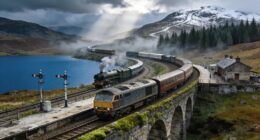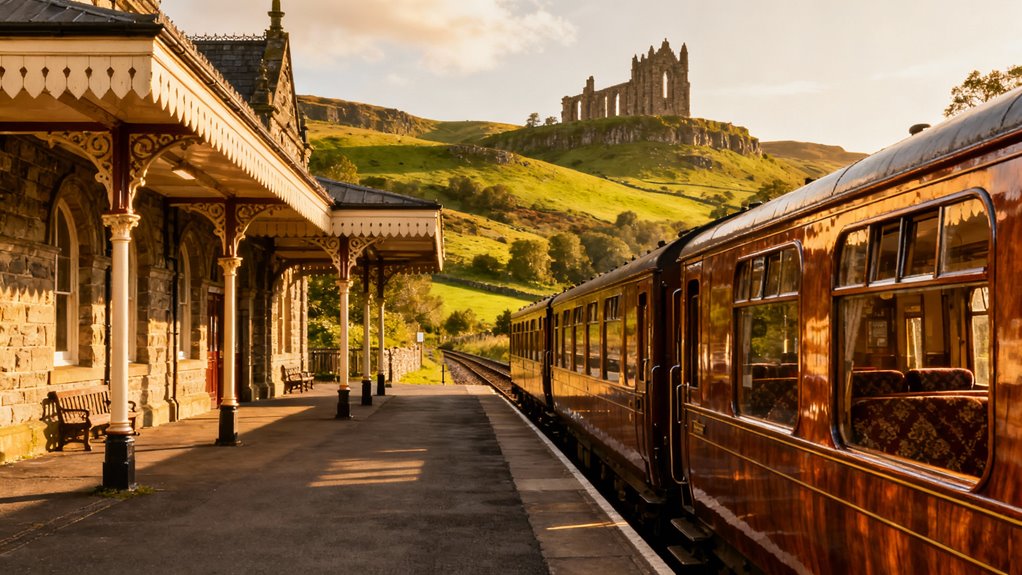

UNESCO has recognized several mountain railways as World Heritage sites for their engineering brilliance and stunning scenery. The Darjeeling Himalayan Railway climbs to 2,258 meters through dramatic Himalayan terrain. The Bernina Express traverses 196 bridges and 55 tunnels without rack-and-pinion technology, reaching 2,253 meters. The Semmering Railway, built in 1854, was the first railway to earn UNESCO status. These historic routes combine colonial-era engineering with breathtaking mountain vistas, tea gardens, and alpine glaciers. Each journey offers unique perspectives on landscapes that defined impossible construction challenges, and there’s more to each remarkable route. The UNESCO sites along the Rhine Valley showcase an equally impressive blend of cultural heritage and natural splendor. With charming towns dotting the banks, visitors can explore historic castles and vineyards that have thrived for centuries. Each site tells a story of the region’s rich history, offering travelers an unforgettable journey through time and beauty.
Route #1- The Darjeeling Himalayan Railway: Where Scenic Heritage Steam Railways Preserve Historic Mountain Traditions

Since 1881, a narrow gauge railway has been chugging up the Eastern Himalayas like it has something to prove.
The Darjeeling Himalayan Railway climbs from 100 meters to 2,200 meters across 88 kilometers of mountainous terrain—no small feat for what amounts to Victorian-era determination on rails. This 610mm gauge wonder uses six zigzag reverses and five loops because, apparently, straight lines are for quitters.
UNESCO recognized it in 1999 as the first hill passenger railway worldwide, which says something about its engineering ambition. Steam locomotives still operate on routes built during British colonial rule. The railway served as a model for similar developments worldwide, demonstrating how mountain transportation could reshape entire regions. The journey offers passengers spectacular views of Nordic landscapes and mountain vistas that rival some of the world’s most celebrated scenic routes. It’s one of only five railways worldwide to achieve World Heritage status, joining an exclusive club of historically significant rail networks. One of the highlights of this journey is the copper canyon railway experience, where the train maneuvers through stunning gorges and valleys that showcase breathtaking geological formations. Passengers are treated to a unique perspective of the rich flora and fauna that line the tracks, making each trip a memorable adventure. Travelers often speak of the exhilaration felt when crossing high-altitude bridges that offer panoramic views of this majestic landscape.
UNESCO’s 1999 designation honored Victorian-era audacity that somehow convinced steam locomotives to defy Himalayan slopes—and still does.
That said, the “Toy Train” reaches Ghoom station at 2,258 meters—India’s highest railway station—proving that Victorian engineering occasionally got things right. Even if the whole enterprise seems designed to thumb its nose at gravity.
Route #2- Why the Historic Bernina Express Spectacularly Traverses Alpine Glacier Routes as UNESCO World Heritage

How does a railway climb to 2,253 meters through the Alps without rack-and-pinion technology? The Bernina Express pulls it off with pure engineering audacity—though calling it “pure” might undersell the meticulous planning involved.
UNESCO recognized this 144-kilometer marvel in 2008 for outstanding technical achievement. We’re talking 196 bridges, 55 tunnels, and gradients hitting 7%. That makes it the world’s steepest adhesion railway, a title that’s as impressive as it sounds.
What’s remarkable is the timeline: just four years, built by 2,000 Italian workers. The route rockets from palm trees in Tirano to glaciers at Ospizio Bernina, a climate shift that feels almost surreal.
You’ll pass the iconic Landwasser Viaduct and Brusio’s circular viaduct along the way. The panoramic cars make the four-hour journey unforgettable, though “unforgettable” probably depends on whether you’re seated on the glacier side or not. Modern panoramic cars provide travelers with first-class comfort while showcasing the Alpine landscapes through expansive windows.
Even so, it’s a stunning example of Swiss precision meeting Alpine drama—engineering that appears to bend physics without actually breaking any rules. Operated by the Swiss Rhaetian Railway, the train connects mountain communities while delivering views of pristine lakes and ancient glaciers. The Bernina Express is part of Switzerland’s Grand Train Tour, which combines multiple panoramic trains, buses, and boats to showcase the country’s most spectacular destinations.
Route #3- Historic Semmering Railway: The World’s First Scenic Mountain Railway UNESCO Engineering Masterpiece

The Bernina Express might hold the steepest adhesion railway title, but the Semmering Railway? It wrote the book on mountain railways—literally the first of its kind.
Between 1848 and 1854, this 41-kilometer beast conquered 457 meters of Austrian Alps. We’re talking 15 tunnels and 16 viaducts here. Up to 20,000 workers hauled stone and blasted rock under Carl Ritter von Ghega‘s supervision—backbreaking work by any standard.
UNESCO handed it World Heritage status in 1998, the first railway ever recognized that way.
That said, it’s been running continuously since 1854, connecting Vienna and Graz without missing a beat.
What’s remarkable is that the engineering worked so well that the original infrastructure still carries modern trains today. No major overhaul needed—just the same tunnels and viaducts Ghega’s crews carved out over 170 years ago. While this historic railway maintains its original character, modern rail networks like Japan’s Shinkansen system demonstrate how high-speed rail technology has evolved to connect major cities with remarkable efficiency.
The route stretches from Gloggnitz to Mürzzuschlag, showcasing dynamic views across forests and mountain landscapes with visible railway special attributes like sharp bends carved into the terrain. Travelers can combine this experience with other scenic train journeys across Europe, where breathtaking vistas and historical landmarks await. Each journey offers a unique perspective of the diverse landscapes and cultures that define the continent. Whether traversing the Alps or winding through quaint villages, these rail experiences are unforgettable.
The eight municipalities along the route now collaborate on a management plan focused on conservation and sustainable development of the railway and its surrounding cultural landscape.
Route #4- How Scenic Mountain Landscapes Define Historic Mountain Panorama Journeys on UNESCO Heritage Railways

Mountains don’t just sit there looking pretty on these UNESCO heritage railways—they’re the entire point.
Darjeeling’s 83.9 km stretch slices through tea gardens and pine groves, though the gradients can shift dramatically over just a few kilometers.
Nilgiri throws 46 km of rack-and-pinion engineering at you—16 tunnels, 250 bridges, each one a small marvel of Victorian-era problem-solving.
Kalka-Shimla? Try 102 tunnels and 900 curves threading through the Shivalik Hills.
These aren’t gentle countryside rides. They’re steep gradients and rugged terrain with colonial-era guts on full display.
The panoramas appear to change entirely with the seasons—forests morph from monsoon green to autumn amber, and colonial stations emerge like time capsules frozen mid-century. On clear mornings, Darjeeling’s route reveals views of Mt. Kanchenjunga, India’s highest peak.
It’s breathtaking, sure. But it’s also why UNESCO designated them heritage sites between 1999 and 2008.
Matheran’s 21 km line adds another dimension with its unique embankments snaking from Neral at a punishing 1:20 gradient. Meanwhile, modern services like the Amtrak Cascades prove that scenic rail journeys continue to evolve with enhanced comfort while maintaining their visual appeal.
That said, the designation may have as much to do with the engineering audacity as the views themselves. When you’re clinging to a hillside at a 1-in-20 gradient, you tend to appreciate both.
Route #5- Heritage Tourism Economically Sustains the Scenic Historic Glacier Express UNESCO Alpine Experience

UNESCO recognition doesn’t just hand out plaques and warm feelings—it prints money. The Glacier Express pulls tourists from around the world to its Rhaetian Railway route, designated World Heritage back in 2008. Those panoramic windows overlooking Alpine engineering marvels? We’re talking 91 tunnels and 291 bridges that generate serious revenue streams. Ticket sales. Accommodations. On-board dining. The whole package.
Employment tends to spike across hospitality and transportation sectors when heritage tourism takes hold. Regional economies expand as tourist money flows through surrounding areas like melted glacial runoff—though measuring that exact economic impact can be tricky. Similar success stories emerge across North America, where VIA Rail’s iconic routes demonstrate how scenic train travel consistently drives tourism revenue.
On top of that, Glacier Express AG even snagged a Swisstainable Level 1 certificate, which appears to prove that green practices attract wallets too. The train’s deliberately slow speed of just 24 mph turns what could be criticized as inefficiency into a premium selling point that justifies higher ticket prices. The railway even features tilting glass technology to prevent drinks from spilling on steep inclines, adding another layer of comfort that keeps passengers coming back.
That said, the narrow-gauge railway launched way back in 1930 doesn’t just preserve history. It monetizes it. Whether that’s entirely good for the Alpine experience itself is another question, but the economic benefits seem hard to dispute.
Route #6- Scenic Narrow Gauge Railways Create Historic River Valley Railways Access on UNESCO Heritage Routes

Dozens of narrow gauge railways worldwide thread through river valleys and mountain passes where standard track simply won’t fit. Take India’s Nilgiri Mountain Railway—it climbs 1,877 meters using rack-and-pinion technology through 208 curves, a testament to engineering ambition.
The Darjeeling Himalayan Railway is equally impressive, ascending from 100 to 2,258 meters across 88 kilometers of 2-foot gauge track that snakes through some of the most challenging terrain imaginable.
Peru’s Central Railway hits 4,818 meters elevation, though not without thirteen zigzags and sixty-six tunnels to get there. Designed by Polish engineer Ernesto Malinowsky, the railway represented a crucial advancement during the Second Industrial Revolution. Ecuador’s Devil’s Nose section may be the most dramatic of all—workers literally dangled from ropes to build portions of it. The route rises 150 meters over just 1.47 kilometers through zigzagging tracks that engineer John Harman designed to overcome what many considered impossible terrain.
These lines weren’t just engineering challenges, though that’s often how we remember them. They were economic lifelines, connecting remote regions during colonial expansion and opening up territories that would have otherwise remained isolated. Modern high-speed trains like the Frecciarossa now offer similar connectivity but with radically different technology and comfort levels.
That said, their historical role is complicated—while they brought connectivity, they also served colonial interests in ways worth acknowledging.
Today most survive as UNESCO World Heritage sites or candidates for designation, preserved more for their cultural and engineering significance than their original economic purpose.
Route #7- Railway Preservation Actively Protects the Scenic Historic Bernina Railway’s UNESCO World Heritage Status

Preservation isn’t just about slapping a plaque on something old and calling it a day. The Rhaetian Railway’s Bernina line earned UNESCO World Heritage status in 2008 under cultural criteria (ii) and (iv), which represents real recognition.
But here’s the thing—actual work goes into maintaining 196 viaducts and bridges, plus 58 covered tunnels and galleries.
The RhB doesn’t just polish brass fittings. They incorporate modern technologies while keeping historical authenticity intact, though balancing those two isn’t always straightforward. Active conservation strategies appear to guarantee the 2,328-meter Bernina Pass route stays viable long-term.
On top of that, international collaboration between Switzerland and Italy helps protect this transnational treasure. The route connects Chur to Tirano, threading through over 120 kilometers of pristine Alpine landscape that demanded exceptional engineering solutions. The site encompasses 152.42 hectares with an extensive buffer zone that provides additional environmental protection.
Similar to how Scotland’s scenic railways connect diverse landscapes through expert engineering and careful route planning, the Bernina line demonstrates how railway preservation can protect both cultural heritage and natural beauty simultaneously.
It’s genuine preservation. Not performative heritage theater.
Did You Know
How Much Do Tickets Cost for UNESCO Heritage Train Routes?
UNESCO heritage train tickets range wildly. The Bernina Express runs CHF 33-66 for basic fares, though pass holders ride free with a CHF 30-38 reservation fee.
Machu Picchu trains? Way pricier—$140 to $950 USD roundtrip, depending on luxury level.
European panoramic routes start around €62 second class. UNESCO status cranks up demand, so book early.
Premium services cost substantially more, and peak season inflates everything.
What’s the Best Season to Photograph Scenic Heritage Railway Journeys?
Autumn and late spring deliver the goods for heritage railway photography. Golden foliage and soft light in September-October create contrast-rich shots, especially on mountain routes.
May-June works wonders too—wildflowers, green landscapes, vibrant backdrops.
Winter’s dramatic with snow and intense steam plumes, but crowds thin out.
Summer? Long daylight hours, sure, but packed with tourists fighting for the same vantage points.
Alpine UNESCO sites shine year-round, though monsoon season adds moody mist to Darjeeling’s charm.
Can Visitors Ride Steam Locomotives on All UNESCO Railway Routes?
No. Most UNESCO railway routes run modern electric or diesel trains, not steam locomotives.
Only India’s Mountain Railways—Darjeeling, Nilgiri, and Kalka-Shimla—maintain regular steam operations for tourists.
Rhaetian Railway? Electric trains.
Semmering? Modern rolling stock on an active mainline.
Bernina? Contemporary electric units.
The UNESCO designation recognizes engineering achievement and cultural landscape, not operational steam fleets.
Visitors wanting authentic steam experiences need to target those specific Indian heritage lines.
Which UNESCO Heritage Railway Offers the Steepest Mountain Gradient?
The Bernina Railway claims that title. It hits a maximum gradient of 7% while crossing the Swiss-Italian Alps—no rack system, just pure adhesion between wheels and rails.
That’s the steepest any UNESCO heritage train manages without mechanical assistance. The line climbs to 2,253 meters at Bernina Pass, maneuvering tight curves and extreme weather year-round.
Semmering tops out at a relatively gentle 2.5%, and India’s mountain railways don’t publish anything steeper than Bernina’s punishing grade.
Do Heritage Trains Operate Year-Round or Only During Tourist Seasons?
It depends on the line. UNESCO routes like Switzerland’s Rhaetian Railway run year-round as actual transport, not just tourist traps.
Smaller heritage railways? They’re seasonal—spring to fall, maybe weekends only.
Mountain lines get shut down by snow and avalanches, even the fancy ones.
Tourist-focused routes follow the money, adding summer services when crowds show up.
If locals need it for commuting, it probably runs all year.
Parting Shot
These seven UNESCO routes prove that trains aren’t just about getting somewhere. They’re about the journey itself. Mountain passes, glaciers, river valleys—all accessible because some 19th-century engineers decided to do the impossible. Sure, millions of tourists crowd these tracks annually, but that’s the point. Heritage railways keep history alive while delivering views that justify the hype. Preservation efforts guarantee future generations get the same experience. Sometimes old really is better. The panama canal railway unique journey offers an unparalleled glimpse into the rich history and stunning landscapes of Central America. Travelers can witness the intricate engineering that connects two oceans while enjoying breathtaking views of tropical rainforests and vibrant wildlife. Each ride becomes a memorable adventure, highlighting the importance of preserving these unique routes for future explorers.