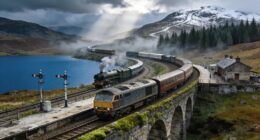
How World’s Most Iconic Train Routes Like the Qinghai-Tibet Railway Defy Engineering Limits
The Qinghai-Tibet Railway: this engineering marvel crosses 550 km of permafrost at 5,072 meters elevation. China Railway constructed 675 bridges to bypass unstable frozen ground. The track floats above terrain that shifts with seasons.
- Qinghai-Tibet Railway: China’s Ministry of Railways engineered thermosiphon technology to keep permafrost frozen beneath tracks. Golmud serves as the departure station for most journeys to Lhasa.
- Bernina Express: Rhaetian Railway operates this Swiss icon through 7% grades. The train climbs using pure wheel-to-rail adhesion. No rack system assists the ascent. Tirano and St. Moritz bookend this UNESCO World Heritage route.
- Gotthard Base Tunnel: AlpTransit Gotthard AG bored 57 km through Swiss Alpine bedrock. Workers from Herrenknecht AG operated tunnel boring machines for nearly two decades. This passage connects Erstfeld to Bodio beneath the Alps.
Engineers negotiate with mountains. They do not fight them. The Bernina route bends around peaks rather than through them. The Qinghai line elevates above permafrost rather than disturbing it. The Gotthard tunnel follows geological seams rather than forcing direct paths.
Local operators like Tibet Train Tours and Swiss Travel System guide travelers through these corridors. Glacier Express complements the Bernina route through similar Alpine terrain.
Fun Activity To Try: Book a window seat on the Qinghai-Tibet Railway’s pressurized carriages and photograph wild Tibetan antelope herds crossing beneath the elevated trackway near Tuotuo River station.
Key Points
- The Qinghai-Tibet Railway crosses 550 km of permafrost using thermosiphon pipes and 675 bridges to minimize ground disturbance.
- Tanggula Station operates at 5,068 m elevation with onboard oxygen systems and doctors to protect passengers from altitude sickness.
- The Gotthard Base Tunnel’s TBMs bored 57 km through Alpine rock under 2,000+ meters of overburden over nearly two decades.
- The Bernina Express climbs 7% gradients without rack rails, using spiral loops and tight curves to reach 2,253 m elevation.
- The Darjeeling Himalayan Railway ascends 2,100 m over 88 km using zigzags and loops while enduring 3,000 mm annual monsoon rainfall.
The Qinghai-Tibet Railway Crosses the Tibetan Plateau at 5,072m Through Extreme Terrain Engineering

When engineers decided to lay track across the Tibetan Plateau, they weren’t just building a railway. They were picking a fight with nature.
And it’s hard to overstate how audacious that sounds.
The Qinghai-Tibet Railway hits 5,072m at Tanggula Pass Station. That’s higher than most people will ever stand in their lives. At these elevations, oxygen levels drop to 50–60% of sea level, making every breath a challenge for workers and passengers alike.
The Golmud-Lhasa section? Over 550km of permafrost, which likely presented some of the most punishing construction challenges imaginable.
Building across 550km of frozen, shifting ground—the kind of terrain that breaks ordinary engineering assumptions.
Ground that freezes and thaws, shifts and buckles—not exactly what you want beneath steel rails. To minimize contact with this unstable terrain, engineers constructed 675 bridges totalling 160 km across the route.
Their answer was a toolkit of permafrost construction methods.
Raised embankments to keep the track elevated.
Thermosiphon pipes that appear to work by passively drawing heat away from the ground.
Thermal regulation systems designed to keep everything stable when temperatures swing from brutal cold to, well, slightly less brutal cold.
Even so, one could argue these solutions were as much about humility as engineering bravado—acknowledging the plateau’s power rather than trying to overpower it outright.
Brutal conditions. Remarkable solutions. This railway stands as a testament to China’s extensive rail network, which has grown to become the world’s longest high-speed rail system.
Tanggula Station Operates as the World’s Highest Railway Platform at 5,068m Elevation

At 5,068m above sea level, Tanggula Station claims the title of world’s highest railway platform. Perched on the Tibetan plateau, this crossing stop opened in 2006—carved into extreme terrain where permafrost engineering challenges likely pushed builders to their limits. The station stretches an impressive 1.25 kilometres long, covering over 77,000 square metres of this remote landscape.
Here’s the thing, though. Passengers can’t actually get off. The altitude appears to be that unforgiving.
Even so, the waiting room comes equipped with oxygen supply systems to help ward off altitude sickness. Professional doctors are arranged on trains to provide emergency medical response for passengers experiencing health issues at these extreme elevations. On top of that, the whole setup seems to acknowledge something quietly obvious: high altitude railway journeys demand serious respect. This remarkable station sits along a route served by China’s high-speed rail network, which has become the world’s largest and connects nearly every major city across the country.
How the Trans-Siberian Railway Stabilizes 1,000km of Track Through Frozen Permafrost Terrain

Stabilizing a thousand kilometers of track through frozen ground sounds like a nightmare—and honestly, it probably is. The Trans-Siberian Railway manages exactly that, though the engineering behind it appears to be a constant negotiation with nature rather than any kind of permanent fix.
Permafrost construction here relies on raised embankments, crushed stone ballast, and serious drainage systems. During the original construction, workers moved 100 million cubic meters of rock to establish the railway’s foundations across this unforgiving terrain.
That said, keeping things cold matters just as much as managing water.
Thermosyphons—essentially passive cooling pipes—work to maintain ground temperatures, which seems almost counterintuitive until you realize that thawing is the real enemy here.
Climate adaptation isn’t optional.
Siberia’s warming fast, and what worked decades ago may not hold up much longer. The original construction, which relied on shallow ballast and lightweight rails, created vulnerabilities that engineers still contend with today. Unlike routes such as the Bernina Express through the Swiss Alps, which benefit from UNESCO heritage protections and stable mountain geology, the Trans-Siberian faces an ever-shifting foundation.
On top of that, track stabilization means constant monitoring.
Crews checking.
Sensors measuring.
Continuous welded rails help reduce stress points, but even so? It’s an endless battle against thawing soil, one that’s likely to intensify as temperatures keep climbing.
Whether current methods can keep pace remains an open question.
Bernina Express Navigates 7% Alpine Gradients Without Using Rack Rail Technology

Climbing a 7% gradient without rack rail sounds like a bad idea—until someone actually pulls it off. The Bernina Express does exactly that, relying on adhesion-only traction across steep Alpine terrain.
How? The answer appears to lie in clever engineering rather than brute force. Spirals and loops do the heavy lifting here.
Take the Brusio Circular Viaduct—it literally circles back on itself, stretching out what would otherwise be an impossibly steep climb into something manageable. Meter-gauge tracks hug those tight curves like they were made for them. And when it comes to the brutal descents, service and emergency braking systems seem to handle the job well enough. No rack teeth required.
That said, you could argue this approach trades simplicity for some seriously complex route design—whether that’s elegant or excessive probably depends on who you ask. The route ultimately reaches Ospizio Bernina at 2,253 meters, making it the highest regular train station in Europe. The engineering achievement is so significant that the majority of the route has been designated a UNESCO World Heritage site as part of the Rhaetian Railway in the Albula/Bernina landscape. This iconic journey is featured as part of the Grand Train Tour of Switzerland, which combines panoramic trains with boats and buses to showcase the country’s most spectacular landscapes. Among these breathtaking views of Darjeeling Himalayan Railway, travelers can witness the dramatic landscapes that stretch across the mountains and valleys. The journey is not only a visual delight but also a journey through rich cultural heritage, reflecting the unique blend of history and modernity that the region has to offer. Each curve of the track reveals hidden gems, making it a must-visit for anyone seeking an unforgettable adventure.
Why the Landwasser Viaduct Represents Peak Bridge Engineering With 65m Curved Stone Arches

Stone arches curving through thin Alpine air at 65 meters up—that’s the Landwasser Viaduct in short.
Built in just 13 months without scaffolding.
Yeah, seriously.
Workers used steel towers to stack limestone piers back in 1902, which still seems almost reckless by today’s standards.
Steel towers, limestone blocks, zero scaffolding—1902 builders worked with a boldness that would make modern safety inspectors faint.
Six arches sweep along a 100-meter curve before the track disappears straight into a cliff-face tunnel—a transition that appears to defy what stone should be asked to do.
On top of that, the whole thing still handles 30 trains daily, suggesting the original engineering was likely overbuilt in the best possible way.
The viaduct spans the Landwasser river as part of the Albula Line, connecting it to a broader network of Alpine rail engineering. Its exceptional design earned the Rhaetian Railway recognition as a UNESCO World Heritage site. Today, the Bernina Express carries passengers across this stunning structure, offering panoramic views of the curved limestone arches and surrounding Alpine scenery.
That said, calling it peak railway innovation might overlook quieter structural achievements elsewhere.
Even so, few bridges stage their drama quite this well.
Gotthard Base Tunnel Construction Methods Bored 57km Through Solid Alpine Bedrock

When engineers decided to punch 57 kilometers through the Swiss Alps, they didn’t just grab one tool and hope for the best.
That would’ve been madness.
The Gotthard Base Tunnel needed twin single-track tubes connected by cross-passages—a layout that appears to have offered the best balance of safety and capacity, though it meant essentially boring two parallel tunnels through some of the most unforgiving rock on the planet.
Open gripper TBMs did the heavy lifting, chewing through solid bedrock where conditions allowed. The massive tunnel drill featured a 10-meter head capable of advancing up to 30 meters per day through solid rock.
But rock, as any tunneller will tell you, rarely cooperates for long.
Where things got sketchy—unstable zones, unexpected geology—conventional tunnelling methods likely proved more adaptable. In the Faido section, crews faced overburden exceeding 2,000 meters at the contact zone between Leventina and Lucomagno gneiss.
Probe drilling every meter kept crews a step ahead of nasty surprises.
Water intrusions.
Fault lines.
The mountain fighting back.
Brutal work.
Methodical too.
And spanning 57 kilometers of Alpine bedrock, there’s a reason it took nearly two decades to complete. The achievement earned this stretch of the Alps UNESCO World Heritage status alongside Austria’s Semmering Line, recognizing these routes as extraordinary feats of railway engineering.
Darjeeling Himalayan Railway Engineering Withstands 3,000mm Annual Monsoon Rainfall

Three thousand millimeters of rain. That’s what the Darjeeling Himalayan Railway stares down every monsoon season—though the actual figures likely vary year to year.
This heritage route climbs from 100 meters to 2,200 meters across just 88 kilometers, which is, by any measure, an ambitious ask of nineteenth-century engineering. Franklin Prestage’s proposal was accepted in 1879, launching construction of this remarkable line.
A 2,100-meter climb in under 90 kilometers—nineteenth-century ambition etched into the mountainside.
Those steep gradient rail passages are unforgiving. Gradient design here isn’t some luxury consideration—it’s what keeps the whole thing from sliding down the mountain.
Six zigzags and three loops work to tackle the gradient challenges while steering clear of the worst terrain obstacles.
Whether this represents the optimal solution or simply the most practical one given the era’s constraints is worth considering.
Even so, there’s something stubborn about the engineering philosophy at play here. Extreme weather engineering that refuses to concede ground. While this mountain railway spans just 88 kilometers, India’s rail network also includes routes like the Vivek Express that stretch over 4,200 kilometers across eight states.
These heritage routes, battered season after season, somehow keep running.
Frequently Asked Questions
Can Passengers With Heart Conditions Safely Travel on High-Altitude Railway Routes?
Passengers with serious heart conditions face increased risks on high-altitude railways like the Qinghai-Tibet route. Medical experts recommend those with unstable cardiac disease, pulmonary hypertension, or recent cardiac events consult physicians before traveling above 2,500 meters.
How Do Pressurized Train Carriages Maintain Oxygen Levels at Extreme Elevations?
Pressurized carriages maintain oxygen levels through dual systems: HVAC units inject oxygen-enriched air to raise cabin concentration to approximately 23%, while individual outlets at each seat provide supplemental oxygen for passengers experiencing altitude discomfort.
What Wildlife Protection Measures Exist Along Mountain Railway Corridors Worldwide?
Mountain railway corridors employ exclusion fencing, wildlife overpasses and underpasses, reduced train speeds at collision hotspots, vegetation management to minimize attractants, and dedicated migration corridors—such as the Qinghai-Tibet Railway’s 33 wildlife underpasses.
How Much Do Tickets Cost for Iconic Scenic Railway Journeys?
Ticket prices for iconic scenic railways vary significantly by class and distance. The Qinghai-Tibet Railway ranges from 224 yuan for hard seats to 1,468 yuan for soft sleepers, depending on departure city and berth selection.
Are Overnight Sleeping Accommodations Available on These Extreme Terrain Train Routes?
Yes, overnight sleeping accommodations are available. The Qinghai-Tibet Railway offers soft sleeper cabins with four private berths and hard sleeper compartments with six open berths, both including bedding, oxygen outlets, and pressurized carriages for high-altitude comfort.
Parting Shot
These railways weren’t built by people who understood the word “impossible.” From oxygen-starved platforms at 5,068 meters to tracks frozen into Siberian permafrost, engineers basically told nature to move over. The results speak for themselves. Curved viaducts, 57-kilometer tunnels through solid rock, monsoon-battered mountain lines. All still running. Sometimes human stubbornness wins. And honestly, that’s pretty impressive.