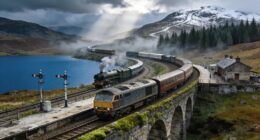
7 Most Iconic Train Routes Including the TranzAlpine That Every Enthusiast Must Experience
The world’s most iconic train routes: journeys that define rail travel excellence. These seven railways deliver landscapes no highway can match. Among these, scenic train routes through Switzerland stand out for their breathtaking views of the Alps and picturesque villages. Travelers find themselves immersed in a landscape of rolling hills and vibrant green valleys that change with the seasons. With each bend in the track, a new panorama unfolds, making every journey an unforgettable adventure.
TranzAlpine: KiwiRail operates this four-hour crossing through New Zealand’s Southern Alps. The open-air observation carriage frames Arthur’s Pass National Park. Christchurch serves as the eastern terminus. Greymouth anchors the west.
Glacier Express: Rhaetian Railway runs this Swiss legend at 24 mph. Slow travel is the intention. The route connects Zermatt to St. Moritz across 291 bridges.
Trans-Siberian Railway: Russian Railways commands 9,289 kilometers. Eight time zones separate Moscow from Vladivostok. Commitment defines this passage.
- Bernina Express — UNESCO World Heritage status distinguishes this Swiss-Italian crossing through the Engadin Valley
- Rocky Mountaineer — This Canadian luxury train spreads British Columbia wilderness across two daylight-only days
- Venice Simplon-Orient-Express — Belmond operates restored 1920s carriages between London and Venice
Each route offers distinct terrain. The TranzAlpine delivers braided rivers and beech forests. The Glacier Express showcases the Matterhorn. Rocky Mountaineer reveals grizzly bears along the Fraser River.
Local operators enhance these experiences. Christchurch station cafes serve flat whites before departure. Zermatt mountain guides meet Glacier Express passengers. Trans-Siberian stops allow Irkutsk market visits near Lake Baikal.
Rail photography demands patience. Golden hour light transforms ordinary windows into frames.
Fun Activity To Try: Book a TranzAlpine journey during New Zealand’s autumn season and photograph the Southern Alps’ golden tussock grasslands from the observation carriage.
Key Points
- The seven iconic routes span four continents, ranging from New Zealand’s compact TranzAlpine to the week-long Trans-Siberian crossing eight time zones.
- Engineering marvels define these journeys, including the Glacier Express’s 291 bridges, Bernina Express’s spiral viaduct, and TranzAlpine’s 8.5 km Otira Tunnel.
- Premium experiences vary from Rocky Mountaineer’s GoldLeaf Service with open-air platforms to Glacier Express’s 20-seat Excellence Class with concierge service.
- TranzAlpine offers an accessible alpine crossing in under five hours with open-air observation carriages ideal for unobstructed photography.
- These routes prioritize scenic immersion over speed, with the Glacier Express averaging just 24 mph through UNESCO World Heritage landscapes.
Route #1 — TranzAlpine Scenic Railway Crosses New Zealand’s Southern Alps in Four Hours

Scenic train rides that actually deliver on the hype? The TranzAlpine doesn’t mess around. This Southern Alps crossing stretches 223 kilometers from Christchurch to Greymouth—a journey that takes roughly five hours, give or take.
You’ll pass through Arthur’s Pass, watch the Waimakariri River carve its way through gorges below, and those panoramic carriages appear to genuinely earn their reputation. Sixteen tunnels. Ten bridges. The route reaches its highest point at 920 meters elevation as you cross through Arthur’s Pass. The Staircase Viaduct alone rises up to 75 meters high, giving you vertigo-inducing views of the landscape below.
For travelers seeking similar alpine panoramas, Switzerland’s Bernina Express offers UNESCO World Heritage scenery through its own mountain crossings.
That said, whether this qualifies as a morning commute likely depends on your tolerance for staring at mountains instead of spreadsheets. Not a bad trade, though.
Route #2 — Glacier Express Panoramic Journey Spans Eight Hours Through Swiss Alpine Valleys

The Glacier Express crawls through the Swiss Alps at roughly 24 mph—and somehow that’s the whole point. Connecting Zermatt to St. Moritz across 291 km of narrow-gauge track, this eight-hour panoramic journey appears to embrace slowness as a feature rather than a flaw. Those luxury carriages with their oversized scenic windows? They’re designed specifically for drinking in Matterhorn views. Absurdly slow, yes. Even so, spectacular. Excellence Class limits capacity to just 20 passengers, offering single window seats, gourmet multi-course meals, and personal concierge service for those seeking the ultimate luxurious experience. Along the way, passengers can witness the dramatic Rhine Gorge, often called Switzerland’s “Grand Canyon,” stretching between Ilanz and Reichenau. The Glacier Express is featured as part of the Grand Train Tour of Switzerland, a comprehensive journey that combines multiple panoramic trains, buses, and boats to showcase the country’s cultural sites and UNESCO World Heritage locations.
| Feature | Glacier Express Stats |
|---|---|
| Bridges | 291 crossings |
| Tunnels | 91 total |
| Summit | Oberalp Pass, 2,033 m |
Route #3 — Bernina Express Alpine Crossing Features UNESCO World Heritage Landscapes

Switzerland apparently wasn’t done showing off.
The Bernina Express delivers UNESCO World Heritage landscapes on what feels like a silver platter — though whether any single route truly captures the Alps is probably up for debate.
This narrow gauge adventure climbs to 2,253 meters without rack assistance.
Just pure engineering stubbornness, really.
What strikes you most is how the alpine scenery shifts from glaciers to palm trees.
It sounds impossible, and yet.
Photography opportunities appear endless, though your phone storage may disagree.
The Brusio spiral viaduct alone likely justifies the trip for most travelers — a piece of railway architecture that seems to defy common sense.
Among heritage routes and scenic railways, mountain viaducts don’t get more dramatic than this.
That said, drama is subjective when you’re white-knuckling the armrest at 2,000 meters.
The four-hour journey between Chur and Tirano threads through 55 tunnels and crosses 196 bridges, showcasing engineering marvels that rival the scenery itself.
The route rolls over the 65-metre-high Landwasser Viaduct, another gravity-defying structure that has become an icon of Swiss rail engineering.
The journey extends beyond Swiss borders, as the Bernina Express spans both Switzerland and Italy in a cross-border alpine spectacle.
Route #4 — Rocky Mountaineer Heritage Rail Delivers Two-Day Canadian Rockies Exploration

Rocky Mountaineer doesn’t just traverse the Canadian Rockies—it pretty much owns the experience. This scenic mountain railway transforms what could be ordinary passenger travel into something borderline theatrical. You’re talking panoramic express journeys through Fraser Canyon, past Hell’s Gate, over the Continental Divide. That said, “theatrical” might undersell it.
| Route Feature | What You See | Duration |
|---|---|---|
| Spiral Tunnels | Engineering marvel | Day 2 |
| GoldLeaf Service | Open-air viewing platform | All-daylight |
| Route landscapes | Bears, eagles, mountain goats | Continuous |
The Spiral Tunnels alone appear to justify the trip for engineering enthusiasts. GoldLeaf Service puts you on an open-air viewing platform—all daylight hours, no overnight travel cramping the scenery. And wildlife? Bears, eagles, mountain goats seem to show up with surprising regularity along the route, though sightings naturally vary.
Observation car journeys here are likely unmatched. For travelers seeking even more dramatic scenery, the Rainforest to Gold Rush route stands as the longest Rocky Mountaineer journey, connecting Vancouver to Jasper via Whistler through lush rainforests and historic gold mining towns. The daylight-only service operates from mid-April to mid-October, with late September offering spectacular fall foliage views along the mountain passes. Even so, two days on any train isn’t for everyone, and the premium pricing may give budget travelers pause. Trips start at $2,245 for SilverLeaf Service in 2025, with meals, transfers, and overnight hotels included in that base price.
Route #5 — Trans-Siberian Railway Transcontinental Line Spans 9,289 Kilometers Across Two Continents

Spanning 9,289 kilometers from Moscow to Vladivostok, the Trans-Siberian Railway doesn’t just cross Russia—it basically *is* Russia, stretched out on tracks.
This transcontinental line passes through eight time zones, which still seems almost absurd when you stop to think about it. Construction began in 1891 under Emperor Alexander III, with an estimated 60,000 workers involved in building this monumental route.
The journey takes roughly six to seven days, give or take, winding through taiga forests, open steppe, and along the shores of Lake Baikal. Along the way, the route passes through 87 towns and cities and crosses 16 major rivers.
That said, whether this counts as the ultimate train experience or an endurance test likely depends on your tolerance for confined spaces.
For railway tourism devotees, though, these rail expeditions appear to represent something close to the pinnacle of train travel—even if your legs might disagree by day four. Like other epic journeys from the Scottish Highlands to the Bernese Alps, it offers travelers the chance to discover cultural and historic highlights while covering vast distances by rail.
Route #6 — TranzAlpine Coast-to-Coast Passage Links Christchurch to Greymouth Through Arthur’s Pass

From Russia’s week-long marathon across eight time zones to something far more compact — New Zealand’s TranzAlpine delivers a coast-to-coast alpine crossing in under five hours.
The Midland Line carries passengers out of Christchurch, rolling across the Canterbury Plains before punching through the 8.5-kilometer Otira Tunnel and dropping down into Greymouth on the West Coast. From there, bus connections extend to Franz Josef, Fox Glacier, Queenstown, and Milford Sound for those continuing south.
Arthur’s Pass appears to mark the route’s alpine high point, though the drama builds steadily on either side. Open-air viewing decks allow photographers to capture the Southern Alps without glass reflections dulling the shots. Like Norway’s Bergensbanen crossing stunning Nordic landscapes, this route delivers concentrated mountain scenery in a single day. Quick, compact, and — for those who prefer their scenery concentrated rather than sprawling — possibly the more satisfying format. That said, brevity cuts both ways. What you gain in efficiency, you may lose in slow immersion.
Route #7 — TranzAlpine Observation Carriage Offers Open-Air Photography of Alpine Scenery

Standing on the TranzAlpine’s open-air observation carriage feels a bit like cheating, honestly.
The TranzAlpine’s observation carriage feels like an unfair advantage—pure mountain air, zero barriers, all the views.
No window glare ruining your shots.
Nothing between you and the Southern Alps but cold mountain air.
The deck sits completely exposed—wind, rain, whatever the weather throws at you.
New Zealand railways clearly aren’t interested in half measures here.
This feature likely gives South Island tourism a genuine boost, and it’s easy to see why.
Beech forests blur past in streaks of green.
Historic railway corridors unfold at a pace that actually lets you take it in.
Unlike express trains, speed drops at the scenic highlights—a small detail that makes all the difference for photographers.
The TranzAlpine has become a social media icon largely because those unobscured open-air shots translate perfectly to online sharing.
That said, the exposure to elements may not suit everyone, particularly on those unpredictable alpine weather days.
The railway recommends bringing warm clothes and sunglasses to prepare for the outdoor conditions.
The relaxed pace allows passengers to truly appreciate the scenic views that make train travel such an enjoyable alternative to faster modes of transport.
Ridiculous, really.
In the best possible way.
Frequently Asked Questions
What Is the Best Season to Experience These Iconic Train Routes?
Late spring through early autumn offers ideal conditions for most iconic routes. The TranzAlpine peaks November–March, European alpine trains favor June–September, while northern routes require December–March for aurora viewing experiences.
How Far in Advance Should Tickets Be Booked for Peak Travel Periods?
For peak travel periods, tickets should be booked two to four weeks in advance, with mid-summer departures often requiring reservations four or more weeks ahead. Premium seating and group bookings necessitate even earlier planning.
Are Meal Packages Included in Standard Ticket Prices for These Journeys?
Meal inclusion varies significantly across iconic routes. Luxury services like Venice Simplon-Orient-Express and Rovos Rail typically bundle gourmet dining, while scenic journeys such as TranzAlpine and Glacier Express offer onboard café purchases separately from standard fares.
Can Passengers Disembark at Intermediate Stops During These Scenic Rail Journeys?
Passengers may disembark at intermediate stops on these scenic rail journeys, provided stations are specified during booking. However, stops are demand-dependent, and travelers must reboard before departure to avoid forfeiting their remaining journey segment.
What Luggage Restrictions Apply Across These Different Iconic Train Routes?
Luggage policies vary significantly across iconic routes. TranzAlpine permits approximately 23 kg checked plus carry-on, Rocky Mountaineer allows only a small daypack onboard, while Machu Picchu trains restrict passengers to 8-12 kg backpacks or carry-ons.
Parting Shot
These seven routes represent railway travel at its finest. From the TranzAlpine’s dramatic Southern Alps crossing to the Trans-Siberian’s epic continental journey, each delivers something trains do best—turning the trip into the actual experience. No airports. No highway monotony. Just windows, wheels, and landscapes that actually deserve attention. Train enthusiasts already know this. Everyone else is just missing out.