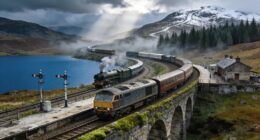
Historic mountain railways like the Mount Washington Cog Railway achieve jaw-dropping altitude gains through engineering that seemed impossible in 1869. The railway conquers 3,700 vertical feet to reach the Northeast’s highest summit at 6,288 feet, grinding up gradients averaging twenty-five percent—with sections hitting a brutal 37.41 percent. Rack and pinion systems grip center rails where normal wheels would slip helplessly beyond ten percent grades. Steam locomotives with slanted boilers and modern biodiesel engines haul passengers through climate zones from subalpine forests to bare rock, offering ninety-mile views that justify the premium ticket prices. The journey reveals how vintage railways turned critics’ declarations of impossibility into operational reality.
Experience Vintage Mountain Railway Journeys Ascending to 6,288-Foot Summit

How does a railway conquer a mountain so steep that critics once called it impossible? The Mount Washington Cog Railway proved them wrong in 1869, kicking off vintage mountain railway journeys that still thrill riders today.
These historic cog railway adventures climb 3,700 vertical feet to reach a 6,288-foot summit—the Northeast’s highest peak.
The heritage alpine route experiences showcase authentic steam powered ascents. That said, you’ll also find modern biodiesel locomotives making the climb, both traversing preserved steep gradient operations that hit up to 37%.
Classic high altitude rail trips cover three miles of scenic routes, passing through multiple climate zones along the way. Like Canada’s VIA Rail routes that traverse Ontario’s forests and mountain landscapes, these journeys offer travelers spectacular natural vistas throughout the ascent. The railway has maintained continuous operation since 1869, with only brief interruptions during the World Wars. Pioneer Sylvester Marsh transformed inventor Walter Aiken’s vision into reality, developing what became the world’s first mountain climbing railway. On top of that, the experience appears to be among the most extreme mountain railway excursions you can take. Period.
Summit Stations Crowning the Northeast’s Highest Peak Define Historic Train Expedition Goals

After conquering three miles of near-vertical track, the Mount Washington Cog Railway deposits passengers at 6,288 feet—the highest point in the entire Northeast.
These historic summit train expeditions culminate at the Sherman Adams Visitor Center, where rooftop observation decks reveal vistas that may stretch ninety miles to the Atlantic on clear days.
The railway’s cog wheel technology navigates steep gradients reaching thirty-seven percent—apparently the second-steepest globally.
That said, what makes these vintage tourist excursions memorable isn’t just the engineering feat. Passengers arrive at multiple destinations: the Tip Top House museum, a weather observatory offering educational tours, and scenic viewpoints spanning three climate zones. The summit also recorded the highest wind gust on Earth at 231 mph, adding to the extreme conditions visitors may encounter.
The 1853 hotel-turned-museum and continuously staffed meteorology lab transform these arrivals into something beyond typical sightseeing. A unique Mount Washington post mark awaits visitors who send postcards from the summit Post Office.
Unlike Canada’s transcontinental overnight rail journeys that span multiple days with sleeper accommodations, this mountain railway offers a concentrated high-altitude adventure within hours.
Even so, the experience depends heavily on weather conditions at the summit, which can shift dramatically within minutes.
How Do Preserved Steep Gradient Operations Navigate Average 25 Percent Grade Challenges?

When the Mount Washington Cog Railway‘s engineers laid out track sections averaging twenty-five percent grade—with Jacob’s Ladder hitting a jaw-dropping 37.41 percent—standard adhesion technology simply wasn’t going to cut it. Rack systems became non-negotiable. Cog wheels grip center rails to prevent catastrophic slippage during those brutal elevation climbs, and honestly, there’s no real alternative when you’re dealing with slopes this aggressive.
Heritage operations today maintain rigorous braking systems that combine mechanical rail brakes with dynamic controls—absolutely critical for descent safety. That said, the hardware is only part of the equation. Operational procedures dictate strict speed limits and mandatory brake checks. No shortcuts allowed when passenger safety hangs in the balance, period.
On top of that, historic infrastructure like this demands constant vigilance. Aging systems, weather exposure, and the sheer mechanical stress of moving trains up near-vertical grades means maintenance schedules are more demanding than your typical operation. While these heritage railways face unique engineering challenges, modern rail travel continues to demonstrate remarkable energy efficiency compared to other transportation modes. In contrast, adhesion railways like the Cass Scenic Railway manage steep non-electrified gradients reaching 1 in 9 without rack assistance, relying purely on friction between wheels and rails. The steepest gradient recorded at the Lickey Incline reaches 1 in 37.7 over approximately two miles, frequently requiring banking locomotives to assist heavily loaded trains up the challenging slope.
This isn’t your suburban commuter line where a minor oversight might cause a delay. Here, the stakes are considerably higher.
Enjoy Heritage Alpine Route Experiences Through Dramatic White Mountain Terrain

Beyond the mechanical wizardry of gripping steep grades lies the actual point of riding this thing—the scenery is legitimately spectacular.
Heritage services traverse White Mountain National Forest, revealing Presidential Range peaks and alpine scenery that shifts dramatically with altitude.
Restored rack railway services climb through subalpine forest into krummholz, then bare rock above treeline at 5,000 feet. The transition happens faster than you’d expect.
Vintage operations offer views stretching into Maine, and on a clear day those vistas appear nearly endless. Educational programs highlight the Appalachian Trail snaking across ridges, though let’s be honest—most passengers are here for the views, not the ecology lesson.
Mountain railways remain engineering marvels, sure. That said, passenger services exist because people pay to see this terrain—not just cog teeth grinding uphill. Like other celebrated panoramic alpine views found on Switzerland’s Glacier Express and Bernina Express, these elevated perspectives transform the travel experience from mere transportation to scenic immersion. The iconic routes of the Glacier Express showcase a breathtaking blend of nature and engineering prowess. As passengers glide through the Swiss Alps, they are treated to panoramic views of majestic mountains, charming villages, and sparkling lakes that create unforgettable memories. Each journey highlights the rich tapestry of landscapes that makes this region a traveler’s paradise.
The mechanics are impressive, but they’re really just the delivery system for what matters: getting you up to where the landscape opens up in ways that feel almost improbable. The route ascends 3,600 feet total from the Marshfield Base Station to the summit platform. Mesonet stations installed at intervals along the vertical profile now track weather patterns that vary dramatically between the east and west faces of the mountain.
Rack and Pinion Systems Engineering Solutions Conquer Impossible Slopes on Historic Cog Railways

Standard railways hit a wall around 7–10% gradient—physics won’t let wheels grip steeper slopes without slipping backward or losing control on descents.
That’s where rack and pinion systems came in, meshing cog wheels with toothed rails to tackle what seemed impossible. Mount Washington’s Jacob’s Ladder section, at 37.41%, stands as proof of what these systems could achieve.
Before this engineering breakthrough, hauling tourists up those kinds of slopes simply wasn’t happening.
These safety systems transformed mountain passenger transport entirely. Vintage locomotives that would’ve been useless on extreme grades suddenly became workable.
Even so, keeping these tourist attractions running takes serious commitment. Preservation efforts battle brutal operating challenges—ice, snow, and exposed alpine conditions that absolutely punish equipment. On top of that, maintaining century-old technology isn’t exactly straightforward.
The Marsh rack design from 1869 still works today, which appears to prove that some engineering doesn’t need improvement.
That said, “doesn’t need improvement” might be overstating it—the design’s longevity likely speaks more to its clever simplicity than perfection. Modern high-speed trains demonstrate how rail technology has evolved dramatically in other applications, achieving remarkable efficiency and passenger comfort on conventional tracks.
Systems like Locher’s design pushed boundaries even further, managing 48 percent inclination where other rack systems couldn’t handle the grade. The Abt system from 1885 became particularly widespread, valued for its cost-effective manufacturing and lower steel requirements compared to competing designs.
Either way, these historic cog railways remain remarkable examples of solving problems that standard rail technology couldn’t touch.
Ride Vintage Locomotives Continuously Operating Since 1869 for Authentic Steam Powered Ascents

The Mount Washington Cog Railway has been running steam locomotives up the mountain since 1869—continuously, though war-time interruptions did halt service temporarily.
What makes these trains special is their authenticity: some are over a century old and still operate with slanted boilers designed to handle 37% grades. When you ride, you’re getting the real thing. Coal smoke fills the air, the whistle blasts, cinders drift down—it’s genuine period train operations, not some sanitized theme park version.
P.T. Barnum rode in 1869 and apparently called it “The Second Greatest Show on Earth,” which speaks to its cultural and tourism impact at the time.
That said, what really matters here is the technical continuity. These aren’t replicas. The railway has preserved the actual engineering from another era, keeping it operational through constant maintenance and expertise. You’re watching historic railway engineering in action, right up to the summit station where presidents once arrived on these antique funicular trains and stepped into the thin mountain air. Like other scenic routes that showcase breathtaking natural landscapes, this railway combines spectacular mountain views with authentic historical transportation.
On top of that, the slanted boiler design itself is fascinating—a specific solution to an extreme problem that most railways never had to solve. It’s the kind of detail that reveals how seriously the builders took this project. The journey employs a geared cog and rack system that grips the track, preventing the locomotive from sliding backward on steep inclines. Modern diesel-powered locomotives now share the track, using 600-horse-power John Deere engines that burn bio-diesel and require less maintenance than their coal-fired predecessors.
Learn How Railway Engineering Triumphs Over Extreme Elevation Challenges

How do you push a train up a mountain so steep that gravity feels like it’s actively fighting back? Rack-and-pinion systems. That’s the answer.
Railway engineering at extreme elevations demands precision—millimeter-level surveying, distributed traction, synchronized braking between locomotives. Mountain railways like preserved incline railway tours can’t mess around. Steep gradients mean you’re looking at limited train length and constant speed adjustments.
On top of that, operators need specialized training for gradient variability, which appears to be more art than science sometimes. Safety protocols intensify when you’re climbing 37% grades. That’s not a typo—37%.
Seasonal operations typically restrict maintenance windows to spring through autumn, and weather shuts everything down fast. No room for error there. Mechanical systems require redundancy because a single point of failure on a mountainside is, well, not an option anyone wants to contemplate. Thinner air at these elevations compromises braking effectiveness, adding another layer of risk management to every descent. Engineers must maintain dynamics and retainers on descents to control speed safely, particularly when extending down miles of continuous gradient.
Even so, ticket pricing reflects this complexity. You’re paying for layers of engineering safeguards most passengers never see. Modern travelers planning European mountain railway journeys can leverage digital ticket storage for seamless access to these historic routes. Engineering triumph? Absolutely. Easy? Never has been, likely never will be.
Frequently Asked Questions
What Weather Conditions Typically Force Suspension of Cog Railway Operations?
Summit wind speeds exceeding 60-70 mph, heavy snow and ice accumulation on tracks, reduced visibility from blowing snow or freezing fog, and closure of summit facilities force operational suspension, with trains terminating at lower-elevation stations for passenger safety.
How Do Biodiesel Locomotives Compare to Steam Engines on Steep Grades?
Biodiesel locomotives deliver continuous full horsepower at any speed, maintaining consistent tractive effort on steep grades up to 25% adhesion factor. Steam engines experience pulsing power delivery, speed-dependent horsepower limitations, and reduced adhesion, causing stalls on extreme gradients.
What Annual Passenger Capacity Does Mount Washington Cog Railway Handle?
Mount Washington Cog Railway transports over 150,000 passengers annually, with hourly capacity reaching 210 riders across multiple coaches. Operating May through November, the railway accommodates the majority of summit visitors choosing rail access over hiking or driving.
Are There Age or Health Restrictions for High-Altitude Railway Journeys?
Mount Washington Cog Railway imposes no universal age limits but advises passengers with respiratory or cardiac conditions to consult physicians before boarding. High-altitude effects, rapid elevation gain, and extreme weather may exacerbate preexisting health issues.
How Does Extreme Weather at Summit Affect Visitor Safety Protocols?
Extreme summit weather triggers shortened layovers, limited building access, mandatory warm clothing advisories, real-time Observatory monitoring, and emergency shelter protocols. Staff adjust operations dynamically based on hurricane-force winds, rapid temperature swings, and year-round snowfall risks.
Parting Shot
Mountain railways like Mount Washington prove engineering can beat geography—or at least give it a serious run for its money. These vintage trains, some of which have been chugging away since 1869, haul tourists up impossible slopes through rack-and-pinion genius. They preserve history while maintaining summit access to 6,288 feet of alpine extremes.
Sure, they’re heritage operations first and foremost, but they also support weather stations and scientific research. Turns out, century-old technology still works when you need it to. That said, these excursions aren’t just about nostalgia. They blend steam power with modern sustainability efforts, creating experiences that educate while conquering vertical terrain most vehicles can’t touch. On top of that, they offer something increasingly rare: a window into how ingenuity solved problems long before computers entered the picture.