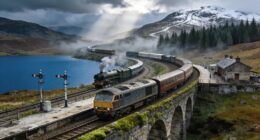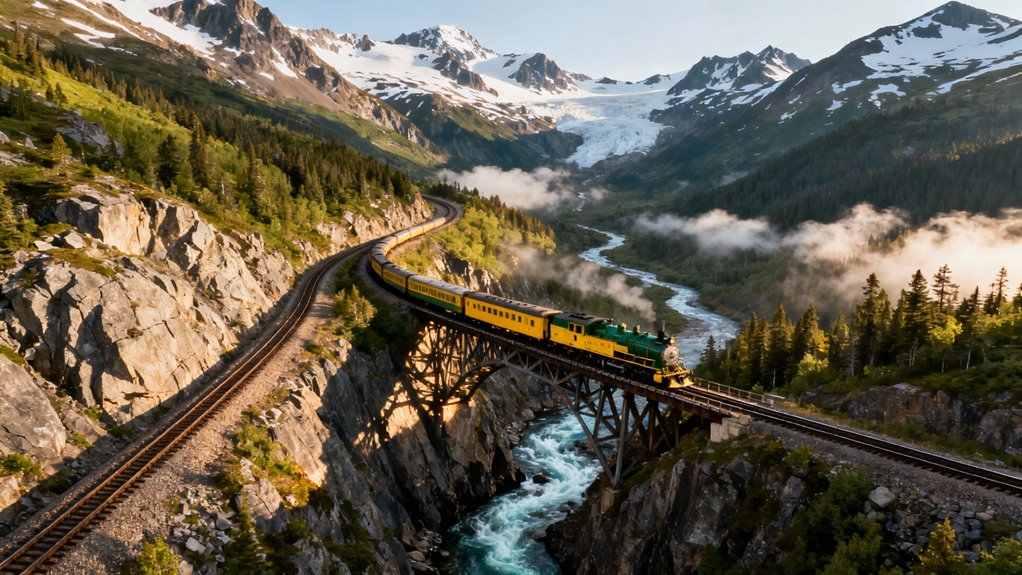
The White Pass & Yukon Route clings to cliff faces while climbing 2,885 vertical feet in just 20 miles through brutal Arctic terrain. Gold rush prospectors blasted this path with 450 tons of explosives in 1898, carving narrow gauge tracks around 3.9% grades that drop straight into oblivion. Glass-domed vintage cars now traverse the same route over 300-foot-high trestle bridges, offering panoramic views of glaciers, waterfalls, and untouched wilderness where Dall sheep roam unbothered. The engineering details reveal why modern experts still marvel at this achievement.
Experience Scenic Narrow Gauge Train Routes Winding Through Alaskan Mountain Passes
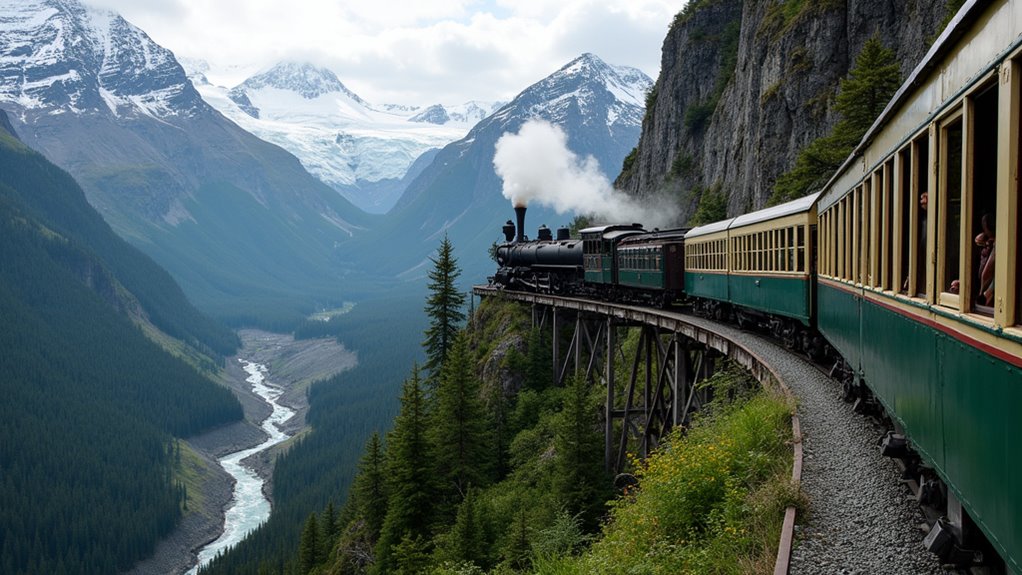
While most tourists crowd onto massive cruise ships to glimpse Alaska’s beauty from a safe distance, the White Pass & Yukon Route railway dangles passengers over thousand-foot drops on a single track carved into sheer cliff faces.
No middle ground here. These scenic narrow gauge train routes climb 2,885 feet through wilderness corridors where heritage mountain railway journeys meet what appears to be pure survival engineering—or at least that’s how it feels when you’re looking straight down.
Vintage cars with panoramic windows offer classic precipice railway experiences. Think waterfalls cascading beside you, glacial rivers cutting through valleys below, and actual glacier crossings visible from outside viewing platforms where the wind hits hard enough to make you grip the railing.
The historic routes trace paths that 1898 gold prospectors carved out, likely with more desperation than caution. Construction required 450 tons of explosives and claimed 35 lives among the 35,000 workers who built it between 1898 and 1900. No safety nets back then. Still none now. Just steel wheels on narrow rails above Deep Gorge’s abyss.
Gold rush desperation engineered these rails—no safety nets in 1898, none today, just narrow tracks suspended over the abyss.
The railway operated continuously until 1982 when metal price collapses shuttered the mines it served, leaving the tracks silent for six years before cruise ship tourism brought it roaring back. Like other renowned mountain railways such as the Bernina Express through the Swiss Alps, this route combines engineering marvel with spectacular natural scenery.
That said, passenger experiences vary wildly between “breathtaking” and “terrifying”—sometimes both in the same five-minute stretch.
Mountain Terrain Ascending to 2,885 Feet Elevation Defines Heritage Mountain Railway Journeys
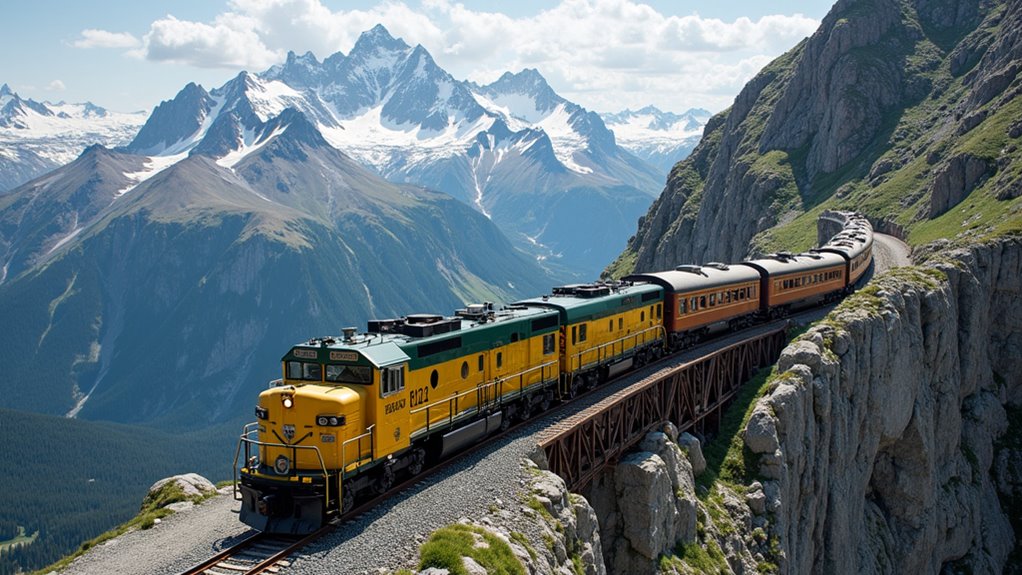
Most railways sensibly wind around mountains. The White Pass & Yukon Route does the opposite—it climbs straight up them.
We’re talking 2,885 feet of vertical ascent in roughly 20 miles, with track clinging to cliff faces that drop into what looks like oblivion.
This narrow gauge demonstration of engineering marvels conquers 3.9% grades through mountain terrain brutal enough to kill the pack horses it replaced.
The preserved gold rush rail lines snake across trestle bridges spanning canyons where one wrong calculation likely meant disaster.
And these historic wilderness railroad passages through glaciers and waterfalls? They weren’t some alpine expedition for the thrill of it. Instead, they were an invitation to experience the glacier express scenic mountain vistas that few ever get to witness. Each turn of the track reveals breathtaking landscapes, making for a journey that transcends mere transportation. Passengers find themselves immersed in nature’s grandeur, creating memories that echo long after the ride is over.
They were desperation routes, built with 450 tons of explosives during humanity’s most frantic gold fever—a scenic marvel born from necessity, not leisure.
The original 110-mile route reached completion when crews drove the golden spike on July 29, 1900, linking Skagway to Whitehorse and opening the Yukon interior.
The entire railway was constructed in just over two years, an accomplishment that today’s engineers would struggle to replicate with modern machinery.
Unlike other mountain railways that operate year-round, these Arctic rail adventures showcase their most dramatic scenery through glass-domed cars that protect passengers from the harsh northern elements.
How Do Preserved Gold Rush Rail Lines Trace History From the 1898 Klondike Era?
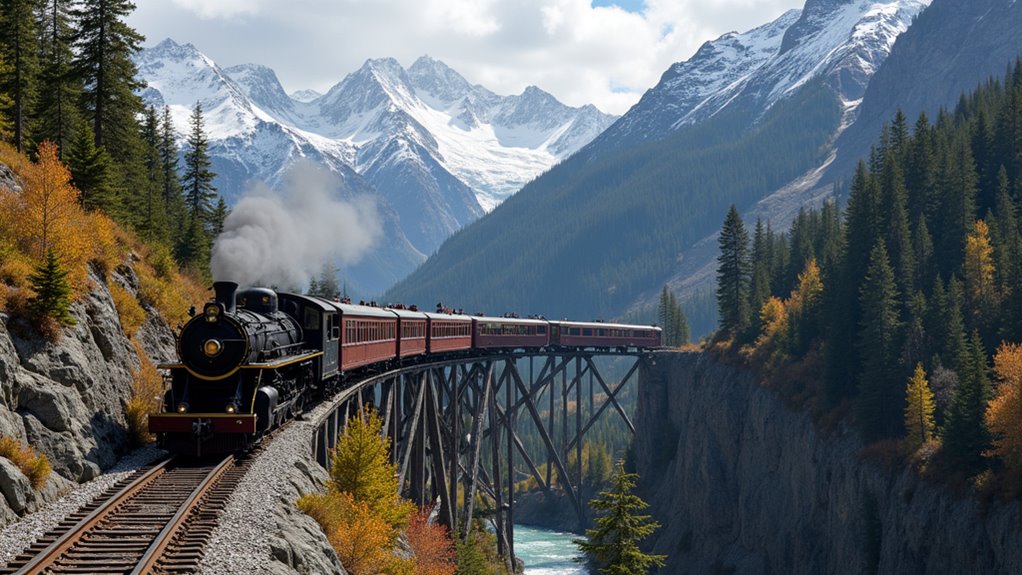
The railroad didn’t just appear—it was carved from desperation, greed, and roughly 450 tons of dynamite.
Construction kicked off in May 1898, mere months after gold flakes triggered international madness. These historic Klondike route operations replaced death-trap trails like Chilkoot and White Pass. Stampeders abandoned those paths faster than their frozen pack animals, and who could blame them?
The 110-mile gold rush lines reached Whitehorse by 1900, transforming what had been frontier territory almost overnight.
That said, today’s vintage alpine railway expeditions follow that exact 1898 alignment through scenic landscapes that remain largely unchanged. Unlike modern transcontinental routes that prioritize speed and efficiency, this historic line maintains its original character and challenging mountain terrain.
Railway preservation means modern tourists ride genuine narrow-gauge heritage railways—same curves, same cliffs, same engineering feat that seemed impossible at the time. The original route appears to have been preserved with remarkable accuracy, though the experience is considerably less harrowing than what those early prospectors endured. Rail service was completed by July 1899, connecting Skagway to Bennett Lake and rendering competing routes obsolete. In 1994, the railway earned recognition as an International Historic Civil Engineering Landmark, joining only 35 other marvels worldwide including the Eiffel Tower and Panama Canal.
Navigate Wilderness Corridors Traversing Pristine Arctic Landscapes on Historic Railroad Passages
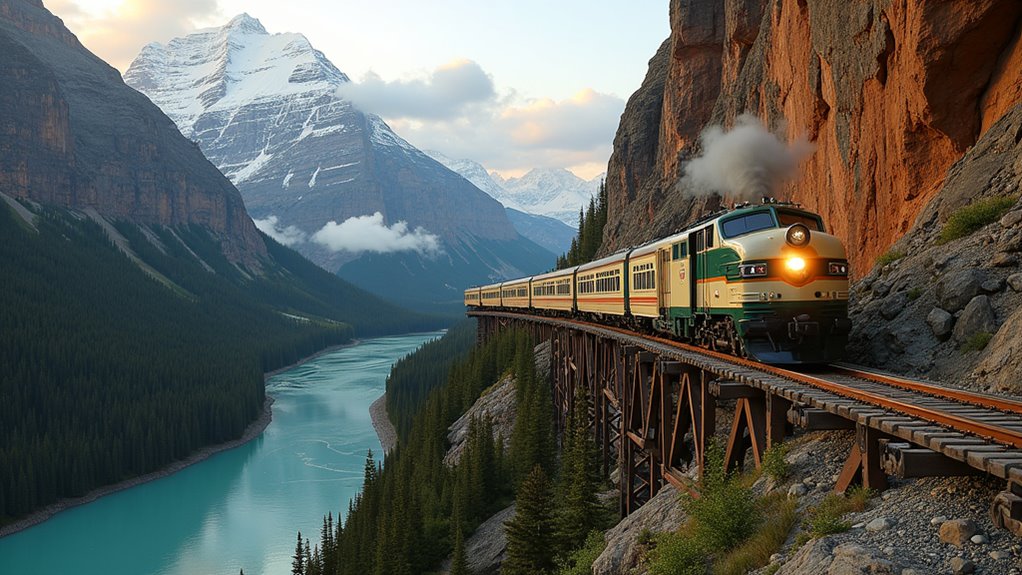
Rails don’t care about convenience—they go where engineers dare them to. Short answer: they go where they’re told.
The White Pass & Yukon Route’s restored frontier train services carved through 110 miles of unforgiving Arctic terrain, and the result is something. Traditional trestle bridge crossings hang suspended over gorges nobody asked to build across, yet there they are. Vintage locomotives haul passengers through wilderness passages where scenic viewpoints reveal glaciers, treeless tundra, and snow-capped peaks that appear largely untouched by modern development.
110 miles of defiant engineering through Arctic wilderness that didn’t ask for permission but got it anyway.
Railway engineering from 1898 navigated 3.9% grades and cliff-hanging curves through what you could call pristine ecosystems—Dall sheep and mountain goats still wander near the tracks, seemingly unbothered. Construction crews consumed 450 tons of explosives blasting through mountain rock to lay the foundation for this narrow-gauge passage. Like other remarkable North American rail routes such as the Rocky Mountaineer, this wilderness corridor demonstrates how trains can traverse some of the continent’s most challenging and beautiful terrain.
That said, preservation efforts work to maintain these corridors in a landscape where nature, not humans, tends to make the rules. The wilderness tolerates the intrusion. For now, at least, it seems willing to coexist with the iron and wood threading through its terrain. The route’s cantilever bridge stands as the highest of its type from that construction era, spanning a gap that demanded bold engineering solutions.
Alpine Environments Showcasing Glaciers and Towering Peaks Create Vintage Railway Expeditions
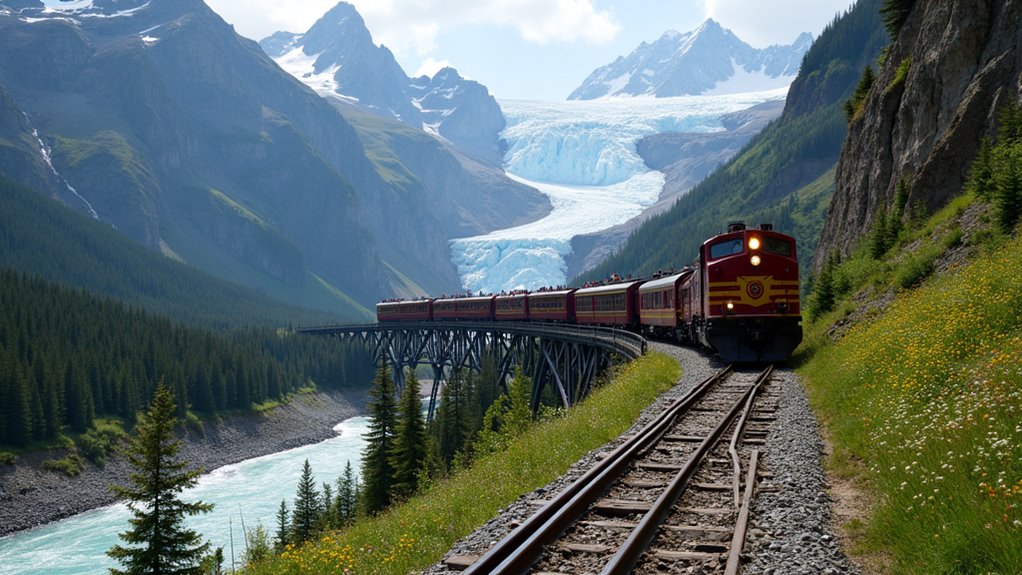
At 2,864 feet, White Pass Summit doesn’t mess around with the tourist-friendly alpine environments most people expect from scenic railways. The vintage equipment climbs through canyon passages where engineering feats from 1898 still grip cliff edges above sheer drops—Bridal Veil Falls cascades down exposed rock faces while glacial valleys stretch toward the horizon.
These heritage operations navigate mountain routes through terrain that twisted conifers into gnarled shapes and, by most accounts, killed 3,000 pack animals during the gold rush. Dead Horse Gulch earned its name the hard way.
That said, the narrow-gauge railway today crosses alpine lakes and international borders with relative ease, though the wilderness itself doesn’t care about your comfort. The route remains a testament to what humans will build when desperation and gold fever collide with geography that seems designed to keep people out. The railroad’s three-foot gauge track reduced construction costs compared to standard gauge, a practical decision that allowed this improbable route to exist at all.
Even so, there’s something almost contradictory about experiencing this landscape from a passenger car. You’re traveling through terrain that broke men and animals, yet you’re doing it with a cup of coffee in hand. While Canada’s Rocky Mountaineer offers luxury train experiences through mountain landscapes, the White Pass journey delivers its alpine scenery with an unvarnished edge that reflects its gold rush origins.
The engineering achievement is undeniable—those 1898 construction methods still hold trains above drops that would be fatal—but the comfort gap between then and now is worth acknowledging. Modern excursions depart from the abandoned town of Fraser, where passengers board for the return journey after experiencing the Klondike Highway drive through Yukon Territory.
Witness Scenic Landscapes Clinging to Vertical Canyon Walls on Classic Precipice Railways
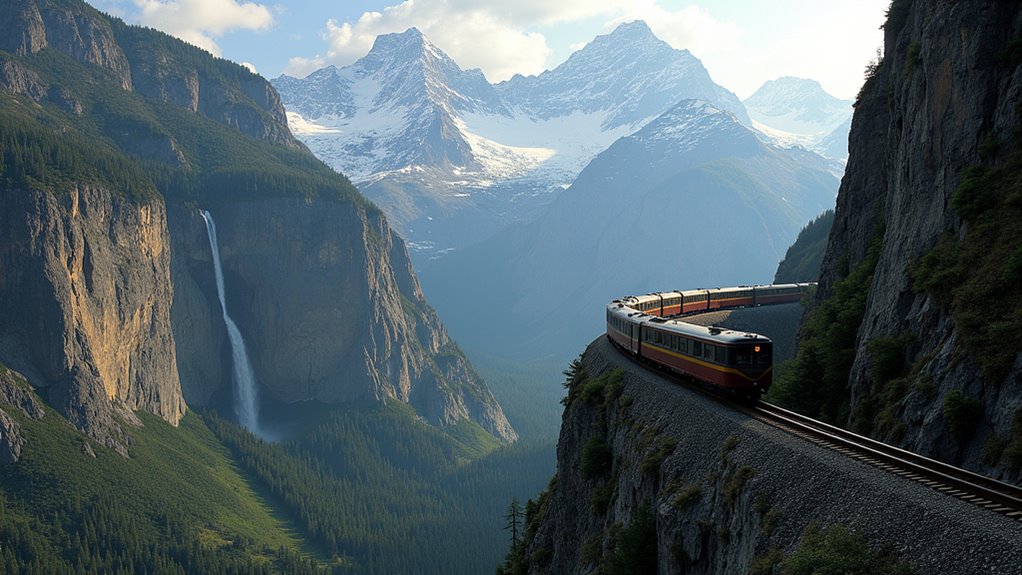
Most railways took one look at vertical canyon walls and routed themselves elsewhere. White Pass engineers in 1898 had a different idea—they used 450 tons of explosives to blast straight through.
Workers literally dangled from ropes while they anchored narrow gauge tracks onto sheer rock faces at spots like Slippery Rock and Rocky Point.
The result? Cliff-hanger curves that snake around horseshoe bends with vertical drop-offs just inches away.
It’s one of the gold rush era’s most dramatic engineering feats, and it likely ranks among the most white-knuckle tourist attractions to come out of that entire period.
Along the route, historic stations break up the journey, while landmarks like Dead Horse Gulch and Inspiration Point showcase what happens when engineers refuse to take the easy path.
That said, “easy” appears to have never been part of the vocabulary here—these tracks cling to surfaces that seem to defy both gravity and common sense.
The route’s remarkable construction earned it designation as a National Historic Civil Engineering Landmark, recognizing both the audacity of its builders and the technical achievement they accomplished through impossible terrain.
The first passenger train reached the summit on February 20, 1899, marking the completion of one of history’s most challenging mountain railway projects.
Like other renowned scenic rail journeys around the world, this route offers travelers unique perspectives on dramatic natural landscapes that would be impossible to experience by any other means of transportation.
Cross Trestle Structures Dramatically Spanning Mountain Gorges on Traditional Bridge Crossings
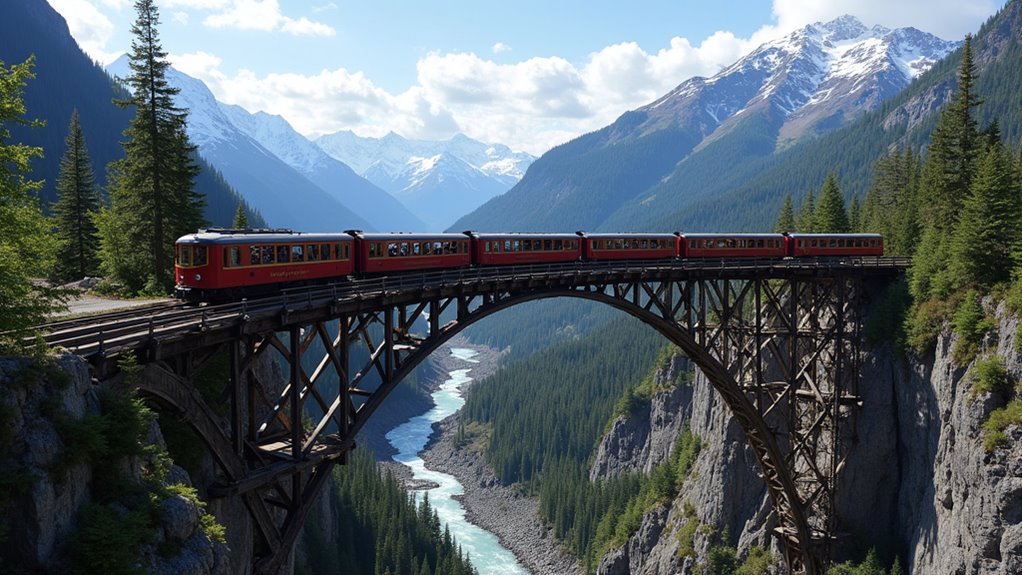
Building a railway across mountain gorges in 1898 was straightforward, if terrifying: erect timber trestle structures and pray they didn’t collapse. The White Pass & Yukon Route’s canyon crossings demanded dozens of these bridges—some towering as high as 300 feet above the gorge floors—all thrown together in punishing -60°F cold that must have made every swing of the hammer an ordeal.
Those early timber trestles used seven-span wooden designs that, against all odds, held up for decades before anyone got around to replacing them with steel.
The real showpiece came in 1901: a steel cantilever bridge at the summit that claimed the title of world’s highest for an impressive 68 years.
That said, those original timber structures? They didn’t make it. All gone now.
But here’s the surprising part—the 1905 steel bridges are still standing, still in use. Today’s heritage railway operation keeps this antique infrastructure running through seasonal schedules, and they’ve apparently gotten pretty efficient at emergency repairs, completing replacements in as little as three weeks when needed. Like many historic rail lines that continue operating today, modern train schedules ensure regular service while maintaining the authentic character of these remarkable engineering achievements.
The entire railway project was completed in just 26 months, fueled by 450 tons of explosives that blasted through the unforgiving mountain terrain. The workers accomplished all of this using only hand tools, black powder, and timber sourced from the surrounding region.
It’s a testament to turn-of-the-century engineering, even if the methods seem almost reckless by modern standards.
Frequently Asked Questions
What Ticket Types and Pricing Options Are Available for Passengers?
Passengers select from Summit Excursion, Bennett Scenic Journey, Lake Bennett Steam, Steam Summit Loop, or Hikers Service tickets. Advance online pricing starts at $142 adult/$71 child for Summit trips, with cruise passenger rates typically higher at $199–$219.
Does the Railway Operate Year-Round or Only During Specific Seasons?
The White Pass & Yukon Route operates seasonally from late May through mid-September, aligning with Alaska’s cruise season and favorable weather conditions. Harsh Arctic winters and remote mountain terrain make year-round operation impractical for this heritage railway.
Can Visitors Bring Cameras and Take Photographs During the Journey?
Visitors may freely bring cameras and photograph throughout the journey. The railway encourages photography from standard cars and open-air platforms, regularly hosting photo contests. Professional equipment is permitted, and specialized photography charter excursions are occasionally available for enthusiasts.
Are There Accessibility Accommodations for Passengers With Mobility Limitations?
Yes, White Pass & Yukon Route provides wheelchair-accessible train cars with lifts, accessible restrooms, and boarding assistance on select routes. Advance reservation is essential due to limited spaces, and passengers should arrive 30 minutes early for arrangements.
How Far in Advance Should Travelers Book Tickets for Peak Season?
Travelers should book tickets 1-2 months in advance for peak season (late May to mid-September). Cruise ship arrivals create high demand, causing frequent sellouts. Online reservations through the official website offer best availability and guaranteed spots.
Parting Shot
The White Pass & Yukon Route isn’t just some train ride—it’s a living monument to gold rush desperation and engineering guts. Built in 26 months flat through impossible terrain, this narrow gauge marvel still follows its original 1898 path. It clings to cliffs and crosses wooden trestles like it’s no big deal.
From May to September, it hauls passengers through Arctic wilderness that hasn’t changed much since prospectors first stumbled through, chasing fortune. That said, the railway itself represents something almost absurdly ambitious—carving a route through mountains that seemed determined to keep people out. The wooden trestles alone appear to defy common sense, yet they’ve held up for over a century. Even so, riding the rails today feels less like a history lesson and more like stepping into that original era, minus the frostbite and broken dreams.