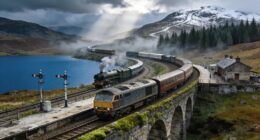
Belmond’s five iconic luxury train routes include the Venice Simplon-Orient-Express, acquired by LVMH for $3.2 billion and consuming 3,084 champagne bottles annually across restored 1920s Art Deco carriages. The Royal Scotsman maintains a 1:3 staff-to-guest ratio for 40 passengers through Scottish Highlands with whisky masterclasses. The Eastern Oriental Express relaunched in 2024 at $3,140 per person through Malaysian jungles. Peru’s Andean Explorer tackles 15,700-foot altitudes with oxygen systems since 2017, while the Hiram Bingham connects travelers to Machu Picchu. Each route demonstrates why Belmond sets global luxury rail standards worth examining further.
Route #1: Venice Simplon Orient Express Sets Belmond’s LVMH-Backed Global Luxury Rail Benchmark

The Venice Simplon-Orient-Express doesn’t just represent Belmond’s flagship—it *is* the reason luxury train still exists as a category.
LVMH’s $3.2 billion acquisition in 2019 cemented its global prestige, though the train had already earned icon status decades earlier. Back in 1982, James Sherwood poured £11 million into restoring 1920s-1930s carriages with genuine historic usage, transforming them into rolling Art Deco masterpieces.
What you get today: five-star dining service across three restaurant cars, white-glove stewards, and exclusive guided excursions in Venice, Paris, and Istanbul.
That may help explain the £35,000 fares. Even so, this isn’t just expensive nostalgia. The train doesn’t follow trends—it sets them, establishing the benchmark that every other luxury rail experience tries to match. Passengers consume 3,084 bottles of Champagne annually alongside nearly 4,000 bottles of Italian wine and 3.2 tons of lobster. The historic blue coaches remain instantly recognizable, evoking the collective imagination of golden-age travel. The allure of luxury train experiences in Europe extends beyond the exquisite dining. Travelers are treated to breathtaking views of the continent’s stunning landscapes, making each journey a feast for the senses. Every detail is meticulously curated to ensure passengers feel like royalty as they traverse the beautiful countryside.
This luxury route from London to Venice showcases the same immersive natural landscapes that define the world’s most spectacular rail journeys.
Belmond just happens to own the blueprint.
Route #2: Why the Belmond Royal Scotsman Highlands Exemplifies Gold Standard Scottish Heritage Excellence

While Venice may claim Belmond’s crown jewel, the Royal Scotsman owns something arguably more challenging to achieve: making heritage feel essential rather than performative.
The Belmond Royal Scotsman Highlands doesn’t just transport passengers—it embeds them in Scottish heritage through panoramic observation carriages, gourmet dining featuring local game, and traditional Scottish music sessions that feel genuine rather than staged. Whisky-tasting events at historic distilleries like Strathisla aren’t gimmicks, though lesser operators have certainly tried to make them so.
Private guided excursions to Culloden Battlefield and Rothiemurchus Estate deliver substance—actual context, not just photo opportunities.
The exclusive themed journeys appear to balance formal luxury with genuine cultural immersion, which is a harder line to walk than it sounds. Much like Norway’s Bergensbanen railway demonstrates how Nordic landscapes can elevate train travel, the Royal Scotsman proves that Scotland’s terrain provides its own compelling backdrop for luxury rail experiences.
The Royal Scotsman succeeds where others stumble: delivering luxury that doesn’t compromise authenticity or cultural depth.
On top of that, the mathematics work in passengers’ favor: maximum 40 guests, all-inclusive service, and those West Highland Line views create a formula that’s difficult to replicate. The full-service spa car adds another dimension to the experience, offering indulgence while Scotland’s rugged landscapes roll past the windows. Passengers receive 24-hour steward service throughout the journey, ensuring personalized attention at any hour.
That said, formula implies repeatability, and what the Royal Scotsman seems to understand is that heritage rail travel succeeds when it resists becoming formulaic.
The whisky is real. The battlefields carry weight. The landscapes do the work themselves.
Route #3: Eastern Oriental Express Asia Proves Belmond’s British Pullman Design Standards Deliver Iconic Luxury

Heritage rail operators love talking about “global standards,” but most can’t actually execute them across continents without something getting lost in translation.
Belmond’s Eastern Oriental Express in Southeast Asia proves otherwise—or at least appears to. Launched in 1993, this luxury train runs British Pullman design standards through Malaysian jungles. Classic woods, en-suite bathrooms, the whole deal. The 4-day routes hit Langkawi and Taman Negara with heritage city walks between fine dining services that mirror London’s Pullman aesthetic.
After a three-year pandemic pause, it relaunched February 2024 at $3,140 per person. Same marquetry. Same service ratios. Different continent.
The rolling stock itself has a curious pedigree—built by Hitachi in 1972, these carriages originally ran as New Zealand’s Silver Star before James B. Sherwood acquired and regauged them for Thai and Malaysian lines.
That said, there’s a legitimate question about whether replicating European luxury wholesale in Southeast Asia is actually the right move, or if it’s just easier than developing something that speaks to the region itself. While Belmond has perfected this formula across multiple continents, their trains through Peru’s Andean landscapes demonstrate how the same luxury standards can complement rather than overshadow regional character.
The dining experience leans into this tension—two onboard cars serve Peranakan-inspired cuisine that at least gestures toward regional identity, even if the service choreography still reads unmistakably British.
Even so, the execution is undeniable. That’s not marketing—it’s follow-through.
Route #4: Andean Explorer Peru Mountains With Belmond’s Hiram Bingham Creates South America’s Luxury Rail Network

Talk is cheap when rail operators promise they’re “expanding into new markets.”
Belmond actually delivered in South America—and didn’t phone it in with some watered-down version of what they run in Europe.
The Andean Explorer launched in May 2017 as South America’s first luxury sleeper train. It threads through Peru’s highlands at 15,700 feet, connecting Cusco, Lake Titicoca, and Arequipa.
South America’s first luxury sleeper train runs at 15,700 feet through Peru’s highlands—not exactly entry-level rail tourism.
Pair that with the Hiram Bingham service to Machu Picchu, and you’ve got what appears to be a legitimate luxury rail network—not just one showy route.
First class compartments come with en-suite bathrooms and oxygen systems, which at that altitude is less luxury amenity and more basic necessity.
The gourmet cuisine leans into Andean ingredients, which seems like the obvious choice given where you are. Menus are crafted by chefs from Belmond Hotel Monasterio in Cusco, sourcing fresh seasonal ingredients served in dedicated dining cars.
The train offers multiple itineraries, including one and two-night trips that range from Lake Titicaca runs to the full three-day Cusco-to-Arequipa journey.
Even so, this is heritage railway travel that meets Belmond’s global standards. While Switzerland sets the global benchmark for efficient rail networks with Swiss Federal Railways operating one of the world’s most punctual systems, Belmond proves that luxury operators can establish their own standards across different continents. It’s proof, or at least strong evidence, that luxury rail can traverse continents without losing what makes it work in the first place.
Route #5: Royal Scotsman Replicates Venice Simplon Orient Express Gold Standard Protocols for Highland Luxury

When Belmond acquired the Royal Scotsman in 2005, they could’ve slapped their branding on it and called it a day.
Instead, they replicated the Venice Simplon-Orient-Express gold standard—same 1:3 staff ratio, same all-inclusive luxury model, same obsessive attention to detail.
The onboard experience mirrors the Orient Express playbook: mahogany carriages, en-suite bathrooms, formal dress codes.
Even so, this isn’t blind imitation. Itinerary highlights span Scotland’s Highlands with exclusive activities like private castle tours and whisky masterclasses—experiences that make sense for the terrain.
Just ten intimate carriages accommodate 40 guests, keeping things deliberately small-scale.
Belmond didn’t reinvent anything here.
They simply imported proven excellence to Scotland’s lochs and glens, betting that what worked in Europe would translate to the Highlands.
The train remains stabled and static overnight, ensuring guests wake refreshed rather than motion-sick—a practical choice for routes winding through mountainous terrain.
Journey options range from 3-day Highland expeditions to the comprehensive 8-day Grand Tour of Great Britain.
Like South Africa’s Rovos Rail with its Victorian elegance and leisurely pace, the Royal Scotsman prioritizes the journey experience over pure transportation.
And judging by the results, that approach appears to have paid off.
Did You Know
What Is Belmond’s Typical Staff-To-Guest Ratio Across Luxury Train Journeys?
Belmond’s staff-to-guest ratios vary by train but remain absurdly high across the board.
The Royal Scotsman operates at 3:1—36 guests, 12 staff. That’s already impressive.
Then there’s the Andean Explorer, which elevates it to nearly 1:1. Insane.
Most Belmond trains hover around 1:3, meaning one staff member for every three passengers.
It’s white-glove service taken seriously, ensuring every whim gets handled immediately.
How Did Lvmh’s Acquisition Change Belmond’s Operational Standards?
LVMH’s $3.2 billion acquisition didn’t reinvent the wheel—Belmond already ran tight operations.
But the deal injected serious capital for refurbishments and brought stricter operational controls. Service delivery got even more obsessive, matching LVMH’s luxury playbook.
The real shift? Financial muscle to upgrade heritage properties and expand without sweating budgets. Plus integration with Cheval Blanc and Bulgari Hotels raised the bar on brand alignment.
Basically, already-excellent standards got LVMH-level polishing.
Can Passengers Customize Itineraries for Private Group Charter Bookings?
Yes. Belmond allows full private charters with extensive customization—routes, menus, décor, entertainment, schedules.
Groups can book entire trains or individual carriages for corporate events, weddings, family trips. Everything’s tailored: itineraries, stopover choices, onboard themes, bespoke dining, live music, dedicated staff.
VIP logistics include flexible departures, private transfers, helicopter options on select routes.
Requires 45+ days’ notice for high-demand dates. Smaller groups can reserve private saloons without chartering the whole train.
What Price Range Should Travelers Expect for Belmond Train Experiences?
Belmond train fares start around £350–£500 per person for British Pullman day trips, but multi-night journeys cost serious money.
Venice Simplon-Orient-Express twins begin at £3,800/$5,100, while Grand Suites hit £8,400/$10,350. Royal Scotsman runs £4,000–£10,000+. Andean Explorer starts near $3,607.
Dynamic pricing means early bookings save cash—last-minute reservations get hammered with premium rates. All fares include gourmet meals and steward service.
Does Belmond Offer Loyalty Integration With Other LVMH Properties?
No formal loyalty program exists linking Belmond with other LVMH properties as of late 2024.
LVMH runs a “house of brands” model—meaning each operates independently. You’ll find Guerlain spas and Dior amenities across properties, sure, but no points transfers or status matching.
The integration is all about high-touch experiences, not transactional rewards.
LVMH prefers curated luxury over cookie-cutter loyalty schemes that cheapen exclusivity.
Parting Shot
Belmond’s seven trains across four continents prove luxury rail isn’t dead—it’s thriving at $10,000 per night. LVMH’s $3.2 billion bet wasn’t charity. With 95%+ occupancy, 1:3 staff ratios, and actual 1920s carriages nobody else owns, they’ve cornered the market. From Venice to the Andes, it’s the same playbook: vintage authenticity, Michelin dining, Art Deco obsession. Forty-five years since Sherwood’s Orient Express revival, Belmond remains the benchmark. Everyone else is just playing catch-up.